



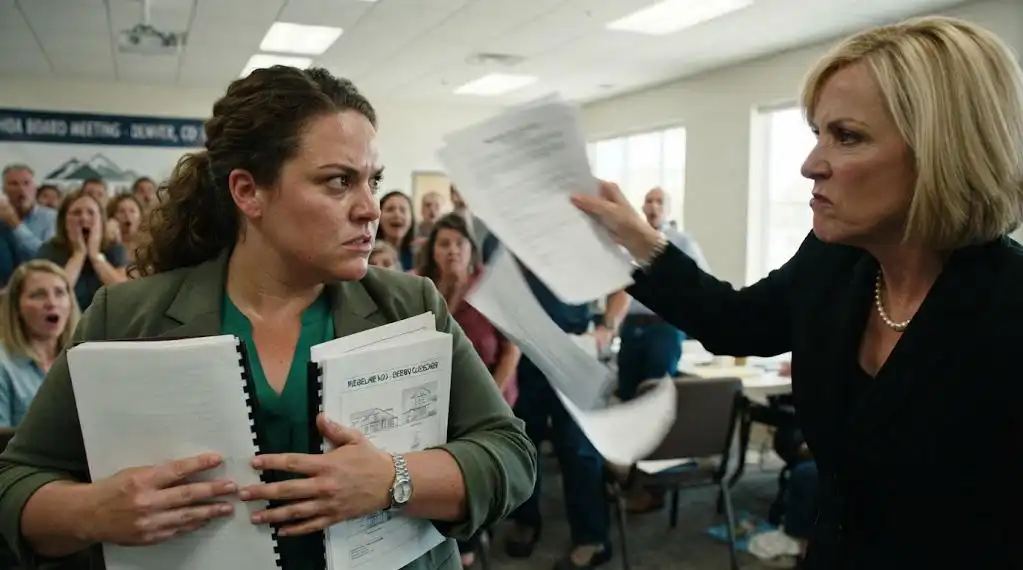
Victoria Shaw shot to her feet before the independent meeting chair could finish reading the property record.
“Those documents are irrelevant!” she snapped. “This association cannot function if every homeowner thinks she can challenge the board.”
The chair asked her to sit down.
Victoria refused.
She pointed at me and announced that I was trying to destroy the neighborhood because I couldn't afford to maintain my own house.
Several residents lowered their eyes.
Others held their phones up, recording every word.
I stood beside three folders containing the records that had brought us there.
For the first time since I had moved into the neighborhood, Victoria wasn't the only person in the room who understood what was at stake.
My name is Lauren Bennett. I was thirty-four years old, a landscape designer, and the owner of a modest, aging house in a residential community outside Denver, Colorado.
I had spent most of my savings on the down payment.
The house needed new windows, repairs to the porch, and years of neglected landscaping. The mortgage was manageable only because I worked hard and kept my expenses under control.
I knew the property wasn't perfect.
That was exactly why I had bought it.
I saw potential where other people saw an outdated exterior and an overgrown yard.
The front garden had compacted soil and struggling shrubs. The backyard contained a cracked concrete path and a patch of grass that barely survived the summer heat.
But the house had good bones.
The neighborhood had mature trees, quiet streets, and a beautiful shared green space at its center.
I imagined restoring the garden with drought-tolerant plants, improving the drainage, and replacing the cracked path with something welcoming.
I wanted to build a home I could be proud of.
I didn't expect the homeowners' association to become my biggest obstacle.
The first letter arrived three weeks after I moved in.
It stated that my front garden violated the community's landscaping standards.
The notice demanded that I remove several plants and pay a fine.
I read it twice.
The plants were native perennials selected for their water efficiency and suitability for Colorado's climate. They were neatly arranged, healthy, and well within the boundaries of my property.
I reviewed the association's landscaping guidelines.
Nothing in them clearly prohibited the planting arrangement I had used.
I sent photographs, a written explanation, and a request for clarification.
A week later, I received another notice.
The fine had increased.
I contacted the HOA office and requested the specific rule I had violated.
The response referred me to the same general landscaping provision without explaining how my garden failed to comply.
I began to worry.
I had a mortgage, a demanding job, and limited savings. I couldn't afford to let unexplained penalties accumulate.
I submitted a formal appeal.
Then I received a notice about the color of my front door.
The door was a muted blue-gray.
The community guidelines allowed several shades in that range, but the HOA claimed mine was inconsistent with the neighborhood's approved palette.
I asked for the current palette and the date on which it had been adopted.
The documents I received were incomplete.
I repainted the door a color that appeared on the available approved list because I couldn't risk another penalty while the dispute continued.
Victoria Shaw was the HOA president.
She was in her late fifties, always impeccably dressed, and extremely skilled at making personal preferences sound like binding rules.
At meetings, she spoke about preserving property values, maintaining neighborhood standards, and protecting residents from irresponsible homeowners.
She rarely raised her voice.
She didn't need to.
She had spent years cultivating the impression that disagreeing with her was the same as disagreeing with the entire community.
Residents described her as decisive.
Some praised her attention to detail.
Others privately admitted that they were afraid of becoming her next target.
I learned about her influence when I attended my first HOA meeting.
I arrived with a folder containing my appeal documents and photographs of my property.
Victoria sat at the front table beside two board members.
She reviewed the agenda, answered questions, and thanked residents for supporting the association.
When I raised my hand, she smiled politely.
“Ms. Bennett. How can we help you?”
I explained the landscaping fine and asked for the exact provision that prohibited my plants.
Victoria glanced at my photographs.
“Your yard doesn't reflect the character of this community.”
“Could you show me which written standard it violates?”
She smiled more tightly.
“Sometimes homeowners need to exercise common sense rather than argue over every sentence in a rulebook.”
“I understand the importance of consistent standards. I just want to know which standard applies.”
A few people shifted in their seats.
Victoria put down the photographs.
“Your property has already required more administrative attention than most homes in this neighborhood.”
I felt my face grow warm.
“I submitted an appeal because I don't understand the basis for the fine.”
“Then perhaps you should have considered the responsibilities of homeownership before buying a property here.”
The room fell quiet.
She didn't mention my weight directly.
She didn't have to.
Her eyes moved over me, then toward the photographs of my house, as if the combination of my appearance and my modest property were evidence that I didn't belong.
A man near the back cleared his throat.
Victoria moved to the next agenda item.
My appeal remained unresolved.
I left the meeting embarrassed and angry with myself for having spoken at all.
For several days, I considered paying the fine simply to make the problem disappear.
Then I remembered why I had bought the house.
I had wanted a place where I could build something with my own hands and skills.
I couldn't keep surrendering every time someone made me uncomfortable.
I paid the undisputed fees I owed and continued challenging the penalties I believed were unsupported.
I also began documenting every interaction with the association.
I saved letters, emails, photographs, payment receipts, and meeting notices.
At first, I thought I was simply protecting myself from administrative confusion.
Then I noticed what was happening to the shared green space.
The green occupied a central parcel between two rows of homes.
It had mature trees, a walking path, several benches, and a small open lawn where neighbors walked their dogs or brought their children to play.
It was not a municipal park. It was a common area designated for the community under the recorded property documents.
Residents paid assessments that helped maintain it.
When I first moved in, the space was attractive but neglected.
Some of the trees needed pruning.
The irrigation system was inefficient.
A few sections of the path had cracked.
I volunteered to review the landscaping and prepare a conceptual improvement plan.
I offered to do it without charging a design fee.
The association's maintenance budget was limited, and I thought a professional plan might help the neighborhood improve the area without wasting money.
Victoria rejected the offer.
“We already have contractors for that,” she said.
“Of course. I thought I could help evaluate the existing planting and identify some lower-cost options.”
She glanced at me.
“We don't need an amateur committee redesigning the community.”
“I work professionally in landscape design.”
“Then you should understand that the board is responsible for these decisions.”
I accepted her answer and stepped back.
A month later, the association installed temporary fencing around part of the green.
A notice appeared on the community bulletin board stating that the area would undergo improvements and that residents should stay out until further notice.
The work never seemed to begin.
Instead, surveyors appeared.
A contractor marked sections of the ground with small colored flags.
One morning, I saw a representative from a local development company speaking with Victoria beside the fence.
They were looking at the green as though they were evaluating a vacant commercial lot.
I approached them.
“Is there a new landscaping plan?”
Victoria turned sharply.
“This matter is being handled by the board.”
“I understand. I live here, and the green is a common area. Are residents going to be able to review the proposal?”
She smiled without warmth.
“The board will communicate whatever information residents need.”
The developer's representative closed his folder.
“Thank you for your time, Ms. Shaw.”
They walked away together.
That evening, I asked several neighbors whether they knew what was happening.
Nobody had received a detailed plan.
One neighbor said Victoria had described the project as a safety improvement.
Another had heard that the association was considering a private access arrangement.
A third said a developer had offered to purchase part of the land.
The stories contradicted one another.
I decided to investigate.
As a landscape designer, I regularly worked with site plans, property boundaries, easements, and municipal requirements.
I knew that a map showing a parcel's boundaries was not necessarily enough to establish every legal right associated with it.
The recorded plat, deed records, governing documents, and any properly executed transfers had to be examined together.
I started with the documents available through the county recorder.
I obtained the recorded subdivision plat and the relevant property records.
The green was identified as a common tract reserved for the community.
I then reviewed the HOA's declaration and bylaws.
The documents established how common property could be managed and what approvals were required for certain major decisions.
The board had authority to maintain the green.
That did not automatically give it authority to transfer the land to a private developer without following the required procedures.
I could not find a recorded transfer authorizing the change Victoria appeared to be planning.
That did not, by itself, prove that every proposed arrangement was unlawful.
But it raised an important question.
What exactly had the board approved, and under what authority?
I requested the relevant board minutes, financial reports, contracts, and notices through the association's established procedures.
Some records arrived quickly.
Others were incomplete.
The minutes referred to landscaping improvements, but they did not clearly explain the fencing or the developer's involvement.
The financial statements showed substantial payments to a contractor called Summit Grounds Management.
Several invoices described work around the community green.
Yet the fenced area showed little evidence of the improvements the association had supposedly funded.
I compared the listed work with photographs I had taken before and after the fencing went up.
Some items were difficult to reconcile.
There were charges for planting materials that I could not locate.
There were repeated entries for site preparation.
There were payments for work that appeared to overlap with earlier invoices.
I did not assume that every discrepancy proved misconduct.
Construction and landscaping projects could involve delays, changes, and legitimate additional costs.
But the records needed an explanation.
I searched the publicly available business registration information for Summit Grounds Management.
The company was registered to a man named Daniel Shaw.
He was Victoria's brother.
I checked the association's available meeting minutes for evidence that the relationship had been disclosed and that the contract had been properly approved.
I could not find a clear record establishing that the board had reviewed the potential conflict of interest.
That discovery changed the nature of my investigation.
The issue was no longer just an argument over landscaping standards.
Residents might have been paying for work that had not been completed, while the association was considering a major change to common property.
I called a local attorney who handled homeowner association disputes.
I explained the fines, the fencing, the recorded property documents, and the financial discrepancies.
The attorney reviewed the materials and warned me against jumping to conclusions.
“The records raise legitimate questions,” she said. “But we need to distinguish what the documents establish from what we suspect.”
She explained that an HOA generally could not simply evict an owner because its president disliked the owner's appearance or landscaping.
Enforcement actions, fines, liens, and other remedies had to comply with the governing documents and applicable law.
A threat from the president was not the same as a valid legal order.
She also advised me to preserve original records, request documents through the proper channels, and avoid making public accusations that I could not substantiate.
I followed her advice.
I organized the documents chronologically.
I created a table showing each questionable payment, the description on the invoice, the corresponding board record, and what could be verified about the work.
I separated confirmed facts from unresolved questions.
I also requested an explanation of the contractor relationship and the association's process for approving the project.
The response was a letter from Victoria.
It accused me of interfering with the HOA's operations and warned that continued disruptive behavior could result in additional penalties.
It also repeated the claim that my landscaping violated community standards.
I read the letter at my kitchen table.
My mortgage statement lay beside it.
I had spent nearly all my available savings buying the house, and I was still paying for repairs.
The prospect of escalating legal expenses frightened me.
I could not afford to fight an endless series of penalties.
For one evening, I considered withdrawing from the dispute.
Then I thought about the neighbors who had told me they were afraid to ask questions.
I thought about the shared green where children played and older residents walked in the afternoon.
If the land were transferred or restricted without the required approvals, the entire community could lose something valuable.
I decided to continue.
I contacted several residents who had independently raised concerns.
One was a retired accountant named Harold Mercer.
He had noticed unexplained increases in maintenance spending.
Another was Denise Parker, a mother of two who lived beside the green.
Her children had been asking why the play area was fenced off.
A third, Michael Turner, had served on a previous HOA committee and understood the association's election procedures.
We met at a neighborhood coffee shop.
I brought copies of the records.
Harold reviewed the financial statements.
Denise compared the project notices with the changes she had observed.
Michael examined the bylaws and explained the process for requesting a special meeting and initiating a recall vote.
We agreed on one essential principle.
We would not accuse Victoria of a crime simply because we disliked her.
We would document the facts, request proper reviews, and follow the procedures available to homeowners.
Harold helped prepare a list of questions for an independent financial review.
We requested supporting invoices, proof of payment, contractor deliverables, and records showing how the contract had been approved.
The association initially resisted.
Victoria argued that residents were wasting time on routine administrative matters.
But our requests were specific, and several other homeowners submitted similar questions.
Eventually, the board agreed to allow an independent accountant to review the relevant transactions.
The accountant was given access to the available records and asked to examine the payments, approvals, and supporting documentation.
The preliminary findings were troubling.
Several payments to Summit Grounds Management lacked sufficient supporting documentation.
Some invoices appeared to duplicate work described elsewhere.
The records did not clearly establish that the board had properly reviewed the contractor relationship before approving the relevant expenses.
The accountant did not declare Victoria guilty of fraud.
That was not the purpose of the review.
The findings established that the transactions required further investigation and that the association's financial controls had been inadequate.
That was enough to justify asking harder questions.
We also requested clarification about the green.
The county's recorded documents confirmed its designation as a common tract.
The association had not produced evidence of a properly approved and recorded transfer of ownership.
The proposed development arrangement, whatever its final form might have been, could not simply be treated as though the green belonged to Victoria personally.
The board needed to explain the authority under which it had fenced the area and discussed the proposed change.
As the evidence accumulated, Victoria's behavior became more aggressive.
She circulated a notice suggesting that I had a personal financial interest in the green because I worked in landscape design.
She implied that I wanted to use the controversy to obtain a paid contract from the association.
The accusation was false.
I had offered to volunteer my professional services before the dispute began, and I had never demanded payment for redesigning the green.
I issued a brief written response explaining the facts.
I did not attack Victoria personally.
I included the original proposal showing that I had offered to help without a design fee.
Some neighbors believed me.
Others preferred to stay out of the dispute.
A few stopped speaking to me at community events.
One person told me that I should apologize to Victoria and let the board handle its own affairs.
The social isolation hurt more than I expected.
I had bought the house because I wanted to become part of a community.
Now I was becoming the person people whispered about.
I worried about the mortgage.
I worried about legal expenses.
I worried that the HOA would continue issuing penalties until I could no longer afford to defend myself.
There were nights when I sat at my kitchen table surrounded by documents and wondered whether I had made a terrible mistake.
Then I reminded myself that the purpose of keeping records was to make the dispute less personal.
The documents did not care whether Victoria liked me.
They did not care whether I was thin or heavy.
They did not care whether I had been invited to neighborhood gatherings.
They showed what had been recorded, what had been paid, what had been approved, and what remained unexplained.
I returned to the evidence.
Michael confirmed that our governing documents allowed homeowners to petition for a special meeting and seek the removal of a board member through a formal vote, provided the required notice, signatures, and voting thresholds were met.
We studied the procedure carefully.
We circulated a petition that stated the reasons for requesting a recall.
The petition focused on the documented issues: inadequate disclosure concerning the contractor relationship, unresolved financial discrepancies, the handling of the common green, and the use of enforcement notices against residents who requested clarification.
We did not include insults about Victoria's personality.
We did not ask residents to vote based on rumors.
We asked them to support an independent review, restore transparent governance, and decide whether Victoria should remain president.
The petition took weeks to organize.
Some residents signed immediately.
Others wanted to examine the records first.
We held small information sessions and answered questions.
Harold explained the financial review.
Michael walked homeowners through the recall procedure.
I showed the recorded plat and explained why the green's legal designation mattered.
I also explained what the documents did not establish.
We did not yet know whether the questionable payments reflected deliberate misconduct, poor administration, or a combination of failures.
That was why the independent review mattered.
The evidence justified scrutiny, not a premature verdict.
Eventually, we gathered enough valid signatures to satisfy the requirements for a special meeting and recall vote.
The association issued formal notice.
Victoria was furious.
She sent a letter accusing the petition organizers of creating division and undermining property values.
She warned that a recall could leave the HOA without effective leadership.
Some residents were frightened by the prospect of instability.
I understood their concerns.
An HOA managed shared expenses, maintenance, insurance, and other important responsibilities.
Removing a president was not something to do casually.
But allowing a president to avoid scrutiny because the process might be inconvenient was not responsible governance either.
We needed a fair election, a proper transition, and an independent examination of the disputed transactions.
The meeting was scheduled for a Thursday evening in the community center.
I arrived early.
The room was crowded with folding chairs and long tables.
Residents brought printed notices, copies of the financial review, and questions about the green.
Victoria sat at the front beside two board members.
She wore a cream-colored suit and carried a thick binder.
When she saw me, she smiled.
It was the same smile she had used when telling me that my garden did not reflect the character of the neighborhood.
“Ms. Bennett,” she said. “I hope you've come prepared to stop wasting everyone's time.”
“I've come prepared to discuss the records.”
She laughed quietly.
“Of course you have.”
The meeting began with the formal agenda.
The independent meeting chair explained the procedures, confirmed the relevant notice requirements, and outlined how the recall vote would be conducted.
Then Victoria took the microphone.
She described herself as a volunteer who had devoted years to protecting the community.
She said the dispute had been manufactured by a small group of dissatisfied residents.
She claimed that the green needed better management and that the association had a responsibility to protect property values.
She also accused me of encouraging homeowners to challenge every decision.
“I have tried to maintain standards,” she said. “But certain residents believe the rules should not apply to them.”
She looked directly at me.
“Some people move into this neighborhood and immediately begin demanding exceptions.”
I stood when the chair invited residents to respond.
“I am not asking for an exception,” I said. “I am asking for the same written rules, financial transparency, and property protections that apply to everyone.”
I held up the recorded plat.
“This document identifies the green as a common tract. The association has not produced a properly recorded transfer of ownership. If the board believes it has authority to change the land's use, residents deserve to see the legal basis.”
Victoria interrupted.
“Those records don't tell the whole story.”
“Then please explain what is missing.”
She looked toward the chair.
“This is becoming a personal attack.”
“No,” I said. “A personal attack would be criticizing your appearance or telling you that you don't belong in this community. I'm discussing recorded property documents and association finances.”
A murmur moved through the room.
I placed the first folder on the table.
It contained the recorded plat, the relevant governing provisions, and the available project notices.
The second folder contained the financial review and the supporting documents we had been able to obtain.
The third contained the recall petition and the records confirming that it met the procedural requirements.
I explained each one.
I described the discrepancies identified by the accountant.
I pointed out that the contractor's connection to Victoria raised a conflict-of-interest question that needed a proper answer.
I made clear that the independent review had identified documentation problems but had not yet established criminal wrongdoing.
Then I turned toward the residents.
“We all pay assessments to maintain this community. We all have a right to understand how those funds are used. We also have a right to know whether decisions about our common property are being made according to the recorded documents and the rules we agreed to follow.”
I looked around the room.
“I bought my house because I believed this was a place where people could build a life. I didn't expect every decision to go my way. I didn't expect the association to approve every garden I designed. I expected the same rules to apply to me as to everyone else.”
My voice grew stronger.
“I was fined for landscaping that the association could not clearly explain how I had violated. I was threatened when I asked for clarification. Other residents were left uncertain about the future of the green where their children play and their neighbors gather.”
I paused.
“This is not about whether you like me. It is not about whether you like Victoria. It is about whether any one person should be allowed to treat a community association as personal property.”
The room became quiet.
“An HOA is supposed to serve its homeowners. It is not supposed to make homeowners afraid to ask questions.”
A woman in the second row stood.
“My family has lived here for eighteen years,” she said. “I have never seen the green fenced off like this, and I have never received a clear explanation of what the money was spent on.”
A retired man near the back raised his hand.
“I want the financial review completed before another contract is approved.”
Another homeowner said she had received a landscaping fine without a clear explanation of the violation.
The discussion continued.
Victoria became increasingly agitated.
She insisted that the board had acted in the community's best interests.
Then the independent meeting chair reviewed the county record and confirmed that the recorded plat did not support the board's description of the green as land available for an unrestricted private transfer.
The chair explained that any change had to follow the applicable governing documents and legal requirements.
Victoria rose so quickly that her chair scraped across the floor.
“Those documents are irrelevant!” she shouted.
She grabbed a stack of papers and hurled them toward me.
The pages scattered across the table and floor.
A few residents gasped.
One document struck my shoulder.
Victoria pointed at me.
“People like you should be grateful we let you live here!”
The room erupted in shocked voices.
I bent down, collected the papers, and placed them neatly on the table.
Then I looked at her.
“I have paid my assessments. I have followed the rules that apply to my property. And I have brought documents that deserve to be reviewed. You don't get to replace an answer with an insult.”
The chair called the meeting to order.
Victoria was instructed to stop interrupting.
The recall vote proceeded according to the established rules.
The ballots were collected and counted by the designated election officials.
When the result was announced, Victoria had lost by a decisive margin.
She was removed from the presidency, and the association began the formal transition to new leadership.
For several seconds, the room was silent.
Then residents began applauding.
I stood still.
I had imagined that the moment would feel triumphant.
Instead, I felt an enormous wave of relief.
The months of uncertainty, paperwork, whispered rumors, and financial anxiety had finally led to a decision made through the process the association's own rules provided.
Victoria gathered her binder.
She did not apologize.
She left the room with her head held high, followed by two people who had supported her.
I did not follow her.
I had no desire to humiliate her in return.
I wanted the community to move forward.
The new board appointed an interim president and began working with the independent accountant to complete the financial review.
The relevant records were preserved.
The contractor relationship and disputed payments were examined further.
Where supporting documents were missing, the association requested them.
Where expenses could not be adequately explained, the matter was referred for appropriate review by the relevant professionals and authorities.
The investigation took time.
Some transactions were supported by additional records.
Others remained inadequately documented.
The final review identified serious weaknesses in the association's financial controls and concerns about how the contractor relationship had been handled.
The findings were referred to the appropriate authorities for further consideration where warranted.
Victoria disputed parts of the review, but she no longer controlled the board's response.
The association adopted stronger financial procedures.
Contractor relationships had to be disclosed.
Significant expenses required documented approval.
Residents received clearer financial reports.
The board also adopted a more transparent process for reviewing fines and handling homeowner appeals.
The changes were not glamorous.
They involved paperwork, meeting minutes, deadlines, and careful administration.
But those were precisely the things that prevented power from becoming personal privilege.
The green space remained a separate issue.
The new board suspended the proposed private arrangement while it obtained legal advice.
After reviewing the recorded plat and the applicable governing documents, the association confirmed that the green would remain a shared community asset unless any future change was approved through the proper process.
The temporary fencing was removed.
The association commissioned a professional assessment of the site's condition and budget.
This time, the board invited residents to participate.
I submitted a landscape plan.
I proposed retaining the mature trees, repairing the paths, improving drainage, adding native flowering plants, and creating shaded seating areas.
I also suggested a modest open lawn and a small gathering area for community events.
The plan prioritized durability and water efficiency.
It could be implemented in phases, reducing the immediate financial burden on homeowners.
I presented the proposal at an open meeting.
Harold reviewed the cost estimates.
Denise spoke about the importance of preserving a safe place for children.
Other residents suggested additional benches and a better route for people with mobility limitations.
We revised the design together.
The board approved the first phase after reviewing the budget and obtaining the required authorization.
I volunteered my design time.
Other residents helped with planting and cleanup.
The association hired qualified contractors for the work that required professional installation.
We did not attempt to replace every service with unpaid volunteer labor.
Instead, we used community participation to make the project more thoughtful and cost-effective.
The work began in early spring.
The old irrigation system was repaired.
Damaged sections of the path were replaced.
Healthy mature trees were retained.
Native plants were added around the edges, providing seasonal color without demanding excessive water.
Benches were placed beneath the shade.
The open lawn was restored for residents to use.
As the project progressed, neighbors who had barely spoken during the dispute began working side by side.
A retired teacher helped organize volunteers.
A young couple brought tools.
Several children planted flowers under adult supervision.
People who had disagreed about the recall discovered that they shared the same basic hopes for the neighborhood.
They wanted safe streets, reasonable fees, maintained common areas, and a board that answered questions without intimidation.
The project did not erase every disagreement.
It gave us a better way to handle them.
My own life changed, too.
The HOA dispute had consumed months of attention and energy.
I had spent evenings reviewing records when I should have been resting.
I had worried about fines, legal costs, and whether the association might take action against my home.
I had endured rumors that made ordinary trips to the mailbox uncomfortable.
There were moments when I regretted becoming involved.
But the process also taught me to separate personal criticism from evidence.
Victoria had repeatedly suggested that my body, my house, and my presence in the neighborhood made me less entitled to be heard.
I had believed her more than I wanted to admit.
I had started to think that perhaps I was too sensitive, too demanding, or somehow unfit to belong.
The documents reminded me that none of those judgments answered the actual questions.
A property boundary did not change because someone disliked the homeowner.
A financial discrepancy did not disappear because the person asking about it was unpopular.
A written rule did not become fair simply because the president insisted it was.
And a person did not lose the right to speak because she failed to match someone else's idea of a respectable homeowner.
I began treating myself with the same fairness I had demanded from the association.
I stopped trying to make every neighbor like me.
I remained polite, but I no longer apologized for asking reasonable questions.
I kept working as a landscape designer.
My clients valued my ability to understand a site's limitations, balance beauty with practical needs, and develop plans that could survive real weather and real budgets.
The community project became a meaningful addition to my portfolio.
It demonstrated that landscape design was not simply about making a property look expensive.
It was about creating spaces people could use and enjoy.
Months after the recall, the association held a small reopening event for the restored green.
Families gathered near the path.
Children ran across the lawn.
Older residents sat on the new benches beneath the trees.
Someone brought lemonade.
Another neighbor set out a table with snacks.
I stood near the flower beds, checking that the new plantings had settled well.
Denise approached with her two children.
“Lauren, look what we found.”
Her younger child held a small book about birds.
“We saw a robin in the tree,” he announced.
I smiled.
“That's a good sign. The trees give them a place to rest.”
He ran back toward the lawn.
Denise looked around.
“You did a wonderful job with this place.”
“Everyone helped.”
“You know what I mean.”
I looked at the green.
The paths were clear.
The plants were thriving.
The benches were occupied.
The space had returned to what it was meant to be: a shared part of the neighborhood, not a prize controlled by the person who held the most power.
For the first time since buying my house, I felt completely at ease there.
Not because every neighbor agreed with me.
Not because the community had become perfect.
Because the rules were clearer, the financial process was more transparent, and residents had learned that they could ask questions without surrendering their dignity.
A few weeks later, I heard that Victoria had left the neighborhood.
The financial review and related inquiries were still being handled through the appropriate channels. I did not know what their ultimate outcome would be, and I did not speculate.
I had no interest in turning her departure into a personal celebration.
The point had never been to destroy one person's life.
It had been to stop one person from controlling the community without accountability.
I returned to my house that evening and stood in the front garden.
The blue-gray door still needed a little maintenance.
Several plants needed pruning.
The porch required another coat of paint.
But the house was mine, and I knew how I wanted to care for it.
I would make improvements according to a sensible plan and the rules that legitimately applied.
I would ask questions when something was unclear.
I would pay the fees I owed.
And I would not accept intimidation as a substitute for a lawful decision.
The next morning, I walked through the green before work.
Sunlight filtered through the trees.
The grass was bright with dew.
A father pushed a stroller along the path while an older couple sat on a bench.
Two children were playing near the flower beds, carefully avoiding the new plants.
I stopped beside the central garden and looked at the space we had restored.
I thought about the first letter I had received, the fines that followed, and the night I had stood in front of the HOA meeting wondering whether I should simply give up.
I had not won because I was the loudest person in the room.
I had not won because I had more money or greater social influence.
I had helped build a case because I preserved records, asked precise questions, sought professional advice, and worked with neighbors who were willing to follow the proper process.
That was what had made the difference.
The community had not needed another powerful person to replace Victoria.
It had needed a system in which no single person could act as though the rules belonged to her.
I looked toward the children playing beneath the trees.
Then I smiled.
The green was open.
The neighbors were talking.
And the home I had worked so hard to buy no longer felt like a place where I needed permission to belong.
CHOOSE YOUR SIDE: LAUREN WAS RIGHT TO ORGANIZE A LEGAL RECALL AND DEMAND TRANSPARENCY, or HOA PRESIDENTS SHOULD BE TRUSTED TO MAKE DECISIONS WITHOUT CONSTANT CHALLENGES.
Comment your choice and share this story with a homeowner who believes that a community belongs to the people who live in it, not the person who holds the gavel. 🌳
Disclaimer: Mention of any brand or trademark is for identification only and does not imply partnership or endorsement

A Wealthy Manhattan Socialite Poured Red Wine on a Plus-Size Artist at a Charity Gala, Calling Her “Cheap and Unworthy.” She Had NO IDEA Who Would Discover Her Paintings... 😱

A Celebrity Trainer Threw CASH in a Plus-Size Nutritionist’s Face at a Luxury LA Gym, Saying She Couldn’t Even Control Her Own Weight. He Had NO IDEA What Her Clients Would Prove... 😱

My Fiancé’s Mother CUT MY Custom Engagement Dress in Front of 200 Guests and Called Me an “Elephant in a Sack.” My Fiancé Just SMILED... 😱