

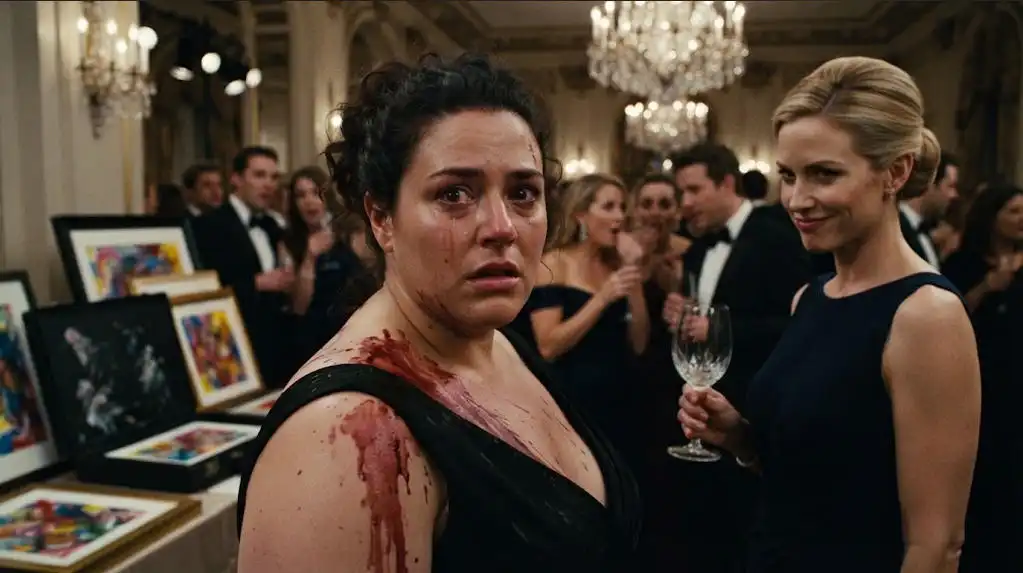
The red wine hit my dress before I could finish introducing myself.
A dark crimson stain spread across the black fabric, soaking through the front of the only formal outfit I owned.
Celeste Whitmore stood in front of me, holding an empty wineglass.
She looked at the stain, then at my face.
“Good heavens,” she said loudly. “Did you mistake this charity gala for a cheap buffet?”
Several guests turned toward us.
Celeste tilted her head.
“You look like you came here to eat, not create art.”
A man near the champagne table gave an uncomfortable laugh.
Someone else raised a phone.
I was thirty-four years old, a struggling independent artist, and a woman who had spent the last six years painting in a cramped Manhattan studio where the heating barely worked in winter.
Celeste was a wealthy gallery investor whose name appeared on museum benefit invitations, auction catalogs, and the guest lists of some of the city's most exclusive art events.
She had money, connections, and the confidence of someone accustomed to having the final word.
I had a portfolio, a nearly empty bank account, and a studio rent payment due in eleven days.
She looked at my stained dress.
“Perhaps you should find somewhere more appropriate to spend your evening.”
I glanced at the wine running toward the hem.
Then I looked at her.
For one brief moment, I considered telling her exactly what I thought of her.
Instead, I placed my portfolio beneath my arm.
“Excuse me,” I said calmly.
She laughed.
That laugh followed me through the ballroom, past the flower arrangements, beneath the crystal chandeliers, and out through the enormous hotel doors.
I had imagined that evening would change my life.
It did.
Just not in the way I expected.
My name is Lena Hart, and for most of my adult life, I had believed that if I worked hard enough, someone would eventually recognize the value of my art.
I grew up in a small Pennsylvania town where creativity was encouraged at home but rarely considered a practical career.
My father repaired appliances.
My mother worked in a public library.
Neither understood the art market, but both believed that making something meaningful was worth doing.
When I was a child, I drew everything.
The cracked sidewalk outside our house.
The old woman who watered her garden every morning.
The empty diner at sunset.
The shadows cast by a streetlamp after rain.
I was never especially interested in painting perfect things.
I wanted to paint the details people overlooked.
A chipped coffee cup could tell a story about loneliness.
An empty chair could suggest an argument that had already ended.
A crowded room could look more isolated than a deserted street.
My teachers encouraged me to apply to art school.
I earned a scholarship, studied illustration and painting, and eventually moved to New York.
The city was overwhelming.
It was also the first place where I felt that the strange images in my head might have a home.
I rented a tiny studio in a converted industrial building.
The windows were tall, the floors were uneven, and the pipes rattled whenever the neighboring tenant turned on the heat.
I could barely afford the rent.
But the room had enough space for a worktable, a bed, several canvases, and shelves of art books.
I painted late into the night.
My first serious collection explored the emotional geography of ordinary life.
I painted laundromats at midnight, apartment windows glowing against winter darkness, abandoned train platforms, crowded sidewalks, and the quiet moments when a person realized that a chapter of life had ended.
My style was unusual.
I combined detailed architectural backgrounds with distorted human figures and bold fields of color.
The figures were sometimes large, sometimes small, sometimes almost swallowed by their surroundings.
I wanted the paintings to challenge the way people judged one another from a distance.
A person could look insignificant in a crowded city and still carry an entire universe inside them.
I believed that was worth painting.
Unfortunately, galleries did not seem to agree.
I submitted portfolios.
I attended open calls.
I met curators at small exhibitions and sent follow-up emails.
Some never replied.
Others sent polite rejections.
One gallery director told me my work was interesting but difficult to market.
Another said collectors preferred recognizable subjects.
A third suggested I develop a more consistent personal brand.
One particularly blunt investor glanced at my portfolio and asked whether I had considered making more decorative paintings for wealthy clients.
“People want art that looks good above a sofa,” he said.
I thanked him and left.
I understood that artists had to consider the market.
I also understood that I could not build an entire career by painting things I didn't believe in.
So I continued.
I took freelance illustration jobs to pay the bills.
I designed book covers, created editorial artwork, and accepted commercial commissions when I could.
Some months were manageable.
Others were frightening.
I learned how to stretch groceries, postpone equipment purchases, and work through headaches caused by staring at a screen for too long.
Years of sitting at a worktable, irregular schedules, stress, and changing habits affected my weight.
I became heavier than I had been in art school.
I was not particularly happy about every aspect of my health, but I had no interest in treating my body as evidence that I had failed at life.
I tried to move regularly.
I paid attention to my sleep when deadlines allowed.
I made changes to my routines when I could.
But my appearance became another thing people seemed to notice before they looked at my work.
At networking events, some gallery representatives glanced at my clothes before asking what I painted.
A collector once interrupted my explanation of a series to recommend a fashionable fitness studio.
A woman who ran a small art consultancy suggested that I should present myself more elegantly if I wanted to attract wealthy buyers.
I learned to smile through those conversations.
Then I went back to my studio.
The work remained the one place where I could tell the truth without asking permission.
My financial situation became increasingly difficult.
A publisher delayed payment for a major illustration project.
A commercial client canceled a commission after I had already spent weeks preparing the concepts.
My rent increased.
I began selling smaller works at prices that barely covered the materials.
I was not in danger of losing my artistic ability.
I was in danger of losing the space where I could practice it.
That was why I accepted the invitation to the Manhattan Art for Tomorrow charity gala.
The event raised money for arts education and emerging artists.
Several established collectors had agreed to attend.
A handful of independent artists had been invited to submit portfolios for consideration by participating curators.
I had been selected for a small emerging-artists presentation after a volunteer coordinator encountered my work through an online portfolio.
The invitation did not guarantee a sale.
It did, however, offer a chance to meet people who might be willing to look at the paintings seriously.
I spent several evenings deciding what to bring.
I selected a collection of high-resolution images showing my most recent work.
I also prepared a short portfolio statement explaining the ideas behind the series.
My original files were preserved in an encrypted cloud archive, with dated working versions and copies of my copyright registrations for the works I had registered.
The archive was part of my normal professional practice.
I had learned early that artists needed to maintain accurate records of their work, especially when sharing images with potential clients and galleries.
I also kept a private collection of correspondence from people who had responded thoughtfully to the paintings.
A respected art critic had once written that my work made ordinary spaces feel emotionally enormous.
An independent curator had described one series as unusually attentive to the relationship between loneliness and public life.
Those comments had meant a great deal to me.
But praise from a critic could not pay rent.
I needed someone willing to take a chance on the work.
On the evening of the gala, I wore a simple black dress with long sleeves and a narrow waist.
It was clean, well fitted, and comfortable.
It was also the only formal outfit I could afford to bring.
I arrived at the hotel early.
The ballroom was enormous.
Crystal chandeliers hung above polished tables.
White roses filled tall glass arrangements.
Servers moved between guests carrying trays of champagne and small plates of food.
The room was filled with people whose names I recognized from art magazines and auction announcements.
Some wore designer suits.
Others wore dresses that looked as though they had been tailored specifically for the event.
I felt out of place, but I reminded myself why I had come.
I was there because I had made something I believed in.
That should have been enough to begin a conversation.
I spent the first hour speaking with a few guests about my collection.
One woman asked thoughtful questions about the way I used distorted perspective.
A young curator wanted to know whether I worked from photographs or memory.
I explained that I used both, often beginning with a real place and then changing the proportions to reflect the emotional impression it left behind.
He seemed interested.
Then Celeste Whitmore arrived.
I recognized her immediately.
She was a gallery investor, a major donor to several arts organizations, and a regular presence at high-profile auctions.
Her influence was not imaginary.
She had helped finance exhibitions, introduced artists to collectors, and supported galleries that might otherwise have struggled.
She also had strong opinions about which artists deserved attention.
Celeste believed the art world needed standards.
By standards, she often meant a polished image, a recognizable network, and work that could be marketed quickly to wealthy buyers.
She examined people almost as carefully as she examined paintings.
When a gallery assistant introduced us, Celeste glanced at my name tag.
“Lena Hart,” she said. “And what sort of work do you do?”
I began describing my collection.
She interrupted before I had finished.
“Do you paint anything people actually want to live with?”
I paused.
“Some of my work is challenging, but it explores the emotional experience of ordinary places.”
She smiled faintly.
“How earnest.”
I showed her an image of one of my paintings.
It depicted a crowded subway platform in which the figures appeared to be drifting away from one another despite standing shoulder to shoulder.
She studied it for a few seconds.
Then she handed the portfolio back.
“Very gloomy. Collectors want beauty.”
“I think beauty can include uncomfortable things.”
“Perhaps. But wealthy buyers don't generally pay to be reminded that life is difficult.”
I took the portfolio.
“Some do.”
Her expression sharpened.
“Do they?”
Before I could respond, a server approached with a tray.
Celeste took a glass of red wine.
Then she looked at my dress.
“You really should have made more of an effort tonight.”
I glanced down at my outfit.
“I dressed appropriately for the event.”
She gave a small laugh.
“Did you?”
I tried to move toward another group.
She stepped into my path.
“Let me give you some advice. This is a charity gala, not a public market. You need to understand the environment you're entering.”
“I understand why I'm here.”
“Do you? Because you seem to think showing up with a portfolio makes you an artist worth investing in.”
I felt my face grow warm.
“I haven't asked you to invest in me.”
“No, but you clearly want someone to.”
She looked around at the guests.
“Everyone wants something here. Money. Attention. A little social elevation.”
I tightened my grip on the portfolio.
“I came to show my work.”
“And I came to support the arts,” she replied. “That doesn't mean I have to pretend every amateur deserves a place at the table.”
I should have walked away then.
Instead, I tried one last time to explain the series.
I showed her a painting of an empty apartment with sunlight falling across a worn floor.
The image had taken me months to complete.
I had worked through several versions before the colors felt right.
I had painted the room as a place that had once been filled with life but now held only the traces of someone who had left.
Celeste barely glanced at it.
“Too depressing.”
Then she looked at my body.
“You would do better to focus on presenting yourself professionally before expecting people to take your art seriously.”
I stared at her.
“My appearance has nothing to do with the quality of my work.”
“Everything has something to do with presentation.”
She lifted her wineglass.
I thought she was about to take a sip.
Instead, she tipped the glass forward.
The wine poured across the front of my dress.
I gasped.
The cold liquid soaked through the fabric.
A nearby guest stepped back.
Someone whispered, “Celeste, what are you doing?”
She lowered the empty glass.
“Perhaps now you'll remember this evening.”
Then she laughed.
“Honestly, you look as though you came here for a cheap buffet.”
The room had gone quiet around us.
I could feel people watching.
My first instinct was to defend myself.
I wanted to tell her that I had spent years working while she had spent years deciding who deserved to enter the room.
I wanted to tell her that the paintings she had dismissed contained more honesty than every polished speech I had heard that night.
But I realized something.
Celeste was not interested in understanding my work.
She was interested in making me feel too ashamed to show it.
I would not give her that satisfaction.
I took a breath.
“I'm sorry you feel that way,” I said.
She blinked.
I turned and walked toward the restroom.
I cleaned the wine from my skin as best I could.
The stain on the dress would not come out.
I looked at myself in the mirror.
My cheeks were flushed.
My eyes were bright with anger.
I thought about the rent payment waiting for me.
I thought about the paintings stored in my studio.
I thought about how many times I had convinced myself that I needed to tolerate humiliation because I could not afford to lose an opportunity.
Then I remembered the reason I had become an artist.
I had wanted to create work that told the truth.
I could not keep doing that while pretending that my own dignity was negotiable.
I changed into the plain trousers and sweater I had brought for the journey home.
I packed my stained dress into a bag.
Then I collected my portfolio and left the gala.
I did not shout at Celeste.
I did not ask anyone to defend me.
I did not post a furious message online.
I went home.
The following morning, I returned to my studio.
I placed the portfolio on my worktable.
For a long time, I stared at the unfinished painting beside it.
I was tired.
I was angry.
And I was afraid.
The rent was still due.
My financial situation had not improved.
I had not suddenly become more connected because someone had humiliated me at an expensive event.
But the night had clarified something.
I could not control whether Celeste respected me.
I could control the quality of the work I created and the care I took in preserving it.
So I went back to painting.
For the next several weeks, I worked with an intensity that frightened me.
I refined the series.
I completed two large canvases that had been waiting for months.
I reorganized my digital archive and verified that my original files and registration records were complete.
I prepared a new portfolio with high-quality images and clear documentation.
I also sent a thoughtful follow-up email to the independent curator who had previously commented on my work.
His name was Daniel Mercer.
He ran a small curatorial practice focused on contemporary artists whose work challenged conventional ideas about identity, place, and social experience.
We had exchanged a few emails months earlier, but he had been traveling and had not been able to arrange a studio visit.
I explained that I had completed the new series and asked whether he would be willing to review it.
He replied two days later.
He wanted to see the paintings in person.
I read the message three times.
Then I began cleaning the studio.
Daniel arrived on a rainy Thursday afternoon.
He wore a dark coat and carried a notebook.
He spent nearly two hours looking at the paintings.
He didn't rush.
He asked about the materials.
He asked how I had developed the distorted perspective.
He wanted to know why certain figures were placed at the edges of the compositions rather than in the center.
I explained the ideas behind the work.
He listened.
Then he returned to the first painting and stood in front of it for several minutes.
“This is a very coherent collection,” he said.
I tried not to look too hopeful.
“Do you think it could find an audience?”
“I think it already has an audience. The question is how to bring the work to people who will engage with it seriously.”
He asked to see my documentation.
I showed him the registered copyrights, dated working files, original high-resolution images, and the records establishing the development of the series.
He reviewed them carefully.
He also asked whether I had any agreements that restricted exhibition or sale.
I explained that the works were available and that I retained the relevant rights.
Daniel nodded.
“I'd like to propose a small exhibition.”
I stared at him.
“Here in New York?”
“Here first. Then, if the response is strong, we can discuss opportunities with partner galleries and international collectors.”
I sat down.
For years, I had imagined hearing those words.
Now that they had arrived, I was almost afraid to believe them.
Daniel explained that he could not guarantee sales or international recognition.
He could offer a serious curatorial presentation, introductions to appropriate galleries, and a plan for documenting the work's reception.
We discussed the costs.
The proposal was modest, but it would still require careful financial planning.
I reviewed the terms with an attorney before agreeing.
The arrangement gave Daniel's curatorial practice permission to present the collection and negotiate specified opportunities under an agreed commission structure.
I retained ownership of the paintings and the rights established by my registrations.
We documented the terms clearly.
Then we began preparing the exhibition.
The first reviews were encouraging.
One critic described the collection as a study of how public spaces could magnify private loneliness.
Another wrote that my paintings transformed ordinary rooms into places of emotional tension.
A small gallery in London requested images.
A curator in Copenhagen asked whether several works might be available for a group exhibition.
Collectors who had never responded to my earlier emails began asking about prices.
I did not become wealthy overnight.
The first sales were modest.
But the money was enough to pay rent, purchase supplies, and continue working without taking every commercial commission that came my way.
For the first time in years, I could devote more of my time to the paintings I wanted to make.
Daniel continued introducing the collection to independent galleries and collectors.
The work traveled to exhibitions in Europe and North America.
An international auction house eventually accepted several pieces for a carefully curated contemporary-art sale.
The auction team reviewed the provenance, ownership records, exhibition history, and condition reports.
The catalog presented the paintings as part of an emerging artist's collection rather than pretending they had appeared from nowhere.
When the auction took place, the bidding exceeded expectations.
One painting sold for substantially more than the estimate.
Another attracted competing bids from collectors in different countries.
The collection became one of the season's unexpected successes.
Art writers began referring to me as a breakout artist.
I was grateful for the attention.
I also knew that the work had not suddenly become meaningful because the prices had increased.
The paintings had been the same paintings in my cold studio.
The difference was that more people were finally willing to look.
Then Celeste Whitmore called Daniel.
She wanted to acquire several pieces from the collection.
Her offer was generous.
She was prepared to pay a premium for the paintings and wanted to secure a private arrangement that would give her exclusive control over their display.
She also wanted certain works removed from the planned public exhibition schedule.
Daniel reviewed the offer.
The collection was already under an exhibition and sales agreement that required compliance with the agreed terms and artist approval for the proposed arrangement.
Celeste's request could not be accepted under those terms without my consent and a formal amendment.
Daniel contacted me.
“I want you to understand that the offer is financially significant,” he said. “But it comes with conditions.”
He explained what Celeste wanted.
I listened carefully.
The money would have solved many of my problems.
I could have moved into a larger studio.
I could have paid off the remaining debts from my early career.
I could have purchased better equipment and worked without worrying about every monthly expense.
But the offer would also have required me to give Celeste control over which parts of the collection the public could see.
I remembered the ballroom.
I remembered the wine running down my dress.
I remembered the way she had looked at me as though my presence alone had lowered the value of the room.
I also remembered that she had never asked what the paintings meant.
She had judged them before she understood them.
“I don't want to sell the collection under those conditions,” I told Daniel.
He paused.
“Are you certain?”
“Yes.”
“It's a substantial offer.”
“I understand.”
“You don't have to make the decision because of what happened at the gala.”
“I know. That's why I'm making it based on the terms.”
Daniel agreed to decline the offer as structured.
Celeste was furious.
She contacted him again, suggesting that I was being emotional and that a serious artist should understand the importance of financial support.
Daniel remained professional.
He explained that the gallery's obligations were governed by the existing agreement and that the proposed arrangement was not acceptable to the artist.
The matter was closed.
A few weeks later, I held my first major solo exhibition in Manhattan.
The gallery was bright and spacious.
Large windows looked onto a busy street.
My paintings filled the walls.
Visitors moved slowly through the rooms, pausing to study the details.
Some asked questions about my process.
Others stood silently in front of the canvases.
One woman told me that a painting of an empty apartment reminded her of the home she had left after her divorce.
A young man said the subway painting captured exactly how he felt living in a city full of people.
I listened to them.
Their interpretations were different from mine, but that was part of what I loved about art.
A painting could begin with one person's experience and become something meaningful to someone else.
Halfway through the evening, Celeste arrived.
She wore an elegant black gown and a necklace that caught the light whenever she turned her head.
She approached me with a broad smile.
“Lena, darling. Congratulations. These paintings are extraordinary.”
I thanked her politely.
She looked around the gallery.
“I knew you had potential.”
I said nothing.
She stepped closer.
“I hope you understand that the gala was a misunderstanding. These events can be stressful, and people sometimes behave in ways they regret.”
I looked at her.
“You poured wine on me and insulted my appearance in front of hundreds of people.”
Her smile tightened.
“Well, I certainly wouldn't describe it that way.”
“How would you describe it?”
She glanced toward the guests.
“An unfortunate social moment.”
I shook my head.
“It wasn't unfortunate. It was a choice.”
She lowered her voice.
“Let's not dwell on the past. I'd love to discuss acquiring some of the remaining work.”
“I understand.”
“I can make a very attractive offer.”
“I appreciate your interest, but I'm not interested in a private arrangement with you.”
Her expression changed.
“Surely you're not refusing a professional opportunity because of one disagreement.”
“No. I'm refusing because the terms you proposed would prevent the work from being shown as agreed, and because I don't trust this relationship.”
She stared at me.
“You're turning down a great deal of money.”
“Yes.”
“For what? Pride?”
I considered the question.
“For the freedom to decide how my work is presented.”
Her cheeks reddened.
“You should be careful. The art world is small.”
“I know.”
She looked around, apparently expecting someone to intervene.
Nobody did.
Daniel approached and greeted her.
He explained that the collection was being presented according to the agreed exhibition terms and that no private acquisition could proceed without the necessary approvals.
Celeste attempted to continue the discussion.
Daniel remained polite but firm.
The conversation ended.
Several guests had heard the exchange.
A critic standing nearby later asked whether everything was all right.
I smiled.
“Everything is fine.”
And it was.
I did not need Celeste to apologize.
I did not need her to admit that she had been wrong about my appearance.
I did not need to humiliate her in return.
Her money had never been the measure of my talent.
Her approval had never been the condition that made my work valuable.
The exhibition continued.
More paintings sold.
The gallery received inquiries from international collectors.
I was offered additional exhibitions and invited to speak at an arts conference about the relationship between identity, public space, and contemporary painting.
The financial improvement was gradual but meaningful.
I moved out of the cramped studio that had once seemed like the only place I could afford.
I found a larger workspace with tall windows, strong natural light, and enough room to work on several canvases at once.
I negotiated the lease carefully.
I kept a reserve for expenses.
I hired an assistant for selected administrative tasks so I could spend more time painting.
For the first time in years, I could afford to let a painting develop without calculating how many freelance hours I would need to work to replace the money spent on materials.
I still had difficult days.
Some paintings failed.
Some exhibitions attracted little attention.
Some critics misunderstood what I was trying to do.
I learned not to interpret every rejection as a verdict on my future.
The art market was unpredictable.
Recognition could open doors, but it could also create pressure to repeat whatever had already sold.
I wanted to keep exploring.
I wanted to make work that surprised me.
I wanted to preserve the freedom that had mattered long before anyone knew my name.
One morning, I arrived at the new studio before sunrise.
The room was quiet.
Soft light spread across the wooden floor.
I placed a large blank canvas on the easel and began mixing paint.
I was working on a new series about rooms that changed meaning over time.
A kitchen could represent safety to one person and confinement to another.
A bedroom could hold memories of love, grief, or relief.
An empty studio could look like failure until someone began creating in it.
I painted slowly.
I stepped back.
I changed a line.
I added color.
Hours passed without my noticing.
At lunchtime, Daniel stopped by to discuss an upcoming exhibition.
He looked at the canvas.
“This is different from the last collection.”
“That's the idea.”
“Do you think collectors will like it?”
I smiled.
“Some might.”
“And if they don't?”
“I'll keep working.”
He laughed.
“That's probably the right answer.”
After he left, I stood by the window and looked at the city.
For years, I had believed that success meant reaching a point where nobody could question my place in the room.
Now I understood that there would always be people who judged quickly, misunderstood, or preferred a version of me that made them comfortable.
I could not spend my life trying to persuade every one of them.
My responsibility was to make honest work, protect my rights, and choose the relationships in which I wanted to invest my time.
Celeste had once believed that her wealth gave her the authority to decide whether I belonged in the art world.
She had mistaken access for ownership.
She could finance exhibitions.
She could introduce collectors.
She could make an offer for a painting.
But she could not decide what I was allowed to create.
That decision belonged to me.
I returned to the canvas.
The first layer of color was drying.
I picked up another brush and began working on the light falling across the painted room.
My body was no longer the first thing I worried about when entering a gallery.
My clothes no longer felt like an apology.
And my work no longer depended on the approval of someone who had never bothered to understand it.
I was still the same artist who had walked out of the charity gala with wine on her dress and fear in her heart.
The difference was that I had stopped confusing rejection with proof that I didn't belong.
I had survived years of uncertainty.
I had learned to preserve my work, build professional relationships, and make decisions based on my values rather than panic.
I had found an audience.
I had earned the freedom to say no.
And I had built a life in which creating art was no longer a desperate attempt to be accepted.
It was simply what I wanted to do.
I stepped back from the canvas.
Sunlight filled the studio.
The painting was not finished.
Neither was I.
And for the first time, that felt like a privilege rather than a problem.
CHOOSE YOUR SIDE: LENA WAS RIGHT TO REFUSE CELESTE'S MONEY AND PROTECT HER ARTISTIC FREEDOM, or SHE SHOULD HAVE ACCEPTED THE OFFER AND PUT BUSINESS BEFORE PERSONAL FEELINGS.
Comment your choice and share this story with someone who believes that a person's worth should never be decided by their appearance, wealth, or social connections.
Disclaimer: Mention of any brand or trademark is for identification only and does not imply partnership or endorsement

A Celebrity Trainer Threw CASH in a Plus-Size Nutritionist’s Face at a Luxury LA Gym, Saying She Couldn’t Even Control Her Own Weight. He Had NO IDEA What Her Clients Would Prove... 😱
My Fiancé’s Mother CUT MY Custom Engagement Dress in Front of 200 Guests and Called Me an “Elephant in a Sack.” My Fiancé Just SMILED... 😱

A Denver HOA President Fined a Plus-Size Homeowner Thousands and Threatened Her Home. Then She Uncovered the ONE Document the Board Didn't Want Anyone to See... 😱