
The entire indoor tennis court went silent after the silver-haired man said my name.
Not “Olivia.”
Not “Miss Hart.”
He said it the way people say a name when the room has been lying to itself for too long.
Victoria Prescott still had blue paint on her manicured fingers.
I still had blue paint dripping from my eyelashes.
And every student who had laughed at me five minutes earlier suddenly looked down at the polished court like the floor might save them.
The lawyer standing beside the silver-haired man opened a black folder.
Victoria crossed her arms.
“This is ridiculous,” she snapped. “Daddy, tell them to leave.”
Her father didn’t answer.
That was the first time I saw real fear on Charles Prescott’s face.
Not annoyance.
Not embarrassment.
Fear.
He was a man who donated money to get plaques on walls.
He was a man who expected doors to open before he touched the handle.
He was a man who had spent years teaching his daughter that every room had a price and every person had a rank.
But the man standing beside me could not be bought.
His name was Adrian Vale.
Most people knew him as the chairman of Meridian Global Alliance, a private international finance consortium that handled ports, infrastructure, medical systems, and school endowments across four continents.
To me, he was Uncle Adrian.
Not by blood.
By promise.
He had been my late father’s best friend.
He had stood beside my mother when I was ten and my father’s plane went down in a storm.
He had helped my grandfather protect me from the kind of world where people smile for cameras and sharpen knives behind closed doors.
And he had begged me not to attend Fairmont Academy without security.
I refused.
“I want to know what ordinary feels like,” I told him.
He warned me, “Ordinary people are often treated the worst, Olivia. That is exactly why you must pay attention.”
So I did.
For six months, I paid attention.
I paid attention when Victoria called cafeteria workers “invisible.”
I paid attention when her friends made jokes about scholarship students “polluting the donor lounge.”
I paid attention when administrators changed seating charts because Victoria didn’t want “financial aid kids” near the Prescott family during events.
I paid attention when my scholarship application mysteriously went missing twice.
I paid attention when my library shifts were scheduled during every major networking reception.
And I paid attention that morning when I walked into the indoor tennis court carrying a box of student art supplies for the charity mural event.
The event was supposed to raise money for a tutoring program.
Victoria treated it like a fashion shoot.
She stood by the donor table in a cream blazer, white skirt, and pearl earrings, surrounded by girls who copied her laugh the way people copy rich people’s opinions.
When she saw me carrying the paint box, her mouth curled.
“Oh good,” she said. “The help is here.”
I kept walking.
She stepped in front of me.
“Olivia, right?”
“Yes.”
She looked me up and down.
Simple jeans.
Old sneakers.
Library sweatshirt.
A backpack with a broken zipper.
She smiled.
“Do they make you dress like that for sympathy points?”
Her friends laughed.
I didn’t answer.
I had learned that people like Victoria don’t want conversation.
They want a stage.
And that day, she had one.
The tennis court was full of students, faculty, donors, and parents.
White banners hung from the balcony.
A string quartet played near the refreshments.
There were glass walls on two sides of the court, so anyone walking through the sports wing could see everything.
Public enough to humiliate me.
Private enough for the school to pretend it was an “internal issue.”
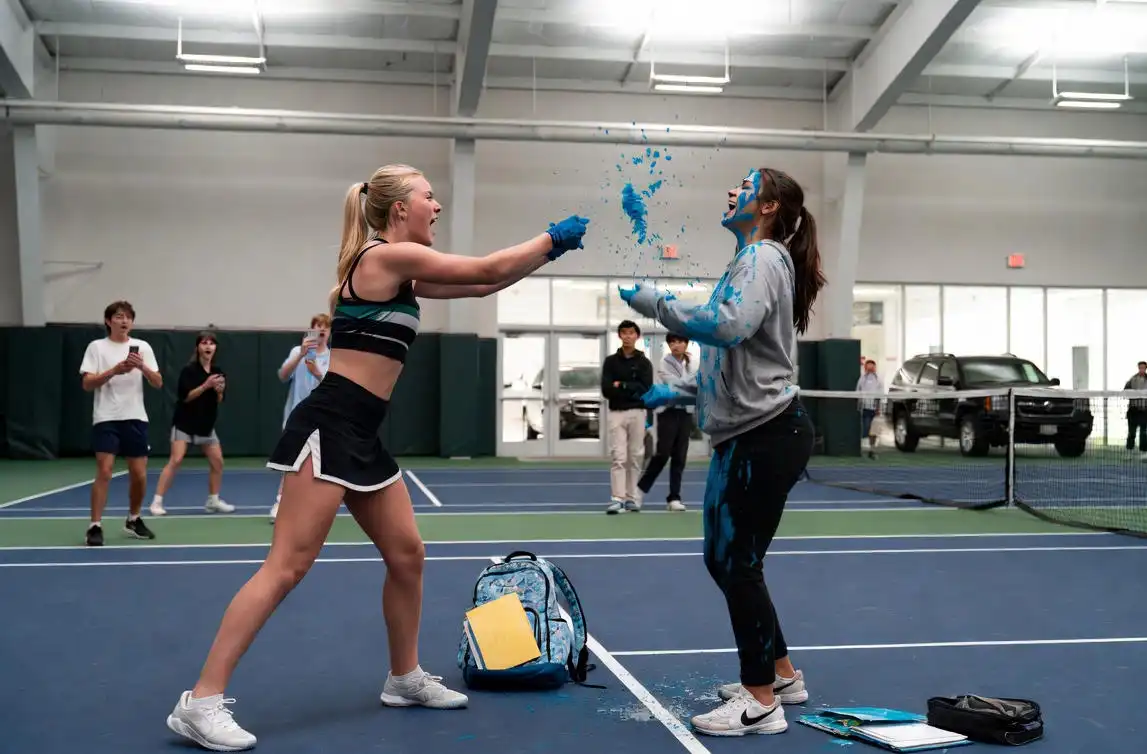
Victoria picked up a plastic cup of blue paint from the mural table.
“I heard you’re on scholarship,” she said.
I placed the box down carefully.
“I am.”
“That must be exhausting.”
“It’s fine.”
“No, really,” she said, tilting her head. “Always trying to prove you belong somewhere you don’t.”
A teacher nearby heard her.
He looked away.
That tiny movement hurt more than the words.
Because cruelty is loud.
Cowardice is quiet.
Victoria took one step closer.
“You know, my dad helped build this court.”
“I know.”
“So when I see someone like you walking around like you have the same rights as people whose families actually support this school…”
She paused.
Her friends leaned in.
Students nearby lifted their phones, pretending to text.
Victoria smiled.
“It feels disrespectful.”
I finally looked her in the eye.
“Respect isn’t purchased with a donation.”
Her face changed.
The smile stayed, but the eyes went cold.
Then she threw the paint.
The cup hit my chest first.
Blue paint exploded across my sweatshirt, my neck, my cheek, my mouth.
The court gasped.
Then came the laughter.
A sharp, nervous, ugly wave of it.
Victoria covered her mouth like she had made a charming mistake.
“Oh my God,” she said. “I thought you were part of the cleanup crew.”
My hands shook.
I wanted to run.
I wanted to scream.
I wanted to tell them my grandfather was Governor William Hart, the man whose portrait hung in half the civic buildings in our state.
I wanted to tell them Adrian Vale could buy the school before lunch and still have time for a board meeting.
But I didn’t.
Because names should not be the only reason people decide you deserve dignity.
So I stood there.
Paint dripping.
Chest burning.
Silent.
Victoria hated that.
She wanted tears.
She wanted begging.
She wanted me to give her the scene she had already written in her head.
Instead, I reached into my backpack and pulled out a towel.
That was when she grabbed my wrist.
“Don’t make a mess on my father’s court,” she hissed.
“Let go.”
She smiled wider.
“Or what?”
The crowd had gone quiet again.
Not because they cared.
Because they wanted to see what would happen next.
Victoria yanked me toward the locker-room entrance beside the court.
My sneakers slipped on a smear of paint.
A few girls followed.
So did two boys from the tennis team.
Someone whispered, “This is insane.”
Someone else said, “Don’t get involved.”
The sink area was visible from the court through a wide open doorway.
Victoria shoved my shoulder.
I hit the counter hard enough to knock over a soap dispenser.
“Wash up,” she said. “The donors are coming.”
Her friend Madison laughed behind her.
“Careful, Vic. She might sue.”
Victoria leaned close to my ear.
“With what money?”
Then she pressed her hand against the back of my head, not hard enough to seriously injure me, but hard enough to make the message clear.
You are beneath me.
You are alone.
You have no witnesses who matter.
My cheek hovered inches from the running water.
My reflection looked back from the mirror.
Blue paint.
Red eyes.
Trembling mouth.
But behind my shoulder, in the top corner of the mirror, I saw the small black dome of the security camera.
And I remembered Uncle Adrian’s rule.
“If you ever need help, do not argue. Do not threaten. Do not explain. Document, step back, and call me.”
So I stopped fighting.
That surprised her.
Victoria laughed.
“There it is. Finally learning your place.”
I reached into my pocket with one hand and tapped the emergency contact he had programmed into my phone.
I did not speak.
I did not need to.
The call connected for three seconds before Victoria slapped the phone out of my hand.
It skidded across the tile.
“You really are dramatic,” she said.
But the call had gone through.
The line had opened.
And the people on the other end had heard enough.
Two minutes later, my phone buzzed on the floor.
Victoria looked down.
The screen lit up.
Stay where you are. Doors in two minutes.
She read it.
Then she laughed so hard her earrings shook.
“Doors in two minutes?” she mocked. “What is that, your little scholarship gang?”
I picked up my phone.
My voice came out quiet.
“No.”
That was all I said.
No threat.
No speech.
Just no.
And that single word irritated her more than tears ever could.
She marched back into the indoor tennis court, grabbed another towel from the donor table, and threw it at my feet.
“Clean yourself up before someone important sees you.”
Then the engines arrived.
At first, it was a low vibration beneath the court.
Then headlights swept across the glass wall.
One black SUV.
Then another.
Then three more.
Students rushed to the windows.
The string quartet stopped playing.
The head of school, Dr. Malcolm Redding, hurried toward the entrance with his polite donor smile already arranged on his face.
But the smile died when the first attorney stepped through the doors.
She was a tall Black woman in a navy suit, carrying a leather document case.
Behind her came two licensed private security officers.
Behind them came Adrian Vale.
Silver hair.
Dark suit.
No raised voice.
No dramatic entrance.
Just a man with enough power to make everyone in the building suddenly remember how to behave.
Dr. Redding stammered, “Mr. Vale, we weren’t expecting—”
“No,” Adrian said. “You weren’t.”
Then he looked at me.
His face changed for half a second.
Pain.
Anger.
Control.
“Olivia,” he said softly.
Victoria froze.
Not because she knew me.
Because she knew him.
Everyone in rooms like that knew him.
Her father had once spent an entire charity dinner trying to get close enough to shake his hand.
Charles Prescott rushed forward from the donor table.
“Mr. Vale,” he said quickly. “There must be a misunderstanding.”
Adrian didn’t look at him.
He kept his eyes on the blue paint running down my chin.
“Did anyone call medical?”
Silence.
“Did any adult intervene?”
Silence.
“Did anyone separate the aggressor from the victim?”
Silence.
The silence was the answer.
The attorney opened her folder.
“For the record,” she said, “we have already requested preservation of all hallway, court, and locker-room surveillance footage. Any deletion attempt will be treated as intentional destruction of evidence.”
Dr. Redding went pale.
Victoria scoffed.
“Oh my God. Evidence? She got paint on her. It’s not a federal case.”
The attorney turned to her.
“Miss Prescott, you placed your hands on another student, shoved her into a hard surface, interfered with her phone during an emergency call, and did so at a donor event on school property while faculty were present.”
Victoria’s mouth opened.
Nothing came out.
Then the doors opened again.
Her parents were escorted in.
Not dragged.
Not harmed.
Escorted.
But they looked worse than dragged.
Her mother’s face was gray.
Her father’s tie was crooked.
Charles Prescott’s confidence had vanished so completely that he looked like a different man.
“Victoria,” her mother whispered, “what did you do?”
Victoria spun toward him.
“Dad, tell them this is stupid.”
But Charles wasn’t looking at her.
He was looking at Adrian.
Then at the attorney.
Then at the folder.
He knew what I didn’t know yet.
That this had not started with paint.
The attorney placed several documents on the donor table.
“Mr. Prescott,” she said, “would you like to explain why your family foundation attempted to condition its donation on the removal of three scholarship recipients from public-facing school programs?”
A low murmur moved through the court.
My stomach dropped.
Three scholarship recipients.
Not just me.
Dr. Redding whispered, “Counsel, perhaps we should discuss this privately.”
Adrian finally turned to him.
“You had six months to handle this privately.”
That sentence landed like a gavel.
The attorney continued.
“Would you also like to explain the emails suggesting that Miss Hart’s application materials be delayed, misplaced, or reassigned to reduce her eligibility for leadership recognition?”
I stopped breathing.
Victoria’s eyes snapped to me.
“Hart?” she said.
There it was.
The name she had heard but never understood.
Olivia Hart.
Not Olivia Nobody.
Not Olivia Charity Case.
Olivia Hart.
Granddaughter of Governor William Hart.
Daughter of the late Daniel Hart.
Goddaughter of Adrian Vale.
But Adrian did not announce it like a trophy.
He let the truth walk into the room on its own.
The attorney slid one printed email across the table.
The subject line was visible.
Re: Optics Around Scholarship Students at Donor Weekend
The sender was Dr. Redding.
The recipient was Charles Prescott.
The message was short.
Cruel.
Polished.
“Per your concerns, we can reduce the visibility of aid-based students during the Prescott reception and assign Olivia Hart to support duties instead of ambassador duties.”
My hands went cold.
I had earned that ambassador position.
I had interviewed for it.
I had written essays.
I had stayed up until 2 a.m. preparing campus tours.
And they had turned me into background labor because Victoria didn’t like seeing poor kids near donors.
Adrian’s voice softened.
“Olivia, did you know about this?”
I shook my head.
The court blurred for a moment.
Not from paint.
From the humiliation of realizing I had worked twice as hard inside a game they had rigged.
Victoria’s mother began crying.
Charles Prescott raised both hands.
“Mr. Vale, this is being blown out of proportion. My daughter made a foolish mistake. We can settle this quietly.”
Adrian stared at him.
“You tried to erase students from a school program because their families weren’t useful to you.”
Charles swallowed.
“That’s not—”
“You pressured administrators using donations.”
“I wouldn’t put it that way.”
“You interfered with scholarship opportunities attached to a fund my consortium helped endow.”
That was when the room truly changed.
Dr. Redding’s knees seemed to weaken.
Because now everyone understood.
Fairmont Academy did not simply receive money from Prescott.
Its scholarship endowment had been quietly backed for years by Meridian Global Alliance.
The same group Adrian chaired.
The same group that had ethical conduct clauses in every donor agreement.
The same group that required anti-harassment compliance, fair access policies, and financial disclosure standards.
Victoria looked from her father to Adrian.
“Wait,” she said. “What does that mean?”
The attorney answered.
“It means the Prescott family’s donor privileges are suspended pending investigation.”
Victoria blinked.
“What?”
“It means the naming rights agreement for the sports wing is under review.”
Her father whispered, “Please.”
“It means the school board has been notified of potential civil liability.”
Dr. Redding gripped the back of a chair.
The attorney looked at him next.
“And it means any faculty member who witnessed today’s incident and failed to intervene will be interviewed.”
Several teachers looked like they wanted to disappear.
One student near the wall muttered, “Oh my God.”
Victoria stepped backward.
Her confidence cracked in real time.
“This is insane,” she said. “She didn’t even get hurt.”
I finally spoke.
My voice was quiet, but everyone heard it.
“You didn’t care whether I got hurt.”
She turned on me.
“You think you’re special now because you know some rich old guy?”
The court went silent again.
Adrian’s expression did not change.
But his attorney’s eyes sharpened.
I wiped paint from my jaw with the towel Victoria had thrown at my feet.
“No,” I said. “I thought I was supposed to be treated like a person before anyone knew who I was.”
That hit harder than any announcement.
Because it left them no escape.
If they apologized now, it was not because they had grown kind.
It was because they had learned I had protection.
Victoria’s father moved toward me.
“Olivia,” he said, forcing a broken smile. “This has been a terrible misunderstanding.”
I stepped back.
He stopped.
“I would never want you to feel unwelcome here.”
I looked at the blue paint on my hands.
“You made sure I felt unwelcome for six months.”
He opened his mouth.
The attorney interrupted.
“Do not approach my client again.”
My client.
The words startled me.
I had not thought of myself that way.
I had thought of myself as a girl trying to survive a room full of people who had decided I was small.
But in that moment, the rules finally stood beside me.
Not money.
Rules.
Evidence.
Contracts.
Cameras.
Emails.
Witnesses.
The legal hammer fell quietly.
And that made it more terrifying.
No screaming.
No threats.
No revenge speech.
Just facts being placed on a table one after another until the lies had nowhere left to stand.
Adrian turned to Dr. Redding.
“Effective immediately, Meridian Global Alliance is exercising its emergency review rights under the scholarship endowment agreement.”
Dr. Redding whispered, “You can’t—”
“We can,” the attorney said.
She placed another document down.
“Clause 14. Public integrity breach. Clause 19. Discriminatory access interference. Clause 22. Donor coercion.”
Every clause sounded like a door locking.
Adrian continued.
“The school will preserve all evidence. The board will meet tonight. Outside counsel will handle the investigation. No Prescott family member is to contact Olivia or any scholarship recipient.”
Victoria laughed once.
A small, broken sound.
“You can’t ban my family from our own school.”
Adrian looked at the plaque above the entrance.
PRESCOTT INDOOR TENNIS CENTER
Then he said, “Watch us do it legally.”
That was the first moment I saw Victoria understand.
Not fully.
But enough.
Her world had always been a staircase built by her father’s money.
And now someone had reached for the bottom step.
Her mother covered her mouth.
Charles Prescott stepped closer to Adrian, lowering his voice.
“Please. We have pending deals. If this becomes public, it could destroy us.”
Adrian’s answer was calm.
“Then you should have raised your daughter to fear disgrace more than poverty.”
The words were not loud.
They did not need to be.
Students began whispering.
Some were still recording.
This time, nobody told them to stop.
Dr. Redding tried again.
“Olivia, perhaps you and I can speak in my office.”
I looked at him.
This man had watched me carry boxes while other students posed for donor photos.
He had watched Victoria insult me.
He had watched paint drip down my face.
He had watched an adult moment unfold and chosen his donors over his duty.
“No,” I said.
One word.
Again.
No.
It felt different this time.
Not small.
Not scared.
Clean.
The investigation moved fast because rich people had been careless.
They had assumed no one beneath them could hurt them.
They had put ugly things in emails.
They had discussed scholarship students like furniture.
They had forwarded messages with phrases like “aid optics” and “donor discomfort.”
They had let Victoria’s cruelty grow because it served their social order.
By 6 p.m., the school board had emergency counsel.
By 9 p.m., Dr. Redding was placed on administrative leave.
By midnight, three staff members had submitted written statements admitting they had been pressured to reduce scholarship students’ visibility at donor events.
The next morning, Fairmont Academy sent a campus-wide message.
It did not name me.
But everyone knew.
The message announced an independent review of donor influence, student safety, scholarship access, and administrative misconduct.
Victoria did not come to class.
Her friends did.
They avoided my eyes.
Madison, the girl who had laughed in the sink area, approached me outside the library.
“I didn’t know it was that bad,” she said.
I looked at her.
“You were there.”
She cried.
Maybe she was sorry.
Maybe she was scared.
Sometimes those look very similar.
I didn’t comfort her.
That was not my job.
Three days later, the Prescott name came down from the indoor tennis center.
Workers removed the letters one by one.
Students gathered outside to watch.
Victoria stood near the parking lot in sunglasses, arms crossed, pretending she didn’t care.
But when the P came off the wall, she flinched.
Her father’s company released a statement about “stepping back from public partnerships during a period of review.”
That was the polite version.
The real version was uglier.
Several major contracts had morality clauses.
Meridian Global Alliance had not blacklisted them illegally.
It didn’t need to.
It simply notified partner institutions that Prescott Foundation funds were under compliance review.
Hospitals paused projects.
Universities returned calls through lawyers.
A bank froze a refinancing package pending an audit.
A construction deal collapsed when due diligence found undisclosed debt tied to the family foundation.
The empire that looked so clean from the outside had been held together with reputation, pressure, and borrowed money.
Once the reputation cracked, everything else followed.
Charles Prescott resigned from two boards.
Victoria’s mother left town for a while.
Their mansion went up for sale within the month.
And Victoria?
Victoria was suspended first.
Then expelled after the investigation confirmed physical harassment, intimidation, and repeated discriminatory conduct toward scholarship students.
But the part that stayed with people wasn’t the expulsion.
It was the restitution hearing.
Because Fairmont Academy’s board, desperate to show the public it had changed, created a scholarship restoration fund.
The Prescott family was ordered through settlement terms to contribute to it.
Victoria also had to complete supervised community service on campus before her transcript transfer would be processed.
No cameras.
No press.
No glamour.
But students saw her one afternoon near the same entrance where the SUVs had arrived.
She wore gloves.
She held a trash bag.
She was picking up litter after a public school tutoring event hosted at Fairmont.
A freshman whispered, “Is that Victoria?”
Another said, “Yeah.”
Victoria heard them.
Her face turned red.
For one second, I thought she might snap.
But she didn’t.
She looked down and kept picking up trash.
Not because she had become humble overnight.
Consequences are not the same as character.
But consequences can be the first honest mirror some people ever face.
As for me, the story spread faster than I wanted.
Someone posted a blurry video of the paint incident.
Someone else posted the SUVs.
Then the clip of the Prescott name coming down went everywhere.
People started calling me “the governor’s granddaughter” in the halls.
Some students who had ignored me suddenly wanted to sit with me.
Some teachers became painfully polite.
It would have been easy to enjoy it.
A little.
Maybe more than a little.
But my grandfather called me that night and reminded me who I was supposed to be.
“Power,” he said, “is not for proving you were right. It’s for making sure the next person doesn’t need your last name to be safe.”
So I made one request.
Not revenge.
A rule.
Fairmont Academy had to create an anonymous reporting system for donor-related pressure.
Scholarship students had to be guaranteed equal access to ambassador roles, leadership programs, and public events.
Faculty who ignored public harassment had to face mandatory reporting reviews.
And every donor agreement had to include a student dignity clause.
Adrian smiled when I told him.
“That,” he said, “is exactly why your father would be proud.”
I cried then.
Not in the court.
Not in front of Victoria.
Not when the paint hit my face.
I cried in the back seat of Adrian’s car, where no one needed me to be brave.
He handed me a clean handkerchief.
For a while, we just sat there.
The world outside the tinted window looked ordinary.
Traffic.
Streetlights.
People carrying groceries.
A little boy laughing on the sidewalk.
Ordinary.
The life I had wanted to understand.
The life I had been trying to experience.
And I realized something painful but important.
I had wanted to be treated like everyone else.
But many people are not treated with dignity unless someone powerful is watching.
That is not justice.
That is proof we still have work to do.
Two weeks later, I returned to the indoor tennis court.
Not for donors.
Not for Victoria.
For the tutoring program.
The same program the charity mural had been meant to support before everything turned ugly.
The court looked different.
The Prescott letters were gone.
The wall where the plaque had been removed was freshly painted.
At center court stood a group of public school students, holding notebooks, laughing nervously as Fairmont volunteers welcomed them.
One little girl pointed at my sneakers.
“I like those,” she said.
They were the same old sneakers Victoria had mocked.
I smiled.
“Thank you. They’ve been through a lot.”
She grinned.
“Me too.”
That nearly broke me.
Because that was the real ending.
Not Victoria losing her crown.
Not her father begging.
Not the lawyers or the SUVs or the headlines.
The real ending was a little girl walking into a rich school and not being made to feel small.
Later that afternoon, I stood outside as my ride arrived.
It was not the city bus this time.
Adrian had insisted.
A custom black Rolls-Royce pulled to the curb.
Armored.
Quiet.
Ridiculous.
I rolled my eyes when I saw it.
He stepped out and opened the door himself.
“You hate it,” he said.
“I hate that I like the heated seats.”
He laughed.
Students watched from the steps.
Teachers stood a little straighter.
Even the board chair looked nervous.
I could feel their fear.
Their respect.
Their calculation.
I could have let it turn me cold.
Instead, I looked back at the school and saw Victoria near the far gate, finishing her community service shift with a trash bag in one hand.
Our eyes met.
For once, she didn’t sneer.
For once, I didn’t look away.
I did not smile.
I did not gloat.
I simply nodded once.
Not forgiveness.
Not friendship.
Just acknowledgment.
You saw me now.
Too late.
But you saw me.
Then I got into the car.
As we pulled away, Adrian asked, “Do you regret coming here without your name?”
I looked at the campus shrinking behind us.
“No,” I said.
“Why not?”
“Because now I know who they are when they think nobody important is watching.”
He nodded.
“And what will you do with that?”
I looked at the tutoring flyers on my lap.
At the names of students who would come next year.
At the new reporting policy waiting for approval.
At the scholarship fund restored with money that had once been used to silence kids like me.
“I’ll make sure somebody important is always watching,” I said.
Not from a motorcade.
Not from a mansion.
From the rules.
From the cameras.
From contracts.
From students brave enough to record.
From adults finally forced to act like adults.
Victoria wanted to teach me my place.
She did.
My place was not under her shoe.
Not at the sink.
Not behind donors.
My place was wherever I could stand up, tell the truth, and make the door wider for the next person.
So choose a side:
Was I wrong for letting Victoria expose herself in public before I called for help — or did she deserve to face the same public shame she tried to give me?
Share this if you believe money should never give anyone permission to humiliate another human being. ⚖️
Disclaimer: Mention of any brand or trademark is for identification only and does not imply partnership or endorsement
A Retired Nurse Was SHOVED At A Luxury Cruise Gate By A Snobby Purser… But They Had NO IDEA Who She Really Was 🚢
A Paint-Stained ART TEACHER Was Humiliated at a VIP Museum Preview by an Elite Critic… But He Had NO IDEA Who She Really Was 😳
A PLUS-SIZE Grocery Cashier Was Dragged Across A Private Island Beach By A Snobby Resort Manager… But He Had NO IDEA Who She Really Was 😳