

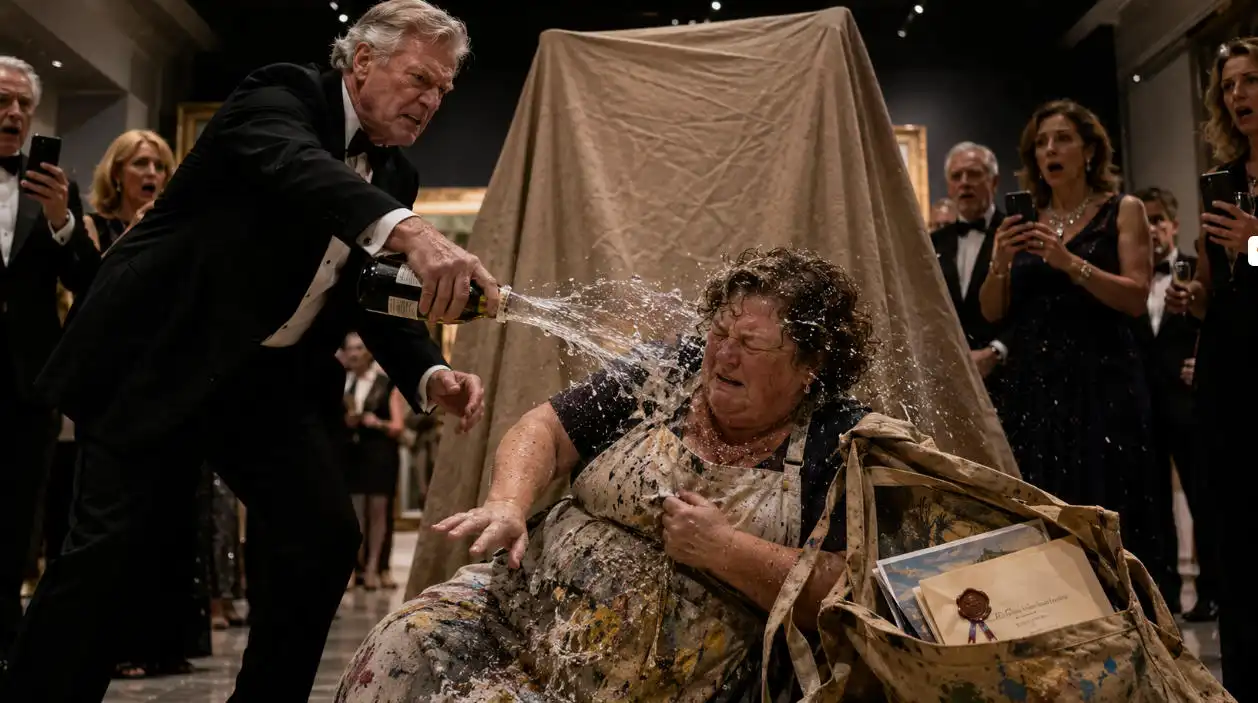
The room went so quiet I could hear champagne dripping from my chin onto the marble floor.
Vincent Hawthorne still had one hand half-raised, like he had not yet decided whether humiliating me once was enough.
My cheek burned.
My canvas skirt was torn.
And the museum director was walking toward us with the expression of a man who had just watched a disaster happen in slow motion.
“Ladies and gentlemen,” he said into the microphone, “before we unveil tonight’s centerpiece, there is something you need to know about the woman Mr. Hawthorne just assaulted.”
Vincent laughed once.
A sharp, nervous laugh.
“Assaulted?” he said. “Please. I was protecting the integrity of the room.”
That was Vincent’s gift.
He could make cruelty sound like culture.
He had spent twenty-five years telling artists whether they mattered.
Collectors feared him.
Gallery owners flattered him.
Young painters quoted him like scripture, even when his reviews left them in pieces.
And me?
I was Clara.
A fifty-three-year-old public school art teacher from Queens.
Round face.
Soft arms.
Paint on my clothes more often than not.
The kind of woman people assume is there to hand out name tags, refill coffee, or apologize for taking up space.
At least, that was what Vincent saw.
That night was a VIP preview for a private donor exhibition at the Museum of Modern Art.
The centerpiece was covered in ivory cloth.
The invitation had called it:
The first public appearance of C’s final New York canvas.
For ten years, the art world had chased “C.”
Nobody had a confirmed photograph.
Nobody had an interview.
Nobody even knew if C was a man, a woman, young, old, American, European, alive, sick, or playing them all for fools.
C’s paintings sold quietly.
Then they vanished into private collections.
Museums begged.
Critics speculated.
Vincent built half his reputation on writing about C.
He called C “the last honest genius in a market full of decorated frauds.”
He once wrote, “If I could meet C before I die, I would kneel before the frame.”
That line had made him famous.
It had also made me laugh so hard I spilled coffee on attendance sheets in my classroom.
Because every weekday morning, I was grading seventh-grade sketchbooks under fluorescent lights.
And every few years, under a name nobody could connect to me, I painted one canvas that sold for more than my school’s annual arts budget.
I never hid because I was ashamed.
I hid because the art world is full of people who love mystery more than truth.
They wanted a myth.
I wanted peace.
I wanted to teach children that a crooked line can still be beautiful.
I wanted to paint without donors asking me to perform genius over dinner.
So I signed my work with one letter.
C.
That evening, I came to the preview because the museum had asked me to attend quietly.
No speech.
No red carpet.
No dramatic reveal unless I chose one.
The covered painting behind Vincent was mine.
The torn tote bag beside my knee contained the provenance documents, the insurance forms, and the museum’s private loan agreement with my legal name printed above my signature.
I had planned to stand in the back.
Watch strangers meet the painting.
Go home.
Make tea.
Grade still-life homework.
Then Vincent smelled paint on my sleeve.
He made a face like I had ruined his wine.
“Is that turpentine?” he asked.
I smiled politely.
“It’s linseed oil, mostly.”
He turned to the couple beside him.
“Charming. They’ve invited the janitorial realism movement.”
The woman laughed behind her hand.
I tried to step around him.
He moved with me.
A small block.
A public one.
“You must understand,” he said, raising his voice, “this room contains people who have spent decades earning access.”
I looked at his tuxedo.
His polished shoes.
The little gold pin from an art foundation that had rejected half the teachers I knew for small classroom grants.
“I’m sure it does,” I said.
His smile tightened.
“You don’t sound impressed.”
“I teach middle school,” I said. “Impressing me is difficult.”
A few people chuckled.
That was when his face changed.
Not much.
Just enough.
Men like Vincent do not mind jokes when they are the one holding the knife.
They mind when the room laughs at them.
He leaned in.
“You know what I think?” he said.
“I’m sure you’ll tell me.”
“I think people like you confuse proximity with belonging.”
The room heard that.
Of course it did.
That was the point.
He wanted everyone to see him sort me into my proper place.
The paint-stained teacher.
The round woman in a handmade skirt.
The nobody too unsophisticated to be embarrassed correctly.
I felt my phone buzzing in my pocket.
A message from the museum director, probably asking where I was.
I did not answer.
Vincent lifted his champagne.
For one second, I thought he would make a toast.
Instead, he poured it over my head.
The cold hit my scalp first.
Then my face.
Then my throat.
Gasps moved through the room.
A phone camera rose.
Then another.
The champagne ran down the front of my dress and darkened the canvas I had stitched myself from old drop cloths.
Vincent smiled.
“Now,” he said, “you smell expensive.”
I could have revealed everything right then.
I could have stood up and said, “That painting you worship is mine.”
I could have watched his blood drain from his face.
But my father used to say something when I was little and someone mocked my drawings.
“Don’t interrupt a person who is busy showing the world who they are.”
So I stayed quiet.
Vincent mistook silence for weakness.
He stepped closer.
“Go clean yourself up,” he said. “And stay away from the covered piece. Some of us are here for history.”
I tried to move past him.
His hand caught my arm.
Not gently.
“Vincent,” someone warned.
He ignored them.
“Don’t touch me,” I said.
He laughed.
“Oh, now she has boundaries.”
Then he slapped me.
The sound cracked across the gallery.
My head turned.
My cheek went hot.
For a second, I saw only white light and gold frames.
Then his fingers caught my hair.
He shoved.
I stumbled backward and hit the floor near the covered painting.
My skirt tore on the corner of the display platform.
The little ripping sound embarrassed me more than the slap.
Isn’t that strange?
Not the pain.
Not the champagne.
The sound of something I had made being ripped in public.
Someone whispered, “Oh my God.”
Someone else said, “Is anybody going to stop him?”
But nobody moved fast enough.
That is how public cruelty works.
People freeze because they are waiting for someone more official to decide whether what they saw was real.
Vincent pointed down at me.
“Keep her away from real art,” he snapped. “I’ve waited ten years to see C’s new masterpiece. I won’t let some paint-smeared nobody ruin it.”
That was the line that ended him.
Not because it was the cruelest.
Because it was recorded from seven angles.
Because the security cameras caught his hand on my arm, his glass tipping, the slap, the shove.
Because the museum’s VIP credential agreement, signed by every guest, included a conduct clause.
Because Vincent had been warned before.
And because, three feet from his polished shoe, my torn tote bag had fallen open.
The sealed certificate slid halfway out.
Cream paper.
Embossed stamp.
My legal name.
My signature.
The director saw it before Vincent did.
His face turned pale.
He hurried toward us, lifted the microphone, and spoke.
“Ladies and gentlemen…”
Vincent rolled his eyes.
“Daniel, please don’t make this dramatic.”
The director looked at him.
“No, Vincent. You did that.”
A few people murmured.
The director turned to me.
“Ms. Clara Whitmore,” he said softly, “may I help you up?”
Vincent blinked.
“Ms. who?”
I took Daniel’s hand and stood.
Champagne dripped from the ends of my hair.
My cheek still burned.
My skirt was ripped from hip to knee.
But my voice was steady.
“Thank you.”
Daniel faced the crowd again.
“Tonight’s centerpiece was loaned to the museum under strict confidentiality. Only four people on our staff knew the artist’s legal identity.”
Vincent’s mouth opened.
Then closed.
Daniel continued.
“The artist known worldwide as C is not an anonymous European man. She is not a recluse in a villa. She is not, as some critics have guessed, a collective.”
He turned toward me.
“She is Clara Whitmore.”
No one breathed.
Then every phone turned toward me.
Vincent took one step back.
“No,” he said.
It was almost gentle.
Like a prayer.
Daniel nodded to the staff member beside the covered painting.
The ivory cloth came off.
And there it was.
My canvas.
Forty-eight by seventy-two inches.
Oil, ash, linen, and ground blue pigment.
A painting of a classroom after sunset.
Tiny chairs stacked on desks.
A jar of brushes soaking by the sink.
One child’s unfinished drawing still taped to the wall.
The title was printed on the placard:
After the Bell, by C Estimated value: $10.4 million
A woman in pearls started crying.
Not because of me.
Because of the painting.
That part I understood.
Art should reach people before the artist does.
Vincent stared at the canvas as if it had betrayed him.
Then he looked at me.
At my wet hair.
At my torn skirt.
At the champagne stain on the floor.
“No,” he whispered again. “C is… C is…”
“A teacher,” I said.
His face collapsed.
For one second, I saw the boy he might once have been.
Scared.
Small.
Desperate to be important.
Then the man came back.
“I didn’t know,” he said loudly.
That made people angry.
Not the apology.
The excuse.
A man behind him said, “Would it have been fine if she wasn’t famous?”
Vincent spun around.
“You don’t understand what was at stake!”
Daniel’s voice hardened.
“What was at stake was a guest’s safety.”
“She provoked me!”
I almost laughed.
Champagne was still dripping off my sleeve.
“I stood here,” I said.
The crowd murmured.
Vincent pointed at the painting.
“I have defended your work for years. I made people care about you.”
I looked at him.
“No. You made people care about your opinion of me.”
That landed.
I saw it hit him harder than the reveal.
Because people like Vincent believe admiration is ownership.
If he praised you, he believed you owed him.
If he crowned you, he believed he could command you.
If he loved your work, he believed he had a right to you.
He moved toward the painting.
Security stepped in.
“Don’t touch it,” Daniel said.
Vincent’s hands trembled.
“I wrote the essay that revived your 2016 series,” he said to me. “I called you the conscience of American solitude.”
“I remember.”
His eyes filled.
“I understood you.”
“No,” I said. “You understood loneliness when it looked expensive.”
The room went dead silent.
Then Daniel did something I did not expect.
He nodded to the museum’s legal counsel.
A woman in a navy suit stepped forward with a folder.
“Mr. Hawthorne,” she said, “your credential is revoked effective immediately. You will be escorted out. The museum is preserving all video evidence of tonight’s assault, property damage, and verbal harassment.”
Vincent went white.
“Assault?” he repeated.
“Yes,” she said. “And damage to loaned property.”
He looked down.
The champagne had splashed the lower edge of the painting’s protective viewing barrier.
Not the canvas itself.
But his shove had knocked my tote into the platform.
The certificate sleeve was creased.
My dress was torn.
My phone screen had cracked.
Small things, compared to a $10 million painting.
But the law has never required cruelty to be expensive before it counts.
The museum had rules.
He signed them.
He broke them.
That was the first hammer.
The second came from his own mouth.
A young curator raised her phone.
“Daniel,” she said, voice shaking, “I have the whole thing.”
Another guest said, “So do I.”
Another: “I was livestreaming the unveiling.”
Vincent looked around and realized the room he had performed for had become the witness stand.
His breathing changed.
Fast.
Uneven.
“Clara,” he said.
Not Ms. Whitmore now.
Clara.
Familiarity as a last resort.
“I’m sorry.”
I wiped champagne from my jaw.
“No, you’re scared.”
He flinched.
Then came the third hammer.
And this one had been waiting long before that night.
For almost six months, three young critics had been gathering evidence that Vincent had plagiarized sections of his published reviews.
Not one line.
Not a careless phrase.
Paragraphs.
Images.
Arguments.
Old exhibition catalogs.
Graduate theses.
Unsigned student essays.
Even two passages from a lecture I gave years earlier at a public school arts conference.
He had built a throne out of stolen words.
The young critics were terrified to publish.
Vincent could ruin them.
So they sent the packet quietly to Daniel.
Daniel sent it to the museum’s ethics board.
The board had planned to confront Vincent privately after the preview.
A quiet institutional investigation.
Careful.
Professional.
Then Vincent poured champagne on me in front of half the donor list.
Daniel looked at him with a sadness that was almost colder than anger.
“Mr. Hawthorne,” he said, “given tonight’s conduct, the museum will also be forwarding the pending plagiarism dossier to your publishers, the Critics’ Association, and the three journals currently listing you as an advisor.”
Vincent’s knees seemed to weaken.
“What dossier?”
The young curator lifted her chin.
“The one with my thesis in it.”
The room turned toward her.
She was maybe twenty-eight.
Brown hair.
Black dress.
Hands shaking, but voice clear.
“You stole four paragraphs from my graduate work and called it ‘your summer essay.’ I was too afraid to say anything.”
Vincent stared at her.
Then at Daniel.
Then at me.
“You can’t do this,” he said.
“I’m not doing it,” I said. “You did.”
Security moved beside him.
That was when Vincent broke.
Not with dignity.
Not with grace.
He stumbled toward my painting and dropped to his knees in front of the frame.
“Please,” he said.
At first, I thought he was talking to me.
Then I realized he was talking to the painting.
His hands hovered inches from the barrier.
“I waited ten years,” he whispered. “Ten years.”
Phones recorded every second.
He began to cry.
Not the clean kind of crying people do in movies.
Ugly crying.
Wet-faced.
Shaking.
A man who had spent his life making artists beg for his approval was now kneeling before a painting made by the woman he had called a nobody.
“Clara,” he sobbed. “Please. Don’t shut me out of this. I love your work.”
I stepped closer.
Security looked at me, but I nodded.
I wanted him to hear me clearly.
“You loved the idea that genius would look like you imagined it.”
He covered his face.
“I made a mistake.”
“No,” I said. “A mistake is spilling champagne. You poured it. You slapped me. You pulled my hair. You shoved me. Then you blamed me for standing there.”
The room stayed silent.
I could feel people listening differently now.
Not for scandal.
For the line.
For the place where forgiveness might appear.
I believe in forgiveness.
I teach children.
You cannot teach children without believing people can grow.
But forgiveness is not a backstage pass.
Forgiveness is not restored access.
Forgiveness is not letting someone keep the weapon because they cried when caught.
So I turned to Daniel.
“Remove my painting from this exhibition.”
A shock moved through the room.
Daniel swallowed.
“Clara…”
“I mean it.”
Vincent looked up fast.
“No. Please. Please don’t.”
I looked at the canvas.
My classroom after sunset.
My little chairs.
My jar of brushes.
The unfinished child’s drawing.
That painting had been valued at more than ten million dollars because adults with money had decided it was rare.
But I knew what it really was.
It was a love letter to every child who had ever stayed after school because home was too loud.
Every kid who said, “I can’t draw,” and tried anyway.
Every teacher who bought supplies out of pocket and called it normal.
And now Vincent’s cruelty had attached itself to the night it entered the world.
I would not let that be its story.
“Take it down,” I said.
Daniel nodded slowly.
Museum staff moved in.
Vincent made a sound I will never forget.
Like something inside him had torn.
“You can’t bury it,” he said. “It’s important.”
I looked at him.
“Yes. It is.”
The staff lifted the painting from the wall.
But I was not finished.
There was a small ceremonial hearth in the donor garden outside.
It had been prepared for a later installation involving controlled flame and treated paper.
The fire marshal was already present.
The museum had permits for that portion of the evening.
A strange detail.
A legal detail.
The kind that matters.
I asked Daniel one question.
“Can the burn station be used tonight?”
He stared at me.
Then understood.
“Legally, yes,” he said. “If you authorize it as the owner.”
Vincent started shaking his head.
“No. No, Clara. Don’t. Don’t punish the world because of me.”
That was rich.
The world had survived without my painting for centuries.
It would survive one more absence.
We walked to the garden.
Not everyone followed.
But enough did.
The cold night air hit my wet hair.
My cheek throbbed.
My torn skirt moved against my leg.
The painting was carried out under museum supervision and placed near the permitted flame station.
People whispered like they were in church.
Vincent struggled against security, not violently now, just desperately.
“Please,” he cried. “I’ll retract everything. I’ll apologize publicly. I’ll write whatever you want.”
I turned.
“That’s the problem, Vincent. You think words are currency after you spent years stealing them.”
He had no answer.
Daniel handed me the authorization form.
I signed my name.
Not C.
Clara Whitmore.
The fire marshal confirmed the setup.
The painting was mine.
The choice was mine.
I touched the lower corner of the canvas one last time.
Then I let it go.
The fire caught slowly at first.
A thin orange line.
Then brighter.
The classroom disappeared by inches.
The chairs.
The brushes.
The little drawing on the wall.
Vincent sank to the stone path and sobbed into his hands.
People watched in stunned silence.
Some thought I was destroying a masterpiece.
I knew I was freeing one.
Because no object, no matter how valuable, should cost a woman her dignity.
🔥
The next morning, Vincent’s apology appeared online.
It was polished.
Too polished.
By noon, three publications had suspended him.
By Tuesday, the plagiarism packet was public.
Side-by-side comparisons.
Dates.
Student papers.
Archived catalogs.
Lecture transcripts.
Receipts.
By Friday, the Critics’ Association revoked his lifetime achievement nomination.
Two galleries removed his essays from exhibition catalogs.
A university canceled his visiting lecture.
Then came the sentence that hurt him most:
The Museum of Modern Art permanently revoked Vincent Hawthorne’s press and VIP access.
Not just for my shows.
For everything.
Other museums followed.
Collectors stopped returning his calls.
Young writers who had feared him began telling their stories.
One said he stole her language.
Another said he threatened to blacklist him.
Another said Vincent had mocked her accent at a panel, then used her research in his review.
The empire did not collapse because I was C.
It collapsed because it had been rotten, and one public night finally made people willing to say so.
As for me, I went back to school the following Monday.
My students had seen clips.
Of course they had.
Middle schoolers can find anything in under seven minutes.
One boy raised his hand and asked, “Ms. Whitmore, did you really burn a ten-million-dollar painting?”
The room went silent.
I looked at their faces.
Curious.
Worried.
A little impressed.
I said, “I burned a canvas.”
Then I pointed to the supply shelf.
“But I did not burn the reason I paint.”
A girl in the back whispered, “That was kind of awesome.”
I pretended not to hear.
At lunch, the principal called me into her office.
I thought I was in trouble.
Instead, she handed me an envelope.
Inside was a donation pledge from three museum trustees.
A full arts fund for our school.
Supplies.
Field trips.
Kiln repairs.
Scholarship money.
A visiting artist program that did not require students to already know the right people.
The note was short.
For the classroom after the bell.
That was when I cried.
Not at the museum.
Not when Vincent slapped me.
Not when the painting burned.
But there, under bad fluorescent lights, holding enough money to give my students the art room they deserved.
Weeks later, Daniel asked whether I regretted burning the painting.
I thought about Vincent on his knees.
The cameras.
The gasps.
The way people only recognized my humanity after they recognized my signature.
Then I looked around my classroom.
A boy was painting his grandmother’s hands.
A girl was drawing a blue horse with six legs.
Two students were arguing very seriously about whether clouds could be purple.
“No,” I said.
And I meant it.
Because the world can always make room for another expensive object.
But dignity?
You protect that the moment someone tries to price it.
Vincent wanted access to genius while stepping on the person who carried it.
He wanted beauty without humility.
Truth without kindness.
Prestige without character.
He lost his platform.
He lost his invitations.
He lost the stolen words that made him powerful.
And the children he would have ignored?
They got the future he never believed they deserved.
So choose a side:
Was Clara right to burn her own masterpiece and shut Vincent out forever — or should a public apology have been enough? Share this if you believe respect matters more than status.
Disclaimer: Mention of any brand or trademark is for identification only and does not imply partnership or endorsement
A Retired Nurse Was SHOVED At A Luxury Cruise Gate By A Snobby Purser… But They Had NO IDEA Who She Really Was 🚢

A PLUS-SIZE Grocery Cashier Was Dragged Across A Private Island Beach By A Snobby Resort Manager… But He Had NO IDEA Who She Really Was 😳
A Wall Street Executive Slapped A Soft-Spoken Farmer At The Bellagio VIP Table… Then The Dealer Froze When He Heard Jim’s Name