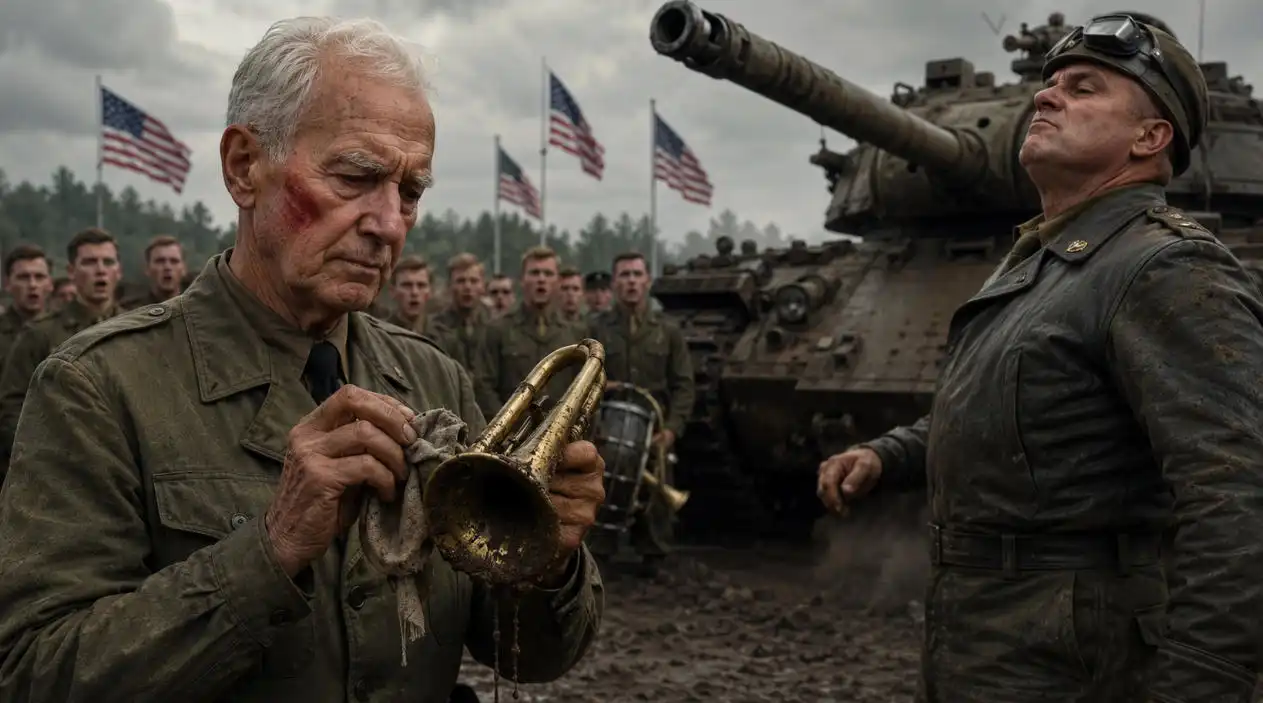

The regional commander didn’t clap right away.
At first, he only lowered his binoculars.
Slowly.
Carefully.
Like he had just seen something no computer in the Army could explain.
Inside the observation post, nobody breathed.
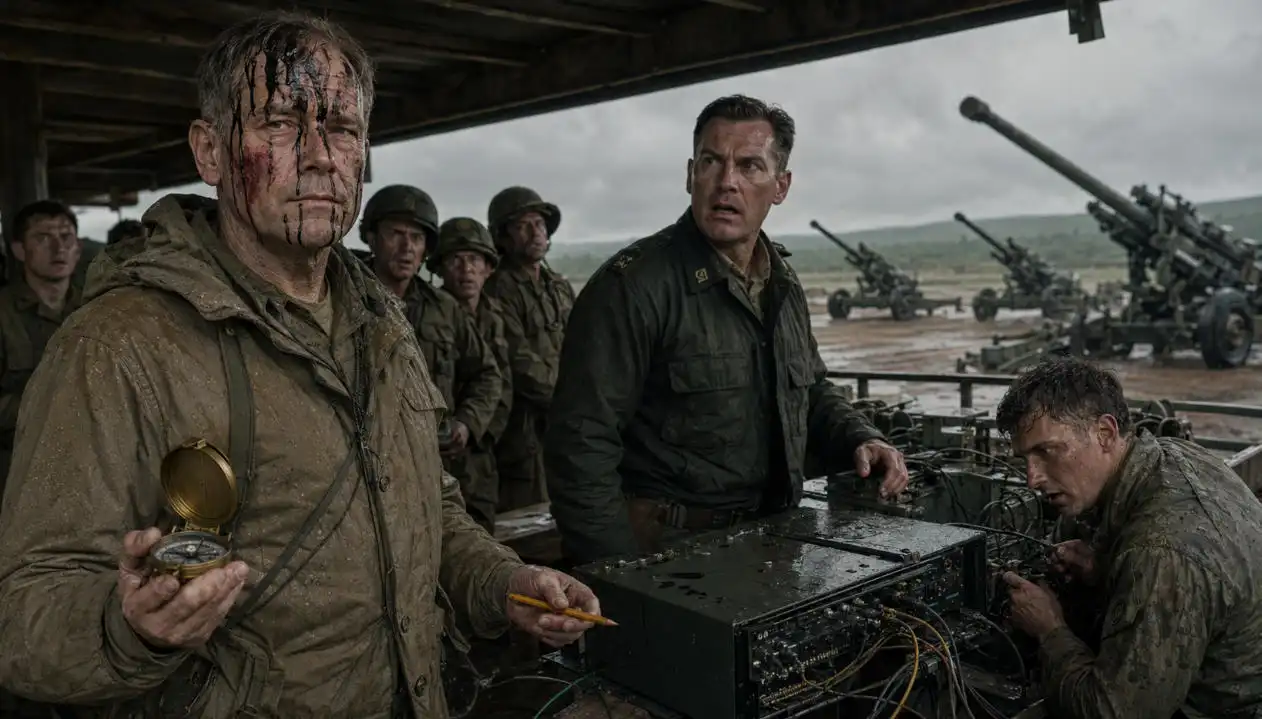
The ink was still running down Colin’s face.
Dallas’s hand was still half-raised from the slap.
And every dead fire-control screen in the tent reflected the same thing:
Panic.
Colin was the only calm man on that ridge.
He was sixty-two years old.
Gray around the temples.
Quiet voice.
Old field jacket.
A pencil tucked behind one ear.
Most of the young soldiers thought he was just some retired observer brought in for tradition day.
Dallas made sure they thought that.
Commander Dallas loved clean screens, glossy briefings, and expensive systems.
He loved walking into a room and watching junior officers straighten their backs.
He loved saying things like, “Modern warfare belongs to men who understand data.”
And he hated Colin.
Not because Colin talked back.
Colin never did.
Dallas hated him because Colin made the room uncomfortable.
The old man could look at terrain for five seconds and know what every sensor should have seen.
He could read smoke.
Wind.
Slope.
Sound delay.
Sun glare.
He could hear an artillery correction once and know whether the battery was lazy, late, or scared.
The soldiers called him a human calculator.
Dallas called him a museum piece.
That morning, the training camp had been packed.
A full artillery exercise.
Observation crews.
Gun crews.
Drone operators.
Communications soldiers.
Inspectors.
And somewhere on the far ridge, the regional commander watching from a covered platform.
Dallas wanted a perfect demonstration.
He wanted the new automated fire-control network to shine.
He wanted applause.
He wanted promotion talk.
Then Colin pulled out his paper notebook.
Dallas saw it like an insult.
“What is that?” he asked.
Colin didn’t look up.
“Backup.”
Dallas laughed.
The laugh was sharp.
Performative.
The kind of laugh meant to tell everyone else they had permission to join.
A young gunner smirked, then stopped when Colin looked at him.
Dallas stepped closer.
“Backup?” he said. “For a million-dollar system?”
Colin marked something with his pencil.
“Everything needs a backup, sir.”
That was the sentence that did it.
Dallas’s face changed.
Not angry.
Worse.
Amused.
Like he had found a bug on his uniform.
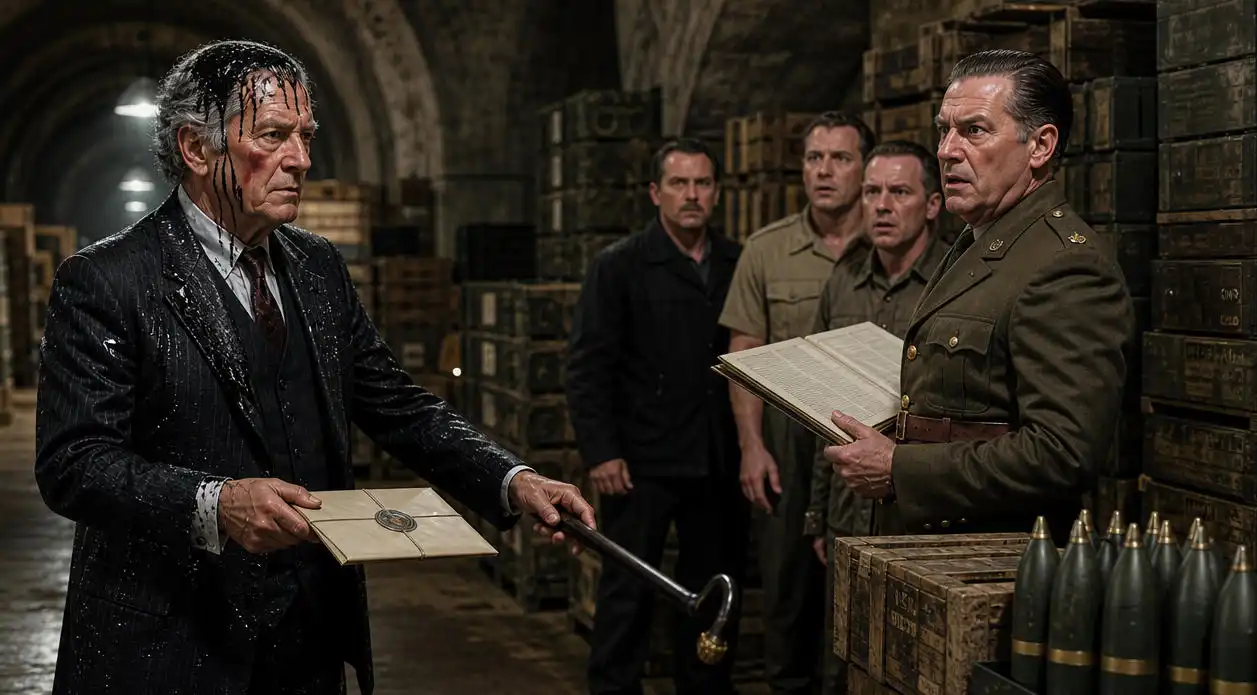
He picked up Colin’s ink bottle from the map table.
“Then let’s modernize you.”
Before anyone could move, Dallas tilted the bottle.
Black ink poured over Colin’s forehead.
Down his nose.
Across his cheek.
Onto the collar of his old field jacket.
The tent froze.
A communications soldier whispered, “Sir…”
Dallas snapped, “Quiet.”
Then he slapped Colin across the face.
Hard enough that the old compass in Colin’s hand clicked shut.
Dallas leaned in.
“Your paper won’t save this battalion.”
Colin’s cheek turned red.
His jaw tightened once.
But he didn’t raise his voice.
He didn’t threaten.
He didn’t touch Dallas.
He simply opened the compass again.
That made Dallas angrier.
Because some men don’t just want obedience.
They want humiliation to work.
The gunners were waiting for firing data.
The comms soldier kept tapping the dead keyboard.
“Network latency,” he muttered. “Trying to re-route.”
Dallas pointed at him.
“Fix it.”
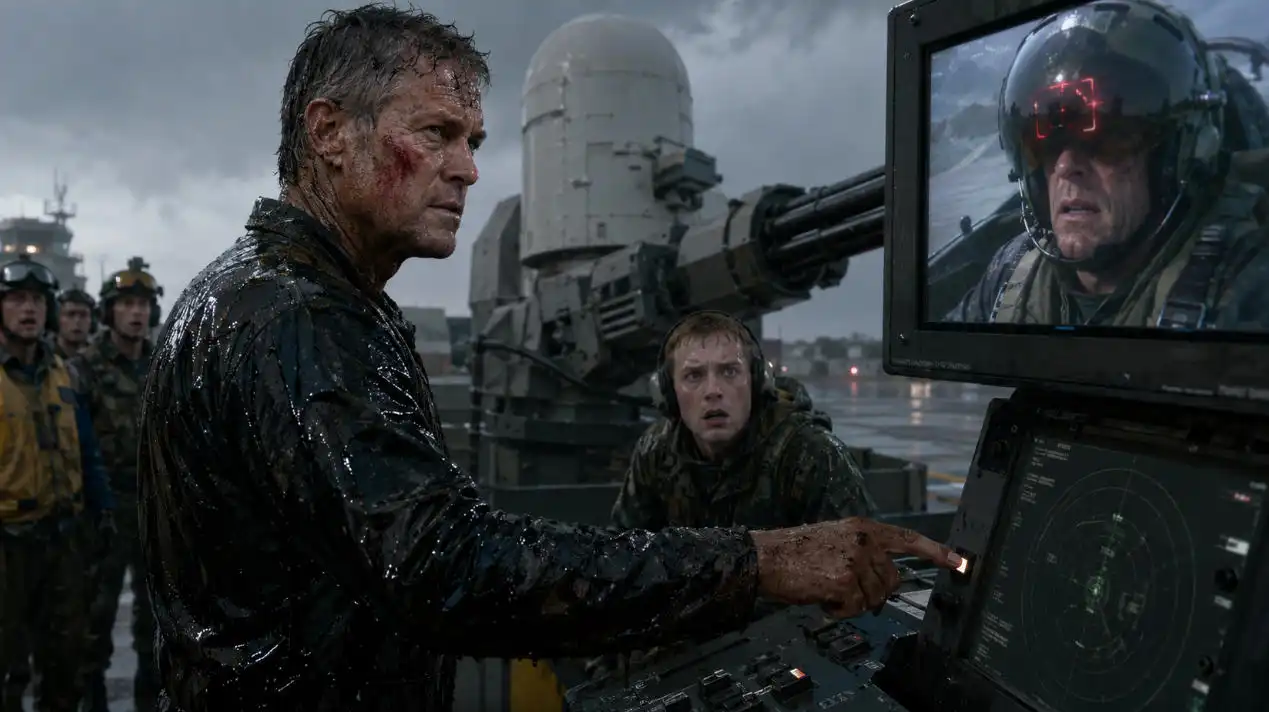
Then the first screen went black.
Then the second.
Then the third.
The drone feed froze.
The digital map disappeared.
A thin alarm tone chirped once and died.
The comms soldier’s face drained.
“Sir… we just lost the fire-control network.”
Dallas blinked.
“What do you mean lost?”
“Electronic warfare hit the range net. It’s all down.”
Dallas grabbed the headset.
“Battery control, respond.”
Static.
“Battery control, respond!”
More static.
Outside, the gun crews stood beside their cannons with no coordinates.
The exercise clock kept running.
The simulated enemy command post was supposed to be located and struck before it “launched” against the camp.
That was the whole test.
Detection.
Adaptation.
Command under pressure.
Dallas had built his career on systems.
But when the systems failed, he had nothing in his hands.
Colin did.
A pencil.
A compass.
A grease-marked map.
And a thumb.
Dallas turned toward him.
For the first time all morning, he wasn’t smirking.
Colin wiped ink from one eye with his sleeve.
Then he stepped to the observation slit.
He studied the ridgeline.
A dust plume.
A flicker of reflected glass.
A patch of brush that didn’t match the wind.
He lifted his thumb.
Closed one eye.
Opened it.
Checked the compass.
Marked once on the map.
Then again.
The entire tent watched.
Ten seconds.
Maybe less.
Colin picked up the backup handset connected to the field line.
“Gun line, this is Observation Post Two.”
A crackle answered.
The old copper field line still worked.
The comms soldier stared at it like it was a miracle.
Colin continued.
“Manual fire mission. Training target. Command post marker. Stand by.”
Dallas whispered, “You can’t clear that.”
Colin didn’t look at him.
“I can.”
Dallas reached for the handset.
Colin moved it away just enough.
Not aggressive.
Not dramatic.
Just final.
“The battalion still needs a commander,” Colin said quietly. “Act like one or step aside.”
Nobody laughed then.
Dallas looked around for support.
He found none.
Only young soldiers watching him with the same thought on their faces:
You slapped the only man who still knows how to fight.
Colin gave the correction.
Not numbers anyone needed to remember.
Not a trick.
Just old-school artillery judgment built from decades of mud, smoke, wind, and pressure.
The gun chief repeated it back.
Colin listened.
Corrected one word.
Then said:
“Send it.”
The cannon fired.
The whole ridge shook.
Seconds passed.
The sound rolled over the training valley.
Everyone turned toward the impact zone.
A white burst rose exactly beside the simulated command-post marker.
Not near.
Not close enough.
Dead center.
The evaluator on the far ridge raised a green flag.
Then another.
Then the regional commander lowered his binoculars.
He clapped once.
Then again.
Then harder.
The sound carried strangely through the quiet after the shot.
One by one, the soldiers in the observation post turned to Dallas.
His face had gone pale.
Colin set the handset down.
Ink still dripped from his chin.
He said nothing.
That was what made it worse.
The investigation started that afternoon.
Not because Colin demanded it.
He didn’t.
Not because the young soldiers complained.
They were too scared.
It started because the regional commander had seen the slap through binoculars.
And because the observation post camera had recorded everything.
The ink.
The insult.
The public humiliation.
The moment Dallas ignored the backup protocol.
The moment he mocked manual calculations in a training exercise specifically designed to test network failure.
That was the part Dallas couldn’t explain.
The exercise wasn’t just a fire-control demonstration.
It was a resilience test.
The regional command wanted to know whether battalion leaders could keep fighting when electronic warfare took away their screens.
Dallas had been briefed.
He had signed the readiness memo.
He had ordered his staff to remove manual plotting boards from the primary tent because, in his words, “they made the unit look outdated.”
Colin had brought his own notebook anyway.
That notebook saved the evaluation.
And Dallas’s arrogance buried him.
At the formal review, Dallas tried to spin it.
He stood in front of three senior officers and said, “I was maintaining discipline.”
The regional commander placed a printed still from the observation camera on the table.
It showed Dallas pouring ink on Colin.
Then another still.
The slap.
Then another.
Dallas laughing while the comms soldier begged for help.
The room went quiet.
The commander asked one question.
“Do you believe humiliating a veteran observer improves combat readiness?”
Dallas opened his mouth.
Closed it.
No answer came.
Colin sat at the end of the table.
Clean uniform now.
Cheek still bruised.
Hands folded.
The regional commander turned to him.
“Mr. Colin, how long did you serve as a forward observer?”
Colin answered, “Thirty-four years, sir.”
“How many live-fire exercises?”
“I stopped counting after eight hundred.”
“How many times did you lose digital support?”
Colin paused.
“Enough to never trust it alone.”
That sentence ended Dallas’s command career.
He wasn’t court-martialed.
He wasn’t dragged away.
Real consequences don’t always look loud.
Sometimes they look like a signed order.
Dallas was relieved from command pending administrative review.
His promotion packet was pulled.
His evaluation cited failure of leadership, public misconduct, and disregard for redundant fire-control procedure.
By Monday, he was reassigned to a logistics yard.
His new job was inventory.
Not strategy.
Not command.
Not speeches.
He counted shell casings.
Crates.
Empty tubes.
Serial numbers.
The same young soldiers who once snapped to attention for him now watched him walk past with a clipboard and no command patch.
Nobody mocked him.
They didn’t have to.
The silence did enough.
As for Colin, he expected nothing.
That was his way.
He cleaned his compass.
Rewrote the stained page in his notebook.
Packed his pencil.
And prepared to leave the training camp before sunrise.
But the regional commander met him outside the barracks.
No crowd.
No cameras.
Just the cold morning air and a folded set of orders.
Colin looked at the paper.
Then at the commander.
“What’s this?”
The commander smiled.
“A correction.”
Colin opened it.
Temporary appointment first.
Then permanent review.
District Artillery Fire Coordination Lead.
Full authority over manual-fire readiness, observer training, and network-failure doctrine.
The old man read it twice.
His eyes didn’t fill with tears.
Not quite.
But his thumb brushed the edge of the paper like it weighed more than it did.
The commander said, “We forgot that tools don’t make judgment. People do.”
Colin looked toward the gun line.
Young soldiers were already setting up manual plotting boards beside the computers.
Not instead of them.
Beside them.
That mattered.
A week later, every battery in the district had to pass Colin’s test.
Screens on.
Screens off.
Radios jammed.
Field lines restored.
Compass checks.
Map checks.
Mental math drills.
At first, the young gunners groaned.
Then they got faster.
Then they got proud.
One private asked Colin, “Sir, what do we call this method?”
Colin smiled for the first time in days.
“Insurance.”
The story spread across the camp.
Not because Colin bragged.
He never did.
It spread because every soldier there had seen the same lesson:
A man with rank can embarrass you.
A man with discipline can outlast him.
And a man who knows his craft doesn’t need to shout when the truth finally fires.
Months later, Dallas was still in logistics.
Colin was standing before a full class of new artillery officers.
On the table in front of him sat a laptop.
A range tablet.
A digital fire-control unit.
And one old brass compass.
He pointed to the modern gear first.
“Use every tool you’re given.”
Then he picked up the compass.
“But never become helpless without it.”
Nobody laughed.
Nobody looked away.
They wrote it down.
Because the old man Dallas called obsolete had become the standard everyone else was measured against.
And somewhere in the back of the room, a young comms soldier who had once watched ink drip down Colin’s face stood a little straighter.
He knew the truth.
Everybody did.
Dallas tried to bury an old soldier’s dignity in public.
But Colin didn’t need revenge.
He had something better.
Competence.
Witnesses.
Rules.
And the patience to let all three speak at once. 🇺🇸
Dallas deserved to lose command. Colin deserved the promotion. Share this if you believe respect is earned by character, not rank.
Disclaimer: Mention of any brand or trademark is for identification only and does not imply partnership or endorsement
A Retired Nurse Was SHOVED At A Luxury Cruise Gate By A Snobby Purser… But They Had NO IDEA Who She Really Was 🚢
A Paint-Stained ART TEACHER Was Humiliated at a VIP Museum Preview by an Elite Critic… But He Had NO IDEA Who She Really Was 😳
A PLUS-SIZE Grocery Cashier Was Dragged Across A Private Island Beach By A Snobby Resort Manager… But He Had NO IDEA Who She Really Was 😳