
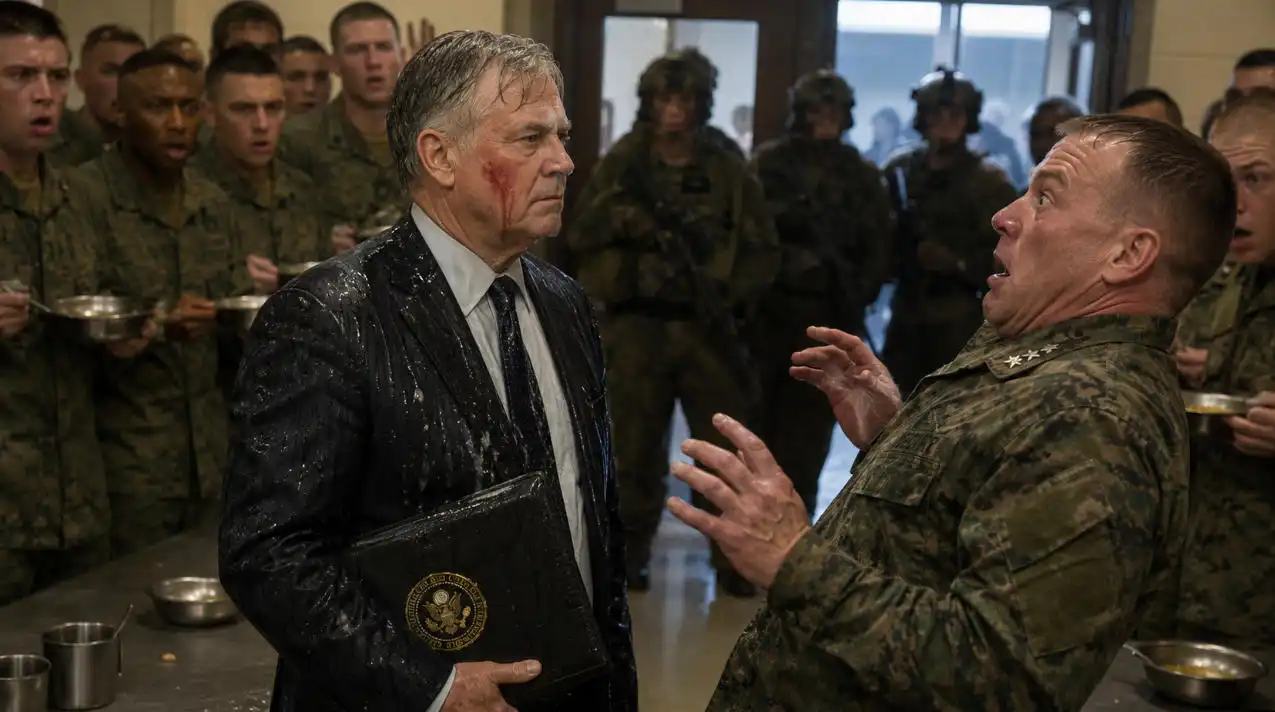
The chow hall doors burst open so hard the metal handles slammed into the cinderblock walls.
Every recruit froze with a bowl of watery soup in his hands.
Commander Walker still had his palm half-raised from slapping me.
And outside the windows, the training yard was shaking under the blades of three Black Hawk helicopters.
For three seconds, nobody breathed.
Then a voice cut through the room.
“Colonel Everett Walker. Step away from the investigator.”
Walker turned slowly.
His face was still smug.
But his eyes had started to panic.
Two Defense Department disciplinary agents entered first.
Then four more.
Black tactical vests.
Federal credentials.
No shouting.
No drama.
Just the calm confidence of people who already knew exactly where every document, every account, every signature, and every lie had been hidden.
Walker looked at them like they were trespassing in his private kingdom.
“This is a restricted military training installation,” he snapped. “Who authorized this?”
I wiped dirty water from my chin.
Then I opened the black leather folder.
The gold seal caught the fluorescent light.
United States Senate.
The recruits saw it before Walker did.
One private whispered, “Oh my God.”
Walker’s mouth opened.
Nothing came out.
I said quietly, “Congress did.”
The room went dead silent again.
That was the moment he understood.
Not everything wearing cheap shoes is powerless.
Not every man with a clipboard is asking permission.
And not every hungry soldier stays hungry forever.
My name is Brian Harlan.
For most of that morning, Walker believed I was a low-level contract auditor from a regional office.
That was the point.
I had arrived before sunrise in a faded government sedan, not a motorcade.
I wore a plain gray suit.
No medals.
No entourage.
No military escort.
Just a clipboard, a temporary badge, and a calm face.
To men like Walker, that made me invisible.
Invisible people hear more.
They see more.
And on a base like Fort Redding, invisible people were exactly what the recruits needed.
Fort Redding was supposed to be a proud place.
Young men and women arrived there to become soldiers.
They came from farms, trailer parks, suburbs, cities, church families, military families, broken homes, and homes that had given everything just to buy one bus ticket.
They came in nervous.
They came in hopeful.
They came in believing the Army would be hard but fair.
Hard was expected.
Hungry was not.
By my second hour on base, I had seen enough to turn my stomach.
Recruits ate soup so thin you could see the bottom of the bowl.
Breakfast had been half a biscuit and powdered eggs cut with too much water.
The fresh fruit listed on the meal plan had never reached the serving line.
The protein supplements billed for field training did not exist.
The winter socks marked “distributed” were still in crates, locked in a storage unit behind the motor pool.
And the monthly training stipends?
Delayed.
Reduced.
Misclassified.
Redirected.
That was the polite word.
Redirected.
The real word was stolen.
The first recruit I spoke to was a nineteen-year-old from Oklahoma named Private Ellis.
He had cheekbones sharp enough to tell me he had lost weight.
He stood at attention even while holding a plastic tray.
“Sir, are we in trouble for talking?”
I said, “No.”
His eyes moved toward the commander’s table.
“That’s what they said last time.”
“Who?”
He swallowed.
“Supply office. Sergeant Pike. He said anybody complaining about meals would be marked as having attitude problems.”
I asked, “Were you marked?”
Ellis did not answer.
He didn’t have to.
A second recruit stepped closer.
Private Moreno.
Twenty-two.
Former grocery store night manager.
She spoke in a low voice.
“My stipend got docked for missing equipment.”
“What equipment?”
“A cold-weather kit I never received.”
Another recruit said, “Same.”
Then another.
Then five more.
They were scared.
Not of combat.
Not of training.
Not of discipline.
They were scared of being labeled weak by the very officers stealing from them.
That kind of corruption is special.
It does not just take money.
It teaches honest people to feel ashamed for asking where their money went.
At 0900, I requested meal invoices from the base logistics office.
The clerk turned pale.
“Sir, you’ll need Commander Walker’s approval.”
“I have authorization.”
She looked behind me.
“Not here you don’t.”
That was the first sign of Walker’s kingdom.
At Fort Redding, nothing moved unless Walker allowed it.
Vendors knew it.
Quartermasters knew it.
Cooks knew it.
Even the chaplain knew it.
By 1000, I had found the second sign.
The food service contract billed the government for fresh produce, whole milk, high-protein meals, hydration packs, vitamin supplements, and extra rations during field weeks.
The recruits received watery soup.
The difference did not vanish.
Money never vanishes.
It travels.
In this case, it traveled into shell vendors, fake transportation fees, emergency procurement charges, and a “family readiness support fund” that had somehow paid for private school tuition, a lake house renovation, two luxury watches, and one hunting trip in Montana.
Walker was not just greedy.
He was organized.
He had help.
The base finance captain signed off on false disbursement codes.
The senior supply officer certified deliveries that never arrived.
A civilian vendor submitted inflated invoices every Thursday.
A kitchen supervisor watered down meals after the real supplies were quietly rerouted.
And Walker stood above it all, smiling in pressed uniforms, giving speeches about sacrifice.
Men like him love that word.
Sacrifice.
They usually mean yours.
Not theirs.
By noon, Walker finally noticed me.
I was in the chow hall, watching lunch service.
A hundred recruits shuffled through the line.
Their boots were dusty.
Their shoulders were tired.
Their faces were too young for how defeated they looked.
The kitchen workers ladled gray broth into bowls.
A recruit asked, “Any bread today?”
The cook looked away.
“No.”
That was when Walker entered.
He didn’t walk like a commander.
He walked like a landlord inspecting tenants who were late on rent.
Behind him came Sergeant Pike and Captain Ross from logistics.
Both looked amused.
Pike had a round red face and the grin of a man who enjoyed being feared by people beneath him.
Ross wore expensive cologne strong enough to smell over boiled cabbage.
Walker stopped in the center of the room.
He clapped his hands once.
“All right, ladies and gentlemen. Eat fast. Train hard. Complaining burns calories too.”
A few supply staff laughed.
The recruits did not.
Walker saw me near the serving line.
His eyes narrowed.
“You.”
I turned.
“Yes?”
“You the paperwork man?”
“I’m reviewing food contracts and training stipend records.”
He smiled.
Not friendly.
Not curious.
Predatory.
“On whose authority?”
I held up my temporary badge.
He barely looked at it.
“That says visitor.”
“It also says federal review.”
Walker stepped closer.
The chow hall quieted.
He liked that.
Some men need a room to go silent before they feel tall.
“What’s your name?”
“Brian.”
“Brian what?”
“Harlan.”
“Mr. Harlan,” he said, loud enough for every table to hear, “I don’t know what office sent you, but this is a military installation, not some city hall lunchroom. These recruits are not customers. They don’t write Yelp reviews.”
A few nervous chuckles came from the staff table.
I said, “Food quality and stipend allocation are still governed by federal rules.”
Walker tilted his head.
“Federal rules.”
He turned toward the recruits.
“You hear that? Mr. Harlan here thinks he’s going to save you with federal rules.”
Nobody moved.
Walker picked up Private Ellis’s bowl.
He held it high.
Broth sloshed over the rim.
“Looks like food to me.”
Ellis stared straight ahead.
Walker leaned toward him.
“You hungry, Private?”
“Yes, sir.”
“You eating?”
“Yes, sir.”
“Then what’s the problem?”
Ellis’s jaw tightened.
“No problem, sir.”
Walker smiled.
“That’s what I thought.”
I wrote one sentence on my clipboard.
Walker saw the pen move.
His smile disappeared.
“What did you write?”
“Observation.”
“I asked what you wrote.”
“I documented a command response to a food-quality complaint.”
Pike laughed.
“Oh, he’s documenting us.”
Walker stepped close enough that I could smell coffee on his breath.
“Let me explain something to you, Brian. These kids are being trained for war. Hunger builds toughness. Discomfort builds grit. Men like you soften institutions until they collapse.”
I looked at the recruits.
A few were staring at their bowls.
One young woman had tears in her eyes and was furious at herself for it.
I said, “Missing money does not build grit.”
The entire room felt the sentence land.
Walker’s face hardened.
“What did you say?”
“I said missing money does not build grit.”
Captain Ross whispered, “Sir…”
Walker lifted one hand to silence him.
Then he smiled again.
It was uglier this time.
“You come into my house,” he said, “and accuse me in front of my soldiers?”
“Your soldiers?”
That was the line he hated most.
His nostrils flared.
“My base. My command. My standards.”
I closed the folder in my hand.
“That answers several questions.”
Walker’s cheeks turned red.
He looked toward the kitchen door and saw a gray mop bucket beside it.
Then he did something that told me everything I needed to know about him.
Not because it hurt me.
Because he did it in front of the recruits.
He walked to the bucket, lifted the metal pitcher floating inside it, and carried it back slowly.
He wanted everyone to see.
He wanted them to understand what happened to people who questioned him.
Pike grinned.
Ross looked uncomfortable, but not enough to stop him.
Walker stood in front of me.
“Here’s your observation.”
Then he dumped the dirty water over my head.
Cold filth ran down my face, into my collar, over my suit.
The room gasped.
One bowl hit the floor.
A recruit jumped up.
I raised one hand.
“Sit down.”
The recruit froze.
Walker laughed.
“Good. Even your little hero knows his place.”
I wiped my eyes.
“I know exactly where I am.”
He stepped closer.
“You are on my base.”
Then he slapped me.
Hard.
The sound cracked off the walls.
For a moment, I tasted blood.
The recruits surged.
Benches scraped.
Pike reached for his sidearm.
I lifted my hand again.
“Everyone stay seated.”
Walker smirked.
“Smart man.”
No.
Not smart.
Patient.
There is a difference.
For six months, my office had been receiving pieces of Fort Redding.
Not formal complaints at first.
Pieces.
A mother in Ohio sent a photo of her son’s meal tray.
A retired sergeant in Texas forwarded a message from his niece saying recruits were buying protein bars with borrowed money.
A chaplain mailed a handwritten note with no return address.
A vendor’s assistant sent copies of invoices that did not match delivery logs.
Then a recruit collapsed during field training.
The official explanation was dehydration.
The medical report told a different story.
Low caloric intake.
Electrolyte imbalance.
Unexplained weight loss.
After that, the Senate Armed Services oversight subcommittee authorized an independent inquiry.
Not a routine review.
A full inquiry.
My title is not printed on my cheap visitor badge.
It does not fit.
Independent Chief Inspector for Congressional Military Oversight.
That means I do not report to Walker.
I do not report to his regional command friends.
I do not report to the men who golf with him.
When Congress signs an emergency military welfare inspection order, the chain of command stops being a hiding place.
Walker did not know that.
He also did not know that the helicopters had already lifted off before he slapped me.
The disciplinary team had been waiting three miles out.
The inspectors had already secured the vendor office.
Federal financial agents had frozen the shell accounts at 11:58.
Base communications had been mirrored.
The warehouse doors had been sealed.
The family readiness fund had been locked.
And every recruit stipend file had already been copied.
Walker thought the slap was the beginning of my humiliation.
It was actually the final signature on his.
I opened the black leather folder.
The Senate gold seal shone under the chow hall lights.
Walker blinked at it.
Once.
Twice.
Then he whispered, “What is that?”
I said, “The authority you asked for.”
The first Defense Department agent reached us.
A tall woman with silver hair tucked under her helmet.
Director Mae Collins.
Her voice was calm.
“Colonel Walker, you are relieved of command pending federal criminal investigation.”
Walker’s face went purple.
“You can’t do that in my chow hall.”
Collins said, “This is not your chow hall.”
That sentence broke something in him.
He looked around as if expecting someone to step in.
Pike looked at the floor.
Ross backed away.
The cooks stared.
The recruits watched with a kind of silence I will never forget.
It was not joy yet.
They were too stunned for joy.
It was the silence of people seeing a bully bleed for the first time.
Walker straightened.
“I demand to call General Haskins.”
Collins nodded to an agent.
“General Haskins has already been notified.”
Walker’s confidence flickered back.
“Good.”
Collins looked him directly in the eye.
“He has been suspended from procurement oversight pending review of communications between his office and yours.”
Walker stopped breathing for half a second.
There it was.
The collapsed roof.
Every corrupt man believes he has a roof over his head.
A friend.
A sponsor.
A superior who owes him.
A political donor.
A family connection.
Walker had all of those.
By 12:04, he had none.
Captain Ross tried to slip toward the side exit.
A second agent stepped in front of him.
“Captain Daniel Ross?”
Ross raised both hands.
“I just process what I’m given.”
Director Collins said, “Your signature appears on seventeen false delivery certifications.”
Ross said, “I was ordered.”
Walker snapped, “Shut your mouth.”
That was when Sergeant Pike made his mistake.
He pointed at the recruits.
“These kids are lying. They exaggerate. They complain about everything.”
Private Moreno stood up.
Her hands were shaking.
But her voice was clear.
“No, Sergeant. We kept the photos.”
Pike turned slowly.
“What?”
Another recruit stood.
“We kept meal logs.”
Another lifted his phone.
“We recorded the stipend deductions.”
Private Ellis reached into his pocket and unfolded a receipt.
“My family sent me money for food. I kept every purchase.”
One by one, recruits stood.
Not all.
But enough.
Enough to show Walker he had never been feared as much as he thought.
He had only been endured.
I looked at them and said, “Place all evidence with Agent Lewis by the west wall. Nobody will be punished for truthful cooperation.”
That was when the chow hall changed.
Recruits moved.
Quietly at first.
Then with purpose.
Phones.
Receipts.
Photos.
Meal schedules.
Messages from parents.
Screenshots.
One recruit had taken pictures of crates being loaded into a private truck after midnight.
Another had recorded Pike laughing about “ghost deliveries.”
A kitchen worker finally stepped forward, crying.
“I watered the soup because Sergeant Pike told me to stretch the meals. He said if I didn’t, my husband’s contract would be cut.”
Walker shouted, “That’s a lie!”
She flinched.
Then she looked at me.
I said, “You’re safe.”
She nodded.
And kept talking.
“The meat came in. The fruit came in. The supplements came in. They moved half of it out the back.”
Director Collins asked, “Where?”
The kitchen worker pointed.
“Storage bay three. But the good stuff goes to a refrigerated truck every Thursday.”
Collins turned to an agent.
“Secure storage bay three.”
Walker laughed suddenly.
It was a desperate sound.
“You people think you understand logistics? Supplies get shifted. Budgets get corrected. Spoilage happens.”
I said, “Spoilage bought your lake house?”
His mouth snapped shut.
There are moments when a guilty man realizes the room knows more than he does.
Walker had reached his.
I pulled a second packet from the folder.
“Emergency procurement invoice, March 14. Ten thousand pounds of fresh chicken billed to recruit meal service.”
I turned a page.
“Delivery photo shows four pallets entering the base.”
Another page.
“GPS from the vendor truck shows a two-hour stop at a private catering warehouse owned by your brother-in-law.”
Walker whispered, “That’s not—”
“Bank records show payment from that warehouse to a limited liability company registered to your wife.”
His face drained.
The recruits murmured.
I continued.
“Training stipend deductions coded as equipment loss were transferred into a discretionary welfare account. That account paid private academy tuition under the name of your daughter.”
Walker lunged half a step forward.
“Leave my family out of this.”
Director Collins moved between us.
I looked at him.
“You brought your family into this when you used recruits’ money to pay their bills.”
That sentence landed harder than the slap.
Because everyone understood it.
The recruits understood it.
The cooks understood it.
Even Pike understood it.
Walker had not stolen from a system.
He had stolen from nineteen-year-olds writing home pretending everything was fine.
He had stolen from families who already had too little.
He had stolen from parents who mailed protein powder because their sons were hungry on an American military base.
Then he called it toughness.
Director Collins gave the order.
“Remove his insignia.”
Walker recoiled.
“You will not touch my uniform.”
Two military police officers stepped forward.
He tried to pull away.
Not violently.
Not bravely.
Just with the panic of a man whose costume was being taken off.
The first officer removed his command badge.
The second removed his shoulder insignia.
The metal pins looked small in their gloved hands.
Walker stared at them like they had taken his skin.
The chow hall watched.
Nobody cheered.
Not yet.
This was too serious for cheering.
Captain Ross began crying before anyone touched him.
“I’ll cooperate,” he said. “I’ll cooperate.”
Pike cursed under his breath.
Director Collins turned to him.
“Sergeant Pike, you are relieved from duty pending charges of conspiracy, intimidation of witnesses, and falsification of supply records.”
Pike looked at the recruits.
“You little rats.”
Private Moreno stepped forward.
Not close.
Just enough.
“No, Sergeant. Soldiers.”
The room finally reacted.
A low sound moved through the tables.
Not a cheer.
Something deeper.
Recognition.
The kind of sound people make when someone says the word they needed.
Soldiers.
Not rats.
Not complainers.
Not weak.
Soldiers.
Walker’s hands were restrained in front of him.
He looked at me one last time.
“You set me up.”
I wiped the last dirty water from my sleeve.
“No. You were given six months to feed your recruits and pay them what they were owed.”
He said nothing.
I added, “You set yourself up.”
Outside, agents were moving across the base.
The raid did not stop at the chow hall.
Storage bay three was opened.
Inside were the missing supplies.
Not all of them.
Enough.
Cases of protein drinks.
Sealed boxes of winter gear.
Pallets of canned fruit.
Medical electrolyte packets.
Training boots.
Cold-weather socks.
Field rations.
All marked as distributed.
All untouched.
In the logistics office, investigators found two sets of books.
One for auditors.
One real.
In the commander’s office, they found handwritten notes listing which complaints to suppress and which recruits to “discipline for attitude.”
In Captain Ross’s desk, they found vendor kickback schedules.
In Sergeant Pike’s phone, they found messages mocking recruits who asked for food.
One text read:
“Water it down. They’ll eat what we give them.”
That line later became evidence.
But in that moment, it became a wound.
When I read it, I had to put the phone down.
I have seen fraud before.
I have seen arrogance.
I have seen officers who forgot that rank is responsibility, not ownership.
But there is something uniquely rotten about starving people who cannot walk away.
By 1500, Walker and four members of his inner circle were removed from Fort Redding.
By 1700, emergency food service contractors arrived under federal supervision.
By dinner, the recruits smelled roasted chicken before they saw it.
Nobody trusted it at first.
They walked into the chow hall slowly, still expecting the trick.
The serving line had changed.
Real vegetables.
Fresh bread.
Milk.
Fruit.
Hot rice.
Chicken.
Soup that looked like soup.
A young recruit near the front whispered, “Is this allowed?”
The cook smiled through tears.
“It always was.”
Private Ellis stood there holding his tray.
He did not move.
I asked, “You all right?”
He nodded too fast.
“Yes, sir.”
But his eyes were wet.
“My mom kept asking if I was eating enough,” he said. “I kept telling her yes.”
I put a hand on his shoulder.
“You can call her tonight and tell her the truth.”
He swallowed.
“Yes, sir.”
Private Moreno came up beside him.
“Sir?”
“Yes?”
“Are they really going to give the stipends back?”
“Yes.”
“All of it?”
“All verified improper deductions will be restored. With review for additional damages.”
She looked down at her tray.
Then she laughed once.
Small.
Shaky.
Relieved.
“I can pay my little brother back.”
That was the part Walker never would have understood.
To him, the money was numbers.
Accounts.
Transfers.
A game.
To Moreno, it was her little brother’s paycheck from a tire shop.
To Ellis, it was his mother mailing twenty dollars she could not spare.
To another recruit, it was a fiancée paying bills alone while he trained.
Corruption always pretends to be complicated.
The damage is simple.
Someone goes without.
The legal process took months.
Not days.
Real justice usually does.
Walker was indicted on charges related to conspiracy, fraud, theft of government funds, witness intimidation, and obstruction.
Captain Ross cooperated and confirmed the kickback structure.
Sergeant Pike tried to blame everyone beneath him.
The records blamed him back.
The civilian vendor lost every federal contract.
The shell companies were seized.
The lake house was placed under federal asset restraint.
Luxury accounts were frozen.
Vehicles were taken.
The so-called family readiness fund was reconstructed transaction by transaction.
And yes, verified assets connected to the fraud were frozen, including accounts held by immediate family members where investigators found stolen funds had been moved.
Not because revenge feels good.
Because stolen money does not become clean when you put someone else’s name on it.
Walker’s wife claimed she had no idea.
Maybe that was true.
Maybe it wasn’t.
A court would decide.
But the tuition payments, renovation transfers, and luxury purchases were documented.
Facts do not care how polished the dining room looks.
At the first hearing, Walker entered without the posture he once wore like armor.
No command badge.
No staff.
No recruits forced to stand when he entered.
Just a defendant in a dark suit that fit him worse than his uniform ever had.
Private Moreno testified.
So did Ellis.
So did the kitchen worker.
The hardest testimony came from a recruit’s mother.
She held up a photo of the meal her son had sent her.
A bowl of gray broth.
She said, “My boy told me not to worry. I worried anyway.”
The courtroom stayed silent.
Walker looked down.
For the first time, he seemed smaller than the people he had tried to break.
Fort Redding changed too.
Not overnight in every way.
Institutions are like old houses.
You can remove the rotten beam, but you still have to inspect the walls.
Congress ordered a wider review of recruit welfare spending.
Meal contracts were moved to direct oversight.
Stipend deductions required dual verification.
Anonymous reporting lines were placed in every barracks.
No commander could block them.
Quarterly food inspections became mandatory.
And every recruit received a written explanation of their pay, deductions, equipment charges, and appeal rights.
Simple things.
Basic things.
The kind of things honest leaders do without being forced.
Six weeks after the raid, I returned to Fort Redding.
This time, I did not come in a faded sedan.
I came for a formal oversight visit.
The new acting commander met me at the gate.
She was a colonel named Harris.
No swagger.
No theater.
She shook my hand and said, “Sir, the recruits are waiting in the chow hall.”
I almost smiled.
“Should I be nervous?”
She said, “Only if you skipped lunch.”
The chow hall looked different.
Not fancy.
It was still a training camp.
Cinderblock walls.
Metal tables.
Boot noise.
Shouted orders outside.
But the air had changed.
Food does not fix everything.
Respect does.
The recruits stood when I entered.
I said immediately, “Sit down. Eat.”
They did.
That made me happier than any salute.
Private Ellis had gained weight.
Private Moreno looked stronger.
The kitchen worker who had testified was now the supervised food service manager.
She ran the line like a woman who knew exactly what rules were for.
A tray was handed to me.
Chicken.
Rice.
Green beans.
A roll.
An apple.
I looked at it longer than I meant to.
Colonel Harris said softly, “Standard menu now.”
I nodded.
“Good.”
Private Moreno walked over with two other recruits.
She held a folded note.
“We wrote this for your office.”
I took it.
On the outside, it said:
For whoever reads the next complaint.
Inside were signatures.
Dozens of them.
Under the signatures was one sentence.
Believe the quiet ones sooner.
I had to look away for a moment.
Not because I am sentimental.
Because they were right.
We should have reached them sooner.
Every oversight officer tells himself the system works.
Most days, it does.
But systems are made of people.
And when people get scared, tired, arrogant, or greedy, someone has to check the locked doors.
Someone has to read the small invoices.
Someone has to listen when a nineteen-year-old says, “Sir, are we in trouble for talking?”
That afternoon, before I left, Ellis asked me one question.
“Sir, did you know he was going to hit you?”
“No.”
“Were you scared?”
I thought about lying.
Then I decided he deserved better.
“Yes.”
He looked surprised.
I said, “Courage is not being unafraid. It’s knowing fear is not in charge.”
He nodded slowly.
Then he said, “That sounds like something my mom would say.”
“Your mom sounds smart.”
“She is.”
“Then call her more.”
He smiled.
“Yes, sir.”
Three months later, Fort Redding’s recruit welfare program received one of the highest compliance ratings in the region.
Not because of me.
Because the recruits spoke.
Because a kitchen worker told the truth.
Because a clerk copied invoices when everyone told her to look away.
Because ordinary people did not confuse rank with righteousness.
Walker’s name became a warning.
Not in official speeches.
In quieter places.
Procurement offices.
Supply rooms.
Command briefings.
Anywhere someone thought about shaving a budget, hiding a delivery, or punishing a complaint.
Someone would say, “Remember Fort Redding.”
And that was enough.
As for the recruits, they finished training.
Ellis graduated with his mother in the front row, crying before his name was even called.
Moreno sent me one photo months later through official channels.
She was in uniform.
Standing straight.
Her little brother beside her.
Both smiling.
The message said:
Paid him back. He said he invested in the Army.
I kept that note.
Not as a trophy.
As a reminder.
A bowl of soup can expose an empire.
A slap can end a kingdom.
And a quiet person with a clipboard can carry the full weight of the law when the truth is on his side. ⚖️
So choose a side.
Share this if you believe leaders who steal from the young people they’re sworn to protect should lose everything the rules allow.
And comment one word:
“JUSTICE” if Walker got what he deserved.
“MERCY” if you think he should have been handled quietly.
Disclaimer: Mention of any brand or trademark is for identification only and does not imply partnership or endorsement
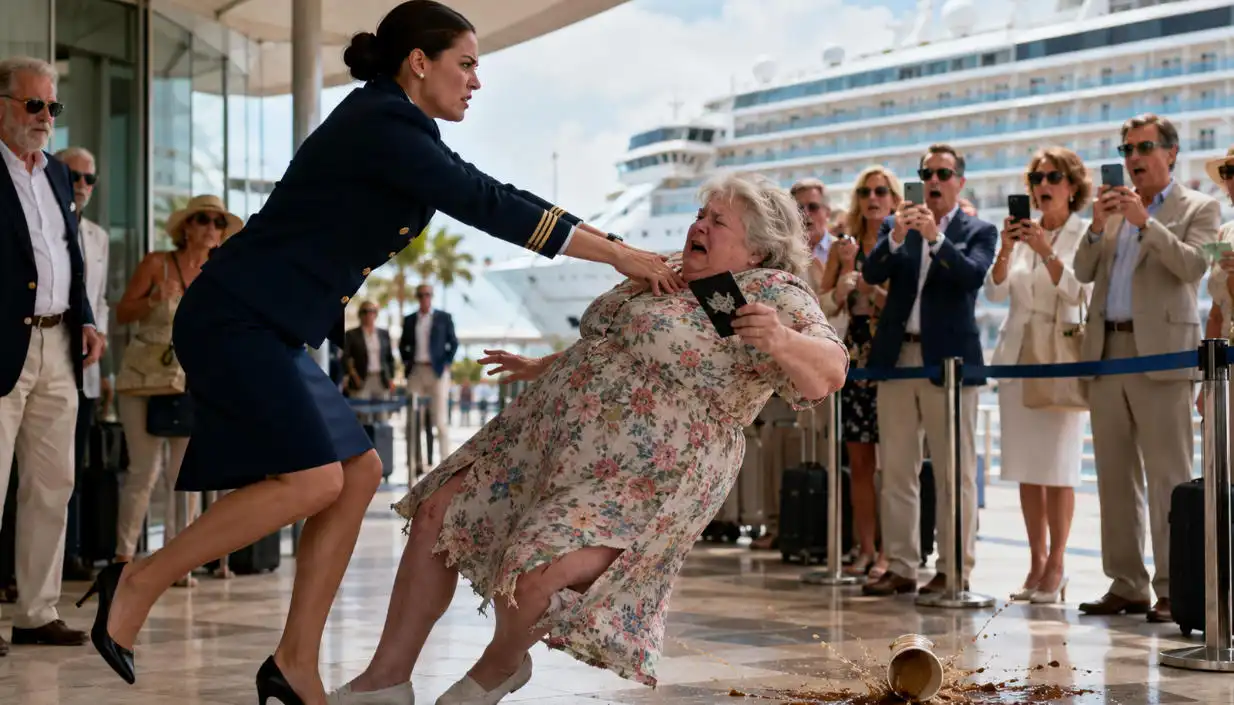
A Retired Nurse Was SHOVED At A Luxury Cruise Gate By A Snobby Purser… But They Had NO IDEA Who She Really Was 🚢

A Paint-Stained ART TEACHER Was Humiliated at a VIP Museum Preview by an Elite Critic… But He Had NO IDEA Who She Really Was 😳

A PLUS-SIZE Grocery Cashier Was Dragged Across A Private Island Beach By A Snobby Resort Manager… But He Had NO IDEA Who She Really Was 😳