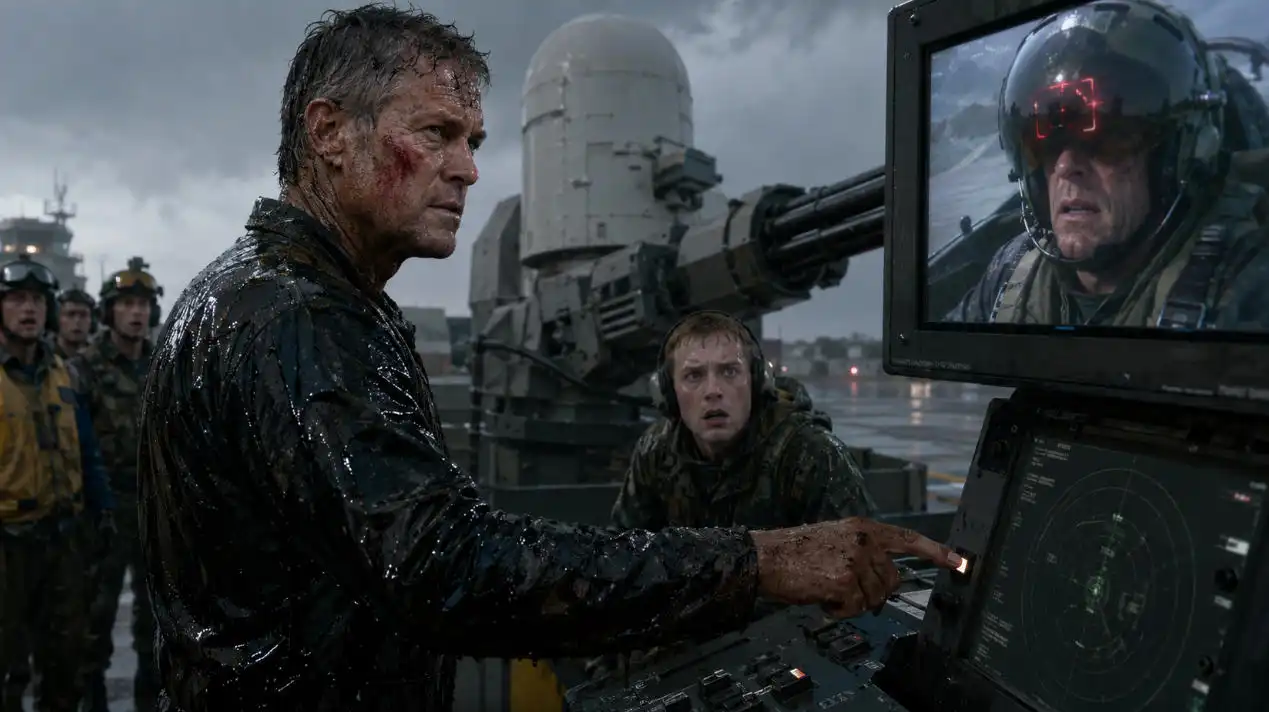

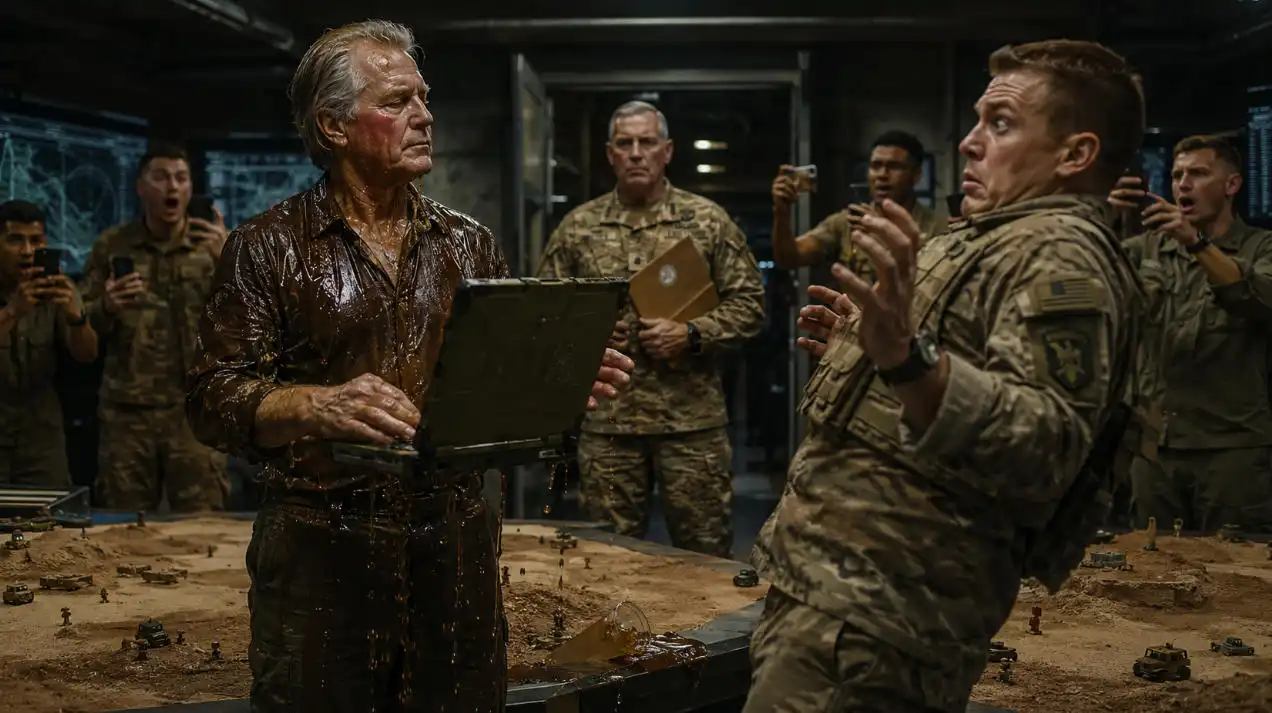
The cup touched Leonard’s hand before anyone dared breathe.
The regional commanding general did not look at Captain Howard first.
He did not ask who had shouted.
He did not ask why there was iced tea dripping from Leonard’s jaw onto the sand table.
He simply poured Leonard a fresh cup, set the kettle down, and said in a calm voice, “Commander Leonard, please continue.”
Captain Howard went white.
The room stayed frozen.
Thirty recruits stood along the walls with their shoulders locked and their eyes wide. Three staff officers hovered near the map board like statues. The projector hummed behind them, paused on a grainy training video of Howard’s lead tank sitting dead in a mock valley, all its internal displays blacked out.
Leonard picked up the cup.
His cheek was red.
His collar was soaked.
But his hand did not shake.
Howard swallowed hard. “General, this is being taken out of context.”
The general finally turned.
“Captain,” he said, “the only thing out of context is your hand on a senior red-team commander’s face.”
Nobody spoke.
Howard’s jaw twitched.
He had spent ten exercises acting like the whole base belonged to him.
He was the kind of officer who walked into a room before his rank did.
He wore polished boots, spoke in parade-ground volume, and treated anyone without armor insignia like furniture.
To the young recruits, he was terrifying.
To the staff, he was exhausting.
To Leonard, he had been predictable.
That was the part Howard never understood.
Leonard was not loud.
He did not raise his voice.
He did not brag.
He was a fifty-eight-year-old electronic warfare specialist with silver hair, a weathered face, and a habit of carrying his own battered laptop under one arm.
To Howard, that made him harmless.
“A paper soldier,” Howard called him.
“A basement analyst.”
“A man who wins wars only on screens.”
The insults started after Howard’s first loss.
Then came the excuses.
A bad map.
Bad visibility.
Bad recruits.
Bad maintenance.
A lazy scout team.
Faulty comms.
A weak supply lane.
A bad referee.
A red-team trick.
Every defeat had a reason.
None of those reasons was Howard.
By the tenth defeat, the whole training camp knew the pattern.
Howard would lose.
Howard would shout.
Howard would blame someone beneath him.
Then Leonard would sit quietly at the far end of the table, writing notes.
That morning was supposed to be a routine review.
The recruits filed into the tactical sand-table room with mud still on their boots and defeat still on their faces. They had spent forty-eight hours in the field, only to watch Howard’s armored company collapse again in less than twenty minutes.
Howard entered last.
He tossed his gloves on the table.
The room stiffened.
“Another embarrassment,” he said.
A young lieutenant tried to speak. “Sir, the red team jammed our—”
Howard cut him off.
“No. We are not starting with excuses.”
Leonard looked down at his notebook.
Howard noticed.
That was enough.
“You find this funny?”
Leonard did not answer.
Howard stepped closer.
“You always sit there like you know better.”
Leonard closed the notebook.
“I know what the data shows.”
“The data?” Howard laughed. “You hear that, gentlemen? The data.”
A few nervous officers looked away.
Howard picked up the glass pitcher of iced tea from the side table.
It was meant for the staff.
He held it over Leonard’s head.
“You want data?”
Leonard looked up.
“Captain, don’t.”
Howard poured.
Cold tea ran over Leonard’s hair, down his face, into his collar, and onto the floor.
A recruit gasped.
Howard leaned in.
“That is what the field does to theory.”
Then he slapped Leonard.
The sound cracked across the room.
A few recruits flinched.
Someone’s phone lifted instinctively, then dropped again when an officer glared.
Howard’s voice dropped low and ugly.
“You made my company look incompetent.”
Leonard slowly removed his glasses.
He wiped them with the edge of his soaked shirt.
Then he said, “No, Captain.”
Howard sneered. “No?”
Leonard put the glasses back on.
“I documented it.”
That was when he opened the laptop.
Howard thought it was another report.
Another chart.
Another clean little explanation from a man he believed had never been close enough to fear to understand command.
But Leonard did not open a slideshow.
He opened the restricted training archive.
Two passwords.
One biometric key.
One command authorization file already loaded.
The projector came alive.
Exercise One.
Howard’s tanks rolled across a desert training lane in perfect formation. His voice came through the internal command audio, bold and certain.
“Push forward. Red team’s blind.”
Then the lead tank’s navigation display flickered.
The radio filled with static.
The turret control lagged.
One by one, the vehicles stopped communicating.
Howard’s recorded voice sharpened.
“Who lost the net?”
Leonard paused the footage.
He turned to the room.
“After this exercise, Captain Howard blamed the signal platoon.”
A signal sergeant in the back lowered his eyes.
Leonard clicked again.
Exercise Two.
Forest terrain.
Howard changed formation.
The red team changed frequency.
A portable electromagnetic interference unit hidden in a drainage culvert disrupted the convoy’s timing. Howard’s second tank drifted too far right. The rear element halted. The mock enemy walked around them.
Leonard paused it.
“After this, Captain Howard blamed the recruits.”
Several young soldiers looked at Howard.
Howard opened his mouth, then closed it.
Leonard clicked again.
Exercise Three.
Urban lane.
Howard ordered a fast breach.
His digital maps froze.
His backup channel was already saturated.
His company took the wrong road into a simulated kill box.
Leonard paused it.
“After this, Captain Howard blamed the maps.”
Exercise Four.
Night movement.
Exercise Five.
Ridge crossing.
Exercise Six.
Supply convoy.
Exercise Seven.
Counterattack drill.
Exercise Eight.
Live command stress test.
Exercise Nine.
Combined arms coordination.
Exercise Ten.
Yesterday.
Every video told the same story.
Howard did not adapt.
Howard did not listen.
Howard ignored junior officers.
Howard overrode scouts.
Howard treated electronic warfare as an inconvenience instead of a battlefield reality.
And every time his company failed, he found someone else to punish.
By the sixth clip, his face had gone gray.
By the eighth, the staff officers were no longer looking at Leonard.
They were looking at Howard.
By the tenth, even the recruits understood.
This was not bad luck.
This was not a weak company.
This was command failure.
Howard snapped, “Turn it off.”
Leonard kept his hand near the keyboard.
“No.”
Howard stepped forward.
The door opened.
That was when General Marcus Whitaker entered.
Every boot snapped together.
“Attention!”
The general’s uniform looked sharp enough to cut the silence.
Behind him came two inspectors from training command and a major from the legal office carrying a sealed folder.
Howard tried to recover.
“General, I was conducting a corrective debrief.”
Whitaker looked at Leonard’s soaked uniform.
Then at the red mark on his cheek.
Then at the paused footage.
“A corrective debrief?”
Howard lifted his chin.
“Yes, sir. The red-team analysis has repeatedly interfered with unit confidence.”
Leonard almost smiled again.
The general heard it too.
“Interfered with unit confidence,” Whitaker repeated.
He stepped closer to the sand table.
“Captain Howard, do you know why Commander Leonard was assigned to this camp?”
Howard hesitated.
“To advise on electronic warfare.”
“No.”
The word landed hard.
The general took the sealed folder from the major.
“He was assigned here under my authority to evaluate whether our armored training program was preparing officers for modern battlefield conditions.”
Howard blinked.
The room shifted.
Leonard looked down at his tea.
Whitaker continued.
“Not the recruits. Not the signal platoon. Not the scouts. The commanders.”
Howard’s mouth opened slightly.
The general placed the folder on the table.
“For ten exercises, Commander Leonard tested your company with limited red-team assets. In most lanes, he used one operator, one mobile interference kit, and publicly available doctrine adapted for training conditions.”
A murmur ran through the recruits.
One operator.
One kit.
Howard’s entire armored company.
The humiliation was no longer loud.
It was total.
Howard stared at Leonard.
“You were testing me?”
Leonard met his eyes.
“I was giving you chances to learn.”
Howard’s face tightened.
“You never told me.”
“I told you after Exercise One that your formation depended too heavily on uninterrupted digital command.”
Howard said nothing.
“I told you after Exercise Two that your backups were performative, not practiced.”
Still nothing.
“I told you after Exercise Three that you were punishing subordinates for failures created by your own assumptions.”
A young lieutenant looked up.
Leonard’s voice stayed calm.
“You told me to stay in my lane.”
Someone in the back exhaled.
Howard looked around the room, realizing too late that the people he had bullied had memories.
The general opened the folder.
“Captain Howard, this is not just about losing exercises.”
Howard’s eyes flicked to the folder.
The legal major stepped forward.
Whitaker read from the first page.
“Training Command has reviewed ten after-action reports submitted under your signature.”
Howard’s lips pressed together.
“In seven of them, you materially misrepresented the cause of failure.”
The room went colder.
“In four, you recommended disciplinary actions against personnel who were not responsible.”
A signal sergeant’s head lifted.
“In two, you attempted to suppress red-team attachments that contradicted your written conclusions.”
Howard took one step back.
“That is not accurate.”
Leonard clicked once.
A new folder appeared on the projector.
Emails.
Timestamps.
Report drafts.
Deleted attachment logs.
Howard’s own comments in the margins.
“Remove EW note. Makes command look unprepared.”
“Don’t include Leonard’s appendix.”
“Blame comms delay.”
“Reassign fault to junior crew.”
Nobody moved.
Howard stared at the screen like it had betrayed him.
Leonard said softly, “You should have deleted the server copies too.”
A recruit covered his mouth.
The general did not smile.
“Captain Howard,” he said, “you struck a senior evaluator in a secure debriefing room. You poured liquid on government equipment. You falsified training conclusions. And you retaliated against personnel to protect your reputation.”
Howard’s pride finally cracked.
“Sir, my record—”
“Your record is exactly why this is unacceptable.”
Howard looked toward the staff officers, searching for someone to save him.
No one did.
Because every person in that room had watched him make someone else smaller to keep himself tall.
The legal major handed Whitaker another page.
“Effective immediately, you are relieved of command pending formal review.”
Howard’s shoulders dropped.
“Sir—”
“You will surrender your command access badge.”
Howard touched the badge clipped to his chest.
For the first time all morning, his hand shook.
“Now,” the general said.
Howard unclipped it.
He placed it on the sand table.
The little metal click sounded louder than the slap.
Then Whitaker turned to the room.
“Let this be understood by every officer and recruit here. Modern war does not care about ego. It does not care how loud you shout. It does not care how polished your boots are.”
His eyes moved from face to face.
“It rewards discipline. Adaptation. Humility. And truth.”
Leonard stood quietly beside him, still soaked, still bruised, still holding the tea the general had poured.
Whitaker faced Howard again.
“You will report to the front gate duty officer.”
Howard blinked.
“The front gate?”
“Yes.”
A staff sergeant entered with a placard.
Not the cruel handwritten sign Howard deserved.
A regulation notice board.
Clean.
Official.
Devastating.
RELIEVED OF COMMAND PENDING REVIEW
Under it, in smaller print:
FAILURE TO UPHOLD TRAINING INTEGRITY
Howard stared at it as if the words had struck him back.
He whispered, “You can’t put me out there.”
The general’s voice hardened.
“You had no concern for public humiliation when you slapped Commander Leonard in front of recruits.”
Howard’s face burned.
“You will stand where every soldier who suffered under your false reports can see that the Army corrects its own.”
That was the Legal Hammer.
No screaming.
No revenge beating.
No backroom deal.
Just rules.
Paper.
Witnesses.
Evidence.
And a consequence Howard could not bully his way out of.
Two military police officers escorted him from the room.
The recruits watched.
No one cheered.
That would have been too easy.
They stood silent as Howard passed, because silence was what he had forced on them for months.
Now it belonged to them.
At the door, Howard turned once.
His eyes found Leonard.
For a second, the old arrogance tried to return.
“You set me up.”
Leonard shook his head.
“No, Captain.”
He closed the laptop.
“You kept showing up.”
Howard had no answer.
The door shut behind him.
Only then did the room breathe.
A young private near the wall raised his hand.
Then lowered it, embarrassed.
Leonard noticed.
“Speak.”
The private swallowed.
“Sir… did one man really disable the whole company?”
Leonard looked at the projector.
“No.”
The private frowned.
Leonard picked up a marker and walked to the sand table.
“One man exposed the company’s dependency. The company disabled itself when its commander refused to train for failure.”
The general nodded once.
Leonard wiped a patch of spilled tea from the table and moved a small blue tank marker back to the starting line.
“Lesson one,” he said. “If your screens go black, the battle does not pause.”
The recruits leaned in.
He moved another marker.
“Lesson two. If your radio dies, your plan should still breathe.”
The room changed.
The shame lifted.
Not all at once.
But enough.
The same recruits who had entered with their heads down now watched the map like it mattered again.
Leonard did not lecture like Howard.
He asked questions.
“What would you do if your lead vehicle lost GPS here?”
A corporal answered.
Leonard listened.
“What if your backup channel was compromised?”
A lieutenant spoke.
Leonard corrected him without humiliating him.
“What if your commander was wrong?”
That one hung in the air.
Then a sergeant said, “We tell the truth before the field teaches it harder.”
Leonard pointed at him.
“Exactly.”
General Whitaker stayed for twenty minutes.
Then thirty.
Then an hour.
By the time the debrief ended, the recruits were not defeated anymore.
They were angry in the right direction.
Not at Leonard.
Not at the red team.
At the lies that had kept them weak.
Howard stood at the front gate that afternoon.
The placard hung from a regulation stand beside him.
Soldiers walked past.
Some stared.
Some didn’t.
The signal sergeant whose career Howard had nearly damaged stopped just long enough to read the words.
Howard looked away.
By evening, everyone on base knew.
By morning, the formal review had begun.
The investigation moved fast because Leonard’s evidence was clean.
Every archive had a timestamp.
Every training note had a witness.
Every suppressed attachment had a server record.
Howard’s defenders disappeared once they saw the emails.
His command qualification was permanently revoked.
He was removed from armored leadership.
The false disciplinary recommendations were withdrawn.
The signal platoon received written corrections in their personnel files.
The junior lieutenant Howard had blamed after Exercise Two was restored to good standing.
The recruits heard that part first.
That mattered more than Howard’s fall.
Because justice is not just watching the arrogant lose.
It is watching the innocent get their names back.
One week later, Leonard took over tactical modernization training for the entire camp.
Howard’s old classroom changed immediately.
The posters came down.
The sand table stayed.
The recruits still failed exercises, but now failure had a purpose.
Leonard made them run blind.
He made them navigate without digital maps.
He made officers give orders after losing communications.
He made tank crews practice old hand signals and backup routes.
He made the signal teams train beside armor instead of being blamed after the fact.
He made the proud listen to the quiet.
At first, the camp hated it.
Then they got better.
After thirty days, the first platoon completed a blackout movement drill without breaking formation.
After sixty, the armored company survived a full-spectrum red-team attack for forty minutes.
After ninety, they won.
Not because Leonard made it easy.
Because he stopped letting them lie to themselves.
On the final day of the training cycle, General Whitaker returned.
This time, nobody was soaked.
Nobody was slapped.
Nobody stood over the table pretending volume was leadership.
The recruits gathered in the same room where Howard had tried to break Leonard.
The projector showed a new clip.
The company moving under jamming.
Screens failing.
Radios cracking.
A young lieutenant switching to backup procedures.
A sergeant redirecting the convoy.
A driver spotting the decoy.
A tank crew refusing the obvious trap.
The red team hit them again.
They adjusted.
Again.
They adjusted again.
The room erupted when the final marker crossed the objective line.
Leonard allowed himself one small smile.
General Whitaker stepped beside him.
“Commander Leonard,” he said, “you turned embarrassment into readiness.”
Leonard looked at the recruits.
“No, sir.”
He nodded toward them.
“They did.”
The young private from the first day raised his hand again.
This time he did not lower it.
“Sir,” he said, “permission to ask something?”
Leonard nodded.
The private glanced at the old sand table.
“Why didn’t you defend yourself when Captain Howard slapped you?”
The room went quiet.
Leonard took a long breath.
“Because that slap was never just about me.”
He touched the edge of his laptop.
“It was about every soldier he blamed instead of teaching. Every junior officer he silenced. Every report he changed. Every lesson he buried.”
His eyes moved across the room.
“If I had shouted back, it would have become an argument.”
He looked toward the door where Howard had been escorted out.
“But when the truth spoke, it became a record.”
No one said anything for a moment.
Then the signal sergeant began to clap.
Slowly.
Once.
Twice.
The recruits joined.
Then the officers.
Then the whole room.
Leonard did not bow.
He just stood there, older, soaked no longer, still quiet.
But now everyone knew what Howard had learned too late.
Quiet is not weakness.
A laptop is not a toy.
And the man you dismiss as “paper” may be the one holding the evidence that ends your command.
So pick a side:
Was Leonard too patient…
or was that the cleanest kind of justice?
Share this if you believe leaders should protect their people — not blame them to save their pride. ⚖️
Disclaimer: Mention of any brand or trademark is for identification only and does not imply partnership or endorsement
A Retired Nurse Was SHOVED At A Luxury Cruise Gate By A Snobby Purser… But They Had NO IDEA Who She Really Was 🚢
A Paint-Stained ART TEACHER Was Humiliated at a VIP Museum Preview by an Elite Critic… But He Had NO IDEA Who She Really Was 😳
A PLUS-SIZE Grocery Cashier Was Dragged Across A Private Island Beach By A Snobby Resort Manager… But He Had NO IDEA Who She Really Was 😳