


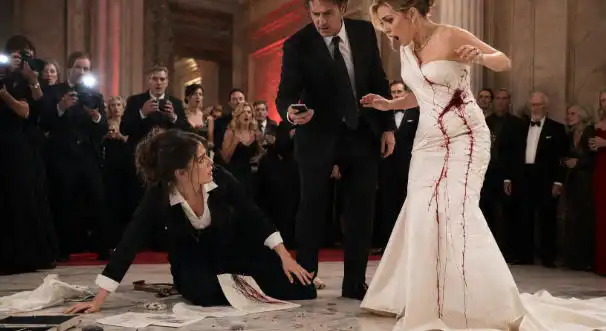
The first seam gave way so quietly that only I noticed.
Celeste was still laughing.
Her manager was still blocking me from the cameras.
And I was still on the marble floor with red wine running down my cheek, pretending I didn’t know exactly what was about to happen.
Because that was the part nobody understood.
I had not come to the Met Gala to beg.
I had come to watch a stolen lie walk under ten thousand lights.
My name is Mara Ellis.
At the time, most people at LaRue Atelier called me “the intern,” even though I had already been sewing since I was nine years old.
My grandmother taught me on an old Singer machine in Pennsylvania.
She used to say, “A garment remembers every hand that touched it.”
I believed her.
That belief made me patient.
Too patient, maybe.
I moved to New York with two suitcases, a folder of sketches, and enough money to survive three months if I ate cheap soup and never got sick.
LaRue Atelier was supposed to be my break.
They dressed actresses, heiresses, singers, women who stepped onto carpets and made the world pause.
I didn’t expect glamour.
I expected work.
I expected long nights, bleeding fingertips, impossible deadlines, and rich people pretending they invented discipline.
I could handle all of that.
What I could not handle was watching someone steal my life one stitch at a time.
Celeste Vane was Hollywood royalty that year.
She had the awards, the perfume campaign, the magazine covers, the soft voice in interviews where she talked about “empowering young women in the arts.”
Behind closed doors, she was something else.
She came into the atelier wearing sunglasses indoors and looked at the staff the way people look at furniture.
Her manager, Grant Lowell, did most of the talking.
He was polished, silver-haired, and always smiling like he had already won the lawsuit in his head.
“The Met look has to be pure,” he said during the first fitting.
“Untouchable. Heavenly. Something people will remember.”
Our creative director nodded.
I stood in the corner holding muslin.
Celeste barely looked at the sketches on the table.
Then her hand stopped on mine.
Not the finished concept.
Mine.
A white architectural gown built around dissolving outer panels.
It was not designed for a red carpet.
It was part of a conservation project I had developed in school — a stage garment made from a special water-soluble fabric blend that could be removed without cutting the inner structure.
The idea was simple.
Museums could display fragile costume layers, then dissolve temporary supports without damaging the preserved base.
It was nerdy.
Technical.
Beautiful, if you knew what you were looking at.
Celeste tapped my sketch with one manicured finger.
“That,” she said.
The room went silent.
My creative director cleared her throat.
“That is Mara’s research sample. It isn’t cleared for wear.”
Grant smiled.
“Everything is cleared if the client wants it.”
I stepped forward before I could stop myself.
“It can’t be exposed to liquids. The outer layer destabilizes with alcohol or water.”
Celeste looked at me for the first time.
“And you are?”
“Mara Ellis,” I said. “I developed the textile treatment.”
Grant laughed lightly.
“Adorable. The intern has a warning label.”
A few people chuckled because powerful people teach rooms when to laugh.
I didn’t.
Celeste tilted her head.
“Can it be made safe?”
“The base can,” I said. “But the outer shell is experimental. It needs documentation. Legal sign-off. Attribution.”
That word changed everything.
Attribution.
The room got colder.
Grant’s smile tightened.
“Mara, is it?”
“Yes.”
“You work under LaRue, correct?”
“I’m an intern contractor, but the design predates my placement. The lab notes are mine.”
Celeste removed her sunglasses.
“Sweetheart, nobody watches the Met Gala to read footnotes.”
That should have been my warning.
Over the next three weeks, my access changed.
Files disappeared from the shared drive.
My supervisor stopped copying me on emails.
A stylist I had trained began presenting my construction solutions as her own.
When I asked questions, people suddenly got busy.
When I pushed harder, Grant called me into a glass conference room.
He did not sit.
Men like Grant enjoyed standing over people.
“Mara,” he said, “you have talent. Don’t ruin it by being difficult.”
“I want my name on the construction credit.”
“You want?”
He repeated the words like they were dirty.
“I designed the fabric behavior. I built the first sample. I have dated files.”
He smiled.
“There are two kinds of people in fashion. The people who get thanked on stage, and the people who should be grateful they were allowed in the building.”
I remember looking past him at the atelier floor.
Women bent over silk.
Assistants running pins.
Young people swallowing insults because rent was due.
Grant lowered his voice.
“Celeste loves the gown. LaRue owns the work. You are a temporary assistant. Take the experience.”
“That isn’t legal.”
His smile vanished.
“Neither is defamation.”
I walked out shaking.
Not because I was afraid of him.
Because part of me still wanted someone to be fair.
That was my mistake.
Fairness does not arrive because you deserve it.
Sometimes fairness needs a timestamp, a contract clause, and witnesses.
So I got quiet.
I stopped arguing.
I became the perfect invisible sewing girl.
I hemmed.
I pressed.
I fetched coffee.
I smiled when Celeste called me “basement hands.”
I listened when Grant told the stylists to “keep the intern away from interviews.”
And every night, I backed up everything.
Original sketches.
Textile lab notes.
Emails where they asked me how to stabilize the dissolving layer.
Voice memos from fittings.
Security camera time stamps showing me constructing the hidden base.
A signed intake form where LaRue had listed my pre-existing intellectual property as “student research samples, not assigned works.”
That one mattered most.
A retired fashion lawyer named Mrs. Donnelly lived two floors below my aunt in Queens.
She had once represented costume designers on Broadway.
My aunt made her soup.
I brought her documents.
Mrs. Donnelly read them with a yellow highlighter and a face that gave away nothing.
Finally, she said, “They’re arrogant.”
“Does that mean I’m right?”
“No,” she said. “Being right is emotional. Being documented is useful.”
She tapped the intake form.
“This is useful.”
Then she tapped the emails.
“These are useful.”
Then she leaned back.
“But you cannot sabotage the dress.”
“I’m not going to.”
“Good. Because if you damage it deliberately, you become the story.”
“I warned them about the fabric.”
“In writing?”
“Multiple times.”
“Did they acknowledge it?”
I pulled up the messages.
Grant had replied once.
Stop dramatizing material behavior. We are not paying for panic.
Mrs. Donnelly smiled for the first time.
“There he is.”
She helped me send a formal notice.
Not loud.
Not dramatic.
Just a precise letter to LaRue Atelier, Grant Lowell Management, Celeste Vane’s legal team, and the gala’s donor-screen production office.
It stated that I disputed the use and ownership of the gown design.
It included proof that the outer textile technology and silhouette sketches predated my internship.
It warned that the material was unstable around alcohol and moisture.
And it attached a digital release packet scheduled for delivery if my attribution was omitted from the official donor display.
Mrs. Donnelly called it boring.
I called it oxygen.
The day of the gala, LaRue told me I was not invited.
Then they called me at 4:12 p.m. because the gown’s back closure was misaligned.
Of course they did.
People who steal your work still expect you to fix it.
I arrived through the service entrance wearing a plain black dress and flats.
Celeste stood in the dressing suite surrounded by mirrors.
The gown looked breathtaking.
I hated that.
It floated around her like frost.
The bodice had the exact inner architecture I had built.
The outer layer shimmered softly over it, delicate as breath.
My hands had made that miracle.
My name was nowhere.
Celeste saw me in the mirror.
“Oh good,” she said. “The little one is here.”
I knelt behind her and repaired the closure.
Grant watched from the doorway.
“No scenes tonight,” he said.
“I’m here to make sure the garment functions.”
He stepped closer.
“You’re here because we allowed it.”
Celeste laughed.
“Grant, don’t scare her. She’ll put a curse in the hem.”
I looked at the seam under my fingers.
“No curse needed.”
Celeste turned slightly.
“What was that?”
“Nothing.”
The first public humiliation happened before the carpet.
A young reporter from a fashion blog asked Celeste, “Who designed this incredible piece?”
Celeste smiled into the camera.
“This was a deep collaboration with LaRue Atelier and my own creative instincts.”
My own creative instincts.
She said it while wearing my sleepless nights.
The reporter glanced at me.
“Were you part of the team?”
Grant slid between us.
“She’s alterations.”
Alterations.
I felt something in me close.
Not break.
Close.
Like a door being locked from the inside.
Then the donor-screen coordinator walked by with a tablet.
“Final credits are locked,” she said.
Grant took it and scanned the list.
His face relaxed.
LaRue Atelier.
Celeste Vane.
Grant Lowell Creative Direction.
No Mara Ellis.
He handed it back.
“Perfect.”
I checked my phone.
8:09 p.m.
The packet would unlock at 8:17.
Eight minutes.
That was when Celeste saw me looking at the screen.
She walked toward me slowly, surrounded by stylists, assistants, and the kind of people who pretend cruelty is confidence.
“You still think your name belongs up there?” she asked.
“I think the truth does.”
Her eyes hardened.
Grant reached for my phone.
I pulled back.
He grabbed it anyway.
“Evidence?” he said, waving it.
Several heads turned.
“Give it back.”
“Or what?” Celeste said.
Two stylists moved in.
One bumped my shoulder.
The other pushed my arm down.
It was quick, ugly, and practiced.
My heel slipped.
I fell backward onto the marble.
My design papers scattered.
Tiny hand needles spilled from the repair kit in my pocket.
Flashbulbs popped.
A few people gasped.
A security guard looked over, then looked away when he recognized Celeste.
That hurt more than the fall.
Celeste stood over me in my stolen gown.
Red carpet lights behind her.
Diamonds at her throat.
My work on her body.
“You know what your problem is?” she said.
I didn’t answer.
She lifted a glass of red wine from a passing tray.
“You confused touching greatness with being great.”
Grant muttered, “Celeste.”
But he was smiling.
She bent slightly, making sure the cameras caught her good side.
“You’re not a designer,” she said. “You’re a tool that forgot it belongs in the drawer.”
Then the wine hit my face.
Cold.
Sharp.
Humiliating.
It ran down my cheek, my neck, my dress.
The crowd reacted the way crowds always do.
Some were horrified.
Some were thrilled.
Most lifted phones.
Celeste laughed.
Then a darker red splash bloomed across the front of the white gown.
For one second, she did not notice.
I did.
Grant did.
His eyes dropped to the fabric.
The outer shell had absorbed the alcohol.
The fibers began to relax.
Not dramatically at first.
Just a soft ripple along the waist.
Then another near the hip.
Celeste was still posing when the first seam gave way so quietly that only I noticed.
She turned toward the main staircase.
The gown shifted.
A photographer shouted, “Celeste! Over here!”
She smiled.
The red stain spread.
The outer layer began to separate in thin translucent ribbons from the structured inner bodysuit beneath.
Not naked.
Not obscene.
Worse for her image.
Messy.
Public.
Uncontrolled.
The untouchable goddess suddenly looked like a woman wrapped in melting tissue paper and panic.
Grant lunged toward her.
“Stop moving.”
“What?” she snapped.
“Stop moving.”
His voice cracked.
That was when she looked down.
The front panel sagged.
The wine had eaten through the delicate shell exactly the way I had warned them it would.
Celeste grabbed at the fabric.
Her nails tore it further.
The crowd roared.
Not cheering.
Not yet.
It was the sound of a room realizing the mask had fallen.
Then the giant donor screen behind her flickered.
At 8:17 p.m., the gala program advanced automatically.
A white slide appeared.
At first, people barely noticed.
Then the title froze the room.
DISPUTED COUTURE CREDIT NOTICE Original textile research and silhouette archive submitted by Mara Ellis
Under it appeared three images.
My dated sketch.
My lab sample.
The intake form with LaRue’s signature acknowledging pre-existing work.
A murmur moved through the hall.
Grant turned so fast he nearly slipped.
“Cut the screen,” he barked.
The coordinator stared at her tablet.
“I can’t. It’s locked through legal review.”
Mrs. Donnelly had been very careful with that.
The slide changed.
Email from Grant Lowell: “Use the intern’s dissolving shell concept, but remove her from press language.”
The room went silent.
Not quiet.
Silent.
There is a difference.
Quiet is polite.
Silent is judgment.
Celeste clutched the collapsing gown.
Her face had gone pale under the makeup.
“This is fake,” she said.
But her voice was small.
The next slide appeared.
Material warning submitted by Mara Ellis: Outer shell unstable when exposed to alcohol or water.
Then Grant’s reply.
Stop dramatizing material behavior. We are not paying for panic.
Someone in the press line said, “Oh my God.”
Another whispered, “She warned them.”
Celeste looked at me.
For the first time all night, she was not looking down.
She was looking for help.
I stood slowly.
My cheek was still wet.
My knees hurt.
A needle had scratched my palm.
Grant shoved my phone back toward me like it had burned him.
“Mara,” he said. “We can fix this.”
I took the phone.
“No,” I said. “We can document it.”
Celeste’s eyes filled with fury.
“You did this.”
“I warned you.”
“You made it dissolve.”
“You chose the fabric. You stole the credit. You ignored the warning. You threw the wine.”
Every sentence landed because every camera was recording.
That was the legal hammer.
Not revenge.
Record.
Notice.
Warning.
Choice.
Consequence.
A female security supervisor finally stepped forward with an emergency wrap.
Before she reached Celeste, I bent down and picked up the old wool coat I had brought from backstage.
It was ugly.
Brown.
Frayed at the cuff.
My grandmother’s coat.
I had worn it on the subway because May evenings in New York can still be cold when you are underfed and nervous.
I walked toward Celeste and held it out.
The room watched.
She stared at the coat like I had offered her a garbage bag.
“You can cover yourself,” I said.
Her lips trembled.
For one strange second, I saw the fear beneath the cruelty.
Then she hissed, “Get away from me.”
So I laid the coat over a nearby chair.
“Your choice.”
That line made the front page.
Not because it was clever.
Because it was calm.
Celeste took the coat ten seconds later.
A photographer caught that too.
The superstar wrapped in an intern’s old coat while standing in the remains of a stolen gown.
By midnight, the clip was everywhere.
By morning, Celeste’s perfume campaign had “paused pending review.”
By the end of the week, two luxury brands cut ties.
Her studio removed her from an awards campaign.
The talk shows played the footage with legal analysts explaining intellectual property, contractor rights, and why written warnings matter.
Celeste released a statement.
It was exactly what you would expect.
She was “shocked.”
She had “trusted her team.”
She “respected young artists.”
She never said my name.
That made people angrier.
Grant tried to blame LaRue.
LaRue tried to blame Grant.
The stylists tried to say I had exaggerated the push, until three camera angles showed their hands on me.
The atelier’s director resigned after former interns started posting stories.
Not rumors.
Screenshots.
Invoices.
Uncredited sketches.
Pattern files.
Years of quiet theft.
For the first time, I understood something painful.
My humiliation had not been unique.
It had only been visible.
Mrs. Donnelly filed the formal complaint.
LaRue settled before court.
The settlement paid my debts, my aunt’s medical bills, and the first lease on a tiny studio in Brooklyn with bad heat and beautiful windows.
But money was not the biggest win.
Credit was.
Every archived image of that gown now carries my name.
Not as an assistant.
Not as alterations.
Designer and textile developer: Mara Ellis.
The first celebrity to call me afterward was not the biggest star.
She was an older actress named Helen Marbrook, famous for refusing to wear designers who mistreated staff.
Her assistant emailed.
Then Helen called herself.
“I don’t need something viral,” she said. “I need something honest.”
I laughed because I thought she was joking.
She wasn’t.
I made her a midnight-blue gown with hand-stitched silver reeds along the hem.
She wore it to a film premiere and told every reporter, “Mara Ellis made this, and every person in her studio is credited.”
That sentence changed my life more than Celeste’s scandal did.
Because shame can make people look.
But dignity makes them stay.
Six months later, I opened Ellis House.
Not big.
Not glossy.
Just twelve machines, a cutting table, fair contracts, and a wall where every contributor’s name is written before the first stitch begins.
No unpaid “opportunities.”
No stolen student work.
No manager allowed to say, “Be grateful.”
At first, people said I was being idealistic.
Then the calls came.
A British singer.
A French actress.
A retired tennis champion.
A senator’s wife who said, “I want the woman who made the coat moment.”
I almost said no to that one.
Not because I hated the phrase.
Because people kept misunderstanding it.
The coat was not forgiveness.
It was not weakness.
It was control.
Celeste wanted me to become cruel on camera.
She wanted me to look small.
Wild.
Jealous.
Bitter.
Instead, I gave her a choice in front of the world.
That was more powerful than revenge.
A year after the gala, I received a box with no return address.
Inside was my grandmother’s coat.
Cleaned.
Repaired.
Folded in tissue.
There was a note.
Not from Celeste.
From a wardrobe assistant who had been there that night.
She wrote:
“I was one of the people who looked away when they pushed you. I’m sorry. I should have helped. I left Grant’s company. I’m sewing again because of you.”
I sat on the studio floor and cried.
Not pretty crying.
The kind that comes from your ribs.
My assistant, June, found me there.
She didn’t ask too many questions.
She just sat beside me and touched the sleeve of the coat.
“Is that the one?” she asked.
“Yes.”
“Are you going to frame it?”
I looked at the repaired cuff.
My grandmother would have hated that.
Clothes were meant to work.
To warm.
To witness.
“No,” I said. “I’m going to wear it.”
The next winter, Ellis House held its first apprentice night.
Thirty young designers came in carrying folders, garment bags, nervous smiles, and the old fear that talent alone would never be enough.
I told them the truth.
“Talent is not enough.”
Their faces fell.
I smiled.
“Documentation matters. Contracts matter. Boundaries matter. So does kindness. Don’t let anyone convince you that being grateful means being silent.”
A girl in the front row raised her hand.
“What if they call you difficult?”
“Then be accurate,” I said.
The room laughed.
I waited until they quieted.
“And keep copies.”
Celeste never fully came back.
She tried a streaming movie.
People posted coat emojis under the trailer.
She tried a beauty campaign overseas.
The brand dropped her after old footage resurfaced.
Years of pretending to empower women collapsed under one night of being seen clearly.
Grant disappeared from red carpets first.
Then from management pages.
Then from the industry.
Not prison.
Not melodrama.
Just the quieter punishment powerful people fear most.
No one wanted to be photographed standing next to him.
LaRue Atelier still exists under new ownership.
They send me polite invitations sometimes.
I decline.
Not dramatically.
Just no.
The best revenge is not always destroying the room that hurt you.
Sometimes it is building a better room and locking the old one out.
As for the gown, people still ask whether I regret using that fabric.
I always correct them.
“I didn’t use it on her. She used it from me.”
Then they ask if I knew the wine would ruin it.
“Yes,” I say.
Because I had warned them.
In writing.
Repeatedly.
That is the part I want every young artist, every assistant, every invisible worker to understand.
You do not need to scream to be strong.
You do not need to be cruel to win.
But you do need to stop handing your silence to people who profit from it.
The night Celeste Vane stood under those lights, she thought she was wearing my dress.
She was actually wearing my evidence.
And when she threw that wine, she did something no lawyer, reporter, or judge could have done better.
She activated the truth herself.
I still keep one photo from that night.
Not the one where she panics.
Not the one where Grant turns white.
Not even the one where the donor screen shows my name.
It is the photo taken three seconds after I stood up.
My cheek stained red.
My hands empty.
My grandmother’s coat over my arm.
My eyes fixed straight ahead.
I looked tired.
I looked hurt.
But I did not look defeated.
That is the picture hanging inside Ellis House.
Under it, in small stitched letters, are my grandmother’s words:
A garment remembers every hand that touched it.
And now, so does the world. 🧵
So choose a side:
Was I wrong to let the cameras see the consequences — or did Celeste finally get exactly what she stitched for herself?
Share this with someone who has ever been told to stay quiet while someone else took the credit.
Disclaimer: Mention of any brand or trademark is for identification only and does not imply partnership or endorsement
A Retired Nurse Was SHOVED At A Luxury Cruise Gate By A Snobby Purser… But They Had NO IDEA Who She Really Was 🚢
A Paint-Stained ART TEACHER Was Humiliated at a VIP Museum Preview by an Elite Critic… But He Had NO IDEA Who She Really Was 😳

A PLUS-SIZE Grocery Cashier Was Dragged Across A Private Island Beach By A Snobby Resort Manager… But He Had NO IDEA Who She Really Was 😳