
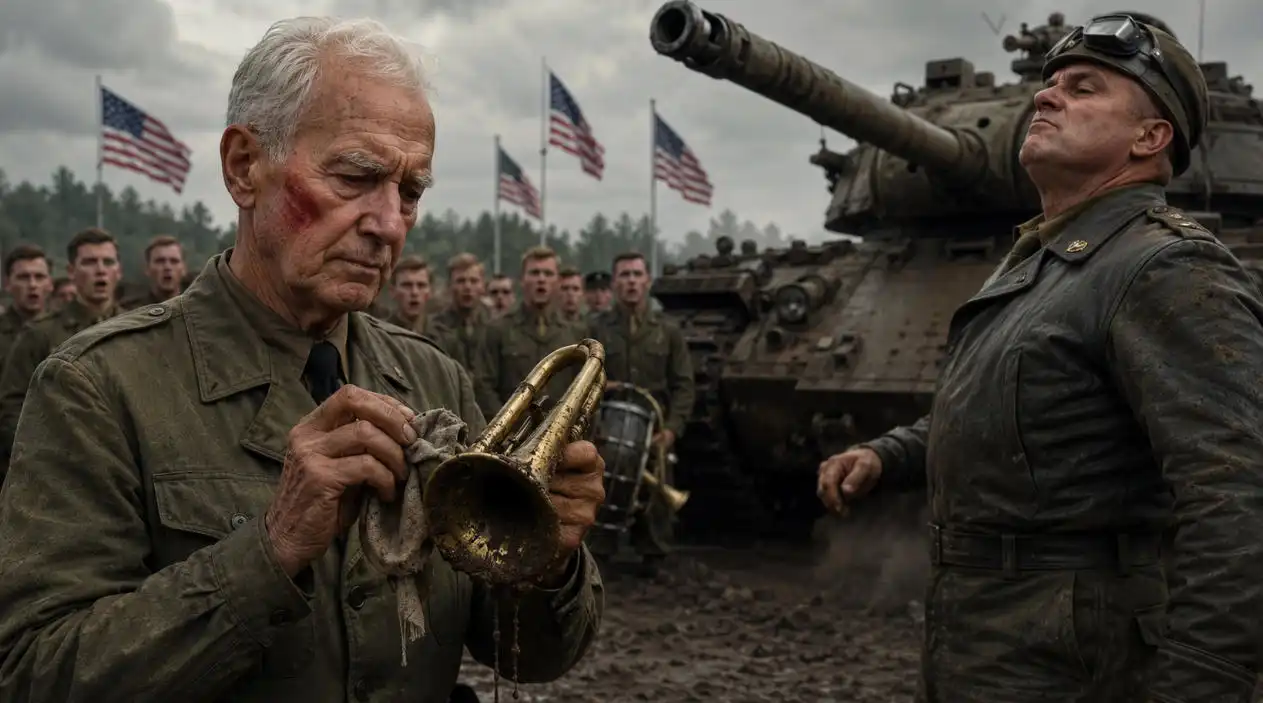
John lifted the bugle to his mouth.
The reviewing stand went silent.
Not quiet.
Silent.
The kind of silence that makes grown men straighten their backs without knowing why.
Dyke still had that smug smile on his face.
He stood beside his armored platoon with his polished boots, his chest full of ribbons, and his hands folded like he owned the whole Fourth of July parade.
“Go ahead, old man,” he muttered.
John heard him.
So did the young trumpet player beside him.
But John didn’t look over.
He just placed the old brass bugle against his lips.
And before one note came out, a retired four-star general in the front row slowly stood up.
Then another.
Then another.
Dyke’s smile finally twitched.
Because suddenly, the old man he had slapped yesterday was no longer invisible.
The day before, John had been standing in the training camp parade assembly area before sunrise.
He was not tall.
He was not loud.
He was one of those old soldiers most people walk past without thinking.
White hair.
Weathered hands.
A pressed uniform that had clearly been cared for more than it had been replaced.
His palms were covered in thick old calluses from decades of valves, brass, cold mornings, and funeral notes played over folded flags.
The younger musicians loved him.
They called him Mr. John.
Never “old man.”
Never “grandpa.”
Because John had taught them something most officers forgot.
“A note can carry respect,” he would say. “And respect carries farther than fear.”
That morning, the band had been rehearsing near the armored staging lane.
They were preparing for the Fourth of July review.
Families would be watching.
Veterans would be watching.
Senior officers would be watching.
And according to the base rumor mill, a very important guest from Washington would be present.
That made Battalion Commander Dyke especially loud.
Dyke commanded armor.
He liked weight.
Steel.
Engines.
Noise.
He believed respect came from making the ground shake.
So when he saw the military band rehearsing near his tanks, he acted like someone had insulted him personally.
He climbed down from his lead vehicle with a grin that made his own soldiers nervous.
“What is this?” he shouted.
The band stopped.
A clarinet player lowered her instrument.
A young drummer swallowed hard.
John turned slowly.
“Morning, Commander.”
Dyke looked him up and down.
Then he looked at the bugle in John’s hands.
It was old.
Older than most people on that field.
The brass had been polished so many times the shine looked soft instead of new.
Dyke laughed.
“Budget waste.”
Nobody moved.
Dyke pointed at the band.
“You people get uniforms, practice time, transport, shade tents, and meal priority for what? Noise?”
One of the young musicians flushed red.
John kept his voice calm.
“Sir, we’re part of the ceremony.”
Dyke stepped closer.
“The ceremony doesn’t need old men blowing little horns.”
His tank crew laughed behind him.
Not all of them.
But enough.
Enough to make the young musicians stare at the ground.
Enough to make the insult feel official.
Public.
Unavoidable.
John said nothing.
Dyke hated that.
Bullies love a reaction.
When they don’t get one, they push harder.
He looked over his shoulder and waved two fingers at his driver.
The tank engine roared.
The heavy vehicle rolled forward just enough to hit a low puddle near the curb.
A sheet of brown water flew up.
It struck John across the chest.
It splashed his face.
And it covered his bugle in mud.
The band gasped.
A trumpet player stepped forward.
“Sir, that was—”
“Stay in your lane,” Dyke snapped.
John lowered his eyes to the bugle.
He did not curse.
He did not complain.
He took a clean cloth from his pocket and began wiping the bell.
Dyke grabbed the bugle.
“Careful,” John said quietly.
That was all.
Just one word.
Careful.
Dyke’s expression changed.
To him, it sounded like disrespect.
He shoved the bugle back against John’s chest.
Then he slapped him.
A sharp crack cut through the assembly area.
The young musicians froze.
The armored soldiers stopped laughing.
John’s face turned slightly from the blow.
A red mark rose on his cheek.
Dyke leaned in.
“Polish that, old man. Maybe the President will care.”
John slowly touched his cheek.
Then he bent down and picked up the cloth.
He wiped the bugle again.
This time, he wiped one tiny engraved mark near the bell.
A small inscription.
Almost hidden.
The only person who seemed to notice was an elderly general standing far away near the reviewing platform.
He had been walking with two aides.
After the slap, he stopped.
His face changed.
But he said nothing.
Not yet.
John looked at the young musicians.
“Back to places,” he said.
His voice did not shake.
The drummer whispered, “Mr. John… are you okay?”
John gave him a small nod.
“I’ve heard worse noise than that.”
Dyke walked away laughing.
But John did not let the moment disappear.
He did what disciplined men do.
He followed the rules.
He wrote the report.
Time.
Place.
Witnesses.
Damage to ceremonial property.
Physical assault in a public military assembly area.
Interference with national ceremonial preparation.
He attached photos of the muddy bugle.
He attached statements from three young musicians.
He attached one more thing.
A copy of the instrument’s registry card.
That card had been locked in the band office safe for years.
Most people thought the old bugle was just an antique.
It was not.
It was a protected ceremonial artifact.
Issued for special national observances.
Preserved under military heritage rules.
And tied to one of the most sacred battlefield stories in the Corps’ memory.
John had carried it carefully for decades.
Not because it was valuable.
Because of what it had witnessed.
That night, the young musicians tried to convince him to report directly to the base commander.
John shook his head.
“We already did it the right way.”
“But Dyke will bury it,” one of them said.
John looked at the bugle case.
“No,” he said. “Men like Dyke bury people. They forget paper has a way of marching.”
The next morning, the Fourth of July parade field filled early.
Families lined the fences.
Veterans arrived in wheelchairs and ball caps.
Officers filled the reviewing stand.
Flags snapped in the warm morning wind.
Dyke appeared in perfect dress uniform.
He had slept well.
Men like him usually do.
He had no idea the report had gone higher than the base command.
He had no idea the old general from the day before had made a phone call.
He had no idea the guest from Washington had already been briefed.
He only saw John standing with the band, cheek still faintly red, bugle clean again.
Dyke walked close enough to whisper.
“Try not to squeak.”
John didn’t answer.
The announcer’s voice rolled across the field.
“Ladies and gentlemen, please rise for the opening ceremonial call.”
John stepped forward.
Some people probably wondered why an old man was standing alone ahead of the full band.
Dyke folded his arms.
The first note came out.
Clear.
Sharp.
Lonely.
It did not sound like entertainment.
It sounded like memory.
The second note followed.
Then the third.
By the fourth, men in the reviewing stand had begun to stand.
Not because protocol told them to.
Because they knew.
One old general removed his cap.
Another pressed his hand over his heart.
A Medal of Honor recipient in the front row began crying quietly.
Dyke looked around, confused.
“What is happening?” he whispered.
The young musicians behind John knew something was changing, but even they did not understand the full weight of it.
Then the announcer returned to the microphone.
His voice was different now.
Less formal.
More careful.
“The ceremonial bugle being played today was sounded by Private First Class John Mercer during the final assault phase at Iwo Jima, after the assigned bugler was wounded. The call rallied scattered Marines under fire and became part of the preserved battlefield record.”
Dyke went pale.
The field was completely still.
The announcer continued.
“Mr. Mercer later refused multiple public honors, requesting only that the instrument be used to teach future service members the meaning of duty.”
John did not turn around.
He kept playing.
The last note hung in the air.
And when it ended, nobody clapped at first.
They saluted.
Old veterans.
Young soldiers.
Generals.
Musicians.
Even some of Dyke’s own armor crew.
One by one, hands rose.
Dyke’s hand did not.
It shook at his side.
Then the President’s representative stepped down from the reviewing platform.
Beside him came the base commander.
Beside him came the elderly general who had witnessed the slap.
The crowd began murmuring.
Phones came up.
Cameras turned.
Dyke tried to step backward.
But his executive officer was standing right behind him.
There was nowhere to go.
The old general stopped in front of John.
He saluted first.
John returned it.
Then the official from Washington reached out and shook John’s hand.
“Mr. Mercer,” he said, loud enough for nearby microphones to catch, “the nation is honored by your service.”
John simply answered, “I only played what better men needed to hear.”
That broke people.
Some cried openly.
The young drummer wiped his face with his sleeve.
Then the base commander turned.
Not to the crowd.
To Dyke.
“Commander Dyke, front and center.”
Dyke stepped forward like a man walking toward a cliff.
The base commander held a folder.
Not thick.
Just thick enough.
“Yesterday,” he said, “you publicly humiliated a military heritage instructor, damaged protected ceremonial property, disrupted preparation for a national observance, and struck a decorated veteran in front of junior service members.”
Dyke swallowed.
“Sir, I didn’t know—”
The old general cut him off.
“That is the problem.”
The words landed harder than the slap ever had.
Dyke tried again.
“I meant no disrespect to his record.”
John finally looked at him.
“My record was not on my face, Commander.”
A murmur moved through the crowd.
Dyke’s jaw tightened.
The base commander opened the folder.
“Effective immediately, you are relieved from ceremonial command duties pending investigation.”
Dyke’s eyes widened.
“Sir—”
“Your battalion’s discretionary demonstration budget is suspended. Pending review, half of the armored public outreach allocation will be redirected to veteran education, military music preservation, and junior leadership ethics training.”
Dyke looked like the air had left his body.
Half his budget.
Gone.
Not because John yelled.
Not because John fought dirty.
Because Dyke had been arrogant in public.
And the rules were written for exactly that kind of arrogance.
The investigation moved fast.
There were too many witnesses.
Too many videos.
Too many statements from young soldiers who had been waiting for someone to say, “That was wrong.”
Dyke received a formal reprimand circulated through the command.
The phrase “failure of judgment and public misconduct unbecoming of command authority” followed him like a shadow.
His armored battalion kept its mission.
But the pageantry money was cut in half.
The flashy demonstrations stopped.
The unnecessary fuel burns stopped.
The “morale shows” Dyke loved became leadership lectures he was not invited to give.
As for John’s band?
Something unexpected happened.
A video of the salute spread across military families online.
Not the slap.
John refused to let that be the focus.
The salute.
The note.
The old men standing.
That was what people shared.
Within weeks, the military band was selected as the official ceremonial group for a presidential overseas visit.
The same young musicians who had been laughed at were now standing on red carpets, playing for veterans, ambassadors, and Gold Star families.
John went with them.
Not as a mascot.
As their guide.
Before their first major performance, the nervous drummer asked him, “Mr. John, what if I mess up?”
John smiled.
“You will,” he said.
The kid blinked.
John tapped the old bugle case.
“Then you will breathe, stand straight, and keep faith with the person beside you. That’s all any of us ever did.”
Months later, Dyke saw John again.
It was at a veteran leadership ceremony.
Dyke was no longer smiling.
He approached slowly.
No cameras were near them.
No crowd close enough to hear.
“I was wrong,” Dyke said.
John studied him.
Dyke added, “Not because of who you were. Because of what I did.”
That mattered.
John nodded once.
“Then remember it when you outrank someone who can’t answer back.”
Dyke looked down.
“Yes, sir.”
John never bragged about it.
He never called it revenge.
He called it correction.
Because to him, the point was never that a powerful man got embarrassed.
The point was that young soldiers saw dignity defended without hatred.
They saw rules matter.
They saw silence was not weakness.
And they learned that sometimes the smallest instrument on a battlefield can carry the loudest truth.
So choose a side:
Was John right to let the system expose Dyke in front of everyone — or should he have handled it quietly?
Share this if you believe respect for old soldiers is not optional. 🇺🇸
Disclaimer: Mention of any brand or trademark is for identification only and does not imply partnership or endorsement
A Retired Nurse Was SHOVED At A Luxury Cruise Gate By A Snobby Purser… But They Had NO IDEA Who She Really Was 🚢
A Paint-Stained ART TEACHER Was Humiliated at a VIP Museum Preview by an Elite Critic… But He Had NO IDEA Who She Really Was 😳
A PLUS-SIZE Grocery Cashier Was Dragged Across A Private Island Beach By A Snobby Resort Manager… But He Had NO IDEA Who She Really Was 😳