

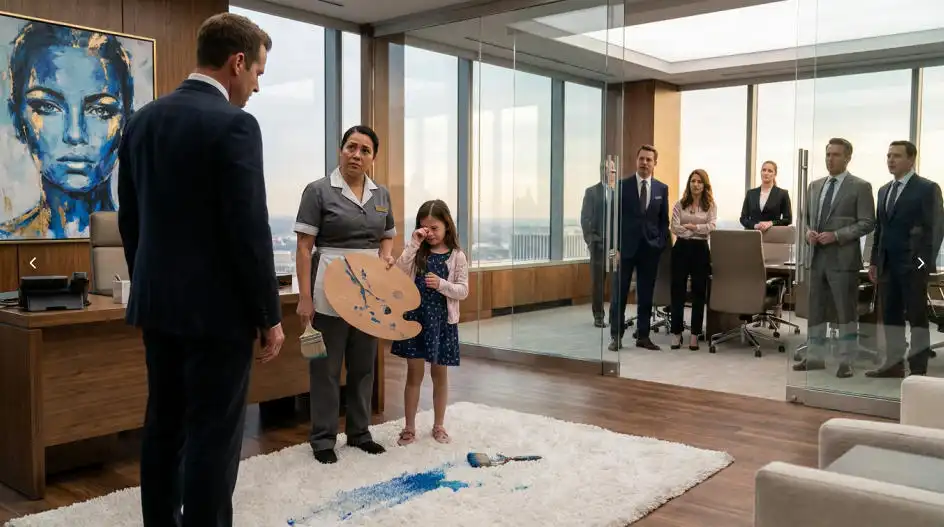
Bradley stood frozen over the stained white rug, his polished shoe inches from Emma’s star-stained brush.
Marisol held the cracked wooden palette against her chest.
Behind them, Emma’s unfinished portrait watched from the corner wall — a woman with soft eyes, blue shadows, and a gold moon resting near her shoulder.
Bradley’s smirk faded for one second.
Then he forced it back.
“I said sweep,” he snapped. “And don’t touch anything else in this office.”
Emma reached for the brush, but Bradley stepped closer to it.
Marisol pulled her daughter gently behind her.
“Please don’t step on it,” Marisol said quietly.
Bradley laughed.
“Now you care about property?”
The room went colder.
Two assistants stood near the glass wall. Three board members sat frozen around the conference table. A security guard had one hand near his radio, but even he looked uncomfortable.
Bradley pointed at the rug again.
“That stain is on camera. That wall is on camera. Your child ruined my office in front of witnesses.”
Marisol looked at the phone sitting on the glass table.
The red recording light was still on.
Bradley had turned it on himself ten minutes earlier for the company’s charity announcement.
He wanted footage of the “Whitmore Family Arts Outreach” helping poor kids.
Instead, he had recorded himself humiliating one.
Marisol saw it.
She said nothing.
Bradley mistook her silence for fear.
“Do you know who I am?” he asked.
Marisol answered softly, “Yes.”
“Then act like it.”
Emma started crying.
“I’m sorry,” she whispered. “I just painted the lady from the picture.”
Bradley whipped around.
“What picture?”
Emma pointed to her tote bag.
Marisol’s hand tightened around the old palette.
Bradley lunged for the tote, but an older woman at the doorway stepped forward.
“Don’t touch that bag.”
Everyone turned.
It was Helen Morris, the Whitmore Foundation’s board secretary.
She was in her seventies, neat gray hair, pearl earrings, and a face that had gone pale the moment she saw the palette.
Bradley frowned.
“Helen, stay out of this.”
Helen didn’t move.
“That palette belonged to Audrey.”
The name hit the room like a dropped glass.
Audrey Whitmore.
Bradley’s late wife.
The woman whose portrait Emma had been painting on his office wall.
Bradley’s face hardened.
“That’s impossible.”
Helen pointed at the palette.
“No. It isn’t. I watched Audrey mix that midnight blue by hand. She called it Starfall Blue.”
Marisol swallowed.
Emma looked up through tears.
Bradley stared at the wall again.
For the first time, he really saw it.
The cheekbones.
The soft smile.
The gold moon beside the shoulder.
It wasn’t random child art.
It was Audrey.
His wife.
Painted by an 8-year-old girl he had just mocked as a mess.
Bradley shook his head.
“That proves nothing. She copied some old photo. Big deal.”
Marisol finally spoke.
“She copied the photo hanging in the community center art room.”
Bradley’s eyes snapped to her.
“What community center?”
“The one your wife funded,” Marisol said. “The one your foundation invited here today.”
Helen stepped closer.
“Audrey left that palette to the children’s program.”
Bradley’s jaw tightened.
“That program is under review.”
“No,” Helen said. “Your control of that program is under review.”
The room went silent.
Bradley gave a sharp laugh.
“Careful, Helen.”
Helen did not blink.
“You just threatened a beneficiary family. You demanded payment from them for participating in a foundation-sponsored art event. You ordered the destruction of a protected student artwork. And you did it on a company recording.”
Bradley looked at the phone again.
For the first time, he looked afraid.
He reached for it.
Marisol moved first.
She picked it up and slid it across the table to Helen.
Bradley snapped, “That is company property.”
Helen said, “And this is foundation evidence.”
A board member stood.
“Bradley, sit down.”
Bradley turned on him.
“You too?”
The board member pointed to the wall.
“That mural was authorized for today’s outreach filming. The carpet was removed from the protected area by your office staff after setup.”
One assistant raised her hand shakily.
“That’s true,” she said. “Mr. Whitmore didn’t like the plastic floor covering in the shot. He told us to pull it out because it looked cheap.”
Bradley’s mouth opened.
Nothing came out.
Marisol looked down at Emma.
“Baby, tell them what happened.”
Emma wiped her cheeks.
“I was told to paint in the corner. The blue dripped. I tried to clean it, but he yelled.”
Bradley said, “She is a child. She doesn’t understand.”
Marisol looked straight at him.
“She understands kindness. That’s more than you showed.”
A quiet murmur moved through the office.
Helen opened Emma’s tote and pulled out a folded paper sealed inside a plastic sleeve.
Bradley stared at it.
“What is that?”
Marisol said, “The program permission form your office sent us.”
Helen unfolded it.
She read the line slowly.
“All child artwork created during the Whitmore Family Arts Outreach event is protected foundation property until reviewed, photographed, and archived.”
Bradley’s face went pale.
Helen continued.
“No participant family shall be billed, threatened, removed, or penalized for ordinary art materials used during approved activities.”
The security guard lowered his radio.
One assistant whispered, “Oh my God.”
Bradley pointed at Marisol.
“She brought an old palette into my office to set me up.”
Marisol shook her head.
“No. Your wife left that palette for children like my daughter. I clean that community center every night. Emma sits beside me after school. She loved the colors before she even knew they were famous.”
Emma hugged her mother’s leg.
“She said the blue looked like stars.”
Helen’s eyes watered.
“Audrey used to say the same thing.”
Bradley looked at the portrait again.
For a second, grief crossed his face.
Then pride shoved it away.
“Enough,” he said. “Paint over it.”
No one moved.
“I said paint over it!”
Helen lifted the phone.
“Say that again for the record.”
Bradley froze.
The board member beside her spoke calmly.
“Bradley, as of this moment, I’m calling an emergency foundation vote.”
Bradley’s face twisted.
“You can’t remove me.”
Helen said, “Audrey’s trust can.”
Then she turned the permission form around so everyone could see the signature at the bottom.
Audrey Whitmore’s.
The document was part of the foundation rules she had written before she died.
Rules Bradley had ignored because he thought charity was good publicity and poor people were easy targets.
Helen said, “Your wife made sure one person could not turn her art program into a branding stunt.”
Bradley looked trapped now.
Not by shouting.
Not by revenge.
By his own signature.
By his own recording.
By the witnesses in the room.
By the paintbrush he had thrown onto the rug.
Helen called the foundation attorney on speaker.
The attorney listened.
Then he said, “Preserve the video. Preserve the brush. Preserve the palette. Preserve the wall. Mr. Whitmore should not contact the family again.”
Bradley whispered, “This is insane.”
The attorney answered, “No, Mr. Whitmore. This is exactly why your wife wrote the clause.”
Within an hour, Bradley’s authority over the Whitmore Family Arts Outreach was suspended.
By the end of the week, the board removed him as trustee of Audrey’s foundation.
The rug claim disappeared.
The company issued a public apology.
The assistant who had been ordered to remove the floor covering gave a written statement.
The security footage matched the recording.
And Bradley’s cruel sentence — “Poor people always think someone else should pay for their mess” — became the line every local news story repeated.
But Marisol did not celebrate his humiliation.
She only cared about Emma.
Two days later, Helen invited them back to the office.
Emma stood at the elevator clutching the same brush, now cleaned and wrapped in a ribbon.
Marisol asked, “Are you sure you want to go in?”
Emma nodded.
“I want to finish her.”
When the elevator doors opened, the office looked different.
The cold glass partition around Bradley’s corner suite was gone.
The white rug was gone too.
In its place, a simple wooden barrier protected the painted wall.
And above it was a small brass plaque:
“THE STARRY BRUSH WALL — CREATED BY CHILDREN OF THE AUDREY WHITMORE ARTS PROGRAM.”
Emma walked to the mural.
Marisol stood behind her.
Helen gave her a fresh cup of water and whispered, “Take your time, sweetheart.”
Emma dipped the brush into the blue.
Then she added one final star beside Audrey’s face.
No one laughed this time.
No one told her she didn’t belong.
Marisol watched her daughter paint in a room that had once tried to shame them, and for the first time that week, she let herself breathe.
Bradley never got that office back.
The company kept the wall.
The foundation expanded the community center program.
And every year after that, children came into that once-cold executive space to paint under Emma’s stars.
Marisol stayed a cleaner by choice.
But no one treated her like she was invisible again.
Because that day proved something Bradley had forgotten:
Money can buy a rug.
It cannot buy grace.
And it cannot erase the truth once a child paints it on the wall.
So tell me honestly — did Bradley deserve to lose control of the foundation after what he did, or was the public apology enough? Share this if you believe dignity matters more than money.
Disclaimer: Mention of any brand or trademark is for identification only and does not imply partnership or endorsement