
The ballroom screen stayed black for two seconds.
Then the first document appeared.
A large financial ledger filled the screen. At the top was the name of a Cayman Islands holding company. Beneath it were transaction dates, account references, transfer amounts, and a series of payments originating from Mercer Grid Systems.
The guests could see millions of dollars moving through several offshore entities.
Then another name appeared repeatedly.
Vanessa Cole.
The room began to murmur.
Grant stared at the screen.
“What the hell is this?” he demanded.
Claire held the microphone steadily.
“These are records of money transferred out of our company's accounts and into offshore entities connected to you and Vanessa. The transactions were traced through the Cayman accounts, including the beneficial ownership records.”
She paused, allowing the guests to read the entries.
“More than eight million dollars. And that's only what my forensic accountant could verify from the records we've obtained.”
Vanessa's face drained of color.
“That's private financial information!” she shouted.
Claire turned toward her.
“Then perhaps you should have thought about that before using company money to hide assets from your business partners and your family.”
Grant pushed his chair backward.
“Turn that screen off! She's making things up!”
Nobody moved.
Claire tapped her phone.
The first document disappeared.
The second appeared.
Its heading was unmistakable:
NOTICE OF IMMEDIATE TERMINATION OF EXCLUSIVE PATENT LICENSE.
Below it were the patent number, the original owner's name, the relevant termination provisions, and the notarized authentication of Claire's signature.
Grant stopped moving.
For the first time that evening, he seemed unable to find an answer.
“You can't do that,” he said.
Claire looked directly at him.
“Actually, I can.”
She enlarged the ownership section.
The original United States patent registration identified Claire Bennett as the sole owner of the thermal-management technology that powered Mercer Grid Systems.
There was no assignment to Grant.
There was no transfer of ownership to his company.
There was no document making him the inventor or patent holder.
His company had been operating under an exclusive commercial license granted by Claire.
And that license contained a specific termination provision.
Grant had spent years concealing patent-related revenue, diverting funds, and falsifying financial disclosures. The evidence gathered by Claire's forensic accountant documented those material breaches.
Under Section 11.2 of their licensing agreement, Claire retained the right to terminate the license immediately upon written notice following those breaches.
She had not simply written an angry letter that afternoon.
Her attorney had prepared the formal termination notice, authenticated her signature before a notary, and arranged for the notice to be served according to the agreement.
The notarization established the authenticity of her signature. The contractual termination clause established the legal effect.
And Grant was about to receive the notice personally.
“You've been lying to everyone,” Claire continued. “You told the world you created this technology. You told your investors it belonged to your company. You even told your mother I was a useless woman who couldn't survive without you.”
Grant shook his head.
“We built that company together. You were my wife. Everything we did was for our family!”
“No,” Claire replied. “I created the technology. You were given permission to use it. You decided that permission meant ownership.”
She reached into the small folder beside the presentation console and removed two additional documents.
The first was the original patent registration.
The second was their prenuptial agreement, signed before their wedding ten years earlier.
The relevant provision was highlighted.
Her patent ownership and all income generated from its licensing were explicitly designated as her separate property.
Grant had known the agreement existed.
He had simply assumed Claire would never use it against him.
He stepped toward the stage.
“Claire, stop this. We can discuss it privately.”
She held out the termination notice.
“Read the final paragraph.”
Grant refused to take it.
Claire placed the document on the lectern and read the operative sentence aloud.
“The exclusive license is terminated effective upon delivery of this notice to the licensee.”
She turned toward him.
“You are the licensee, Grant. And you're standing right here.”
He finally understood.
His company had no ownership of the technology. Its entire commercial operation depended on a license that had just been terminated.
He lunged toward the lectern.
“Give me that phone!”
Before he could reach Claire, Mara Ellison stepped forward.
“Don't touch her.”
Mara had been watching the entire presentation from the front row. She was not merely another wealthy guest. As president of Asterion Global, she was authorized to negotiate and execute the company's major technology agreements.
Two security personnel immediately moved between Grant and Claire.
Grant tried to push past them.
“This is a private family matter!” he shouted.
Mara didn't move aside.
“No, Mr. Mercer. It became a business matter when you built your company on technology you didn't own.”
She turned toward Claire.
“Our legal team has completed its review. The patent ownership is verified. The existing license termination is supported by the agreement and the evidence your counsel supplied.”
Grant stared at her.
“You knew about this?”
Mara looked at him without hesitation.
“We have known who owns the patent for weeks.”
The truth was that Claire had approached Asterion through her attorney several months earlier.
She hadn't gone looking for revenge on the first day she discovered the offshore transfers.
She had first needed to understand what she actually owned, what rights her husband had been granted, and how to terminate those rights without putting herself in a position where he could challenge the entire transaction.
She had also needed to find out whether another company would be willing to license the technology.
Asterion had been studying the patent for six weeks.
Grant had invited Mara to the anniversary dinner because he believed she might agree to acquire Mercer Grid Systems.
He thought he was bringing a wealthy buyer to admire his business.
He had unknowingly brought the representative of the company that was prepared to compete with him using the technology he had no longer been authorized to use.
Mara's assistant brought a leather document folder to the lectern.
Inside was a prepared exclusive licensing agreement and an eight-figure commercial commitment.
Mara opened the folder.
“Asterion Global is prepared to offer an exclusive worldwide commercial license for your patented technology in the grid-scale energy storage sector. You retain ownership of the patent and your independent research rights. We are offering substantial upfront compensation, development funding, milestone payments, and continuing royalties.”
Claire looked at the documents.
For years, she had imagined what it would feel like to negotiate a deal using her own name.
Now the opportunity was sitting in front of her.
She read the key terms one more time.
Then she signed.
Mara signed the company's counterpart.
She also signed the eight-figure letter of intent confirming Asterion's commercial commitment.
A few guests began whispering excitedly.
Others simply watched.
The deal wasn't a transfer of Claire's patent ownership. It was something more important to her at that moment: a new exclusive commercial license granted by the person who actually owned the technology.
Grant's company no longer had the right to manufacture or sell products using it.
And his biggest competitor now had the legal right to do exactly that.
Grant looked from the signed agreement to the two documents still displayed on the screen.
His face had gone pale.
“Claire,” he said, his voice suddenly softer. “Please. Let's not do this.”
She didn't answer.
He stepped closer, but the security personnel kept him back.
“Think about the last ten years. Think about our marriage. I made mistakes, but we can fix this.”
Claire looked at the man she had once believed she would grow old with.
She remembered the evenings she had spent alone while he attended corporate dinners.
She remembered the countless times he had introduced her to investors as someone who simply stayed home.
She remembered being told that she should be grateful he had given her a comfortable life.
And she remembered how many times she had almost convinced herself that leaving him would mean losing everything she had ever accomplished.
Then Grant dropped to his knees.
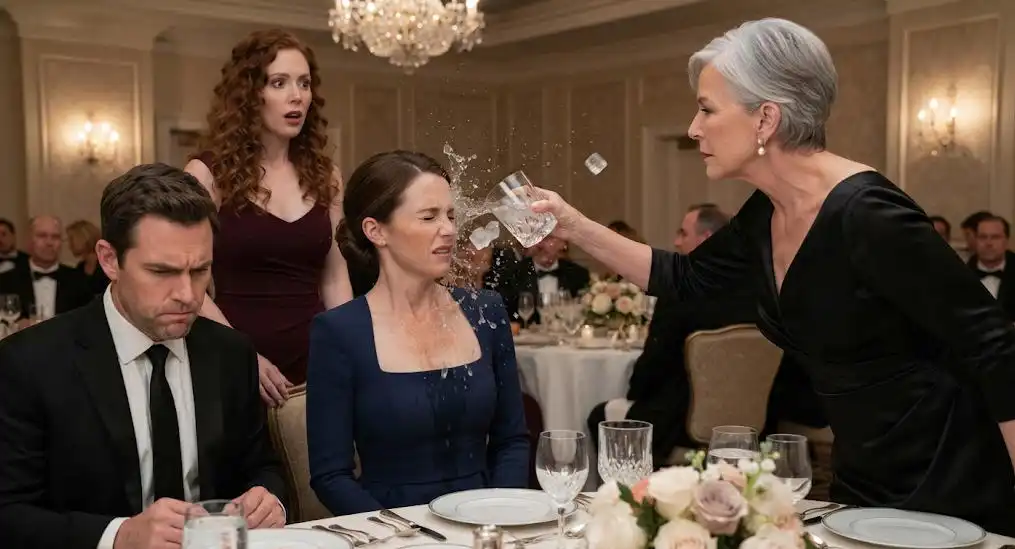
The stage floor was still wet from the ice water Margaret had thrown. Small ice cubes remained scattered near the main table.
His expensive trousers touched the wet surface.
“Claire, please. I'll change. I'll give you whatever you want. Just don't destroy the company.”
For years, he had expected her to beg him for attention.
Now he was begging her not to take away the thing that had made him powerful.
Claire reached into her folder again.
She removed a divorce settlement agreement.
Her signature was already on the final page.
She looked down at him.
“You should have thought about our marriage before you brought your mistress to our anniversary dinner.”
Then she threw the signed agreement directly at his face.
The papers struck his cheek and scattered across the wet stage.
Grant stared at them.
Claire's voice remained steady.
“My attorney will communicate with yours. You can respond through the proper channels. But I will never again live in a house where I have to ask permission to be treated like a human being.”
Margaret finally found her voice.
“You ungrateful woman! My son made you who you are!”
Claire turned toward her.
“Your son used my work to build his reputation. You used my silence to convince yourselves I had no value.”
Margaret opened her mouth, but no words came.
Claire picked up her phone.
Mara stepped beside her, and two security personnel formed a protective escort.
As Claire walked toward the ballroom exit, Vanessa stood motionless beside the chair she had wanted so badly.
Nobody offered it to her now.
Grant remained on his knees, surrounded by the scattered papers and melting ice.
For the first time in ten years, Claire walked out of a room without wondering whether her husband would be angry when she got home.
She didn't look back.
The following morning, Grant arrived at Mercer Grid Systems headquarters expecting his legal department to find a way around the termination.
He was already on the phone with outside counsel when his operations director entered his office.
“Mr. Mercer, we have a problem with the production line.”
Grant rubbed his forehead.
“What now?”
“The patent authorization has been terminated. We need instructions about today's shipments.”
“Keep everything running,” Grant snapped. “She can't shut down a company overnight. Our lawyers will challenge it.”
But Claire's legal team had prepared for precisely that response.
Before dawn, her attorneys filed a patent infringement complaint and an emergency request for injunctive relief. The filing included the original patent registration, the exclusive licensing agreement, the notarized termination notice, proof of delivery, and the forensic accountant's supporting declaration.
The company had been notified that its authorization was over.
Yet Grant was still attempting to manufacture and ship products using the patented technology.
That distinction mattered.
By late morning, the federal court had reviewed the emergency application and issued a temporary restraining order against further unauthorized production and shipment.
Court officers arrived at Mercer Grid Systems.
The manufacturing floor was shut down.
The patent-dependent equipment and inventory were sealed pending further proceedings. Company records and relevant electronic systems were preserved under the court's order.
Employees stood outside the facility, watching the doors close.
A business that had once advertised itself as one of America's most promising energy technology companies had suddenly lost the right to use the technology at its center.
Grant watched the proceedings from his office.
He called three investors.
Two refused to answer.
The third told him that the investment committee had suspended all discussions.
Then Asterion Global announced that it had secured an exclusive commercial license from Claire Bennett.
The announcement sent another shock through the industry.
Asterion immediately began pursuing several of the major contracts Mercer Grid Systems had expected to win. Its legal team also began reviewing potential claims relating to the company's previous use of the patented technology.
Grant's competitive advantage had disappeared.
His biggest competitor now had the technology, the commercial rights, and the financial resources to develop it.
But the patent dispute wasn't the only problem waiting for him.
The offshore financial records had already been submitted to the appropriate authorities through Claire's legal team.
The records were not simply a collection of suspicious-looking transfers. They included account statements, beneficial ownership information, payment authorizations, and transaction histories that could be independently examined.
Several weeks later, the IRS opened a formal investigation into the offshore transactions.
Grant and Vanessa were required to answer questions about the Cayman entities and the movement of company funds.
Their lawyers could dispute the allegations, but the records were no longer something they could quietly make disappear.
Vanessa stopped appearing at the company's offices.
She also stopped answering Grant's calls.
The relationship that had helped destroy his marriage did not survive the collapse of his business.
Claire's victory had consequences she hadn't fully anticipated.
She had spent months preparing to recover her patent rights, but recovering her professional life was a different challenge.
For nearly a decade, she had been separated from the industry.
She understood the technology better than almost anyone, but she had not managed a laboratory, negotiated major commercial agreements, or led an engineering team in years.
Asterion had offered her an extraordinary deal.
It had not offered to build her life for her.
That responsibility remained hers.
During the first few weeks, she worked with her attorney Daniel Price to finalize the license termination, protect her patent ownership, and separate her personal finances from the accounts Grant had controlled.
The divorce process also began.
Her prenuptial agreement protected the patent and its licensing income. The forensic accountant continued tracing the money moved through the offshore entities, while Claire's attorneys handled the appropriate financial disclosures and claims.
She learned that Grant had personally guaranteed several of the company's expansion loans.
His mother, Margaret, had also pledged her own property as collateral for one of the financing arrangements.
They had both believed Mercer Grid Systems was too successful to fail.
They had used their homes and personal assets to support its expansion.
When the company stopped operating, the lenders began enforcing their contractual rights.
Grant tried to sell personal assets to raise money.
But the luxury cars, investment properties, and other holdings were tied up in debts and legal proceedings.
Margaret blamed Claire for everything.
She told relatives that her daughter-in-law had deliberately destroyed the family.
But the documents told a different story.
Claire had not created the debt.
She had not signed away her patent.
And she had not forced Grant to conceal company funds.
The consequences came from decisions they had made long before the anniversary dinner.
Over the following months, Mercer Grid Systems lost its remaining commercial contracts and entered insolvency proceedings.
The personal guarantees came due.
The family mansion was eventually taken to satisfy the outstanding debt. Margaret lost the property she had pledged as collateral.
The two of them were left with substantial liabilities and very few assets.
When the movers arrived at the Mercer estate, Grant and Margaret had to decide what they could carry away.
Their expensive furniture, paintings, and designer possessions were sold or seized.
The two people who had once looked down on Claire for living in their house were suddenly standing outside with suitcases, without a home of their own.
For several nights, they slept in Grant's car before finding temporary accommodation.
Margaret still insisted that Claire had ruined them.
Grant no longer had the strength to argue.
Meanwhile, Claire was learning how to live without asking anyone's permission.
The first payment from Asterion gave her the financial resources to begin building something of her own.
But she didn't immediately rent a massive office or hire a hundred employees.
Instead, she leased a modest industrial space in Seattle's SoDo district.
The building had once been a small manufacturing workshop. Its concrete floors were worn, its windows needed replacing, and several rooms had to be renovated before they could hold sensitive engineering equipment.
Claire loved it.
For the first time in years, she could walk into a room and know that every decision about what happened there belonged to her.
She called an old colleague, Nora Hayes, an engineer she had worked with before her marriage.
Nora had spent years in energy-storage research and had once admired Claire's technical work.
When she arrived at the new building, she looked around at the unfinished laboratory.
“You're really doing this?” Nora asked.
Claire smiled slightly.
“I've been thinking about it for a long time.”
Nora picked up one of the old engineering notebooks Claire had placed on a workbench.
“You kept these?”
“Every one.”
They spent the afternoon reviewing the original thermal-routing designs.
Some of the technology was still ahead of its time. Other parts needed updating to meet newer engineering requirements.
Claire didn't pretend that ten years away from daily laboratory work had changed nothing.
She had to relearn certain industry procedures. She had to rebuild professional relationships. She had to understand the newer manufacturing standards and recruit people who could challenge her ideas instead of simply agreeing with her.
There were difficult mornings.
Sometimes she sat in her car outside the laboratory, staring at the entrance, remembering how easily Grant had made her believe she wasn't capable of doing anything without him.
But she began going inside anyway.
She hired three engineers and a laboratory technician. She established a proper testing program and began developing a new generation of battery safety systems.
Asterion received the exclusive commercial rights to the original patented technology.
Claire retained ownership of the patent, her research rights, and the freedom to develop new inventions outside the licensed commercial scope.
The distinction mattered.
She was no longer building a business around a husband's permission.
She was building one around her own knowledge.
Her first major technical review was difficult.
A young engineer questioned one of her thermal-flow calculations in front of the entire team.
For a moment, Claire felt the old instinct to apologize for taking up space.
Then she walked to the whiteboard.
She rewrote the calculation, explained the pressure difference, and showed him where his model had overlooked a critical variable.
The engineer checked the numbers.
He looked up.
“You're right.”
Claire nodded.
“Then let's fix it.”
That afternoon, she stayed in the laboratory until the revised test was complete.
When the prototype passed its initial thermal stability assessment, the team applauded.
Claire didn't make a speech.
She simply stood beside the equipment, looking at the results.
It was a small achievement compared with the business empire she had once helped create.
But it was hers.
The divorce was finalized after months of negotiations and financial proceedings.
Claire retained her patent rights and the licensing arrangements protected by her prenuptial agreement.
Grant lost control of the company he had once believed would make him untouchable.
The offshore financial investigation continued separately.
Margaret no longer had a daughter-in-law to order around.
And Claire no longer had a husband whose approval she needed.
Ten months after the anniversary dinner, the doors of her new laboratory were finally ready to open.
A small crowd gathered outside the renovated building in Seattle.
Former colleagues, engineers, business partners, and representatives from Asterion Global stood beside the entrance.
A clean sign above the glass doors read:
BENNETT APPLIED SYSTEMS LAB
Claire stood at the center of the entrance wearing a beautifully tailored charcoal professional suit.
Her chestnut hair was neatly styled, and her expression carried the quiet confidence she had spent months rebuilding.
A blue ribbon stretched across the entrance.
Nora stood beside her, holding one end.
“Ready?” she asked.
Claire looked through the glass doors.
Inside were the laboratory benches, testing equipment, engineering stations, and the people who had chosen to build something with her.
She thought about the woman who had sat at that anniversary dinner with ice water running down her face.
That woman had believed she had to endure humiliation to keep her home.
She had been wrong.
Claire took the scissors.
The ribbon fell apart.
Applause filled the entrance.
She smiled as the laboratory doors opened behind her.
For the first time, nobody introduced her as someone's wife.
The sign on the building carried her own name.
Disclaimer: Mention of any brand or trademark is for identification only and does not imply partnership or endorsement
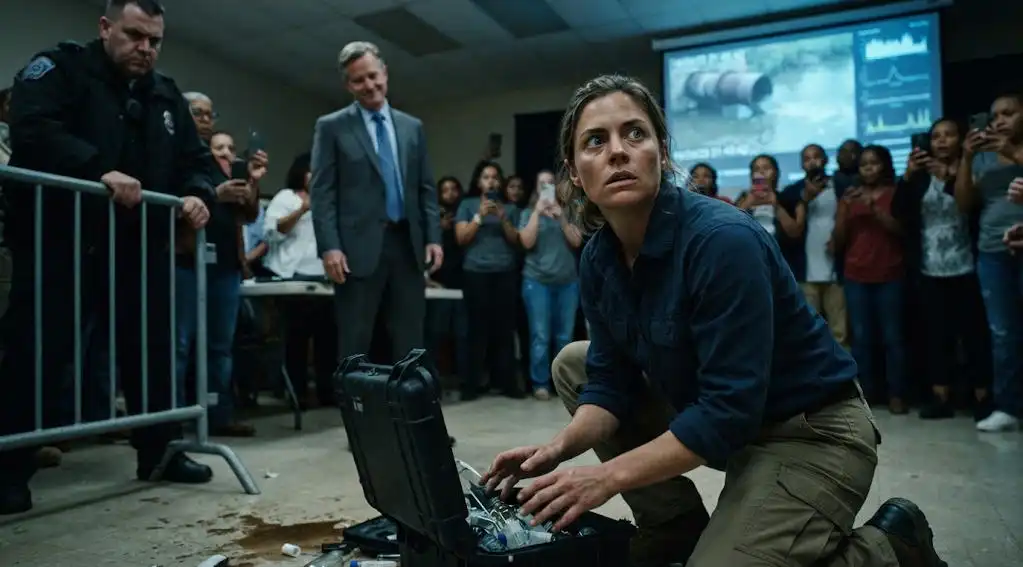
A Chemical Plant Guard Mocked an OVERWEIGHT Water Scientist and Smashed Her Sample Case in Public. He Had NO IDEA What She’d Already Recorded 😱

A Polished Developer Had His Men Shove a Postpartum Home Repairwoman Into the Mud. He Had NO IDEA What She Was Bringing to City Hall 😱

A Quiet Las Vegas Hotel Auditor Was DRENCHED in Red Wine by a Powerful VP in Front of Dozens of Guests. He Had NO IDEA What She’d Already Saved... 😱