

Evelyn's fingers tightened around the photograph inside her apron pocket.
For a moment, she looked at the inventory sheet Daniel Brooks had placed on the table. Then she looked at Grant.
He was no longer smiling.
"That's the shipment," she said quietly. "The one I counted before my shift ended this morning."
Daniel nodded to the auditor standing beside him.
"Let's hear exactly what you found."
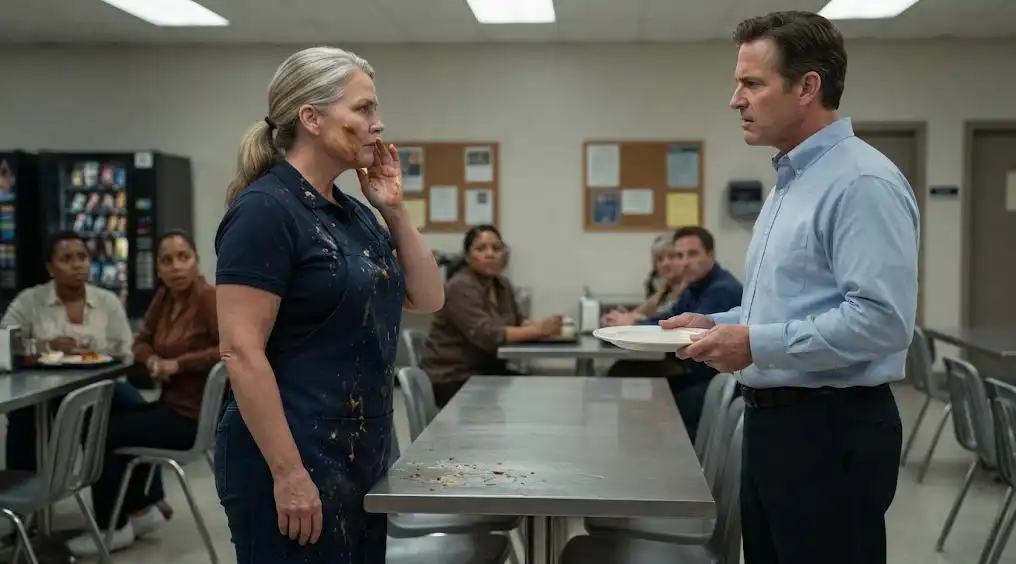
Evelyn stepped closer to the table. Her hair was still wet with leftover food, and a streak of sauce remained on the sleeve of her uniform. One security guard was still holding her left arm.
Daniel noticed.
"Release her."
The guard immediately let go.
Grant moved toward the table.
"Daniel, this is getting completely out of hand. She's an hourly employee. She has no authority to access management reports, and she's been taking company information without permission."
Daniel didn't look at him.
"Then you should have no problem explaining the numbers."
The auditor, a woman named Laura Bennett, placed three documents side by side.
The first was the morning's receiving report.
The second was the inventory-loss report Grant had approved.
The third was a printed copy of Evelyn's independent handwritten ledger, which Daniel had received several days earlier.
Laura pointed to the same product category on all three documents.
"Ms. Carter, please explain the discrepancy."
Evelyn leaned forward.
"Those premium refrigerators arrived yesterday afternoon. I counted twenty-four units when the delivery truck was unloaded. All twenty-four were placed in the secured receiving area."
She touched the first document.
"Here, the receiving report shows twenty-four."
Then she moved her finger to the second sheet.
"But this report says eighteen were damaged during handling."
Grant immediately interrupted.
"That was a preliminary adjustment. We were waiting for a quality inspection."
Evelyn turned toward him.
"No. I checked the units myself. I inspected the packaging, recorded the serial numbers, and signed the receiving count. None of those twenty-four units had been damaged."
Laura looked at Grant.
"Where is the inspection report?"
Grant hesitated.
"The paperwork is in the system."
"Then we can retrieve it," Laura answered.
She turned to another auditor and asked him to preserve the relevant inventory records and transaction history.
Grant folded his arms.
"You don't understand how this department works. We process hundreds of products every day. Mistakes happen."
Evelyn opened her mouth, but Daniel raised one hand.
"Let her finish."
For eleven years, Evelyn had heard supervisors explain why missing merchandise was normal.
She had heard that damaged goods were common, that counting errors were inevitable, and that warehouse employees shouldn't question decisions made above their pay grade.
But she knew the difference between a mistake and a pattern.
And she had spent months documenting that pattern.
"Those six refrigerators weren't the only ones," she said.
Laura looked up.
"What else?"
Evelyn pulled out a small folded notebook from another pocket of her apron.
"Televisions. Premium coffee machines. Commercial kitchen equipment. The same thing kept happening."
She opened the notebook.
"First, the merchandise was received normally. Then a few days later, the inventory system showed that some units had been written off as damaged or unsellable. But the products weren't in the damaged-goods area."
"Where were they?" Daniel asked.
"Near the outbound loading dock."
Grant shook his head.
"That's ridiculous."
Evelyn didn't argue.
Instead, she showed Laura the dates.
On each date, the same sequence appeared:
A high-value shipment arrived.
Evelyn counted it.
The merchandise was later reclassified as a loss.
A truck appeared at the loading dock.
And the physical inventory disappeared.
Laura studied the entries.
"How did you establish the truck connection?"
Evelyn reached into her apron.
This time, she removed a small printed photograph.
It showed the rear of a dark commercial box truck parked near the loading area. The photograph had been taken from the warehouse's designated employee walkway several weeks earlier.
The license plate was visible.
Evelyn placed it beside the inventory reports.
"This vehicle came three times that I personally witnessed. Each time, merchandise listed as damaged disappeared from the outbound area shortly afterward."
Daniel picked up the photograph.
"Did you record the dates?"
"On the back."
He turned it over.
Three dates were written in Evelyn's neat handwriting, each accompanied by a brief note about the merchandise movement.
Laura compared them with the inventory records.
Her expression changed.
"These dates match three separate loss adjustments."
Grant stepped forward.
"That truck belongs to a legitimate transportation contractor. We use outside carriers all the time."
"Then identifying the contractor shouldn't be difficult," Daniel replied.
He handed the photograph to Laura.
"Have the audit team verify the registration, carrier records, purchase orders, and payment trail. Preserve everything."
Grant's voice grew louder.
"You're taking the word of a warehouse clerk over mine?"
Daniel finally faced him.
"I'm taking documented discrepancies seriously. That's what I was brought here to do."
Grant looked around the cafeteria.
The employees who had watched Evelyn being humiliated were still there.
But nobody was looking at the floor anymore.
For the first time that morning, Grant seemed unsure of who was actually in control.
The investigation did not end in the cafeteria.
And Evelyn knew better than to assume that one photograph would settle everything.
She had seen enough paperwork disappear from the company system to understand that the records needed independent verification.
Laura asked her to explain exactly how she had maintained her evidence.
Evelyn described the routine she had developed.
Every morning, she compared incoming shipments with the physical goods delivered to the warehouse. She recorded quantities, product identifiers, and damaged-item counts in a personal paper ledger.
When a discrepancy appeared, she made a photocopy of the relevant receiving and dispatch paperwork while she still had legitimate access to those documents as part of her assigned work.
She kept the copies separately from the company's inventory system.
She also carried a small personal audio recorder.
She used it to preserve conversations about inventory adjustments and instructions she had received during her normal work duties. She had not altered the recordings or edited their contents.
Most importantly, she kept the original files and dated notes together.
"Why didn't you report this sooner?" Laura asked.
Evelyn glanced at Grant.
He was standing several feet away with one security guard beside him.
"I did try."
Her voice was steady.
"I asked him why merchandise I had counted was being classified as damaged. He told me to stop questioning his decisions."
She paused.
"Then my supervisor began changing my assignments. I was removed from some receiving duties, and he started writing me up for things that had never been problems before."
Daniel's expression tightened.
"What kind of write-ups?"
"One said I had failed to complete a count. I had completed it. Another said I had mishandled damaged merchandise. I had never even been assigned to that shipment."
Laura wrote down each detail.
Evelyn continued.
"I knew if I made another complaint through the same management chain, it could disappear. So I sent the records directly to the regional office."
Daniel nodded.
"I received your package."
He explained that the envelope had arrived through a traceable delivery service three days earlier.
It contained photocopies of inventory records, handwritten comparisons, dated notes, and a cover letter explaining why Evelyn feared retaliation.
Daniel had initially asked the regional compliance team to preserve the records and arrange an independent review.
The evidence had already raised enough concerns to justify the surprise visit.
The encrypted message Evelyn had just sent from her phone was an additional notification, not the only copy of her evidence.
Even though Grant had smashed the device, the message had already reached the company's secure ethics reporting system. Its receipt was recorded on the server.
Grant stared at Daniel.
"You came here because of a letter from an employee?"
"I came because the information warranted an investigation," Daniel replied.
"That letter could have been fabricated!"
"Then the original documents, receiving records, transaction history, and physical inventory should establish that."
Grant had no answer.
Laura and the external audit team began checking the records.
They did not rely on Evelyn's notebook alone.
They compared her handwritten counts with original delivery receipts, archived purchase orders, warehouse dispatch records, and the inventory adjustment history.
The results were worse than Daniel had expected.
The discrepancies weren't random.
Over several months, expensive products had repeatedly been removed from company inventory through false damage classifications.
The products were then transferred out through transactions that did not have legitimate supporting documentation.
The losses had been entered as ordinary operating expenses, making the warehouse appear inefficient and unprofitable.
But the company hadn't actually lost those products through accidents.
They had been diverted.
The auditors also found that several adjustments had been approved under Grant's management credentials.
Other transactions were linked to a vendor that appeared repeatedly in the transportation records.
Laura requested additional documentation for the vendor.
Grant refused to provide a clear explanation.
Instead, he insisted that a relative working in corporate headquarters could confirm that all his decisions had been approved.
Daniel asked for the name.
Grant gave it.
Daniel immediately instructed the compliance team to document the claimed relationship and review any transactions or communications involving that individual.
He made it clear that no employee would be excluded from the investigation because of a family connection.
That was when Grant's confidence finally began to collapse.
The external audit team found that the vendor's business address and ownership information did not match the independent transportation records.
The vehicle in Evelyn's photograph was associated with the same contractor.
The company was now examining whether the contractor had been used to move stolen merchandise and whether payments had been directed to accounts connected to Grant.
A photograph alone could not prove every part of the scheme.
But it had given investigators a concrete lead that matched the dates, products, and inventory discrepancies.
And Evelyn had preserved the one detail the company's altered reports had failed to erase.
The truck's license plate.
Grant tried one final time to stop the investigation.
He turned toward the security guards.
"Remove her from the building. She's suspended pending review."
Daniel stepped between him and Evelyn.
"You no longer have authority to issue instructions concerning this employee."
Grant stared at him.
"What?"
"Effective immediately, you are terminated from your position as warehouse operations supervisor, pending the formal documentation of this decision and the company's investigation findings."
Grant's face went pale.
"You can't do that. My family—"
"Your family has nothing to do with the inventory."
Daniel continued.
"Your access to company systems is being revoked. The relevant records have been preserved, and the evidence is being referred to law enforcement. You will not contact witnesses or interfere with the investigation."
Grant looked at the guards.
One of them stepped away from Evelyn and moved toward him.
"You're making a mistake," Grant said.
Daniel's voice remained firm.
"No. The mistake was believing that the people who count your inventory don't understand what disappears."
Grant attempted to argue again, but Laura instructed the security team to escort him to a separate office while the company completed the formal handover.
He was not permitted to return to the warehouse or access company records.
Evelyn watched him walk away.
She didn't smile.
She didn't shout.
She simply looked down at the broken phone on the cafeteria floor.
For months, she had feared that one false disciplinary report could cost her the job that paid her family's bills.
Now the person who had threatened her was the one being escorted out.
But Daniel wasn't finished.
He turned toward her.
"Ms. Carter, I'd like to speak with you about something."
Evelyn straightened.
"Yes, sir?"
He looked at the auditors and then back at her.
"How long have you been doing inventory work?"
"Eleven years with this company. Before that, I worked in shipping and receiving for a regional distributor."
"Have you ever supervised a warehouse?"
"Not officially."
"Have you ever trained new employees?"
"Almost every person who has worked receiving in this building has learned the job from me at some point."
Daniel gave a small nod.
"Laura tells me your records were more organized than some of the reports we received from management."
Evelyn looked down at her stained apron.
"I just wanted the numbers to be right."
Daniel paused.
"That's exactly why I'm asking."
The next morning, Evelyn returned to the warehouse.
She had slept very little.
Her phone was broken, her uniform had been washed, and she was still trying to understand how quickly her life had changed.
She expected to meet with human resources about the investigation.
Instead, Daniel was waiting in the conference room with Laura and the human resources director.
There was a folder on the table.
Daniel asked her to sit.
"Before we discuss anything else, I want you to know that the company has formally documented yesterday's incident."
He explained that the cafeteria footage had been preserved, along with employee statements and the records of the security response.
The company would review the supervisor's conduct separately from the merchandise investigation.
Evelyn nodded.
She wasn't accustomed to being invited into meetings like this.
Daniel opened the folder.
"We've reviewed your employment history. Your attendance record is excellent. Your inventory accuracy has been consistently high, and your training contributions are documented."
He slid a letter across the table.
"Effective today, we're promoting you to warehouse operations manager."
Evelyn stared at the paper.
She read the position title once.
Then again.
"Are you sure?"
Daniel nodded.
"The company needs someone who understands the actual work happening on the warehouse floor. Someone who knows that an inventory number represents real merchandise, real money, and real employees."
Evelyn looked at the human resources director.
"Does that mean I can change the way we handle inventory?"
"It means you'll have the authority and resources to improve the department, within the company's operating policies," the director replied.
Daniel added that her promotion came with a revised salary, management training, and direct reporting access to regional operations.
Evelyn's eyes filled with tears.
Not because she had suddenly become wealthy.
Because for eleven years, she had done the work without the title, the authority, or the recognition.
And now the company was finally acknowledging what she could do.
"There's one more thing," Daniel said.
He placed a second document on the table.
The company had approved a substantial financial reward for her documented assistance in protecting its assets and exposing the misconduct.
The amount was significant enough to change her family's financial situation.
Evelyn covered her mouth.
"I wasn't doing it for money."
"I know," Daniel said. "That's why we want to recognize it."
She looked down at the two documents.
The first gave her responsibility.
The second gave her family some breathing room after years of worrying about every unexpected expense.
For the first time in a long while, she allowed herself to cry.
The criminal investigation continued after Grant left the company.
The police received the company's preserved records, the original documents supplied by Evelyn, the photograph of the truck, and the findings of the independent audit.
Investigators traced the contractor's business records and examined payments associated with the suspicious merchandise transfers.
They also interviewed employees who had witnessed the loading activity.
The investigation eventually established that Grant had participated in a scheme involving false inventory-loss reports and the diversion of valuable merchandise.
The merchandise had not simply disappeared.
It had been transferred through a network of transactions designed to make stolen products look like ordinary warehouse losses.
The company also discovered that the scheme had caused substantial financial damage.
Grant was charged with offenses connected to the fraudulent merchandise transactions.
He initially denied responsibility.
But the documentary trail, financial records, witness statements, and corroborating evidence made his explanation increasingly difficult to defend.
The case proceeded through the criminal justice system.
Eventually, Grant was convicted of the offenses established at trial and sentenced to prison.
The company also cooperated with investigators in pursuing the other individuals involved.
The relative Grant had repeatedly invoked was not automatically treated as guilty merely because of their family connection. That person's involvement was examined separately through the financial and communication records.
The company wanted accountability, not another investigation built on assumptions.
Evelyn's work continued.
And she made sure the warehouse would never again depend on one manager's word to determine what had happened to valuable merchandise.
She introduced independent daily reconciliation between receiving counts and inventory adjustments.
High-value damaged merchandise required documented inspection and a second authorized approval.
Outbound transfers were matched against original dispatch records.
Employees were given a direct reporting route outside the warehouse management chain.
She also made sure workers knew they could report discrepancies without first confronting the person they suspected.
Some of the older employees were surprised by the changes.
One afternoon, a young receiving clerk approached her with a clipboard.
"Ms. Carter, I think the count on this pallet is wrong."
Evelyn looked at the sheet.
"Then let's check it before we sign."
The clerk hesitated.
"What if the supervisor doesn't like that?"
Evelyn looked at him.
"Then we show him the numbers."
She took the clipboard and walked with him toward the receiving area.
There was no lecture.
No humiliation.
No threat.
Just two employees doing the work properly.
That was the kind of department she wanted to build.
Several weeks later, the warehouse looked different.
The receiving area had been reorganized. Damaged merchandise was kept in a clearly marked section, and every high-value transfer had a documented approval trail.
The old culture of whispered warnings and unexplained inventory losses was slowly being replaced by something better.
Evelyn's financial reward had given her family a degree of security they had never enjoyed before. She could finally replace things that had been postponed for years and put money aside without wondering whether one missed paycheck would undo everything.
But the greatest change wasn't the money.
It was the way people treated her.
Employees who had once avoided speaking in front of Grant now came directly to her with questions and concerns.
They knew she would listen.
They also knew she would check the facts.
One morning, Evelyn arrived before the rest of the management team.
She walked through the clean warehouse wearing her new manager's uniform.
The navy fabric was crisp. Her name badge sat neatly above the pocket.
She stopped beside a pallet of newly received appliances.
A young employee held out the receiving sheet.
"Twenty-four units, Ms. Carter."
Evelyn looked at the pallet.
Then she checked the document herself.
"Let's count them."
They moved along the row together.
One.
Two.
Three.
She continued until they reached the final unit.
Twenty-four.
She checked the serial numbers, confirmed the receiving record, and signed the inspection sheet.
Then she handed the clipboard back to the employee.
"Good work."
The young worker smiled and carried the paperwork toward the office.
Evelyn remained beside the pallet for another moment.
Her new uniform was clean.
The warehouse floor was clean.
Every product had a place, and every number had to match what was actually there.
She straightened her name badge, picked up the next inventory sheet, and continued checking the merchandise.
This time, nobody could tell her to keep her mouth shut.
She was the manager now.
And she knew exactly what every missing box was worth.
Disclaimer: Mention of any brand or trademark is for identification only and does not imply partnership or endorsement
A Chemical Plant Guard Mocked an OVERWEIGHT Water Scientist and Smashed Her Sample Case in Public. He Had NO IDEA What She’d Already Recorded 😱
A Polished Developer Had His Men Shove a Postpartum Home Repairwoman Into the Mud. He Had NO IDEA What She Was Bringing to City Hall 😱

A Quiet Las Vegas Hotel Auditor Was DRENCHED in Red Wine by a Powerful VP in Front of Dozens of Guests. He Had NO IDEA What She’d Already Saved... 😱