


The cardboard container was hot enough to sting Leo’s fingers through his gloves, but he held it with both hands anyway.
Steam slipped through the folded lid as the seven-year-old hurried along the cracked sidewalk in South Boston, keeping his shoulders tucked against the cold. Inside was beef stew, potatoes, carrots, and enough broth to make the apartment smell like a real dinner instead of fever medicine.
His mother, Nora, had barely eaten since the night before.
That morning, she had tried to get out of bed for her nursing shift and nearly collapsed beside the kitchen table. By afternoon, her fever had climbed high enough that Leo had stopped pretending he was not scared.
Nora had told him there was soup in the cupboard.
Leo had checked.
There was half a can.
So he had taken the money from the jar under his bed—the coins and crumpled bills he had been saving for months—and bought the biggest hot meal the corner diner would give him.
He was less than two blocks from home when Arthur stepped out from beside a boarded storefront.
Arthur was in his fifties, broad even under a stained winter coat, with the heavy face of a man who had spent years angry at everyone who still had something to lose. People in the neighborhood knew pieces of his story. He had once had a house. He had once owned a decent car. Then gambling had eaten the savings, the house, the marriage, and finally whatever patience he had left for the world.
Lately he slept wherever no one chased him away.
Leo tried to walk around him.
Arthur moved with him.
“What’ve you got there?”
Leo hugged the container closer.
“Dinner.”
Arthur looked at the steam rising from the lid.
“For who?”
“My mom.”
Arthur held out his hand.
“Give it here.”
Leo stared at him.
“No.”
Arthur almost smiled.
It was not the answer he expected from a skinny child whose coat sleeves were too short.
“You say no to me?”
“My mom’s sick.”
Arthur took another step.
Leo backed away, but there was a brick wall behind him and dirty snow along the curb.
“She hasn’t eaten,” Leo said. “Please.”
Arthur’s expression changed at the word please.
For a second, Leo thought he might move aside.
Instead, Arthur grabbed the container.
Leo clamped both arms around it.
“No!”
Arthur yanked.
Leo stumbled forward but refused to release it.
“Let go.”
“No!”
The struggle lasted only a few seconds, but Leo fought with the desperate strength of someone who understood exactly what the food meant. Arthur could have taken it immediately if he had simply hit him.
But something about the child refusing made his face harden.
Arthur had spent years being told no by people with better clothes, better jobs, better homes, better luck. He had been thrown out of betting rooms, shelters, bars, and apartments. He had watched people cross streets to avoid him.
Now a seven-year-old was telling him no.
Arthur wrenched the container free.
Leo reached for it.
“Please! That’s for my mom!”
Arthur looked down at the food.
Then he tore the lid back.
Leo’s eyes widened.
Arthur turned the container over.
The stew came down over Leo’s head.
Leo screamed.
Hot broth soaked his hair and ran across his forehead and neck. Chunks of meat and vegetables slid down the front of his coat. He fell backward onto the sidewalk, clawing at his collar as the heat trapped beneath the fabric burned his skin.
The empty container hit the pavement beside him.
For several seconds, Leo could not understand anything except pain.
Then he saw the stew spreading across the dirty sidewalk.
His dinner.
His mother’s dinner.
Gone.
Tears spilled down his face.
“Mom’s still hungry,” he cried. “Why did you do that?”
Arthur spat onto the pavement.
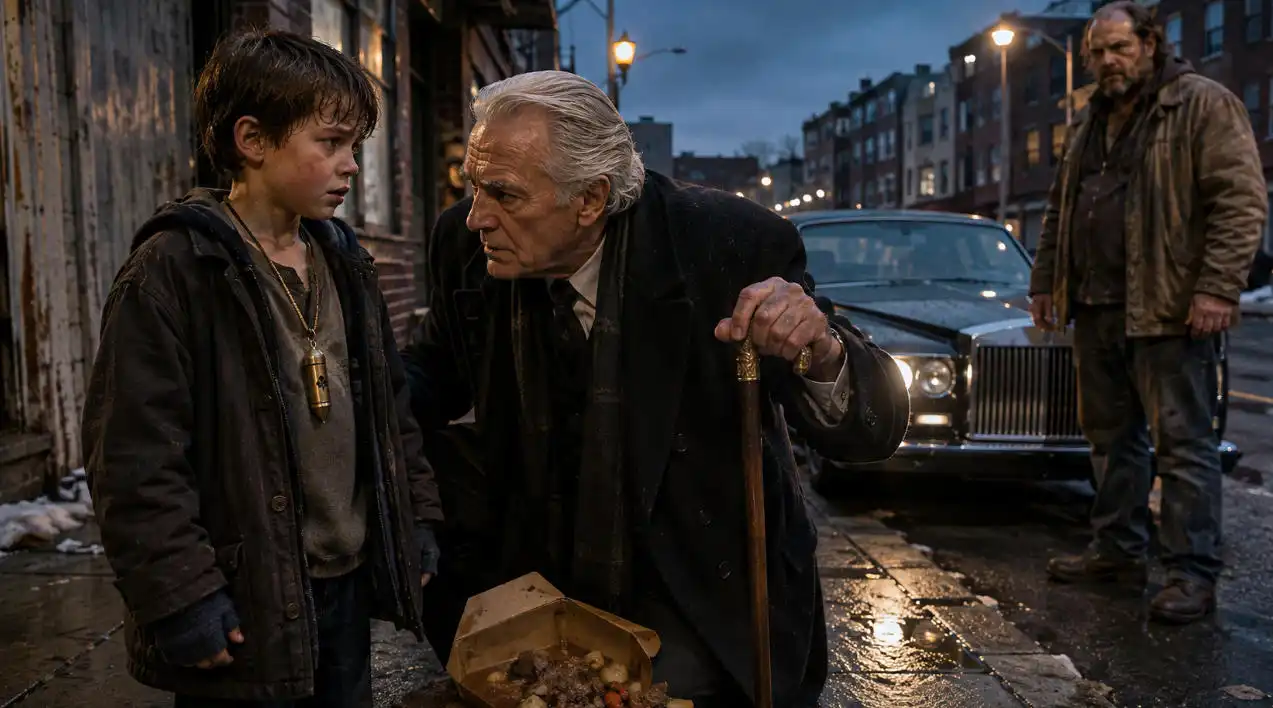
“Poor trash pretending to be a good person,” he said. “The gutter’s where you belong.”
Across the intersection, an old Rolls-Royce stopped.
It had been moving slowly through those streets for several days, too polished and too expensive for the neighborhood. People had noticed it. A few had joked that some rich man’s driver had lost his way.
Inside the car, Declan had just looked down at the address on his phone.
“We’re close,” he said.
The man beside him did not answer immediately.
Sullivan was seventy, silver-haired, narrow-faced, and leaning on a heavy cane even while seated. Age had reduced the speed of his movements, but very little else. Men who had known him for forty years still lowered their voices when they said his name.
Some called him Ironhand Sullivan.
Fewer said it to his face.
For most of his adult life, his influence had run through docks, unions, construction crews, clubs, back rooms, and streets where official authority did not always arrive first.
Yet he had come to this neighborhood for one woman.
Ten years earlier, Sullivan had stumbled through a different Boston alley with blood filling his shirt.
An ambush had left him badly wounded. One bullet had struck the brass charm he wore beneath his shirt before tearing into him, changing the angle just enough to keep the shot from killing him immediately.
Nora had found him while walking home from a nursing shift.
She had not known his name.
She had known only that a man was bleeding to death.
She dragged him out of sight, pressed her hands against the wound, improvised a bandage, and kept him alive until his own people found them.
When Sullivan later tried to give her money, Nora refused it.
She would not take cash she believed came from crime.
So Sullivan gave her something else.
The dented brass bullet charm he had worn for decades, marked with the tiny shamrock pattern of his family.
“If you ever need me,” he had told her, “show this. Anyone who matters will know.”
Nora had never used it.
She had hidden its history from her son because she wanted no part of Sullivan’s world attached to Leo. Years passed. She moved. Numbers changed.
Sullivan, growing older and increasingly aware that time was narrowing, finally hired a private investigator to find the nurse who had once saved his life.
The investigator had found an address.
Sullivan had been on his way there when Leo screamed.
Declan looked through the window.
Sullivan followed his gaze.
A small boy was sitting in the street, soaked in food.
An older man stood over him.
Sullivan’s face tightened.
“Stop.”
The Rolls-Royce halted beside the curb.
Leo was trying to pull the hot collar away from his neck when the damaged fabric slipped aside.
Something swung free from beneath his shirt.
A brass bullet.
Dented on one side.
A tiny shamrock caught the last gray light of the evening.
Sullivan stopped breathing for a moment.
His hand closed around the top of his cane.
He had worn that piece of brass against his chest for forty years.
He knew every scratch.
Declan opened the door.
Sullivan stepped out.
Arthur glanced toward the car and laughed once under his breath.
“Well, look at that.”
He saw an old man with a cane and another man in a dark coat.
He did not see danger.
Not yet.
Sullivan walked toward Leo.
His eyes moved from the ruined food to the red skin along the boy’s hairline, then to the pendant.
The cold distance in his face disappeared.
What replaced it made Declan straighten.
“Boy,” Sullivan said quietly.
Leo looked up.
Sullivan pointed at the pendant.
“Where did you get that?”
Leo gripped it instinctively.
“My mom.”
“What’s her name?”
“Nora.”
Sullivan shut his eyes for half a second.
When he opened them again, he looked at Arthur.
There was nothing uncertain in his expression now.
Arthur noticed.
“What?” Arthur snapped.
Sullivan did not answer him.
He crouched as far as his old knees allowed and looked at Leo instead.
“Nora the nurse?”
Leo nodded, frightened and confused.
“She’s sick.”
Sullivan’s jaw flexed.
Before he could speak, Arthur picked up a broken bottle from beside the wall.
“Everybody back off.”
Declan moved between him and Sullivan.
Arthur waved the jagged glass.
“This has nothing to do with you.”
Declan’s gaze dropped to the bottle.
“Put it down.”
Arthur stepped forward.
“Make me.”
He barely finished the words.
Declan caught his wrist, turned under the arm, and drove Arthur against the wall with one compact movement. The bottle shattered on the pavement. Arthur screamed as his shoulder came out of place, and the strength vanished from his knees.
He dropped hard.
“Jesus! Stop! Stop!”
Declan released him only after the broken glass was out of reach.
Arthur clutched his useless arm and stared up at Sullivan.
Something in his face finally changed.
Recognition had arrived.
Maybe not of Sullivan personally, but of the kind of man who could step from that car and make another dangerous man move without hesitation.
Arthur’s voice became small.
“I didn’t know.”
Sullivan looked at the stew dripping from Leo’s hair.
“You didn’t know what?”
Arthur swallowed.
“I didn’t know who the kid was.”
That answer seemed to anger Sullivan more.
“You thought he was nobody.”
Arthur opened his mouth.
Nothing came out.
“You thought that made it safe.”
Arthur’s eyes filled with panic.
“I’m homeless, all right? I lost everything. I’ve got nowhere to go.”
Sullivan stared at him.
“So you found someone smaller.”
Arthur bowed his head.
“I’m sorry.”
Leo was still crying quietly. His scalp hurt, his neck hurt, and every few seconds he looked toward the ruined food as though it might somehow become dinner again.
Sullivan turned away from Arthur.
“Declan.”
“Yes.”
“Call ahead. We need a doctor for the boy and a full team for his mother.”
Declan immediately reached for his phone.
Sullivan reached inside his coat and took out a thick fold of bills.
He held it toward Leo.
“For the food. For whatever else you need.”
Leo stared at the money.
He did not take it.
Sullivan lowered his hand slightly.
“It’s all right.”
Leo wiped broth and tears from his cheek with his sleeve.
Then he pushed Sullivan’s hand away.
“I don’t want money.”
Sullivan froze.
For a strange second, the street disappeared from his mind.
Ten years earlier, Nora had stood beside a hospital loading entrance and pushed away another stack of his money with almost the same expression.
He had remembered her exact words for a decade.
I didn’t help you so you’d owe me.
Leo looked up at him.
“Can you get a doctor to see my mom?”
The old man’s hand slowly closed around the cash.
“Yes,” he said.
Leo sniffed.
“She’s really hot. And she keeps saying she’s fine, but she’s not.”
Sullivan nodded.
“Then your mother gets a doctor.”
Behind them, Arthur tried to rise.
Declan turned his head.
Arthur stopped.
Sullivan did not raise his voice when he addressed him.
“You wanted the gutter to be the boy’s place.”
Arthur’s breathing became uneven.
“No, listen—”
“You’re going to learn what it means when a street decides it has no place for you.”
Arthur stared.
Sullivan’s orders moved through the neighborhood before the Rolls-Royce did.
He did not call the police.
He did not need to.
By the time Arthur reached the first shelter he knew, the answer waiting for him was no. At the next place, another door closed. Corners where men normally tolerated him suddenly did not. Places where he had begged, slept, borrowed, or traded favors became unavailable one after another.
Word had gone out through the network Sullivan controlled and the people who preferred not to oppose it.
Arthur was finished in Boston.
No corner.
No protected doorway.
No sympathetic back room.
No shelter willing to risk defying the order.
With one arm hanging uselessly and nowhere left to stay, Arthur eventually walked south until the neighborhood lights were behind him.
No one applauded when he left.
No crowd gathered.
The city simply stopped making room for him.
Leo knew none of that yet.
He was standing beside the Rolls-Royce while Declan gently poured bottled water over the less serious burns along his hairline. Sullivan watched with visible impatience until Declan confirmed that the boy needed treatment but did not appear critically injured.
Then Sullivan opened the rear door.
“We’ll take you home.”
Leo hesitated.
“My mom says not to get in cars with strangers.”
For the first time that evening, Declan almost smiled.
Sullivan nodded solemnly.
“She’s right.”
Leo looked at the pendant.
“You knew this.”
“I did.”
“Was it yours?”
Sullivan glanced at the old brass charm.
“Yes.”
“Why did my mom have it?”
Sullivan leaned on his cane.
“Because she saved my life.”
Leo stared at him.
Sullivan did not add anything about bullets, ambushes, criminal families, or the old promises Nora had deliberately buried.
Not there.
Not while the child was burned and frightened.
“She helped me when nobody else did,” he said. “I told her if she ever needed help, I would come.”
Leo looked toward the apartment buildings.
“She needs help now.”
“Yes,” Sullivan said. “So we’re coming.”
The Rolls-Royce carried Leo the final blocks home.
Two more dark cars joined it before they reached Nora’s street.
Neighbors came to windows when the small convoy stopped in front of the battered apartment building. Men in expensive coats stepped out and quietly took positions along the sidewalk.
Leo climbed from the car.
Sullivan followed.
A light rain had begun.
Declan opened an umbrella over him, but Sullivan took it from his hand.
Then the old man did something that made Declan blink.
He set his cane against the car.
Without it, his first step was unsteady.
He ignored the pain.
He held the black umbrella over Leo instead.
Leo looked up.
“You need that stick.”
“I’ve needed worse things.”
Sullivan walked beside him toward the building.
The boy stayed dry.
The old man did not.
Minutes later, another vehicle pulled in.
Then another.
Doctors and nurses stepped onto the sidewalk carrying medical cases.
They had been taken away from dinners, offices, and private practices with almost no explanation beyond a name and an address. No one complained when they saw Sullivan waiting at the entrance.
Leo led them upstairs.
At the apartment door, he stopped.
His hand hovered near the knob.
Suddenly, after everything that had happened outside, he looked seven again.
“What if she’s worse?”
Sullivan studied him.
“Then they help her.”
Leo looked at the medical team behind them.
“You promise?”
Sullivan looked at the brass bullet resting against the boy’s chest.
Ten years earlier, a young nurse had refused to let him die in an alley.
For ten years, she had asked him for nothing.
Now her son had finally asked.
“Yes,” Sullivan said. “I promise.”
Leo opened the door.
Inside, Nora called weakly from the bedroom.
“Leo?”
“I’m home, Mom.”
He hurried inside.
Sullivan remained in the hallway.
He did not enter.
Not yet.
The medical team moved forward, but softly, as though approaching a sleeping child rather than a sick woman in a run-down apartment. One of the doctors reached the door first.
He raised his hand.
And beneath the black umbrella still dripping onto the hallway floor, while Sullivan’s men waited in complete silence behind him, the doctor gently knocked on Nora’s door.
Disclaimer: Mention of any brand or trademark is for identification only and does not imply partnership or endorsement
A Wealthy Manhattan Socialite Poured Red Wine on a Plus-Size Artist at a Charity Gala, Calling Her “Cheap and Unworthy.” She Had NO IDEA Who Would Discover Her Paintings... 😱
A Celebrity Trainer Threw CASH in a Plus-Size Nutritionist’s Face at a Luxury LA Gym, Saying She Couldn’t Even Control Her Own Weight. He Had NO IDEA What Her Clients Would Prove... 😱
My Fiancé’s Mother CUT MY Custom Engagement Dress in Front of 200 Guests and Called Me an “Elephant in a Sack.” My Fiancé Just SMILED... 😱