


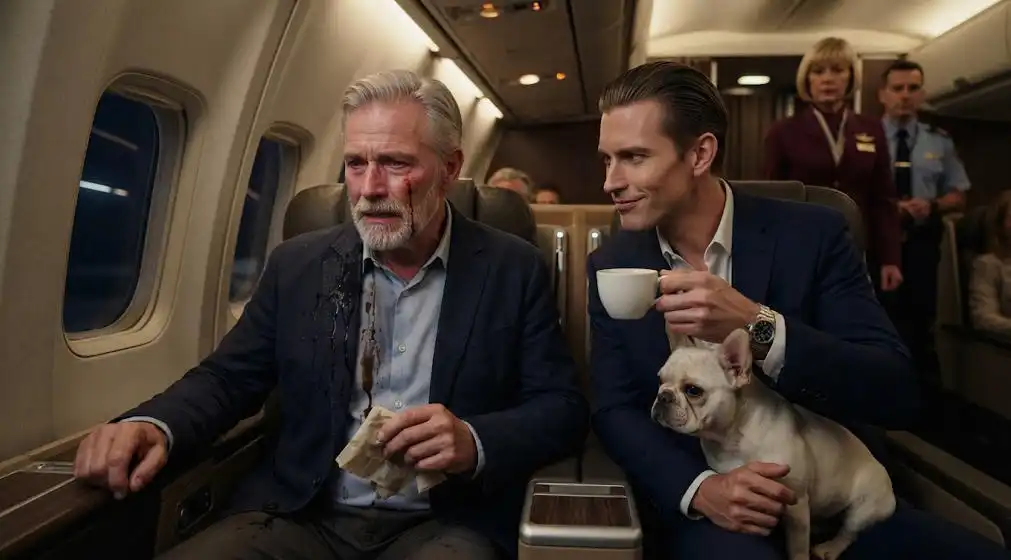
The coffee hit Walter Hayes before he had time to turn his head.
One moment, he was sitting quietly beside the window on Northstar Atlantic Flight 417, preparing for the overnight journey from New York to London. The next, scalding black coffee splashed across his cheek, ran beneath his collar, and soaked the front of his navy jacket.
“Move. My dog gets this seat.”
The man beside him lowered an emptying white ceramic cup.
Walter jerked backward. His eyes squeezed shut, and his left hand flew to his face. The heat made him gasp. For several seconds, all he could feel was the sting spreading across his cheek and the wet fabric sticking to his skin.
Then came the insult.
“You reek of poverty. Back to economy, you broke nobody.”
Grant Mercer, thirty-nine, managed a successful Wall Street hedge fund. His tailored suit, expensive watch, and polished confidence announced that he was accustomed to being obeyed. A cream-colored French bulldog named Winston rested on his lap, its little black nose pointed toward Walter.
Grant looked at the coffee on Walter's jacket and shrugged.
“It's only a drink. Don't make this into a whole production.”
Walter opened his eyes.
He wanted to shout. He wanted to ask what kind of man threw hot coffee at a stranger over a seat. His cheek burned, his eyes watered, and the humiliation was almost worse than the pain. Around them, conversations had stopped. Several passengers were watching.
He swallowed his first response.
Then he reached for a paper napkin.
“That's better,” Grant said, settling back. “Now, get your bag.”
Walter dabbed his face. His fingers trembled slightly, but he did not leave his seat.
Grant had purchased two adjacent first-class seats on the flight. He intended to use one for himself and the other for Winston, his pedigreed French bulldog. He had refused to place the animal in an approved carrier for the flight, insisting that the dog deserved its own seat.
Northstar Atlantic's policy was clear: a pet could travel in the cabin under the applicable carrier requirements, but it could not occupy a passenger seat merely because its owner had purchased an additional seat.
Grant considered that rule an inconvenience meant for people who lacked the money to negotiate around it.
A last-minute aircraft change had left the first-class cabin one seat short of the number sold. Walter's valid boarding assignment now conflicted with Grant's extra-seat reservation.
The airline should have resolved the problem through its established seating process.
Grant had chosen another solution.
Earlier, in the galley, he had slipped an envelope of cash to Elaine Brooks, the flight's purser. In exchange, she had agreed to mark Walter for a downgrade, clearing the disputed seat for Winston.
A junior flight attendant named Sophie Lane had witnessed the exchange. She had wanted to report it, but Elaine controlled her training evaluation and her chances of securing a permanent position. Sophie had spent the past hour convincing herself that someone else would notice.
Now she watched Elaine approach Walter with an airline security officer at her side.
“Sir, stand up.”
Elaine's voice was firm enough to make it sound as though Walter had already done something wrong.
Walter lowered the wet napkin.
“Why?”
“There's a seating issue. You'll be moved to another cabin.”
“I have a first-class ticket.”
“We're aware of that.”
“Then explain why I'm being moved.”
Elaine glanced at Grant. He gave her a small, impatient nod.
“Sir, we're not going to debate this in the aisle. Please collect your belongings.”
Walter looked from her to the security officer.
“My ticket is valid. I haven't agreed to a downgrade.”
Grant leaned forward.
“Do you have any idea how much I spend with this airline? Get him out of here.”
Elaine's expression tightened. She pointed at Walter's carry-on.
“Take his bag.”
The security officer reached down.
Walter placed his hand firmly over the handle.
“Don't touch my property.”
His voice was quiet, but the refusal was unmistakable.
He was not a large man. His jacket was ordinary, his shoes were worn, and his face was now marked by the coffee. Yet there was something in the way he held the bag that made the security officer pause.
Walter looked at Elaine again.
“You can ask me to move. You cannot pretend I've agreed.”
Across the aisle, a passenger began recording. Another quietly asked a flight attendant whether this was really how Northstar treated its first-class customers.
Elaine heard them.
Her professional composure began to crack.
“Sir, your behavior is disrupting the cabin.”
Walter almost laughed at the absurdity of it. He was the man sitting quietly with coffee dripping from his face, yet somehow he was the problem.
He had spent years listening to complaints from people who felt that their money, their time, and their dignity mattered less than the demands of someone more influential. Most complaints arrived after the damage was done. Some were dismissed as misunderstandings. Others were marked resolved before anyone had bothered to investigate them.
That was why he had booked this flight himself.
At sixty-five, Walter Hayes was the founder, executive chairman, and controlling shareholder of Northstar Atlantic Group, the company behind the airline carrying his name on its boarding pass.
He had built the business from a small regional operation into an international airline group. He had negotiated aircraft contracts, recruited its first pilots, and spent decades insisting that the company could not call itself premium if its employees treated ordinary people as disposable.
Recently, several complaints had reached his office about unauthorized downgrades and special treatment for wealthy passengers on the New York-to-London route.
The reports were troubling. The internal records, however, showed that the disputed passengers had supposedly accepted their changes voluntarily.
Walter had suspected that somebody was manipulating the system.
Rather than announce an inspection and give everyone time to prepare, he had booked a regular first-class ticket under his own name, left his assistants behind, and boarded in his usual jacket.
He wanted to see what happened when nobody believed he mattered.
He had not expected the answer to arrive in the form of a cup of hot coffee.
Now Elaine was reaching for his carry-on again.
Walter drew his hand back, slipped it inside the inner pocket of his jacket, and removed a thin, completely black metal card.
There was no name printed on it. No logo. No account number. Its surface was matte and unmarked except for a tiny recessed notch along one edge.
Elaine frowned.
“What is that supposed to be?”
Walter did not answer.
Beneath the inner side of his seat's armrest was a narrow panel concealed behind a leather flap. Almost nobody who had flown on that aircraft would have noticed it. Walter had approved the original cabin specification decades earlier, when Northstar commissioned the aircraft's proprietary safety and communications system.
The hidden reader was part of a physical executive safety override. It was not a feature passengers could access through ordinary cabin controls, and the black card was issued to only one person: the company's executive chairman.
Walter opened the panel.
The card slid into the reader with a precise metallic click.
For a moment, nothing happened.
Then a small indicator beneath the armrest illuminated amber. The ordinary cabin announcement channel went silent, and the aircraft's proprietary emergency communications system acknowledged the authenticated override. The flight-deck access system entered its secured mode, the normal cabin announcement controls were locked out, and a priority communications channel opened to the captain and the airline's operations center.
Elaine stared at the armrest.
The security officer stepped back.
Walter's face was still red. His jacket was still soaked. But his hands had stopped trembling.
He pressed the red communication button in front of him.
“Captain, this is Walter Hayes. Suspend departure. Return to the gate. Preserve the cabin records and initiate an immediate safety review.”
The message reached the flight deck through the authenticated channel.
The captain, Daniel Foster, had been preparing for departure when the alert appeared. He recognized the override protocol from Northstar's aircraft documentation. He also knew that the card did not give a passenger control of the aircraft. The captain retained operational responsibility, and any instruction affecting movement had to be carried out through the appropriate flight and ground procedures.
But the identity authenticated by the system was not an ordinary passenger.
It was Walter Hayes.
Captain Foster immediately stopped the departure process and transmitted the return request to air traffic control. The aircraft halted its movement away from the stand, then followed the captain's instructions to return to the gate.
Across the cabin, passengers looked up as the public-address system came alive.
Walter's voice carried through the speakers.
“This is Walter Hayes, executive chairman of Northstar Atlantic Group. This departure is suspended. No passenger is to be removed, no cabin record is to be altered, and no crew member is to leave before the incident has been documented. We will conduct an immediate review on the ground.”
Nobody spoke.
Grant's expression changed first.
He looked at Walter, then at the black card, then at Elaine.
“What is this?” he demanded. “Who gave him permission to do that?”
Walter turned toward him.
“I don't need your permission.”
The aircraft returned to the gate. Ground personnel secured the aircraft, and the door was reopened only after the captain had confirmed it was safe to do so.
Two Port Authority police officers boarded, accompanied by the airline's station manager and a duty investigator. The captain came out of the flight deck and spoke privately with the station manager before approaching Walter.
“Mr. Hayes,” he said, “I've ordered the aircraft held. We won't depart until the incident is reviewed.”
Walter nodded.
“Thank you, Captain. Please preserve the communications record and the seating assignment history. I want the original entries, not a rewritten summary.”
“Understood.”
The captain glanced at Walter's face.
“Are you injured?”
“Only a minor burn. Please have the medical team check it.”
Walter's first request was not for a speech, an apology, or a public announcement of his position. He wanted the facts preserved, the injured passenger treated, and the people responsible held accountable.
That was when the station manager finally understood why the captain had addressed the older man so formally.
“Mr. Hayes,” she said, “we'll begin the review immediately.”
Grant sprang to his feet.
“Hold on. This is ridiculous. I paid for two seats. My dog has a reservation. That man was being difficult, and the purser was fixing it.”
“Did you throw hot coffee at him?” one of the officers asked.
Grant hesitated.
“It was an accident.”
Walter looked at him.
“You were looking directly at me.”
“I was trying to get him to move!”
“And when he didn't, you poured coffee on his face?”
Grant's mouth opened, but no answer came.
The station manager asked Elaine for the seat reassignment record.
She produced a tablet and claimed Walter had been selected for a routine downgrade because of the overbooking. She described the incident as a disagreement that had escalated after the passenger refused to cooperate.
Walter listened without interrupting.
Then he asked one question.
“Where is his signed consent?”
Elaine glanced at the tablet.
“He was informed of the reassignment.”
“That wasn't my question.”
The cabin record showed that Walter had been assigned a valid first-class seat. There was no signed consent, no documented acceptance of compensation, and no completed record authorizing the downgrade. Elaine had attempted to move him before the dispute had been properly resolved.
Sophie Lane stood near the galley, pale and visibly frightened.
Walter noticed her.
“Did you see anything before this happened?”
Sophie looked at Elaine. The purser's expression warned her to remain silent.
For a moment, the young flight attendant looked ready to back away.
Then she took a breath.
“Yes, sir. I saw Mr. Mercer give Ms. Brooks an envelope in the galley before boarding. Ms. Brooks put it in her folder. She told him she would take care of the seat.”
Elaine spun toward her.
“That's an outrageous accusation.”
Sophie flinched, but she continued.
“I saw it. I should have reported it earlier.”
“You should have minded your own business,” Elaine snapped.
The station manager intervened and separated the crew members. Elaine's service folder was secured for the investigation, and the envelope was recovered. Sophie provided a formal statement describing the exchange. The investigator also preserved the available communications and seating records rather than allowing the incident to be closed as a routine customer dispute.
The evidence did not establish every detail of the arrangement in a single conversation, but it was enough to expose a serious breach of trust and justify immediate action.
Walter turned to the station manager.
“Remove Ms. Brooks from duty now. Preserve every relevant record. Her conduct, the payment, and the false downgrade entry will be reviewed together.”
Then he looked directly at Elaine.
“You were entrusted with the safety, comfort, and fair treatment of every passenger in this cabin. Instead, you used your position to favor someone who paid you, and you tried to force an innocent passenger out of a seat he had paid for.”
Elaine's face had gone pale.
“Mr. Hayes, I can explain—”
“You had your opportunity to explain when he asked you a simple question. You chose to threaten him instead.”
As executive chairman, Walter exercised his authority to terminate her employment effective immediately for serious misconduct, subject to the written documentation of the decision. The station manager took her crew badge and wings, and Elaine was escorted away from the cabin pending the formal handover of the case.
For the first time since boarding, Grant seemed to understand that his money could not buy his way out of what he had done.
He tried anyway.
“Walter Hayes?” he said, staring at the older man. “You're the Walter Hayes?”
Walter gave him no answer.
Grant looked toward the station manager, then toward the officers.
“Look, whatever this is, I can pay for the damage. I'll cover his medical expenses. We can settle this privately.”
Walter's expression hardened.
“You thought you could buy a seat by paying a crew member. Then you thought you could buy my silence by throwing money at me. This isn't a private misunderstanding.”
One of the officers stepped forward.
“Mr. Mercer, we need you to come with us for questioning in connection with the assault.”
Grant refused to move.
“You can't be serious. Do you know who I work for?”
“Yes,” the officer replied. “And right now, we're asking you to come with us.”
When Grant continued arguing, the officers took him by the arms and escorted him down the jet bridge. He protested that his lawyers would make the airline regret everything. His voice carried through the open aircraft door, growing fainter as he was led away.
The French bulldog remained unharmed. A ground employee retrieved its carrier and arranged for the animal to be taken safely into the terminal with Grant's belongings rather than being treated as part of the dispute.
Walter watched the dog leave before turning back to the station manager.
“There is one more thing.”
She waited.
“Review every first-class downgrade on this route. Compare the original seat assignments with the final records. Check whether passengers actually consented, whether compensation was offered, and whether complaints were closed without proper investigation.”
“Yes, Mr. Hayes.”
“And protect anyone who reports misconduct. Ms. Lane should not lose her position because she told the truth.”
Sophie looked up, startled.
Walter met her eyes.
“You were afraid. I understand that. But now that the review has begun, tell the investigators everything you saw. Don't leave anything out.”
“I will, sir.”
The captain confirmed that the aircraft would remain at the gate until the immediate safety and conduct review was complete. The airline's operations team began preserving the relevant records and initiating an independent examination of the route's seating practices. The first review identified other downgrade entries that required verification, including cases marked voluntary without the expected passenger acknowledgments.
Walter ordered those cases examined individually. He would not assume that every discrepancy proved corruption, but neither would he allow a convenient label to substitute for the truth.
The airline had a delayed departure, an injured passenger, a dismissed purser, and a wealthy customer facing police questioning. More importantly, it had a clear indication that its internal controls had failed where they mattered most.
Walter declined a private room and a special escort. The medical team checked his cheek and confirmed a mild superficial burn. They offered treatment, but he asked first to see the captain.
Captain Foster returned from the flight deck carrying a clean white towel.
“Here you are, Mr. Hayes.”
“Thank you, Captain.”
Walter accepted the towel and pressed it gently against his reddened cheek. His navy jacket remained stained, and the paper napkin lay crumpled on the side table. The cabin around him was quieter now, its passengers watching from their seats as the crew began documenting the incident.
Through the open aircraft door, Walter could still see the jet bridge.
Grant was being led farther down it by the two officers, his expensive suit creased, his confident gestures reduced to angry movements of his hands. He turned once, still protesting, but neither officer stopped.
Walter sat in his first-class seat, the clean white towel against his face, and watched Grant being taken away.
His expression was cold, his cheek still burning.
He did not smile.
He simply kept watching until the man who had believed everyone had a price disappeared from view.
Disclaimer: Mention of any brand or trademark is for identification only and does not imply partnership or endorsement
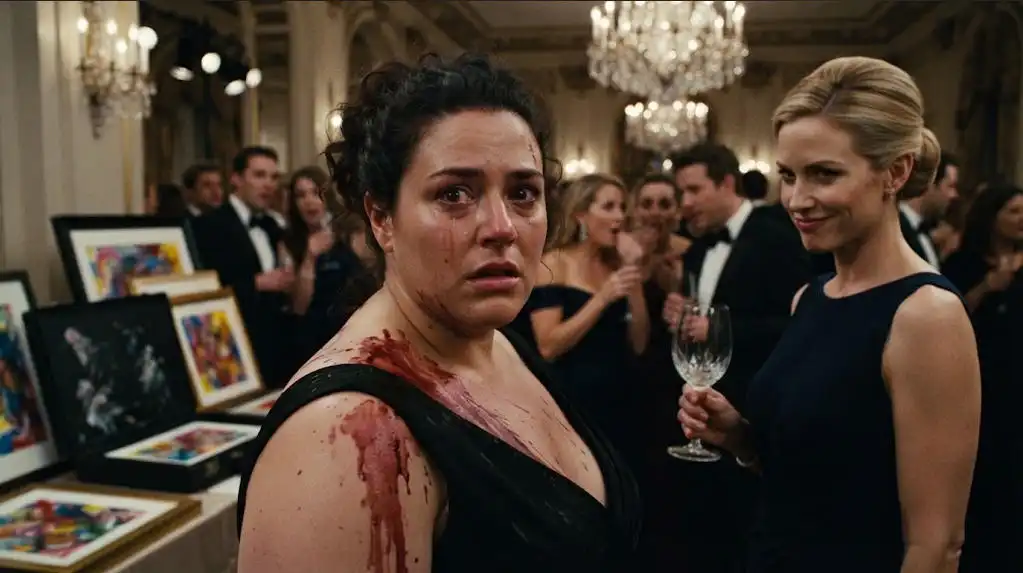
A Wealthy Manhattan Socialite Poured Red Wine on a Plus-Size Artist at a Charity Gala, Calling Her “Cheap and Unworthy.” She Had NO IDEA Who Would Discover Her Paintings... 😱

A Celebrity Trainer Threw CASH in a Plus-Size Nutritionist’s Face at a Luxury LA Gym, Saying She Couldn’t Even Control Her Own Weight. He Had NO IDEA What Her Clients Would Prove... 😱

My Fiancé’s Mother CUT MY Custom Engagement Dress in Front of 200 Guests and Called Me an “Elephant in a Sack.” My Fiancé Just SMILED... 😱