


The first thing Walter Bennett heard was the sound of his father's sewing machine breaking apart.
The second was the sickening crack of a whiskey bottle against his skull.
For fifty-two years, Walter had worked inside the same narrow tailor shop on West 38th Street in Manhattan.
He had survived recessions, rising rents, changing fashions, and the slow disappearance of the neighborhood's old garment workshops.
But at sixty-eight, he had never imagined he would have to fight for his life's work with blood running down his face.
And he certainly hadn't imagined that the unfinished navy-blue suit lying on his cutting table would become the most important garment he had ever made.
Three hours earlier, Walter had been sitting beneath the warm yellow light of his workbench, carefully examining a seam.
His hands were no longer as steady as they had been at twenty-five.
Sometimes his fingers stiffened in the morning. Sometimes he needed a magnifying lamp to see the finest stitches.
But he still knew the difference between good tailoring and beautiful tailoring.
Beautiful tailoring, his father used to tell him, was the kind nobody noticed until they put the garment on.
Walter had spent his entire adult life trying to meet that standard.
Bennett Tailoring had opened in 1923, when his grandfather, Thomas Bennett, rented a small Manhattan storefront and hung a hand-painted sign above the door.
His father took over after World War II.
Walter began sweeping the floors when he was sixteen.
By twenty, he could shape a jacket shoulder without a machine. By thirty, he had customers who would wait months for his work.
Now the century-old sign outside was weathered, the hardwood floors were uneven, and most of the garment businesses that had once surrounded him were gone.
Luxury towers had replaced workshops.
Designer showrooms had replaced family stores.
And Victor Kessler, a billionaire real estate developer, wanted the last little storefront on the block.
Walter's storefront.
Kessler's company had acquired the building and assembled several neighboring properties for a new luxury development.
There was only one problem.
Walter's commercial lease had six months remaining.
He had paid every month's rent.
He had violated none of the lease's occupancy terms.
And he had no intention of leaving early.
Kessler first offered him money to surrender the lease.
Then more money.
Finally, his attorney sent a letter implying that Walter's refusal would make his remaining months very unpleasant.
Walter responded with one sentence.
"I intend to honor my lease, and I expect you to honor it too."
That should have been the end of the conversation.
It wasn't.
On the morning of December 31, Walter arrived at his shop and discovered a large red notice taped to the front door.
EMERGENCY FIRE HAZARD.
IMMEDIATE VACATING REQUIRED.
The notice claimed that a recent fire inspection had identified dangerous electrical conditions and that continued occupation was prohibited.
Walter stared at the paper.
His shop was old, but he had paid a licensed electrician to repair its wiring the previous spring.
He also recognized something suspicious about the document.
The inspection reference number didn't match the format on the building's earlier official notices.
Instead of panicking, Walter photographed the notice, called the city's information service, and checked the available property and violation records.
He found no emergency vacate order.
No city official had contacted him.
And when he called the number printed on the notice, he reached a private inspection company hired by Kessler's development firm.
Walter understood what was happening.
Someone had created a false fire-hazard report to frighten him into abandoning the property.
He placed his lease agreement, rent receipts, and photographs of the notice in a folder behind the counter.
Then he returned to his cutting table.
Because he had another deadline.
One far more important than Victor Kessler's demolition schedule.
At four o'clock that afternoon, a security team was coming to collect an extraordinary custom-made suit.
The client was Mayor Evelyn Hart of New York City.
Hart was preparing for her second inauguration on January 1.
Following the ceremony, she intended to deliver a major public address about organized crime, violent racketeering, and her administration's plans to confront criminal networks operating across the city.
The speech had attracted unusual security concerns.
Weeks earlier, the mayor's protective detail had quietly contacted Walter.
Its commander, Captain Claire Rowan, had visited his shop without publicity or an entourage.
She had been referred by a specialist protective-garment manufacturer that had worked with Walter on discreet custom tailoring.
"We need something that doesn't look like protective equipment," Rowan had explained.
Walter listened as she described the requirements.
The mayor needed a formal suit that would allow her to move naturally, stand for a long speech, and appear before television cameras without exposing additional protective measures.
Specially engineered ballistic inserts had already been developed and tested by an approved protective-material supplier.
They consisted of layered, high-performance polymer fibers designed to reduce the danger from certain ballistic threats.
But a technical protective panel was not a finished garment.
It needed to be held securely, positioned correctly, and incorporated into clothing without puncturing or damaging the certified material.
That was where Walter came in.
He designed a navy-blue suit around the protective inserts, with carefully shaped internal pockets and concealed support structures.
The protective panels themselves remained intact.
His hand stitching secured the surrounding fabric and lining, not the ballistic layers.
Over several private fittings, he adjusted the shoulders, sleeves, and waist until the suit moved as naturally as an ordinary bespoke garment.
The mayor had examined herself in the mirror during the final fitting.
"Nobody would guess," she had said.
Walter had smiled.
"That's usually how I know I've done my job."
The protective components were checked separately by the specialist supplier. The suit would undergo another inspection by the mayor's security technicians after delivery.
Walter's remaining task was to finish the lining perfectly.
Two tiny stitches remained at an interior closing seam.
He had left them until the last moment so the protective compartments could receive one final inspection.
The delivery was scheduled for four.
The ceremony was tomorrow.
And as Walter reached for his needle, the bell above his shop door rang.
Victor Kessler entered.
Two men followed him.
The larger one was Derek Shaw, a broad-shouldered man wearing a charcoal jacket.
The other, Miles Rourke, stayed near the entrance.
Walter put down his needle.
"We're closed for private work."
Kessler looked around the shop with open disgust.
"Still playing dress-up in here, Walter?"
"This is a business."
"Not for much longer."
Kessler placed a document on the counter.
It was a voluntary surrender agreement transferring possession of the premises back to the landlord.
The proposed effective date was December 31.
Today.
Walter didn't touch it.
"My lease ends in June."
"The building has a fire problem."
"No," Walter answered. "Your paperwork has a problem."
Kessler's expression changed.
Walter opened the folder behind the counter.
"I checked the notice. There's no city order requiring me to leave. And the company behind that report works for you."
Derek glanced at Kessler.
For the first time, the developer seemed irritated rather than amused.
"You're making this much harder than necessary."
"Then stop trying to force me out."
Kessler looked toward the unfinished suit.
"What's so important about that thing?"
Walter moved instinctively closer to the cutting table.
"An order for a client."
"Then take it with you. I'm being generous."
Walter shook his head.
"Six months. That's what my agreement says. You don't get to erase it with a fake notice."
Kessler's jaw tightened.
He turned to Derek.
"Clear the place."
Derek picked up a heavy steel crowbar leaning against a stack of renovation materials that his crew had brought inside.
Walter stepped forward.
"Don't you touch anything in here."
Derek swung.
The crowbar struck the cast-iron housing of Walter's vintage sewing machine.
The impact shattered its casing and knocked the machine off the workstand.
It crashed onto the hardwood floor.
Metal parts scattered beneath the cabinets.
Walter froze.
His father had bought that machine decades earlier.
Walter had repaired it himself more times than he could count.
It wasn't the most valuable object in the shop.
But it was the last machine his father had ever worked on.
"You son of a bitch!" Walter shouted.
He grabbed Derek's arm.
Derek shoved him backward.
Walter struck the cutting table and nearly lost his balance.
Kessler didn't intervene.
"Sign the agreement," he said.
Walter shook his head.
"No."
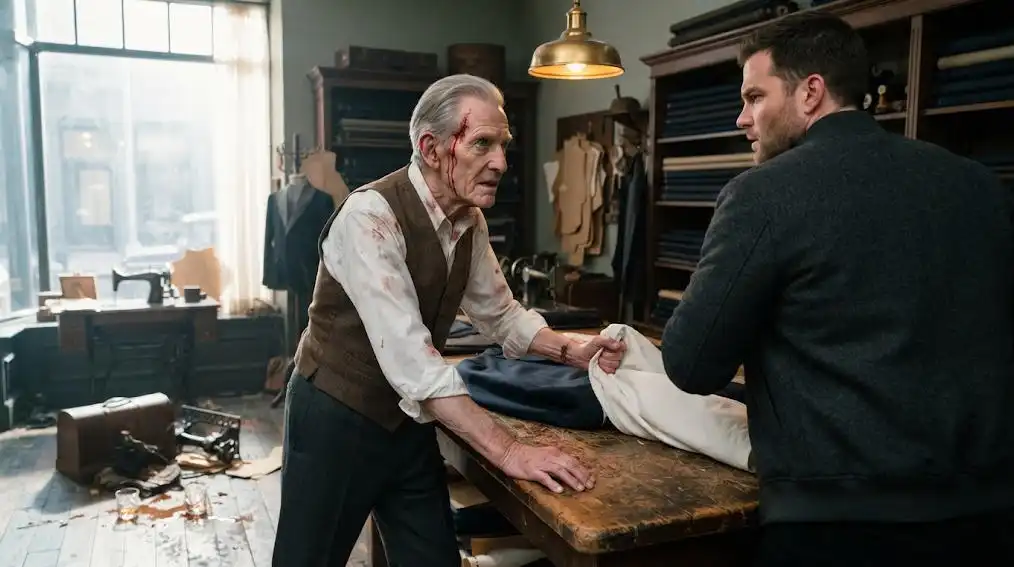
Derek grabbed a whiskey bottle from the counter, where Kessler had set it down upon entering.
He swung it at Walter's head.
The bottle struck just above the old man's left ear.
Glass cracked and broke.
Whiskey splashed across Walter's shoulder as the impact threw his head sideways.
He staggered into a chair.
For a moment, the room spun.
He heard the distant sound of traffic outside.
He tasted blood where he had bitten his tongue.
Then he felt something warm running down the side of his neck.
He raised his hand.
His fingers came away red.
"You stupid old fool!" Derek snarled.
The broken neck of the bottle hit the floor.
Walter's eyes filled with tears, partly from pain and partly from something that hurt even more.
He had spent half a century serving people in this city.
He had dressed fathers for weddings, sons for funerals, musicians for their first performances, and men who saved for years to own one beautiful suit.
And now a stranger was standing in his father's shop, treating him like garbage because he refused to surrender something that belonged to him.
Then Derek looked toward the navy-blue jacket.
"Maybe I'll tear up your little masterpiece next."
Walter's fear vanished beneath a rush of anger.
"Stay away from that suit!"
Derek stepped toward the cutting table.
Walter lunged after him.
His knees nearly buckled, but he caught himself against the table.
When Derek reached for the jacket, Walter shoved his arm away.
The movement sent a stab of pain through his head.
Walter gasped.
Still, he seized the thick white protective cloth lying beside the garment and pulled it over the unfinished jacket.
As glass fragments from the bottle and damaged furnishings scattered around the crowded work area, Walter turned his back toward the debris, keeping his own body between it and the suit.
Several pieces struck his wool vest and dropped to the floor.
He pressed his right hand against the protective cloth.
His left hand gripped the table.
"You'll have to go through me."
Derek stared at him.
Then he smiled.
"That can be arranged."
From the doorway, Kessler watched with growing impatience.
He had expected Walter to surrender after the first broken piece of equipment.
He hadn't expected a bleeding sixty-eight-year-old man to become more stubborn with every threat.
"Enough," Kessler said. "Get his signature."
Across the street, Maggie Doyle was arranging pastries in the window of her bakery when she noticed the struggle.
She had known Walter for twenty years.
Every Christmas Eve, he brought her a small box of hand-wrapped chocolates.
Every Easter, she left fresh rolls at his shop door.
She knew he worked alone on most afternoons, especially when he had a deadline.
Through the front window, she saw Walter clutching his head.
She saw the overturned furniture.
Then she saw Derek advance on him again.
Maggie grabbed her phone.
"Nine-one-one. What's your emergency?"
"There's an elderly man being attacked inside Bennett Tailoring on West Thirty-Eighth," she said breathlessly. "He's bleeding. There are men inside threatening him. Please send someone!"
The dispatcher kept her on the line.
Inside, Walter was beginning to lose strength.
His vision blurred whenever he moved too quickly.
He had pressed a folded piece of cotton against the cut, but blood continued to stain his collar.
Kessler placed the agreement on the cutting table.
"One signature," he said. "That's all I want."
Walter looked at the document.
"You forged a fire report."
Kessler gave a thin smile.
"Careful what you accuse people of."
"I called the city."
The smile disappeared.
For several seconds, nobody spoke.
Then Kessler turned toward Miles.
"Do it."
Miles stepped toward a red gasoline can beside the entrance.
He unscrewed its cap.
Walter caught the smell immediately.
Gasoline.
His stomach tightened.
"Are you insane?"
Miles tipped the container.
Liquid splashed across the hardwood floor near the front entrance and spread toward the cutting area.
Walter stared at the growing stain.
He could survive losing a shop.
He might even survive losing the building that had sheltered three generations of his family.
But if the gasoline reached the cutting table, one spark could destroy the garment.
Worse, the entire block could be endangered.
Walter pulled the covered suit closer to the center of the table, away from the spreading liquid.
Miles took a lighter from his jacket.
"Sign," Kessler demanded.
Walter looked at the paper.
Then he looked at the table.
He was sixty-eight years old.
His head was bleeding.
His beloved sewing machine lay in pieces.
His hands trembled so badly he could barely hold the table edge.
He thought of his father standing beside that same workbench.
He thought of his grandfather arriving in Manhattan with a suitcase, a measuring tape, and enough money to rent one room.
And he thought of the woman who would stand before the city tomorrow, trusting that someone had properly completed a garment designed to help protect her life.
Walter swallowed.
"No."
Miles flicked his thumb toward the lighter wheel.
And then the street outside erupted with sirens.
Not one siren.
Several.
Loud enough to rattle the shop's front window.
Derek turned.
Kessler stepped toward the glass.
Four black armored SUVs pulled up in a line along the curb.
A marked NYPD emergency vehicle stopped behind them.
Doors opened.
Officers in tactical protective equipment poured onto the sidewalk.
One woman emerged from the lead SUV, already speaking into a radio.
Captain Claire Rowan.
The commander of the mayor's protective detail.
She had been expecting to receive a finished garment from Walter at four o'clock.
A security team had been staged nearby for the scheduled pickup.
When the police dispatcher received Maggie's call reporting a violent attack and a gasoline threat at Bennett Tailoring, the address immediately raised an alarm with the officers coordinating the mayoral delivery.
Rowan's team had been sent toward the shop, while responding NYPD officers converged on the same location.
Now Rowan saw smoke-colored liquid spreading across the floor through the glass.
She recognized the gasoline can.
"Police! Drop the lighter!"
Miles spun around.
At the doorway, heavily armed Emergency Service Unit officers held him at gunpoint.
"Hands where we can see them!"
The lighter fell from Miles's hand.
Derek backed away from Walter.
Kessler raised both palms.
"There's been a misunderstanding," he began. "I own this building."
An officer ordered him to stay where he was.
Another moved quickly to secure the gasoline can and keep everyone away from the spill.
Rowan entered with two members of her protective team.
She saw the shattered machine.
The broken whiskey bottle.
The blood on Walter's clothes.
And the old man leaning against the cutting table, barely conscious.
"Walter?"
He recognized her voice.
"Captain."
"Don't move. Medical help is coming."
Walter tried to straighten his back.
"You're early."
Rowan glanced at the covered jacket.
Then at the two men being restrained.
Her expression hardened.
"Tell me the garment is still here."
Walter nodded.
"On the table."
"Has anyone touched the protective inserts?"
"No."
He paused to catch his breath.
"I kept them away."
Kessler stared at her.
"Protective inserts?"
Rowan did not answer him.
She carefully lifted the white cloth.
Beneath it lay the midnight-blue suit.
The exterior was immaculate.
Not a drop of whiskey had reached the wool.
Not a shard of glass had cut the fabric.
The custom inner compartments were still in place.
Rowan turned toward her team.
"Secure the garment. Notify the inspection unit."
Kessler stepped forward.
"Wait a minute. What is that suit?"
One of the officers held him back.
Rowan looked directly at the developer.
"It is custom protective clothing commissioned for the mayor's security detail."
Kessler went pale.
For the first time since entering the shop, he seemed incapable of speaking.
Walter lowered his head.
He had been instructed not to disclose the garment's purpose to unauthorized people.
Now the danger inside the shop made limited disclosure necessary to secure the equipment.
Rowan signaled to her communications officer.
"Possible attempted destruction of a protected mayoral delivery. Preserve the scene and notify Major Case."
Kessler's eyes moved toward the cutting table.
"You're saying that's for Mayor Hart?"
Rowan gave him a cold look.
"I'm saying you are going to explain why your men assaulted a city contractor and tried to set his occupied shop on fire."
Derek began protesting.
"We didn't know anything about the mayor!"
"Then you can explain why you brought gasoline," Rowan replied.
Behind her, officers continued securing the suspects.
Outside, additional NYPD personnel began establishing a perimeter while the fire department was called to address the fuel spill.
Walter barely heard any of it.
His attention was fixed on the suit.
Something was wrong.
Not with the ballistic components.
Not with the wool.
With the finishing.
The two tiny stitches.
He had never completed them.
Walter looked toward the workbench.
His needle was still there.
Threaded with a short length of dark navy silk.
He had placed it in a small cork holder so he wouldn't lose it among the tools.
He reached toward it.
Rowan noticed.
"Walter, don't."
He shook his head.
"It's not finished."
"We can have our people take care of it."
"No."
He looked at her through eyes clouded by pain.
"The protective panels are secure. But the lining hasn't been closed. Two stitches."
Rowan glanced at the jacket.
Walter's voice dropped.
"I promised it would be finished."
A paramedic had just entered the shop.
She moved toward him, medical bag in hand.
"Sir, you need to sit down. You've lost a lot of blood."
Walter nodded weakly.
But he had already lifted the needle from its cork.
His fingers trembled.
A drop of blood fell onto the white protective cloth covering the edge of the table.
He turned that cloth aside, exposing the narrow opening in the jacket's inner lining.
He positioned the garment beneath the light.
His left hand steadied the fabric.
His right hand held the needle.
For fifty-two years, he had been able to place stitches by touch.
Now the simple movement felt nearly impossible.
The room seemed to tilt.
"Walter," Rowan said quietly.
He drew the needle through the lining.
The first stitch.
A tiny, even movement of navy silk.
His breathing grew shallow.
The paramedic moved closer, ready to catch him.
His hand slipped slightly.
Walter stopped.
He blinked hard, repositioned the fabric, and drew the thread gently until the stitch lay flat.
Then he made the second.
Perfectly aligned.
No puckering.
No loose thread.
No damage to the protective insert beneath.
Walter secured the finishing thread within the lining.
He smoothed the seam with his fingertips.
And for the first time that afternoon, his expression softened.
"Done."
His voice was almost inaudible.
Rowan stepped forward.
Walter gathered the jacket carefully, keeping his bloodstained fingers against the clean protective cloth rather than the outer fabric.
He placed the finished suit into her waiting hands.
"Tell her..." he whispered.
Rowan leaned closer.
"Tell her it fits."
Then Walter's knees gave way.
The paramedic and a nearby officer caught him before his head struck the floor.
"Walter!"
Rowan knelt beside him.
His eyes were closed.
The paramedic checked his pulse and began treating the bleeding wound.
"He's still breathing. We need to get him to the hospital now."
Rowan stood.
She looked down at the navy-blue suit in her hands.
A garment that had nearly cost its maker his life.
Then she handed it to a security technician, who placed it into the prepared protective garment bag.
"Take this directly to the inspection team," Rowan ordered. "Verify every insert and the construction before it goes anywhere near the mayor."
Her voice was steady.
But her hands were trembling.
Outside, Walter was carried into an ambulance.
As the vehicle pulled away, Rowan watched until it disappeared into the traffic.
Then she turned toward Victor Kessler.
The developer was being held beside the damaged storefront.
His expensive overcoat was creased. His polished shoes stood inches from the gasoline-soaked floor.
"Captain," he said quickly, "I had no knowledge of what that garment was. I'm a legitimate property owner. Those men went too far."
Rowan stared at him.
"Did you bring them here?"
Kessler hesitated.
"Yes, but..."
"Did you order them to clear the shop?"
He opened his mouth.
Nothing came out.
NYPD Major Case Squad detectives, assisted by armed tactical officers, took custody of Kessler and both enforcers for further investigation.
Their immediate concerns included the assault, the gasoline threat, the property destruction, the suspected forged fire documents, and the attempt to damage a garment connected to a sensitive mayoral security operation.
Kessler's ownership of the building did not give him the right to assault its tenant or manufacture a dangerous emergency to force an eviction.
He was taken away in handcuffs with Derek and Miles.
But the police response was only the beginning.
That evening, investigators interviewed Maggie Doyle at her bakery.
She described seeing Walter injured through the storefront window and identified the men she had watched inside.
She also provided the time of her emergency call.
Walter's apprentice, twenty-eight-year-old Tessa Cole, returned from a fabric supplier to find the shop cordoned off.
She had worked beside Walter for four years.
He had taught her how to pad-stitch a lapel, shape a sleeve by hand, and repair antique garments without leaving a visible seam.
More recently, she had convinced him to install a small security camera above the shop entrance.
Now that camera mattered.
With the investigators present, Tessa opened the authorized recording account on her phone and saved the original footage for police.
The video captured Kessler's arrival, the destruction of the sewing machine, the assault, and his instructions to the men.
It also showed Miles carrying the gasoline can into the shop.
Investigators preserved the footage and documented its timestamps.
The supposedly official fire notice was examined separately.
A preliminary records check found no corresponding city-issued emergency vacate order. Detectives secured the document and began tracing the private inspection company that had produced it.
Kessler's attorneys could argue over ownership, redevelopment plans, and lease interpretation through the proper legal process.
They could not erase what the video showed.
Meanwhile, the mayor's security technicians examined Walter's finished garment.
They checked the specialized inserts against the supplier's records, confirmed their identifying information, and inspected the internal compartments for signs of damage or displacement.
The jacket's protective layers had not been pierced.
The positioning and closures remained intact.
The garment passed the required inspection for its intended use.
After the final security review and fitting, Mayor Hart's team approved it for the next day's event.
At the hospital, Walter knew none of this.
He woke under bright lights with a pounding headache.
His scalp wound had been closed and dressed, and he was being monitored for complications from the head injury and blood loss.
When he tried to sit up, a nurse gently stopped him.
"Easy, Mr. Bennett. You've been through a lot."
Walter stared at the ceiling.
For several seconds, he didn't remember where he was.
Then he remembered the bottle.
The broken machine.
The gasoline.
His shop.
He grabbed the nurse's sleeve.
"The suit."
"Your doctor will be here shortly."
"Please. I need to know."
A familiar voice answered from the doorway.
"It's safe."
Captain Rowan stepped inside.
Walter's shoulders loosened.
"Did they check it?"
"Every component."
"And the seam?"
Rowan smiled faintly.
"The seam is perfect."
Walter closed his eyes.
A shaky breath escaped him.
For the first time since the attack, he allowed himself to feel what he had lost.
Not simply a machine.
Not simply money or damaged furniture.
He had seen strangers destroy the things his family had spent a century building, and he had been powerless to stop most of it.
Rowan pulled a chair beside his bed.
"Mr. Bennett, I need you to understand something."
Walter looked at her.
"You were protecting a garment. We understand that. But you could have died."
He gave a tired smile.
"My father always said a promise was worth finishing."
"Your father probably also wanted you to live long enough to make another suit."
That brought a small, unexpected laugh from Walter.
Then the laugh faded.
"What happens to my shop?"
Rowan didn't offer an easy answer.
"The building is part of an investigation. The fire department is dealing with the gasoline contamination, and police have documented the damage. Your lease hasn't disappeared just because someone wanted it to."
Walter nodded slowly.
"The developer?"
"In custody. Detectives have the video and the forged notice. Prosecutors will decide which charges the evidence supports."
Walter looked down at his hands.
The fingertips were marked with small old scars from decades of needles and scissors.
Now one hand was bruised and stained from the attack.
"I don't know if I can rebuild everything."
Before Rowan could answer, someone knocked.
Tessa entered carrying a familiar brown leather sewing case.
Walter recognized it immediately.
His father's old traveling kit.
Tessa had retrieved it from the shop with an officer's permission after the scene was documented.
She placed it carefully beside his bed.
"The big machine's gone," she said.
Walter looked away.
"I know."
"But this survived."
She opened the case.
Inside were tailor's chalk, old brass thimbles, carefully stored needles, and a measuring tape whose markings had faded after decades of use.
Walter touched the tape with two fingers.
Tessa sat beside him.
"The police told me the lease is still valid. I've already spoken with a small-business attorney. She says we need to document the damages and prepare for whatever Kessler's company tries next."
Walter studied her.
"And if they eventually get the building?"
Tessa took a breath.
"Then we'll find somewhere else to work. But we're not closing Bennett Tailoring because they broke a machine."
He stared at her.
She had never spoken so firmly to him before.
"You're still learning," he said.
"I know."
"There's a lot you can't do yet."
"Then you'd better get well enough to teach me."
Walter looked down at the leather case.
For decades, he had quietly feared that the family craft would end with him.
He had no children who wanted to inherit the business.
And the world seemed increasingly uninterested in garments that required days of patient handwork.
But here was a young woman who understood that the value of the shop did not live in its walls.
It lived in what someone knew how to make.
Walter took her hand.
"All right," he whispered. "We'll figure it out."
Tessa smiled through her tears.
Rowan stood to leave.
At the door, she turned back.
"One more thing. The mayor asked me to thank you personally."
Walter shook his head.
"Just tell her not to let anyone see those stitches."
Rowan laughed softly.
"I think she'd prefer that nobody ever finds out why she needed them."
The hospital room grew quiet after she left.
Outside the window, Manhattan was preparing for a new year.
Millions of lights shone across the city.
In a secure location, the finished navy-blue suit was waiting for its owner.
And in a hospital bed, the man who had made it was finally sleeping.
The following morning, Walter woke to the sound of a television.
His head was wrapped in thick white gauze.
Tessa had arranged an extra pillow behind him, and a nurse had brought him a cup of tea.
On the screen, the mayor's inauguration coverage was beginning.
Walter reached for the remote.
His fingers paused when Mayor Evelyn Hart appeared.
She walked toward the podium beneath a pale January sky.
Her navy-blue suit moved naturally as she greeted the assembled officials.
The shoulders sat perfectly.
The lapels lay flat.
The sleeves fell exactly where Walter had intended.
No one watching could see the carefully positioned protective layers beneath the fabric.
The mayor adjusted the microphone.
Then she began speaking about the city's responsibility to confront intimidation, corruption, and organized violence without surrendering its public institutions to fear.
Walter leaned back against his pillow.
On the television, Mayor Hart stood straight and composed, wearing the suit he had finished with two bloodstained hands.
And beneath the thick white bandages around his head, the old tailor smiled as he watched her deliver her speech.
Disclaimer: Mention of any brand or trademark is for identification only and does not imply partnership or endorsement
A Wealthy Manhattan Socialite Poured Red Wine on a Plus-Size Artist at a Charity Gala, Calling Her “Cheap and Unworthy.” She Had NO IDEA Who Would Discover Her Paintings... 😱
A Celebrity Trainer Threw CASH in a Plus-Size Nutritionist’s Face at a Luxury LA Gym, Saying She Couldn’t Even Control Her Own Weight. He Had NO IDEA What Her Clients Would Prove... 😱
My Fiancé’s Mother CUT MY Custom Engagement Dress in Front of 200 Guests and Called Me an “Elephant in a Sack.” My Fiancé Just SMILED... 😱