


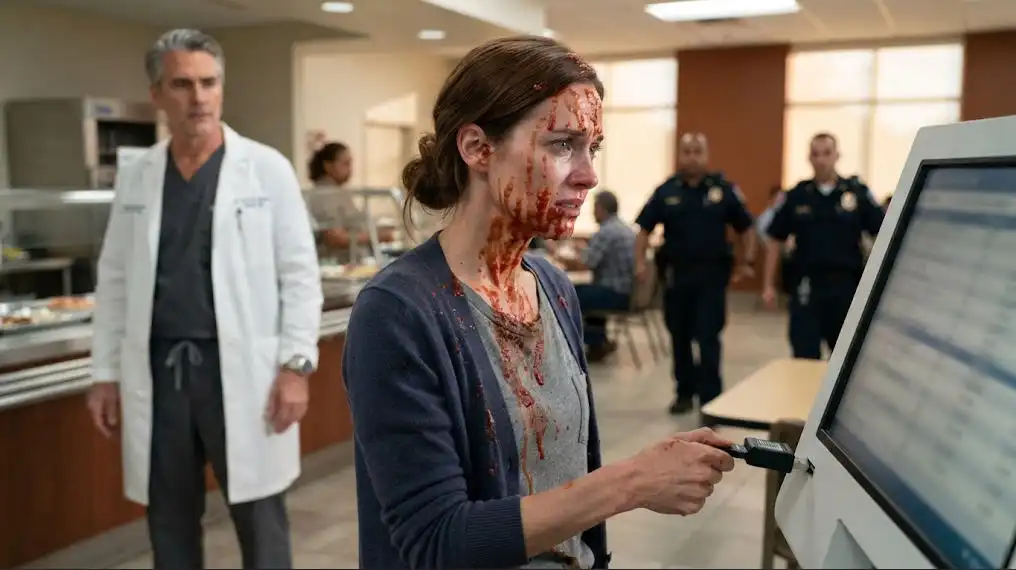
The plate was still steaming when Dr. Grant Mercer tipped it over Emily Carter’s head.
Thick red meat sauce spilled across her hair, struck her forehead, and ran down the collar of her faded navy cardigan. Emily recoiled with a sharp gasp. The empty plate clattered against the edge of the cafeteria counter as several people turned to stare.
She had been picking through leftover food on a returned tray because she had not eaten a proper meal all day.
Dr. Mercer looked at her as though she had contaminated the room simply by standing in it.
“A broke woman like you doesn't deserve the care this hospital provides.”
Then he turned toward the two security guards approaching from the far side of the cafeteria.
“Security, get this beggar out.”
Emily's face burned. Some of the heat came from the sauce. The rest came from the humiliation of standing in front of a room full of strangers while a man in a white coat treated her like something to be swept off the floor.
Her hand rose toward her head.
She stopped it.
For fifteen days, she had been fighting to keep her nine-year-old daughter alive and healthy. She had no intention of letting this man decide whether she would be allowed to finish what she had started.
Emily tightened her fingers into a fist and looked directly at him.
“Don't touch me.”
She stepped toward the self-service information terminal beside the cafeteria's tray-return counter.
In her pocket was a small black USB drive fitted with a miniature barcode scanner.
Dr. Mercer had no idea what was stored on it.
And he had no idea how long she had been preparing to use it.
Lily Carter had entered Westbridge Private Hospital in Houston for reconstructive surgery on a complicated fracture in her lower leg. Her mother had expected a difficult recovery, weeks of appointments, and the exhausting work of helping a child learn to walk comfortably again.
She had not expected a postoperative infection that would spread despite treatment.
Within days, Lily developed worsening pain, fever, and swelling around the surgical site. Doctors performed additional tests and started treatment, but the infection remained stubborn.
At one consultation, Dr. Mercer told Emily that if the infection continued advancing into the bone and surrounding tissue, amputation might become necessary.
Emily remembered the way he had delivered the news. He had spoken while glancing at his tablet, as though he were discussing an inconvenient scheduling problem rather than the possibility that a little girl might lose her leg.
When Emily asked whether something used during the operation could have caused the infection, he dismissed the question.
“Postoperative infections happen,” he told her. “Some patients have more complicated recoveries than others.”
“But she was improving before she suddenly got worse.”
“Your daughter is receiving appropriate care. I suggest you leave the medical decisions to the people qualified to make them.”
He walked away before she could ask another question.
Emily wanted to believe him. She desperately wanted to believe that no one had made a preventable mistake.
But something about the timing bothered her.
Before she became a single mother struggling to pay hospital bills, Emily had worked as an auditor for a medical-device manufacturer called Helixor Medical. Her job had involved checking invoices, shipment records, vendor payments, and discrepancies between what companies claimed to have supplied and what their records actually showed.
She had learned that a product's label could tell a story that the people selling it would rather keep hidden.
She had also learned that suspicious payments rarely appeared under a heading that said bribe.
They appeared as consulting fees, advisory payments, or miscellaneous professional expenses.
Three years earlier, Emily had questioned a series of payments connected to a group of medical-device distributors. Her supervisors had urged her to approve the accounts and stop delaying the audit. She refused to sign off on the discrepancies.
Her position disappeared soon afterward.
Before leaving, she had retained a reconciliation copy of the vendor-payment records she had worked on. She had kept it because she feared the irregularities would eventually matter. She also knew that keeping confidential company records after leaving her job could expose her to accusations of misappropriating trade secrets.
For years, the file had remained untouched.
Then Lily became infected.
Emily began asking questions.
At first, she requested the ordinary information available to a patient's parent: operative notes, itemized supply records, and the lot numbers of the medical products used during surgery.
The records gave her something concrete to investigate.
During the fifteen days she spent at Westbridge, Emily carefully recorded the barcodes on discarded medical-supply packaging and labels from the hospital's disposal area. Her customized scanner stored each code with a date and time.
She did not need to understand every medical term printed on a package. She needed the identifiers that could connect one record to another.
Each evening, after Lily fell asleep, she compared the scanned numbers against the documents she had requested and the old reconciliation file on her USB drive.
At first, she found nothing conclusive.
Then she noticed that two lot numbers appeared in both her daughter's operative supply records and a set of manufacturer documents marked for a quality hold.
The lots had been flagged after failures in sterile-packaging integrity tests. That did not automatically prove that every unit was contaminated, but it meant the products should have been quarantined until the problem was resolved.
Instead, shipment records showed that the lots had reached Westbridge.
Emily checked the dates again.
The shipments had been approved, and payments had followed.
The ledger recorded transfers of $18,600 and $22,400 to a company called Mercer Clinical Consulting LLC, each made shortly after a shipment approval. Public business records identified Dr. Grant Mercer as the company's manager.
The amounts, dates, and product identifiers aligned too closely to dismiss as coincidence.
Emily did not yet know whether she could prove that the products had caused Lily's infection. She knew only that the connection was serious enough to demand an independent investigation.
She also knew why Dr. Mercer might want her out of the hospital.
If she was removed from the building, her investigation would become much harder to complete. If she accused him without evidence that others could verify, he could portray her as a desperate mother who had misunderstood technical documents.
And if she disclosed the old ledger, Helixor could accuse her of stealing confidential information.
Emily had spent days weighing those risks.
Every time she looked at Lily's swollen leg, the decision became easier.
The cafeteria terminal offered a way to make the evidence visible.
It was an old public information station used for visitor inquiries and cafeteria announcements. Its service port was poorly secured, and its display could be mirrored to the large television above the counter. Emily had watched staff use the system to update menus and announcements throughout her stay.
She had prepared a simple presentation on her USB drive.
It contained the scanned lot numbers, the matching entries from Lily's operative supply records, the quality-hold information, and the relevant payment transactions. She had organized the data by date so that anyone examining it could follow the sequence without taking her word for anything.
She had not included unrelated patient information.
All she needed was a chance to put the records in front of someone who could verify them.
Now, with meat sauce dripping from her hair, she had that chance.
Emily reached the terminal.
Behind her, one of the security guards stretched out a hand toward her arm.
“Ma'am, you need to come with us.”
“Don't touch me,” Emily repeated, keeping her eyes on the screen.
She inserted the USB drive into the exposed port and opened her presentation.
For a moment, nothing happened.
Her heart hammered. The terminal's old interface stalled, and she imagined the screen going dark, the guards pulling her away, and Lily waking up to another doctor telling her that losing her leg was simply unavoidable.
Then the file opened.
A table of lot numbers appeared.
Emily selected the display option, and the giant television above the cafeteria counter changed from the lunch menu to the same table.
She moved to the next page.
The screen showed the quality-hold entries and the dates when the products had been shipped.
Then came the payment records.
Mercer Clinical Consulting LLC.
$18,600.
$22,400.
The dates sat beside the corresponding shipment approvals.
A woman holding a cafeteria tray stopped walking. A man near the drinks refrigerator lowered his cup. Several diners took out their phones.
Dr. Mercer turned toward the television.
“What is that?”
Emily's voice shook, but she did not lower it.
“Those lot numbers match the supplies recorded in my daughter's operation. The manufacturer flagged the lots for failed sterile-packaging tests, but they were shipped here anyway. These payments followed the approvals.”
Mercer's face hardened.
“Turn that off.”
One of the guards grabbed Emily's forearm.
She twisted away, stumbling against the counter. The other guard reached toward the USB drive.
For an instant, Emily felt the old fear return. She was a tired mother with no money, no institutional power, and a file that the manufacturer could claim she had no right to possess.
They could restrain her.
They could remove her from the building.
They could threaten her with a lawsuit.
But they could not make the numbers stop matching.
Emily slammed her palm against the red emergency alarm beneath the counter.
The alarm sounded.
“Call the police,” she said. “I am reporting a patient-safety crime.”
Dr. Mercer stepped toward her, his voice suddenly stripped of its earlier confidence.
“She stole proprietary company information. She is trying to destroy my reputation.”
Emily looked at him.
“Then verify it.”
The words were simple. They did not need to be louder.
“Check the lot numbers. Check the dates. Check the payments. Don't take my word for it.”
The security guards held her arms, but they did not drag her away. The alarm had brought hospital personnel toward the cafeteria, and several witnesses had already recorded the display.
The hospital's compliance officer arrived and ordered the guards to release Emily while the incident was assessed. She also instructed staff not to erase or alter the terminal's records.
Local police responded to the emergency call. An officer photographed the displayed information, interviewed witnesses, and took custody of a copy of the evidence. Emily provided the original drive for forensic preservation and insisted that the transfer be documented.
Her auditing experience returned at precisely the moment she needed it. She identified the files, explained how the lot numbers had been recorded, and separated what she could prove from what still required independent testing.
She did not claim that the spreadsheet alone established criminal guilt.
She asked investigators to verify the records.
That distinction mattered.
The apparent connection between the product shipments and the consulting payments was serious enough to trigger a broader review. Because the records implicated interstate medical-device shipments and a possible kickback scheme, the case was referred to federal investigators, including the FBI's healthcare-fraud investigators and the Department of Health and Human Services Office of Inspector General.
Before the end of the day, the hospital had suspended Dr. Mercer from treating patients while the allegations were reviewed.
For the first time since Lily's infection began, Emily felt that someone might finally be looking at the same problem she was.
But the most important question remained unanswered.
Could Lily's leg still be saved?
That evening, an independent surgical team reviewed Lily's records.
Dr. Nora Hayes, an experienced surgeon who had not been involved in the original operation, met Emily outside the patient's room. She explained that the infection was serious, but she would not recommend amputation simply because the first treatment plan had failed.
The team would obtain new cultures, remove infected tissue where necessary, evaluate the existing hardware, and use targeted antibiotics. They would also ensure that every supply used in the next procedure came from a verified, approved lot.
Emily gripped the edge of a chair.
“Can you save her leg?”
Dr. Hayes did not make a promise she could not guarantee.
“I can't promise the outcome. But we have more information now, and we have a plan. We are going to do everything medically appropriate to give her the best chance.”
For Emily, that was the first honest answer she had heard in days.
The next operation was difficult. The surgeons removed infected tissue, addressed the damaged area, and adjusted the treatment plan according to the cultures. Lily received intensive antibiotic treatment and close monitoring.
The infection did not disappear overnight.
There were days when her fever returned and Emily watched every movement of the nurses with her stomach knotted in fear. There were nights when Lily woke crying because her leg hurt and asked whether she would ever walk normally again.
Emily never promised that everything would be easy.
She promised that she would stay.
Meanwhile, the federal investigation was moving beyond the evidence displayed in the cafeteria.
Investigators obtained the manufacturer's original shipment and quality-control records. They compared them with the barcode scans, the hospital's purchasing documents, and Lily's operative supply records.
They also examined the payment trail behind Mercer Clinical Consulting LLC.
The original records corroborated the entries on Emily's drive. Bank documents confirmed that the payments had reached the company connected to Mercer. Investigators found communications showing that Mercer had advocated for the discounted lots despite warnings about the unresolved packaging failures.
The quality records showed that the products should not have been used until the problems were resolved. Testing of retained units from the implicated lots subsequently confirmed compromised sterile packaging, strengthening the connection between the defective supplies and the infection investigation.
The evidence was no longer a collection of suspicious coincidences.
It was a traceable sequence of quality failures, product shipments, hospital use, and payments to a surgeon who had a financial interest in the products being selected.
The company that manufactured the supplies faced its own scrutiny.
Mercer tried to portray the affair as a disgruntled former employee's attempt to embarrass him. His lawyers argued that the payments represented legitimate consulting work and that a failed packaging test did not prove that a specific surgical product had caused a specific infection.
Investigators tested those claims against the original records, not the public display.
The payment records, internal communications, quality documents, and product traceability data continued to corroborate one another.
Three weeks after the cafeteria incident, federal agents arrived at the hospital and took Mercer into custody under a warrant connected to the fraud and kickback investigation.
He was no longer the man who could dismiss Emily with a sentence and walk away.
The hospital revoked his clinical privileges. The criminal case proceeded, and he eventually pleaded guilty to federal conspiracy and kickback-related charges. The state medical board revoked his medical license, ending his career as a practicing surgeon.
The hospital's independent review also confirmed serious failures in its procurement oversight and response to the product warnings. It faced substantial civil liability and ultimately agreed to a seven-figure settlement with Emily's family.
The agreement covered every dollar of Lily's treatment, rehabilitation, and follow-up care. Emily no longer had to choose between paying for the next medical appointment and buying food.
None of that could return the days her daughter had spent in pain.
None of it could erase the image of a surgeon pouring a plate of hot food over her head while she stood in a crowded cafeteria.
But the investigation had established what had happened, the people responsible had faced consequences, and Lily had received the treatment she needed without the threat of an impossible bill hanging over every decision.
Most importantly, Lily's infection gradually came under control.
The fever stopped returning. Her pain eased. The doctors watched the healing process carefully, and the threat of amputation receded.
Recovery took patience. Lily needed rehabilitation to regain strength and confidence in her leg, and Emily stayed beside her through every difficult appointment.
The hospital could pay the bills. It could not do the walking for Lily.
That part belonged to the little girl who had endured more pain than she should ever have had to experience.
On the morning of Lily's final discharge appointment, Emily washed her hair thoroughly, removing every last trace of the meat sauce that had once dripped down her face in the cafeteria.
Her hair was clean. Her cardigan was clean. The USB drive had been preserved as evidence, and the records it contained had helped bring the truth into the open.
Emily stood beside the open hospital-room doorway.
Lily placed her feet carefully on the floor, straightened her back, and took a steady step forward. Then another.
She was healthy enough to walk out of the room on her own.
Emily watched her daughter cross the doorway, her eyes filling with tears that no longer came from humiliation or fear.
Her hair freshly washed and her face finally at peace, Emily smiled as Lily walked out of the hospital room.
Disclaimer: Mention of any brand or trademark is for identification only and does not imply partnership or endorsement
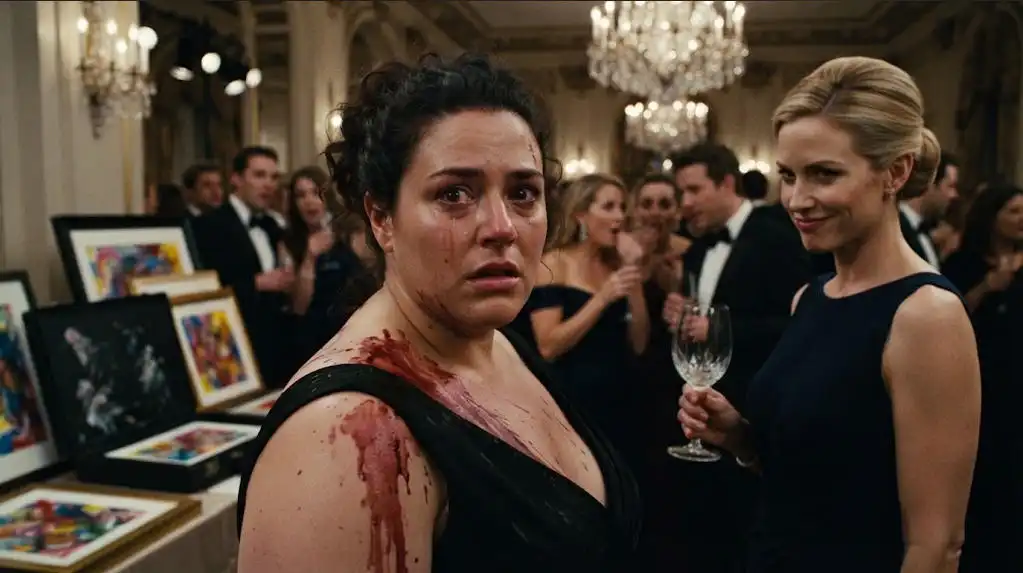
A Wealthy Manhattan Socialite Poured Red Wine on a Plus-Size Artist at a Charity Gala, Calling Her “Cheap and Unworthy.” She Had NO IDEA Who Would Discover Her Paintings... 😱

A Celebrity Trainer Threw CASH in a Plus-Size Nutritionist’s Face at a Luxury LA Gym, Saying She Couldn’t Even Control Her Own Weight. He Had NO IDEA What Her Clients Would Prove... 😱

My Fiancé’s Mother CUT MY Custom Engagement Dress in Front of 200 Guests and Called Me an “Elephant in a Sack.” My Fiancé Just SMILED... 😱