


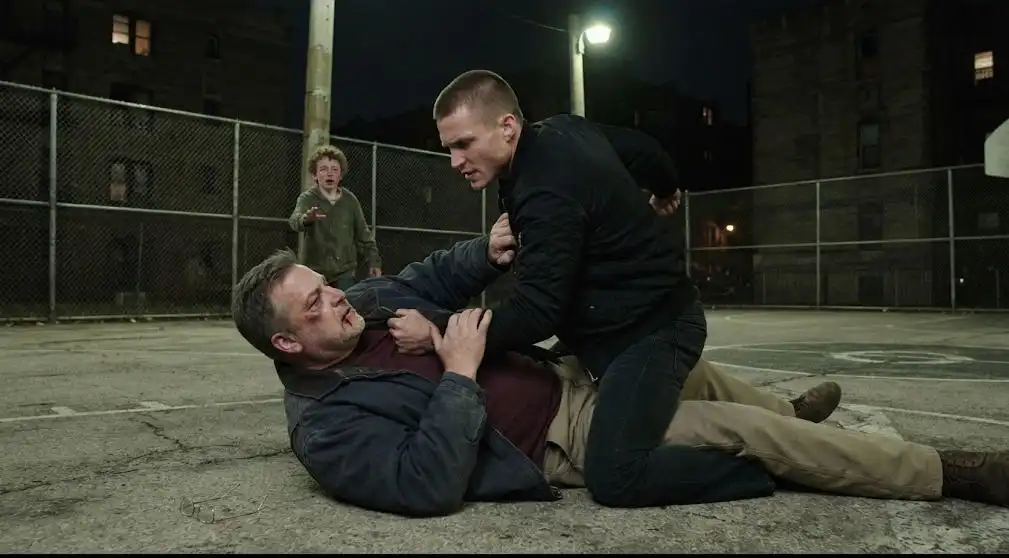
The gang leader's boot struck Patrick Donnelly square in the chest.
The 55-year-old bakery owner stumbled backward and crashed onto the concrete basketball court, the impact driving the air from his lungs.
He tried to get up.
He never made it.
Derek Voss stepped over him, dropped his weight onto Patrick's torso, seized the collar of his faded navy work jacket, and slapped him across the face.
The blow knocked Patrick's glasses from his nose.
Before they stopped sliding across the pavement, Derek slapped him again.
Blood appeared at the corner of Patrick's mouth.
“Who's gonna stop me?”
Derek grinned down at him.
Around the basketball court, apartment windows overlooked the scene. Patrick could see curtains moving. Someone was watching from the third floor.
Then the light behind that curtain went out.
Patrick felt something worse than the pain in his face.
For one terrible second, he felt completely alone.
But behind him stood a 14-year-old boy in a green hoodie, shaking so badly that he could barely keep his balance.
Patrick turned his bleeding face toward him.
“Leave the boy alone!”
“Mr. Donnelly!”
Eli Bennett's frightened voice nearly broke.
Patrick pushed against Derek's chest with both hands.
Derek barely moved.
Instead, he leaned forward and struck Patrick again.
The sound echoed across the empty basketball court.
“Look around,” Derek said. “Nobody's coming.”
Patrick knew the boy could see everything.
The humiliation burned. He had spent his entire adult life working, paying his bills, and treating people decently. Now a man young enough to be his son was sitting on his chest, striking him while his neighbors hid behind their curtains.
For a moment, Patrick wanted to close his eyes.
Then he remembered another boy.
A boy he hadn't been able to save.
His son.
Four years earlier, Daniel Donnelly had been nineteen years old.
He had Patrick's crooked smile, his mother's brown eyes, and an unfortunate habit of believing that everyone deserved a second chance.
Daniel had worked mornings at the family bakery while attending community college. He had dreamed of becoming a firefighter.
One November evening, Daniel had called his father to say he was walking a friend home.
There had been trouble between rival neighborhood gangs near the bus stop. Daniel's friend was afraid to cross the block alone.
Patrick remembered what he had said.
“Be careful, Danny. I need you here at five tomorrow.”
Daniel had laughed.
“Save me a cinnamon roll, Dad.”
Those were the last words Patrick ever heard from his son.
Daniel was shot that night while helping his friend get away from armed gang members. His friend survived.
Daniel didn't.
For months afterward, Patrick had barely spoken.
He continued baking because he didn't know what else to do with the hours.
He would arrive at the shop before sunrise, knead dough until his wrists ached, and sometimes catch himself setting aside Daniel's favorite cinnamon roll.
His wife, Margaret, had died several years before their son. After Daniel's funeral, the little brick bakery on the South Side was nearly all Patrick had left.
People told him to sell the business.
Move somewhere quieter.
Start over.
But Patrick stayed.
He knew most of the neighborhood children by name. He remembered which elderly customers needed someone to carry their groceries and which families had begun buying fewer loaves because money was tight.
He had once watched a hungry boy dig through a trash can behind his store.
Patrick had brought him a sandwich.
The next night, another hungry child appeared.
Soon Patrick started leaving a small basket outside after closing, filled with day-old rolls and individually wrapped sandwiches.
A handwritten sign read:
Take what you need. No questions asked.
Some nights he delivered food himself, walking through the neighborhood with a paper bag under one arm.
Homeless men knew he wouldn't chase them off his doorstep.
Children knew he wouldn't ask why they couldn't afford lunch.
And struggling parents knew he would sometimes pretend to forget to charge them.
It wasn't charity Patrick could afford.
It was simply the only thing that made his days feel useful again.
One of the people who regularly visited him was Frank Holloway, a retired Marine who had spent decades working as a city bus mechanic.
Frank lived alone in an apartment overlooking the basketball court.
After hip surgery had kept him off his feet for weeks, Patrick had delivered groceries to his apartment every other evening.
Another neighbor, Ruth Caldwell, was a retired Army medic. Patrick had quietly helped her organize meals for older residents during a difficult winter.
Ruth used to tease him about his habit of giving food away.
“One of these days, Pat, you're going to bankrupt yourself.”
Patrick always shrugged.
“Better that than watching somebody go hungry.”
He never expected anything in return.
And for a long time, it seemed the neighborhood had forgotten how to return anything at all.
Over the previous six months, a new gang had begun tightening its grip on the surrounding blocks.
Its leader was Derek Voss.
Twenty-six years old, lean, aggressive, and desperate to establish himself, Derek had learned that fear could be a profitable business.
He didn't control a large organization.
He controlled a handful of young men, several corners, and enough frightened shopkeepers to make himself feel powerful.
His crew started with small demands.
Forty dollars a week from a convenience store.
Sixty from a laundromat.
Then more.
They called it protection.
When owners refused, windows were broken, merchandise disappeared, and anonymous threats arrived after dark.
Some business owners paid because they thought the police couldn't protect them every hour of the day.
Others stopped opening after sunset.
Patrick refused to pay.
When Derek first appeared at the bakery, Patrick had stood behind his counter and told him that if he wanted bread, he was welcome to buy some.
“But I'm not paying you for permission to keep my doors open.”
Derek had smiled.
“You'll change your mind.”
Two weeks later, someone smashed the bakery's front window.
Patrick reported the vandalism, but the camera above his door had captured only a hooded figure from behind. There wasn't enough evidence to establish who had done it.
He boarded up the window and opened the next morning.
Still, he began checking the street more carefully before locking up.
He understood what Derek was capable of.
He just couldn't bring himself to surrender.
Then Derek began targeting children.
Eli Bennett was a freshman at the neighborhood public high school.
His mother, Nora, worked long shifts cleaning offices downtown. Eli spent most afternoons on the basketball court, waiting until she came home.
He wasn't especially good at basketball.
He was short for his age, wore the same battered sneakers nearly every day, and got nervous whenever older boys mocked his shooting.
But he loved the game.
Patrick had known him since he was little.
For years, Eli had stopped by the bakery after school. When Nora's paycheck was late, Patrick made sure the boy had something to eat.
Sometimes Eli helped sweep the floor in exchange for a sandwich, though Patrick never required him to work for food.
On the afternoon everything changed, Eli entered the bakery looking pale.
Patrick was arranging fresh bread behind the counter.
“What's wrong, kid?”
Eli shook his head.
“Nothing.”
Patrick glanced at the untouched sandwich in the boy's hands.
“Eli.”
The boy stared at the floor.
Then the story came out.
Derek had approached him outside school earlier that week.
At first, he'd offered Eli money to deliver envelopes between stores.
Then he explained that the envelopes would contain protection payments.
Eli had refused.
Derek responded by telling him he would be working for the gang whether he liked it or not.
That afternoon, one of Derek's men had followed Eli halfway home.
“He knows where Mom works,” Eli whispered.
Patrick set down the bread tray.
“Did you tell your mother?”
Eli nodded.
Nora had called the police after the first threat and provided what little information she had. An officer had taken the report, but the men continued hanging around the school route.
Eli was terrified that another complaint would make Derek angrier.
“He said if I keep saying no, he'll make sure she pays for it.”
Patrick looked at the boy sitting at his counter.
Fourteen years old.
Still young enough to worry about homework and whether his mother would be home for dinner.
Yet somebody was trying to turn him into a criminal before he had even finished his freshman year.
Patrick felt his stomach tighten.
He reached for his phone.
“We're calling your mom.”
Nora answered from work.
She was frightened and furious, but she couldn't leave immediately. Patrick told her Eli could stay with him until she arrived.
He also urged her to report the new threat.
“I'll get there as soon as I can,” Nora said.
Patrick promised to keep Eli safe.
He meant it.
That evening, shortly before nine, Patrick finished cleaning the bakery's kitchen.
Eli sat at a small table near the back, his basketball resting beside his chair.
Nora had called again to say she was on her way.
Patrick offered to walk Eli to the apartment courtyard where she could pick him up.
The quickest route passed the basketball court.
As they approached, three men emerged from the shadows near the fence.
Derek Voss stood in the middle.
To his right was Jonah Pike, a thin young man with a handgun tucked into his waistband.
The third, Cal Reed, carried a short metal bar.
Eli stopped walking.
Patrick recognized the fear in his face immediately.
Derek smiled.
“There he is.”
He pointed at Eli.
“You've been avoiding me, little man.”
Eli took a step backward.
“I told you I don't want to do it.”
Derek's smile disappeared.
“You don't get to decide that.”
Patrick moved in front of Eli.
“His mother is coming. Leave him alone.”
Derek looked him up and down.
“The bread guy.”
Patrick kept his voice steady.
“Go home, Derek.”
Derek laughed and glanced at his two companions.
“Listen to Grandpa giving orders.”
Then he reached past Patrick and grabbed the front of Eli's hoodie.
The boy cried out.
Patrick caught Derek's wrist and pulled his hand away.
It was the first time anyone in the neighborhood had physically stopped Derek from putting his hands on someone.
For one brief moment, Derek looked genuinely surprised.
Then his face hardened.
He pointed at Eli.
“Move aside, old man. This is between me and the kid.”
Patrick spread his arms, keeping Eli directly behind him.
“No. It isn't.”
Derek stepped closer.
Patrick could smell cigarette smoke on his jacket.
“You really want to do this?”
Patrick's hands were shaking.
He knew Jonah had a gun.
He knew what a gang member could do when he wanted to prove himself.
He knew all of it.
And still, he wouldn't move.
“You're not taking that boy anywhere.”
Derek's right boot came up.
The kick landed directly against Patrick's chest.
The old baker fell backward.
Derek crossed over his fallen body, sat on him, and began slapping his face while demanding to know who would interfere.
Patrick's glasses skidded across the court.
His mouth filled with the metallic taste of blood.
And through the pain, he saw Eli crying behind the fence.
Now, lying beneath Derek's weight, Patrick understood what the gang leader wanted.
He wasn't just trying to hurt him.
He wanted Eli to watch a grown man surrender.
He wanted every hidden witness to understand that resisting the gang meant being publicly humiliated.
Patrick felt rage rise through his fear.
His son had died in a neighborhood where too many people were afraid to intervene.
He could not bear to watch another child disappear into that same darkness.
Derek finally climbed off Patrick's chest.
“Enough of this.”
He turned toward Eli.
Patrick rolled onto his left side.
Every movement sent a sharp pain through his ribs.
But he lunged forward, wrapped both arms around Derek's left lower leg, and pulled.
Derek stumbled.
“Get off me, old man!”
Patrick tightened his grip.
Derek tried to wrench his leg free.
Patrick's cheek scraped against the concrete.
He could barely breathe.
“Run, Eli!”
The boy didn't move.
“GO!”
Still, Eli stayed.
He stared at the man who had fed him when he was hungry, who had fixed his bicycle tire one summer, who had never once made him feel ashamed of being poor.
That man was bleeding on the pavement because he had refused to abandon him.
Eli looked toward the chain-link fence.
A broken red brick lay beside its concrete footing.
The boy bent down and picked it up with his left hand.
Jonah noticed.
“Put that down, kid.”
Eli's fingers tightened around the brick.
His whole body was shaking.
For a moment, Patrick feared the boy might throw it at Derek.
That would give the gang another excuse to hurt him.
But Eli didn't throw it.
Instead, he raised the brick and smashed it against the concrete.
The crack was loud enough to bounce between the apartment buildings.
A piece broke off.
Eli began sobbing.
Then he pulled the black phone from his right pocket and dialed 911.
When the dispatcher answered, his voice came out in broken bursts.
“Please! They're killing Mr. Donnelly!”
The dispatcher asked where he was.
Eli shouted the address of the basketball court and described the men attacking Patrick.
“There's a gun,” he cried. “One of them has a gun!”
The dispatcher told him officers were being sent and instructed him to keep his distance.
But Eli couldn't leave Patrick behind.
He backed toward the fence, keeping the phone to his ear.
Derek heard him.
“You little snitch!”
He jerked his leg violently.
Patrick held on.
Derek staggered, furious that the old man was still preventing him from reaching the boy.
He bent over and grabbed Patrick's jacket with one hand, trying to wrench him off his leg.
Patrick's arms were weakening.
His injured chest burned with every breath.
Derek seized a handful of his hair and pulled his head upward.
“You want to die right here?”
Patrick saw Jonah move.
The younger man reached toward the handgun at his waistband.
For a moment, Patrick was certain he was about to be shot.
Then Derek pressed down on Patrick's shoulder, trying to force him to release his grip.
Patrick did something he had never imagined doing.
He twisted his head and sank his teeth into Derek's wrist.
Derek screamed.
Patrick tasted blood again.
He wasn't trying to punish Derek.
He was desperately trying to make him let go long enough to keep Eli safe.
Derek jerked backward, but Patrick continued clinging to his leg.
The gang leader stumbled onto one knee.
Jonah pulled the handgun free.
“LET HIM GO!”
Eli screamed into the phone.
“He has the gun out! Please hurry!”
Patrick looked toward the weapon.
His arms were trembling uncontrollably.
He thought of Daniel's last phone call.
For an instant, he imagined his son waiting for him somewhere beyond the pain.
But then Eli's voice reached him.
“Please don't hurt him!”
Patrick pressed his forehead against Derek's leg and held on.
He had failed to bring his own boy home.
He would not willingly hand this one over.
Jonah took a step forward.
And then, above the court, a light switched on.
It came from a third-floor apartment.
A second light appeared across the courtyard.
Then another.
And another.
Derek glanced upward.
“What the hell?”
On the second floor, someone pulled back a curtain.
A window slid open.
Then a heavy apartment door creaked on its hinges.
Another door opened.
Then a third.
The sounds began to overlap.
Metal latches clicked.
Footsteps descended stairwells.
A screen door slammed.
Patrick heard something scraping across the pavement beyond the basketball court.
Derek looked toward the entrance.
An older man stepped through the gate.
He had white hair, a stiff walk, and a wooden baseball bat in his hands.
Patrick recognized him.
Frank Holloway.
The retired Marine had to steady himself against the fence for a moment before standing upright.
He looked at the blood covering Patrick's face.
Then he looked directly at Derek.
“Get your hands off him.”
Derek gave a nervous laugh.
“Go back inside, Grandpa.”
Frank didn't move.
“You heard me.”
A woman appeared behind him.
Ruth Caldwell.
She carried her phone in one hand and a metal pipe in the other.
Two younger men followed.
Then four more neighbors.
Then an entire group came around the corner of the apartment building.
Derek stood motionless.
He had expected one old man with a bat.
He hadn't expected dozens of people.
Ruth looked at Jonah's handgun.
“Everybody stay back from the muzzle!” she called. “Keep the children behind the buildings!”
Frank stepped forward just far enough to make himself heard.
“Jonah. Put it down.”
The young man tightened his grip on the pistol.
“Back up!”
Nobody rushed him.
Nobody attacked.
But nobody went home.
More apartment doors opened.
Men in work boots emerged carrying baseball bats.
Fathers who had spent years worrying about their children walking home after dark came out holding iron pipes.
Several retired servicemen moved into view, positioning themselves near the court entrances while keeping their distance from the armed men.
Mothers stood behind the fence with their phones raised, recording.
A shopkeeper who had paid protection money for months walked out carrying a wooden broom handle.
Another man emerged with a heavy tire iron.
A voice shouted from a balcony.
“We called 911 too!”
Another voice answered.
“So did we!”
By the time Derek looked around the entire basketball court, more than a hundred residents had gathered around its perimeter and adjoining courtyard.
Their faces were frightened.
Some hands shook.
Several men looked as though they regretted coming outside.
But they stayed.
The crowd continued to grow.
Patrick recognized people who had eaten at his bakery for years.
There was Vincent Moretti, whose wife Patrick had driven to medical appointments.
There was Claire Ellison, who had borrowed money for groceries one winter and paid him back in small installments.
There were teenagers who had once come through the bakery door looking for free sandwiches.
And there were men whose children Patrick had helped when those children were too embarrassed to ask their parents for money.
Frank turned toward the crowd.
“Don't give them a reason to shoot. Stay together and let the police handle them.”
Ruth was already speaking into her phone.
She had been recording from her apartment window after hearing the first blows.
Now she told the dispatcher exactly where the gunman stood.
“Three suspects. One handgun visible. Victim on the ground. Large crowd present. We need officers and an ambulance.”
Jonah turned from one face to another.
There were too many witnesses.
Too many phones.
Too many people refusing to lower their eyes.
He raised the handgun slightly.
The people nearest the muzzle moved behind the masonry gateposts.
Nobody charged him.
Frank's voice became dangerously quiet.
“Put that gun on the ground, son.”
Jonah swallowed.
Derek shouted, “Don't you dare!”
But Jonah was no longer looking at his leader.
He was looking at an entire neighborhood staring back at him.
Far away, police sirens began to rise.
Derek released Patrick's hair.
Patrick's fingers were still locked around his leg.
“Tell them to back off,” Derek hissed.
Patrick lifted his battered face.
His lips were swollen. Blood streaked his chin. His voice was barely more than a whisper.
“They're not here because I told them to come.”
Derek stared at him.
Patrick coughed painfully.
“They came because they're tired of you.”
Jonah slowly lowered the handgun.
He placed it on the concrete and stepped away.
Cal Reed looked at the men surrounding the fence.
Then he dropped his metal bar.
It struck the court with a hollow clang.
Derek's eyes moved frantically toward the exits.
Every opening was watched by residents standing back at a safe distance.
Behind them, the first police vehicles were turning onto the block.
Derek tried to pull away one last time.
Patrick's exhausted arms finally slipped loose.
But Derek didn't run.
He looked at Frank, at Ruth, and at the dozens of fathers and older men holding their ground around the court.
The weapons in the residents' hands had not been raised against him.
They didn't need to be.
For the first time that night, Derek understood that nobody was going to obey him simply because he was frightening.
His breathing became ragged.
“Okay,” he said. “Okay, just let us go.”
Frank shook his head.
“That's not our decision.”
Derek took another step backward.
“Please. I'll leave. We won't come back.”
Then the first patrol officers entered the courtyard, using the route Eli and the other callers had described.
“Police! Nobody move!”
Ruth raised her empty hand and directed the officers' attention toward the discarded handgun.
Frank told the residents to lower their bats and pipes and give the officers room.
The crowd obeyed.
The officers ordered Jonah, Cal, and Derek to get on their knees.
Jonah complied immediately.
Cal followed, begging the officers not to let anyone hurt him.
Derek hesitated.
Then he looked once more at the people surrounding the court.
He dropped to his knees.
“Please,” he whispered. “I didn't mean for it to go this far.”
Patrick heard him.
He was still lying on the concrete, trying to draw a full breath.
For a moment, anger surged through him.
He wanted Derek to understand what it felt like to be helpless.
What it felt like to lie on the ground while someone stronger decided whether you would live.
But Patrick also knew that beating Derek in front of Eli would teach the boy the wrong lesson.
He turned his face away.
“Just don't let him touch another kid,” he whispered to the nearest officer.
The officers handcuffed all three men.
The handgun was secured.
The metal bar was collected.
Ruth supplied the recording she had captured from her apartment window and agreed to preserve the original file.
Other residents offered their own recordings and accounts.
Eli told an officer about the threats outside school and the demand that he carry protection money.
Nora's earlier police report gave investigators another starting point.
Derek and his companions were arrested over the attack, threats, and weapons incident. Investigators began reviewing the allegations of extortion against neighborhood businesses, with the residents' statements and recordings available for follow-up.
The arrests didn't erase the danger overnight.
Nobody standing at that basketball court believed three arrests could undo years of fear.
But for the first time, the shopkeepers were willing to tell the police what had been happening to them.
And for the first time, Derek's crew had been stopped in public without another frightened resident surrendering.
Eli ran to Patrick as soon as the officers allowed him through.
He dropped to his knees.
“Mr. Donnelly?”
Patrick opened his eyes.
The boy's face was soaked with tears.
“You stayed,” Patrick whispered.
Eli nodded.
“I was scared.”
“Me too.”
The answer startled the boy.
Patrick tried to smile, but his swollen lip made him wince.
“Being scared doesn't mean you have to do what they say.”
Eli stared at the blood on Patrick's jacket.
“He could've killed you.”
Patrick looked toward the waiting ambulance.
“I know.”
That was all he said.
He wouldn't pretend he hadn't been terrified.
He wouldn't tell the boy that standing up to a gun was easy or that courage made people bulletproof.
He only reached for Eli's hand.
The boy held it tightly.
A paramedic knelt beside Patrick and began examining him.
His cheek was badly swollen, his lip was split, and the bruising over his ribs made the paramedic concerned about a possible fracture.
Patrick needed hospital evaluation.
Ruth helped explain what had happened, keeping her voice steady while another paramedic cleaned the blood from Patrick's face and covered the worst abrasions.
Then Nora arrived.
She pushed through the cluster of neighbors, breathless and crying.
“Eli!”
The boy ran into her arms.
She held him so tightly that he complained he couldn't breathe.
Then she looked over his shoulder at Patrick.
Her expression changed.
“Mr. Donnelly…”
Patrick managed a weak nod.
“He's okay.”
Nora covered her mouth.
“You could've been killed.”
Patrick glanced at Eli.
“He's going home with you. That's what matters right now.”
Nora tried to thank him, but the words dissolved into tears.
She knelt beside the old baker and took his hand.
“I don't know how I'll ever repay you.”
Patrick shook his head.
“Take care of that boy. That's enough.”
Frank stood nearby, leaning on his bat.
For the first time all evening, his eyes were wet.
Patrick looked up at him.
“Didn't know you could still run, Frank.”
Frank let out a rough laugh.
“I can't. Nearly fell down the stairs.”
“You should've stayed inside.”
Frank's expression softened.
“You brought food to my apartment when I couldn't walk. You think I was going to watch those animals kill you through a window?”
Patrick didn't answer.
He looked beyond Frank at the neighbors gathered beneath the court lights.
Some were comforting their children.
Others were giving statements to officers.
Several shopkeepers were speaking together, exchanging phone numbers, agreeing that they would no longer face threats separately.
Ruth had already offered to help organize a neighborhood meeting and connect the affected shopkeepers with investigators.
Nobody claimed the streets were suddenly safe.
But the silence that had protected Derek was gone.
The paramedics asked Patrick whether he could stand with assistance.
He tried.
A burst of pain shot through his ribs.
Frank caught him under one arm.
Eli rushed forward and took the other.
“Easy, Mr. Donnelly.”
Patrick looked down.
“You ought to be home, kid.”
Eli shook his head.
“I'm not leaving you.”
Patrick recognized something in the boy's expression.
Not recklessness.
Not a desire for revenge.
Just the determination not to abandon someone who had refused to abandon him.
With Frank and Eli supporting him, Patrick rose slowly from the court.
Ruth walked beside them while the paramedics stayed close, ready to help and arrange his hospital transport.
One officer escorted the group through the gathering crowd.
As they passed the fence, neighbors stepped aside.
No one cheered.
The violence had been too frightening for celebration.
Instead, people reached out to touch Patrick's shoulder.
Someone thanked him.
Someone else asked whether he needed help with the bakery the next morning.
Claire Ellison promised to arrange meals while he recovered.
Vincent Moretti offered to repair the damaged shop window.
Frank told him that several neighbors had volunteered to cover the bakery counter if Patrick needed time off.
Patrick listened without knowing what to say.
For four years, he had believed that keeping his bakery alive and feeding people quietly was all he could do for the neighborhood.
Tonight, those same people had come outside when he needed them.
Across the narrow street, the bakery stood dark.
Its old sign had been switched off when Patrick locked up.
The faded lettering above the door read:
DONNELLY'S BAKERY
Patrick paused when he saw it.
He had expected to return to the shop with Eli safely beside him.
Instead, he was covered in dirt, his ribs throbbing, his face swollen, and his shirt stained with blood.
But the boy was alive.
And he was still holding Patrick's arm.
Frank looked toward the bakery.
“Pat, you need to get checked at the hospital.”
“I know.”
“We'll take care of the shop.”
Patrick swallowed.
For years, he had kept that little business running almost entirely by himself.
He hadn't known how to ask anyone else to share the burden.
Now, standing between an old friend and a frightened boy, he found himself surrounded by people who had already decided to help.
Across the street, Ruth reached the bakery door and used Patrick's key to turn on the lights.
Warm yellow light spilled through the front windows.
The old sign above the entrance flickered once.
Then it glowed steadily.
Eli looked up.
“Mr. Donnelly?”
Patrick turned toward him.
“Yeah, kid?”
Eli wiped his tears with his sleeve.
“Daniel would've been proud of you.”
Patrick stopped walking.
For a moment, he couldn't speak.
Then he tightened his arm gently around Eli's shoulders.
“Let's get you home safe.”
And beneath the newly glowing sign of Donnelly's Bakery, the 14-year-old boy and his neighbors supported the battered, dirt-covered old baker as they walked together toward the warmly lit door.
Disclaimer: Mention of any brand or trademark is for identification only and does not imply partnership or endorsement
A Wealthy Manhattan Socialite Poured Red Wine on a Plus-Size Artist at a Charity Gala, Calling Her “Cheap and Unworthy.” She Had NO IDEA Who Would Discover Her Paintings... 😱
A Celebrity Trainer Threw CASH in a Plus-Size Nutritionist’s Face at a Luxury LA Gym, Saying She Couldn’t Even Control Her Own Weight. He Had NO IDEA What Her Clients Would Prove... 😱
My Fiancé’s Mother CUT MY Custom Engagement Dress in Front of 200 Guests and Called Me an “Elephant in a Sack.” My Fiancé Just SMILED... 😱