


FULL STORY · AMERICAN ENGLISH
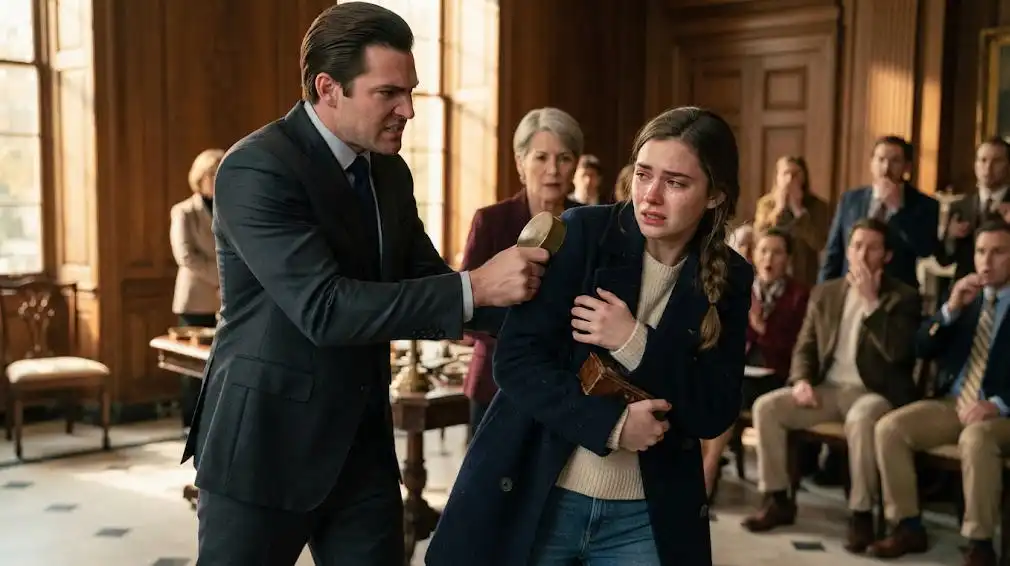
The brass paperweight struck Nora Bennett's left shoulder with enough force to make her knees buckle.
She had barely lifted her grandfather's old music box from the auction table when her cousin attacked.
Pain exploded down her arm.
For one terrifying second, the room tilted. Her feet scraped against the marble floor, and she nearly lost her balance.
But she didn't drop the box.
Instead, she wrapped both arms around it, pressing the worn wooden lid against her chest as though the little object were something alive.
"Thief! That's my property!"
Adrian Mercer stood less than two feet away, gripping the heavy brass paperweight.
He was thirty-two, impeccably dressed in a charcoal suit that probably cost more than Nora's monthly rent.
His expression held no remorse.
Nora looked at him, struggling to breathe through the pain.
"You just hit me."
Adrian glanced toward the wealthy buyers gathered around the auction tables.
"Then maybe you'll finally understand that you don't belong here."
He set the paperweight down heavily.
Nora's eyes filled with tears.
She could feel the entire room watching her. Some guests looked embarrassed. Others turned away, unwilling to involve themselves in another family's ugly business.
But nobody seemed interested in asking why a grown man had attacked a young woman over a battered wooden box.
Nora held it tighter.
She had not come to Virginia for money.
She hadn't come to fight over property or challenge her cousin's inheritance.
She had come for one thing.
A music box that had once belonged to her grandmother.
And until that afternoon, Nora had believed it might be the last piece of her grandfather she would ever be allowed to keep.
Five years earlier, Charles Mercer had been one of Virginia's wealthiest businessmen.
His family controlled manufacturing companies, commercial properties, and a chain of industrial supply businesses built over three generations.
The Mercer estate stood on hundreds of acres of wooded land, its main house filled with expensive furniture, oil paintings, and photographs of important men shaking hands.
Charles had spent nearly his entire adult life expanding that fortune.
But there was one person who had loved him before she understood how much money he possessed.
His granddaughter, Nora.
When Nora was little, she spent summer afternoons following her grandfather through the gardens.
He taught her how to identify birds by their songs, how to grow tomatoes, and how to repair the old grandfather clock in his study.
Every evening, he would sit beside her bed and wind a small wooden music box.
Its melody was simple, warm, and slightly uneven.
Charles had bought it for his late wife, Margaret, during the first year of their marriage.
The box was never valuable.
Its hinges were tarnished. The finish had worn thin. One corner had a permanent dent from the time six-year-old Nora accidentally knocked it off a table.
But Charles refused to replace it.
"Some things aren't meant to be worth money," he once told her.
Nora remembered that sentence for years.
Especially after discovering that her grandfather had forgotten it himself.
When she was seventeen, Charles announced that Nora would become engaged, after turning eighteen, to the son of one of his business partners.
The arrangement would strengthen a major commercial alliance.
He spoke about it as though Nora were another part of his estate, something he could transfer in exchange for favorable terms.
Nora refused.
At first, Charles assumed she was being difficult.
Then he threatened to withdraw her college funding.
When she still refused, he told her she was throwing away everything her family had built.
"I don't love him," Nora said.
Charles looked at her across his enormous mahogany desk.
"Love isn't what keeps a family business alive."
"Then I don't want that kind of family business."
His face hardened.
"If you walk out that door, don't expect this family to take care of you."
Nora stood there for a long moment, waiting for him to soften.
He didn't.
That evening, she left the mansion with one suitcase and seventy-three dollars.
She was seventeen years old.
Over the next five years, she worked wherever she could find a paycheck.
She cleaned offices, stocked grocery shelves, tutored high school students, and eventually found steady evening work at her university library.
Scholarships covered most of her tuition, but she still struggled with rent, groceries, and textbook costs.
She lived in a cramped apartment and learned how to stretch a bag of rice across several meals.
Sometimes, when she was exhausted, she thought about calling her grandfather.
But she remembered the last look on his face.
And she never made the call.
She didn't know that, during the final month of his life, Charles had been trying desperately to reach her.
By then, Adrian had become his grandfather's constant companion.
He handled appointments, screened visitors, and controlled access to the estate.
Whenever Charles asked about Nora, Adrian had an answer.
She was too busy.
She didn't want to speak to him.
She had moved on.
Sometimes Adrian simply said he had already tried calling.
Charles believed him longer than he should have.
And while the old man grew weaker, Adrian quietly positioned himself to take control of the family fortune.
Six weeks before the auction, Charles Mercer died at the age of seventy-nine.
The official explanation was complications following a fall.
Nora learned about his death from an online obituary.
No one in the family called her.
The funeral had already taken place by the time she saw it.
She sat alone in her apartment that night, staring at the photograph of Charles beside the announcement.
For five years, she had imagined one last conversation.
Now there would never be one.
A few weeks later, Nora received an unexpected telephone call.
It was from Elaine Foster, a former housekeeper who had worked at the Mercer estate for nearly twenty-five years.
Elaine had been dismissed shortly after Charles's death.
"Your cousin is selling everything," the older woman told her.
"What do you mean, everything?"
"The furniture. The paintings. Even the things from your grandfather's bedroom."
Nora closed her eyes.
"His music box?"
"I'm afraid so, sweetheart."
Nora sat down.
Elaine hesitated before continuing.
"Your grandfather asked about you before he died."
Nora felt her throat tighten.
"What?"
"He asked me if I thought you would ever come home."
"Did you tell him I might?"
"I told him you had every right to decide for yourself."
Elaine was quiet for a moment.
"Then he asked Adrian to help him call you."
"Did he?"
"I never saw you come."
Nora spent the rest of the evening looking at photographs from her childhood.
In one picture, she was sitting on Charles's lap, both of them smiling beside the little wooden music box.
She made her decision before midnight.
She would go to the estate.
She would ask for the box.
And then she would leave.
She wasn't prepared for the auction.
The mansion's front hall was crowded with bidders carrying numbered cards.
Tables displayed silverware, antique clocks, paintings, and objects Nora remembered from childhood.
Adrian had arranged a private sale even though the estate's probate proceedings were not complete.
Mara Caldwell, the senior attorney retained by the Mercer family's principal trust, was present to monitor the inventory and question any unauthorized disposal of assets.
She had already warned Adrian that the estate's authority to sell property remained disputed.
He insisted that the will naming him as sole beneficiary would soon be approved.
Until then, he was determined to proceed.
Nora approached the long table where smaller household items were displayed.
And there it was.
The music box.
Its once-polished walnut surface had dulled, and the small brass decoration on its lid was scratched.
But Nora recognized it immediately.
She asked the auction attendant whether she could examine it.
The attendant nodded.
Nora lifted it gently.
Her thumb settled into the same shallow dent she had made when she was six.
Then Adrian spotted her.
He crossed the room, grabbed the brass paperweight from a nearby table, and struck her left shoulder.
Now, standing before him in pain, Nora tried to make him understand.
"Please. I don't want his money. I just want this."
Adrian gave a contemptuous laugh.
"You had five years to come crawling back. Grandfather left everything to me."
Nora swallowed.
"He used to play this when I couldn't sleep."
"That doesn't make it yours."
He reached for her arm.
Nora twisted away.
"It was his favorite. Let go!"
Adrian's face reddened.
He turned toward the security guards near the doorway.
"Get her out of here!"
One guard hesitated when he noticed Nora clutching her injured shoulder.
The second guard approached and took hold of her right arm.
"Miss, please come with me."
"I'm not stealing anything!"
She tried to pull away.
Pain shot through her injured shoulder, and her grip weakened.
The music box slipped between her fingers.
Nora reached for it.
Too late.
The box struck the marble floor.
A sharp crack echoed through the room.
For a moment, Nora couldn't move.
The wooden lid had twisted sideways, and a jagged opening ran along the bottom.
Her grandfather's treasured music box was broken.
She sank to her knees.
"I'm sorry," she whispered, though she wasn't certain whether she was speaking to the broken box or the man who had once played it for her.
Then something caught her eye.
A section of the bottom lining had separated from the wood.
Underneath was a narrow hidden compartment.
Inside lay a miniature videotape and a folded handwritten letter.
Nora stared.
She had never known the compartment existed.
The envelope was yellowed, but the writing on its surface was unmistakable.
For Nora. Please read this yourself.
Her grandfather's handwriting.
Near the bottom of the envelope was a dark reddish fingerprint.
It looked disturbingly like dried blood.
Nora felt cold.
Adrian had been watching from above her.
When he saw the envelope, his expression changed.
"Give me that."
He stepped forward.
Nora quickly covered the letter with her hand.
"No."
"That belongs to me."
"You said the box was worthless!"
"I said give it to me!"
Across the room, Mara Caldwell rose from her chair.
She had witnessed the attack, and she had been about to demand that the guards release Nora.
But now she saw something that troubled her even more.
The handwriting on the envelope.
"Nora," she said carefully, "don't let him touch that letter."
Adrian lunged.
Nora reacted before she could think.
With her uninjured right hand, she grabbed the miniature videotape and the envelope from the broken compartment.
She pulled them against her chest, using her body to shield them from Adrian.
He caught the sleeve of her coat.
The movement sent another wave of pain through her shoulder.
"Let go of me!"
She tried to step backward.
Adrian reached for the envelope, his fingers grazing its edge.
For a terrible instant, Nora thought he was going to tear it from her hand.
She pivoted away, hit the edge of the auction table, and nearly fell.
But she did not release the letter.
Mara was moving toward them.
"Adrian, step back!"
He ignored her.
"Nora stole those documents!"
"They came out of the box," one of the auction attendants said.
Adrian turned on him.
"Stay out of this!"
That distraction gave Nora the opening she needed.
She moved toward Mara and thrust both objects into the attorney's hands.
"Please. Take them before he destroys them."
Mara accepted the letter and videotape.
The senior attorney held them carefully, making sure that Adrian could not reach either item.
Then she addressed the security guards.
"Separate them. Now."
The guards finally moved between Nora and Adrian.
Mara turned to the auctioneer.
"This sale is suspended. There is a serious dispute over the ownership of these materials, and the estate's authority to proceed is unresolved."
Adrian laughed nervously.
"You can't stop my auction."
"I'm not deciding who inherits anything," Mara replied. "I'm preserving disputed estate property and requesting immediate court intervention."
She looked toward an assistant.
"Call the sheriff. We have an assault to report."
Adrian's expression shifted.
For the first time, he seemed to understand that his control of the room had limits.
Mara brought the envelope and videotape to a clear section of the auction table.
With Nora and two witnesses watching, she photographed their condition and recorded where they had been found.
Then she carefully opened the folded letter.
Something else was tucked inside.
Several sheets of closely folded legal paper.
Mara unfolded them.
Her breathing changed.
At the top of the first page were the words:
Last Will and Testament of Charles Edward Mercer.
Beneath that was a date.
Seven weeks before Charles's death.
Mara looked at the signature.
Then at the attached witness statements.
Then at the notarized self-proving affidavit.
Adrian stood several feet away, staring at the papers.
"That's fake," he said immediately.
Mara did not respond.
She continued examining the document.
Nora watched her, barely aware of the pain spreading through her shoulder.
"What is it?" she asked.
Mara looked up.
"Nora, I need you to listen carefully."
Nora nodded.
"This appears to be a later will than the one Adrian submitted to the probate court."
The room seemed to go silent.
Nora stared at her.
"Another will?"
"Yes."
"What does it say?"
Mara hesitated.
She was not prepared to declare an inheritance valid on the auction-room floor. The document would require formal verification and court approval.
But she could read the central provision.
She lowered her eyes to the page.
Then she looked directly at Nora.
"It names you as the principal beneficiary."
Nora couldn't speak.
Adrian exploded.
"She's lying! Grandfather disowned her!"
Mara turned toward him.
"Mr. Mercer, you need to stop talking."
But Adrian was already moving toward the table again.
"I know what that is! It's not real!"
The security guards stopped him.
Nora barely noticed.
Her attention had returned to the handwritten letter.
Mara passed it to her after documenting its contents.
Nora recognized every uneven curve of her grandfather's handwriting.
It began simply.
My dear Nora,
There are things I should have said to you five years ago.
Nora pressed her lips together.
I thought I was teaching you responsibility when I demanded you accept a marriage you did not want.
Instead, I was asking you to give up your freedom for my convenience.
You were right to refuse me.
Her vision blurred.
She continued reading.
I told myself you were stubborn. I told myself that one day you would come back and apologize.
The truth is that I was too proud to admit I was the one who owed you an apology.
Nora stopped reading.
For five years, she had carried the memory of her grandfather's anger.
She had imagined him dying with that same anger in his heart.
Now, standing in the room where he had rejected her, she discovered that he had regretted it.
The letter continued.
I have tried to reach you. Adrian tells me you will not speak to me. I hope that is not true.
I have changed my will. The original is enclosed, properly witnessed and notarized.
If Adrian claims that I meant to leave him everything, do not believe him.
Nora's hands began shaking.
Then she read the next paragraph.
I have grown frightened of what he is willing to do.
He tried to take these papers from me. I injured my hand during our struggle. I have left my bloody thumbprint here because I want you to know exactly which letter I wrote afterward.
Nora looked down at the dark reddish mark.
Her stomach tightened.
I have also left a recording. Please see that it reaches someone who can protect it.
I hid these things in Margaret's music box because Adrian has never cared enough about either of us to look inside it.
The final lines were written more unevenly.
I don't know whether I will get another chance to speak to you.
But I want you to know something before it is too late.
You never needed my money to deserve my love.
I was simply too foolish to tell you.
Your grandfather, Charles.
Nora covered her mouth.
For a moment, she was seventeen again, standing in front of his desk with her suitcase beside her.
Except this time, the old man was telling her he had been wrong.
And it was too late to answer him.
The sheriff's deputies arrived shortly afterward.
Nora gave her account of the assault.
The guards and several auction guests confirmed that Adrian had struck her with the brass paperweight.
A deputy photographed the object and the damaged music box.
Mara documented the transfer of the letter and tape into protected evidence packaging. The original papers were then secured for the probate proceedings, while investigators took custody of the videotape under a recorded evidence transfer.
Nora was taken to an urgent care clinic.
An examination found severe bruising and a shoulder contusion. She was placed in a sling and told to avoid lifting anything heavy until the injury healed.
But the physical pain was not what kept her awake that night.
It was one sentence from the letter.
I have grown frightened of what he is willing to do.
Why would Charles Mercer, a man who had once seemed afraid of nothing, have been frightened of his own grandson?
Two days later, Mara invited Nora to her office.
The attorney had arranged for the miniature videotape to be examined and copied by a qualified video specialist working with investigators.
It was a MiniDV cassette.
Charles had owned a small digital camcorder for years. He used to record family holidays and Nora's childhood birthdays.
The recording had been recovered successfully, and investigators had preserved the original.
Now Mara and Nora watched an authorized copy together.
The screen flickered.
Charles appeared seated in his study.
He looked terribly thin.
His hands trembled slightly, but his voice was clear.
A date written on a calendar beside him was consistent with the period shortly before his death. Investigators would later corroborate the recording's timing through witness accounts and the camera's stored files.
Charles looked directly into the lens.
"My name is Charles Edward Mercer. I am making this recording because I want my intentions to be understood."
He paused to catch his breath.
"I have signed a new will. I know what it says. I chose its beneficiaries myself."
He lifted a sheet of paper toward the camera.
It was the same will found inside the music box.
"I have been wrong about my granddaughter. I know that now."
His eyes grew wet.
"Nora, if you ever see this, I hope you will forgive an old man who valued his pride more than his family."
Nora began crying.
Then a door opened somewhere behind the camera.
A second voice entered the recording.
Adrian's.
"What are you doing?"
Charles turned.
"Something I should have done a long time ago."
Adrian moved into the edge of the frame.
His face was unmistakable.
"Are those new estate papers?"
"They are my papers."
"Grandfather, you can't seriously intend to give everything to her."
Charles straightened.
"It is my decision."
Adrian reached toward the documents.
Charles pulled them away.
"Don't touch them."
The recording became chaotic.
Adrian grabbed Charles's wrist.
Charles cried out.
There was a loud scrape as the papers struck the corner of the desk.
When Charles pulled his hand back into view, blood was visible near his thumb.
Adrian's voice rose.
"You think she's going to take care of you? She hasn't even visited!"
Charles looked shaken.
"You told me she wouldn't answer."
"Because she won't!"
For several seconds, neither spoke.
Then Charles said something so quietly that Nora almost missed it.
"Get out of my study."
The recording ended shortly afterward.
Mara stopped the video.
Nora sat motionless.
The letter and tape did not show her grandfather's death.
But they showed something equally important to the inheritance dispute.
Charles had understood the document he signed.
He had wanted Nora to inherit.
And Adrian had known about the change before Charles died.
"Why didn't he send the will to you?" Nora asked.
Mara considered the question.
"He didn't ask our firm to prepare it. It appears he went outside the family circle because he no longer trusted the people around him."
The attorney explained that the original document had been signed before two independent witnesses, accompanied by a notarized self-proving affidavit.
The witnesses were named.
Their signatures could be checked.
The notary's records could be examined.
The document itself still had to be admitted by the probate court.
But if it proved genuine, Adrian's claim would face a devastating challenge.
Nora leaned forward.
"And the will Adrian submitted?"
Mara's expression hardened.
"That is what we need the court and investigators to examine."
Over the following weeks, the truth began to emerge.
The two witnesses who had signed Charles's genuine will were located.
One was a retired county librarian named Caroline Reed.
The other was a home-care nurse, Lydia Hayes, who had assisted Charles during his illness.
Both confirmed that Charles had signed the document voluntarily, while mentally alert and aware of what he was doing.
The notary's journal supported the date and circumstances of the signing.
A document examiner identified serious irregularities in the signature and printing of the will Adrian had submitted.
Investigators also discovered that portions of the supposed final will had been assembled using copied signature material from older estate documents.
The handwriting on the letter was examined against known samples of Charles's writing.
Laboratory analysis of the reddish mark, compared with preserved medical samples, supported that the blood belonged to Charles.
The letter, video, and witness testimony formed a consistent picture.
Charles had changed his mind.
He had tried to make amends.
And someone had been determined to prevent Nora from learning about it.
But the investigation uncovered another disturbing problem.
Charles's death.
Elaine Foster told investigators that Charles had repeatedly requested help contacting Nora during his final month.
Adrian controlled the household telephone system and the old man's visitor appointments.
Telephone records showed attempted calls to Nora's number that had never connected.
Elaine remembered hearing Charles ask why his granddaughter would not answer.
Adrian had told him she refused to speak to him.
Nora examined her own phone records.
She had never received those calls.
The discovery devastated her.
For years, she had imagined her grandfather too angry to reach out.
In reality, he had been trying to find his way back to her.
Then Lydia Hayes, the home-care nurse, provided records that raised questions about the night Charles died.
Her notes documented injuries and increasing tension in the household during the days before his death.
There were discrepancies between Adrian's account of the final evening and the timeline recorded by household security systems.
Emergency services records also revealed a troubling delay between the time Charles was reportedly found injured and the call for medical help.
Investigators revisited the medical findings.
The original conclusion that Charles had simply fallen was no longer accepted without further examination.
The bruising, the delayed emergency call, Adrian's changing statements, and the earlier recorded assault created grounds for a homicide investigation.
Nora struggled with what this meant.
She wanted the truth.
But part of her was terrified of finding it.
"What if he really did something to Grandfather?" she asked Mara.
The attorney did not offer easy reassurance.
"Then the investigators need to establish what happened. We cannot replace proof with suspicion."
Nora nodded.
She understood.
Her grandfather had been denied the opportunity to explain himself.
She would not allow another person's lies to decide the truth a second time.
At the probate hearing, Adrian arrived with two attorneys.
He maintained that the will naming him as sole beneficiary was legitimate.
He claimed Nora had invented the entire discovery to steal the estate.
But the evidence did not support him.
Mara's legal team presented the original later will, the signed witness affidavits, the notary's documentation, and expert findings.
Both witnesses testified.
The video was introduced through properly authenticated evidence.
And Nora described exactly how the documents had been discovered after Adrian struck her and the music box broke.
Adrian's attorneys challenged the circumstances of the discovery and questioned Charles's judgment.
But the testimony of the witnesses, supported by Charles's own recorded statement, showed that he had understood his choices.
The probate court ultimately admitted Charles's genuine will and rejected the document Adrian had submitted.
The estate's controlling business shares, the Virginia manor, and Charles's remaining principal holdings were to pass to Nora through the lawful administration of his estate.
The court appointed an independent representative to complete that process and protect the assets from improper sale.
The planned liquidation was permanently stopped.
Nora heard the ruling without moving.
For several seconds, it didn't feel real.
She had spent five years worrying about whether she could afford her next semester.
Now the fortune her grandfather had once used to control her future was legally destined to become hers.
But the ruling did not give her back those five years.
It did not erase the night she had packed her suitcase.
And it did not bring Charles home.
Her first thought was not about the money.
It was about the music box.
Adrian, meanwhile, was facing consequences far beyond the loss of an inheritance.
Investigators had obtained evidence supporting criminal forgery charges tied to the fabricated will.
Further examination of Charles's final hours, including the medical findings, emergency-response timeline, and Adrian's inconsistent statements, led to Adrian's arrest in connection with the suspected homicide.
He was taken into custody under criminal warrants while the investigation into Charles's death continued.
The criminal proceedings had not yet determined whether he had caused his grandfather's death.
But Adrian could no longer treat the family's wealth as protection from scrutiny.
When Nora learned that he had been arrested, she did not celebrate.
She sat quietly with Mara for several minutes.
Then she asked one question.
"Will they keep looking into what happened to him?"
"Yes," Mara answered. "The investigation is continuing."
Nora nodded.
"That's all I want."
She knew that wasn't entirely true.
She wanted one more afternoon with her grandfather.
One more walk through the gardens.
One opportunity to tell him that she had never stopped loving him, even when she couldn't live the life he wanted.
But those were things nobody could give her.
Months passed.
The inheritance proceedings continued, and the transfer of Charles's principal assets was completed under court supervision.
Nora became the owner of the manor and the controlling interests in the family businesses.
She did not pretend that being Charles Mercer's granddaughter made her qualified to manage an industrial empire overnight.
Instead, she retained experienced managers, brought independent financial advisers into the companies, and ordered a careful review of the transactions Adrian had authorized.
She also halted the unnecessary sale of the old household furnishings.
Employees who had served the family for decades were offered stable contracts while the estate's operations were reorganized.
And when Nora met with the senior company officers for the first time, she made one thing clear.
"I won't be using this company to decide who my family is allowed to love."
Nobody in the room argued.
Elaine Foster returned to the estate, this time as Nora's invited guest.
They walked through the old garden together.
The roses had grown wild along the stone wall, and weeds had appeared between the paths.
Nora remembered Charles kneeling beside those same roses when she was a child, teaching her how to trim the dead branches without damaging the new growth.
Elaine watched her quietly.
"He was proud of you, Nora."
Nora shook her head.
"Not when I left."
"He was angry when you left."
Elaine paused.
"Those aren't always the same thing."
Nora looked toward the house.
"I wish he'd told me."
"I know."
Elaine reached over and squeezed her hand.
Nora returned the gesture.
There was no grand speech.
No promise that everything was healed.
Only two women standing in a garden, remembering a difficult man who had finally understood his greatest mistake.
Later, Nora arranged for Charles's personal papers to be preserved.
His letters and photographs were carefully cataloged.
The original will remained part of the official estate record, and copies of the video and handwritten letter were retained as required by the legal proceedings.
She kept a personal copy of the letter.
Sometimes she reread it when the weight of her new responsibilities became overwhelming.
Other times she couldn't bear to open it.
The inheritance had changed her circumstances.
But forgiveness was not something a court could award.
It came slowly.
In small moments.
In memories that no longer hurt quite as sharply.
And in the realization that Charles had tried, however imperfectly, to undo what he had done.
One quiet afternoon, Nora returned to her grandfather's study.
The room looked much as she remembered it.
The broad mahogany desk stood beneath the tall window.
Charles's favorite leather chair faced the garden.
An old clock ticked steadily on the mantelpiece.
And on the desk lay the wooden music box.
Its cracked bottom had been repaired.
The damaged hinge had been cleaned and fitted with a replacement pin.
Nora had spent several evenings carefully restoring the old box, using the same tiny screwdrivers and patient techniques Charles had taught her when she was little.
Now only the final adjustment remained.
She sat down in her grandfather's chair.
For a moment, she simply looked at the worn walnut lid.
She remembered being six, waiting impatiently for Charles to finish winding it.
She remembered being seventeen, leaving the house because he had refused to accept her choices.
And she remembered the words he had left hidden beneath its lining.
You never needed my money to deserve my love.
Her eyes filled again.
But this time she managed a small smile.
Nora picked up the tiny screwdriver and gently tightened the final brass screw.
Then she closed the repaired lid, turned the winding key, and opened the music box.
A familiar, warm melody filled her grandfather's study.
And Nora sat quietly at his desk, one hand resting on the music box she had finally repaired, listening to the gentle tune he used to play for her when she was a little girl.
Disclaimer: Mention of any brand or trademark is for identification only and does not imply partnership or endorsement
A Wealthy Manhattan Socialite Poured Red Wine on a Plus-Size Artist at a Charity Gala, Calling Her “Cheap and Unworthy.” She Had NO IDEA Who Would Discover Her Paintings... 😱

A Celebrity Trainer Threw CASH in a Plus-Size Nutritionist’s Face at a Luxury LA Gym, Saying She Couldn’t Even Control Her Own Weight. He Had NO IDEA What Her Clients Would Prove... 😱
My Fiancé’s Mother CUT MY Custom Engagement Dress in Front of 200 Guests and Called Me an “Elephant in a Sack.” My Fiancé Just SMILED... 😱