The cane snapped before Oliver Hayes hit the floor.
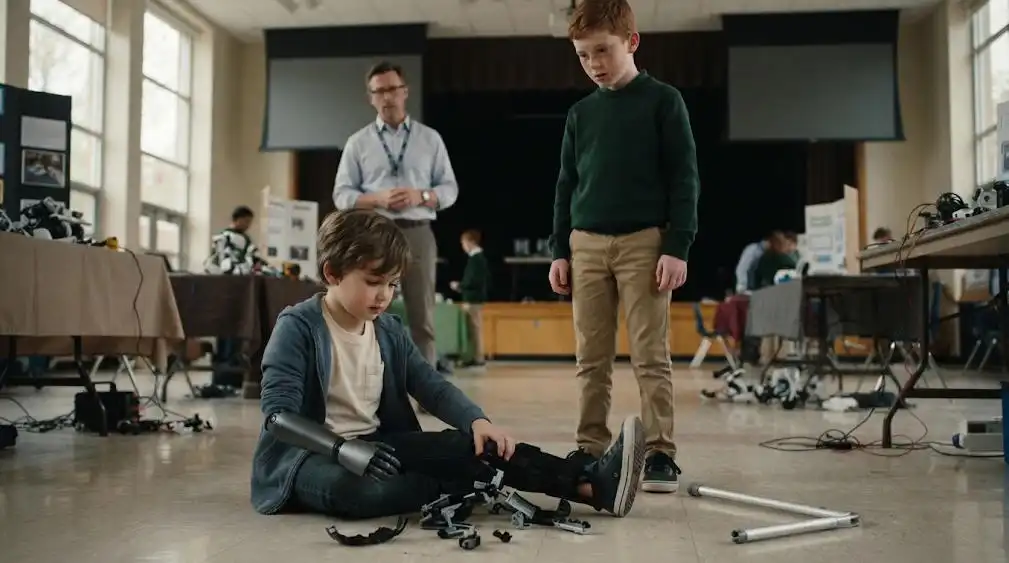
One moment, the six-year-old was reaching for the little robot dog he had spent three weeks building. The next, his support cane was broken beneath an eleven-year-old boy's sneaker, and Oliver was falling toward the polished tiles of the school auditorium.
His right leg brace scraped against the floor. He caught himself with his right hand, but the impact sent a sharp jolt through his hip.
Across the room, hundreds of parents, teachers, and students had gathered for the annual technology expo at Crestwood Academy in Sacramento, California.
Oliver had wanted to show them what he could do.
Instead, they were watching him struggle to sit upright among the pieces of his own invention.
Ethan Caldwell stood over him, looking pleased with himself.
A few seconds earlier, Ethan had snatched Oliver's robot dog from his hands and thrown it onto the floor. Its plastic shell had split on impact. One mechanical leg had snapped off, and the small sensor board Oliver had carefully calibrated was now lying beneath a display table.
Oliver had reached for the pieces.
Ethan had taken his cane.
Now both were broken.
"Look at that," Ethan said, nudging one of the robot's legs with his shoe. "You can't even keep your stuff together."
Oliver's left arm ended in a sophisticated prosthetic. His right leg required a custom brace, and the lightweight cane had been his backup support whenever he needed to stand or move between tables.
He was six years old.
He had built the robot himself.
And he had come to the expo hoping that, for one afternoon, people might look at his work before they looked at his disabilities.
Ethan knew all of that.
He also knew that his grandfather, Richard Caldwell, chaired the school's board of trustees.
At Crestwood, that family connection had become a kind of permission slip.
Ethan could interrupt a presentation, grab another student's components, or laugh at someone else's failed experiment without worrying much about the consequences. His grandfather's influence protected him, and Daniel Mercer, the school's technology teacher, had repeatedly demonstrated that he was willing to help.
Oliver had seen it happen before.
Three weeks earlier, a student's carefully assembled bridge had collapsed after Ethan tampered with its supports. Another student's small wind turbine had stopped working after its wiring was pulled loose. Each time, Mercer had called it an unfortunate accident.
Each time, Ethan had walked away untouched.
Oliver had quietly repaired his own work and concentrated on the competition. He believed that if he made something good enough, the judges would eventually have to take it seriously.
His robot dog, Scout, was his best work yet.
It was small enough to fit on a classroom table, but its adjustable gait and obstacle sensors allowed it to navigate an uneven path without tipping over. Oliver had spent evenings testing the design, changing the position of its joints, and correcting tiny errors in its movement.
His father had offered to let a team of engineers help.
Oliver had refused.
He wanted to show what he could build himself.
His father, Nathan Hayes, had smiled and agreed. He had promised to arrive for the final judging, although a business meeting in Silicon Valley had delayed him.
Oliver had no idea how much that delay was about to matter.
"Get up," Ethan said.
Oliver tried to move his braced right leg into a better position, but without the cane, standing was difficult. He pressed his right palm against the floor and looked for a stable edge of the nearby table.
Mercer finally approached.
For one hopeful second, Oliver thought the teacher might help him.
Instead, Mercer looked down at the scattered robot parts.
"Defective products don't belong in a competition."
The words landed harder than Oliver expected.
A couple of students looked away. One parent began to step forward, then hesitated when Mercer turned toward the judges' table as though the incident had already been settled.
Ethan laughed.
Oliver felt his face grow hot. His eyes stung, and his fingers curled against the tile.
He wanted to shout at them.
He wanted someone to say that what had happened was wrong.
Instead, he lowered his head and began collecting the pieces of Scout.
He picked up a tiny wheel first, then the broken sensor housing. When he found the main circuit board, he held it carefully in his right hand.
The board was cracked.
He knew that before he even examined it.
For a moment, he simply stared at it.
Then he took a slow breath.
The underside of his prosthetic wrist had a small recessed switch that most people would never notice. Nathan had explained its purpose when Oliver first received the experimental device.
The prosthesis was not an ordinary piece of equipment. It was an advanced prototype developed by Asterion Systems, the technology company Nathan had founded and built into one of Silicon Valley's most powerful engineering enterprises.
It was designed to adapt to Oliver's movements, learn his preferences, and work safely with the muscles he still controlled.
It also contained a concealed emergency signal.
Nathan had made Oliver promise not to use it casually.
"If you're frightened, you can always tell someone," Nathan had explained. "But if you're in a situation where you truly need help, press that switch. I'll know."
Oliver had never used it.
He had wanted to handle school on his own.
Now he pressed it.
A tiny amber light flashed beneath the wrist of his prosthesis.
Across the auditorium, every screen went black.
The judges' monitors vanished first. Then the presentation displays, the large stage screen, and the security monitors mounted near the doors.
The sudden darkness silenced the room.
A second later, a huge white-and-blue emblem illuminated the central screen.
ASTERION SYSTEMS.
Oliver looked up.
So did everyone else.
Crestwood's technology lab had been equipped through an anonymous corporate donation. The school had received robotics equipment, networking infrastructure, presentation displays, and a sophisticated security system. Teachers knew the donor's name, but few knew why the company had insisted on retaining an emergency management channel for its donated systems.
They were about to find out.
At Asterion's headquarters, Nathan Hayes had received the alert.
The signal included Oliver's location and a clear indication that his son had manually requested emergency assistance. The accompanying safety feed showed Oliver on the floor, his cane broken, and his robot scattered around him.
Nathan watched the footage once.
Then he watched the moment Mercer leaned over his six-year-old son.
Something in Nathan's expression changed.
He had spent years building technology that could help people overcome physical limitations. He had funded school laboratories because he wanted children to discover what they could create, regardless of their circumstances.
He had not built Asterion so a teacher could call a child defective while watching someone destroy his work.
Nathan activated the company's emergency management override.
Asterion's retained management channel took control of the school's donated security and presentation systems. Every display remained dark for a beat, then the company's emblem appeared.
Nathan instructed the system to display the relevant security recordings from the school's own archived footage.
He did not need to manufacture evidence.
The cameras had already recorded the truth.
The first clip showed Ethan walking past a student's bridge project and deliberately dislodging one of its supports. Mercer was standing several feet away. He looked directly at what Ethan had done, then turned toward the judges' table instead of intervening.
The next clip showed Ethan pulling wires from a wind turbine.
Mercer watched him do it.
When another student complained, the teacher collected the damaged components and told the child to stop making a scene.
Then the footage showed the moments immediately before Oliver's fall.
Ethan snatched Scout from Oliver's hands and hurled it onto the floor.
He seized the cane.
He broke it.
Oliver fell.
And Mercer did nothing.
The footage repeated across every screen.
This time, no one in the auditorium could pretend they had not seen it.
Ethan's grin vanished.
Mercer stepped backward, staring at the display as though he might somehow make the images disappear by refusing to look at them.
Richard Caldwell, seated near the front of the auditorium, rose from his chair.
"Turn that off!" he demanded.
No one obeyed.
The principal, Dr. Evelyn Shaw, hurried toward the technical control desk. She tried the normal display controls, but the screens remained under the emergency override.
"What is this?" she asked.
No one answered her.
Then the auditorium doors opened hard enough to strike their stops.
Several security professionals entered first, dressed in dark suits and moving with the disciplined coordination of an experienced executive protection team. They did not threaten the students or touch anyone. They simply cleared a path through the crowd.
Nathan Hayes walked in behind them.
He wore a charcoal suit, a white shirt, and no tie. His face was pale with anger, but his movements were controlled.
He had left Silicon Valley aboard his private jet as soon as the alert arrived. The aircraft had landed at a regional airport outside Sacramento, where two waiting vehicles had carried him directly to the school.
He had not called ahead to ask permission.
He had come for his son.
The first thing Nathan saw was Oliver sitting on the floor.
The second was the broken cane.
The third was the shattered robot dog.
Nathan crossed the remaining distance and dropped to one knee.
"Oliver."
The boy looked up.
For the first time since the fall, his face crumpled.
"Dad."
Nathan wrapped an arm around him carefully, making sure not to pull on the prosthesis or disturb the brace on his right leg. He checked Oliver's hands, asked whether he had hit his head, and waited for him to answer before trying to help him stand.
"I'm okay," Oliver whispered.
Nathan glanced at the broken cane.
"Are you sure?"
Oliver nodded, then looked down at Scout's remains.
"My robot isn't."
Nathan followed his gaze.
For a moment, the auditorium seemed to shrink around them. Nathan had negotiated billion-dollar contracts without raising his voice. He had faced hostile investors, collapsing supply chains, and competitors who had spent years trying to undermine his company.
None of it had prepared him for seeing his six-year-old son sitting on a school floor, apologizing with his eyes for being hurt.
"You don't have to apologize for what happened," Nathan said quietly.
Oliver swallowed.
"I wanted them to see my robot."
"I know."
"I didn't want you to make them give me first place."
Nathan looked directly at him.
"I won't."
Oliver's shoulders lowered slightly.
"But I want them to stop doing this to other kids."
Nathan held his son's gaze for a moment.
"Then that's what we're going to do."
He helped Oliver gather the remaining pieces of Scout, placing them in a protective case brought by one of the security professionals. He refused to let anyone sweep the fragments into a bin.
Then he stood.
Only then did Richard Caldwell recognize him.
"Nathan Hayes?"
Nathan turned.
Richard had spent years cultivating the image of a man who could make a phone call and have a problem disappear. As chairman of Crestwood's board, he was accustomed to seeing teachers, administrators, and parents defer to him.
But he knew Nathan Hayes.
Everyone in the technology industry knew the name.
Asterion Systems owned foundational patents used in advanced robotics, motion control, and sensor technology. Caldwell Robotics, Richard's family company, depended on exclusive licensing agreements for several of its most important products.
Richard's company also relied on financing secured against those licensed technologies.
And Nathan controlled the patents.
"Mr. Hayes," Richard began, forcing a smile. "I'm sure we can resolve this privately. Children sometimes get carried away."
Nathan glanced at the enormous screen, where the footage of Ethan breaking Oliver's cane was still playing.
"That wasn't a misunderstanding."
Richard lowered his voice.
"You don't want to turn a school incident into a business dispute."
"I'm not turning anything into anything," Nathan replied. "Your grandson destroyed a six-year-old child's work and the support he needs to stand. Your teacher watched him do it. The school's own cameras recorded the entire event."
Mercer stepped forward.
"The boy was disruptive. I was trying to maintain order."
Dr. Shaw stared at him.
"You didn't intervene."
"I was handling it."
"No," Nathan said. "You were protecting the child you wanted to win."
Mercer opened his mouth, but no answer came.
Nathan turned to his security director, who had arrived with the rest of the team.
"Preserve the original footage. All of it. Make verified copies for the school and the independent investigators. Nobody edits the files, and nobody deletes the originals."
"Understood."
The instruction mattered.
The recordings were not merely images being played on a screen. They came from the school's existing security archive, with timestamps and a retained audit trail. The emergency display had made the footage visible, but the original recordings could be examined independently.
Richard could dispute Nathan's motives.
He could complain about the public embarrassment.
He could not simply dismiss the footage as a story invented by a furious father.
Dr. Shaw took a breath and faced Mercer.
"Until an independent review is completed, you are suspended from all teaching and judging duties."
Richard spun toward her.
"You cannot suspend him without consulting the board."
"The board will be consulted," she said. "But I will not allow him to continue supervising students while this is investigated."
For the first time, Richard appeared genuinely uncertain.
Then his phone rang.
He looked at the screen and frowned.
Nathan had been in negotiations with Caldwell Robotics before Oliver's emergency signal interrupted his meeting.
The company had missed required payments under its patent licensing agreements and was already in financial default. Its remaining credit depended on a secured bridge loan, and its board had signed a conditional restructuring agreement that included a prearranged asset acquisition and an emergency insolvency process if the default was not cured.
Nathan's team had prepared the necessary documents.
Until that afternoon, he had been willing to consider another extension.
Now he had seen exactly how the Caldwell family exercised power when it believed no one important was watching.
Richard answered his phone.
"What do you mean, the extension is gone?"
He listened.
His expression changed.
Nathan looked at his own counsel, who had joined the school response through a secure call.
"Execute the acquisition option," Nathan said. "Call the secured notes. Terminate the patent license under the existing default provisions. Submit the agreed insolvency filing."
His counsel paused only long enough to confirm the instruction.
"The defaults are documented. The signed restructuring protocol is ready."
"Proceed."
Nathan ended the call.
Richard stared at him.
"You can't do this because of what happened to Ethan."
"I'm not inventing a default because of your grandson," Nathan replied. "Your company was already in default. Your board signed the agreement. I was prepared to extend the deadline. I am no longer extending it."
Richard's phone began vibrating repeatedly.
Within sixty seconds, the prearranged notices had been issued, the acquisition option had been exercised, and the insolvency filing had been submitted under the signed agreement. Caldwell Robotics entered emergency liquidation proceedings, its financing was frozen, and control of its operating assets passed into the restructuring process.
The company that had given Richard his influence was suddenly beyond his personal control.
Its core technology licenses were terminated. Its secured creditors were notified. The family would lose control of the business, even as the asset acquisition process moved forward to preserve viable operations and protect employees who had played no part in the school's misconduct.
Richard sat down slowly.
For years, he had assumed his family's money could shield Ethan from consequences.
Now he was learning that money did not make a contract disappear.
Nor did it erase a recording.
Nathan did not celebrate.
He returned to Oliver, who was watching the proceedings with a mixture of confusion and exhaustion.
"Are we going home?" Oliver asked.
"Yes," Nathan said. "But first, we're making sure you have everything you need."
He asked the security team to bring the car around and arranged for a medical professional to check Oliver's hip and leg. The examination found no serious injury. Oliver's brace remained intact, although his hip was sore from the fall.
Before leaving, Oliver asked to see the broken pieces of Scout one more time.
Nathan opened the protective case.
Oliver examined the fractured sensor board and the snapped joint.
"I think I know why the front leg kept slipping," he said quietly.
Nathan looked at him.
"Even now?"
Oliver nodded.
"If I move the sensor a little farther back, the balance correction might work better."
Nathan's anger softened into something more complicated.
His son had been humiliated, knocked down, and robbed of the chance to demonstrate his invention.
Yet Oliver was already thinking about how to improve it.
"Then we'll make sure you have the chance to test that idea," Nathan said.
He did not promise Oliver a trophy.
He promised him the opportunity to build again.
The independent investigation began the following morning.
The original security recordings were examined alongside the school's equipment logs and statements from students whose projects had been damaged. Several students confirmed that Ethan had repeatedly interfered with their work. Others described how Mercer had dismissed their complaints or moved damaged projects out of sight.
The recordings supported their accounts.
The inquiry found that the problem had not been one bad moment at the technology expo. It was a pattern of favoritism that had allowed one student's family connections to override the rules everyone else was expected to follow.
Mercer lost his teaching position. His judging credentials were revoked, and the professional consortium overseeing the school's sponsored technology programs placed him on a permanent ineligible list. Member institutions and corporate education partners barred him from future teaching, judging, and laboratory-supervision roles.
Ethan was removed from the competition, and the school formally withdrew the award his project had been expected to receive. His parents were required to participate in the school's disciplinary process, and his grandfather could no longer use his position on the board to influence the outcome.
Richard resigned from the trusteeship as the investigation widened.
Caldwell Robotics continued through its court-supervised liquidation and asset restructuring. The family lost control of the enterprise. The acquisition preserved viable technology operations and allowed employees to seek continued employment under new management, but the Caldwell name no longer guaranteed influence over the company's future.
The school also had to change.
An independent review found that its complaint procedures had been ineffective and that its technology competitions lacked adequate safeguards against favoritism and sabotage. The old board was dissolved, and a new group of independent trustees introduced documented judging standards, stronger incident reporting, and rules requiring staff to intervene when students' safety or work was threatened.
The school was eventually renamed Oliver Hayes Academy.
Oliver had not asked for that honor. He had asked for a fair chance to build something.
But the new trustees chose his name because his experience had become the clearest reminder of what their school had failed to protect.
The technology laboratory was rebuilt, damaged student projects were replaced where possible, and future awards would be judged independently. Asterion continued supporting the program, but Nathan insisted that the funding agreement include protections for every student, not just the children whose families could afford to demand attention.
Through it all, Oliver kept thinking about Scout.
He did not want to forget what had happened. He wanted to understand it.
The shattered robot could not be repaired exactly as it had been. Its main sensor board was too badly damaged, and several of its mechanical joints had broken beyond reuse. But Oliver still remembered the design, and he had kept his sketches.
Asterion's engineering team offered to help him rebuild.
This time, Oliver accepted.
He worked with the engineers on a new chassis, stronger joints, and a revised balance-control system. They handled the heavier fabrication, while Oliver chose the sensor positions, tested movement patterns, and explained how he wanted the robot to respond to uneven surfaces.
The upgraded robot dog was faster, steadier, and more responsive than the original.
But the most important part was that Oliver had helped design it.
He had not been handed a replacement trophy.
He had been given back his chance to create.
Several weeks after the expo, the work was ready for its first full demonstration.
Nathan sat behind his desk at Asterion Systems headquarters, watching as Oliver climbed into his father's enormous executive chair. The wide leather seat nearly swallowed the small boy, and his right leg brace rested comfortably beside the chair's arm.
Oliver held the controller in his right hand.
His left prosthesis rested against the chair's padded armrest.
Across the office carpet, the newly upgraded robot dog lifted its head, adjusted its stance, and began to walk. It navigated around a table leg, corrected its balance on the edge of a rug, and turned neatly when Oliver moved his thumb on the controller.
Oliver leaned forward, concentrating.
The robot dog paused, then trotted back toward him with a smoothness the first Scout had never achieved.
For a second, Oliver simply watched it.
Then his face broke into a bright, unguarded smile.
He nudged the controller once more, and the little machine turned toward him, steady on all four legs.
Oliver sat in his father's wide office chair, guiding his newly upgraded robot dog with his one natural hand, his smile shining as the machine moved exactly the way he had imagined.
Disclaimer: Mention of any brand or trademark is for identification only and does not imply partnership or endorsement
A Wealthy Manhattan Socialite Poured Red Wine on a Plus-Size Artist at a Charity Gala, Calling Her “Cheap and Unworthy.” She Had NO IDEA Who Would Discover Her Paintings... 😱
A Celebrity Trainer Threw CASH in a Plus-Size Nutritionist’s Face at a Luxury LA Gym, Saying She Couldn’t Even Control Her Own Weight. He Had NO IDEA What Her Clients Would Prove... 😱
My Fiancé’s Mother CUT MY Custom Engagement Dress in Front of 200 Guests and Called Me an “Elephant in a Sack.” My Fiancé Just SMILED... 😱