



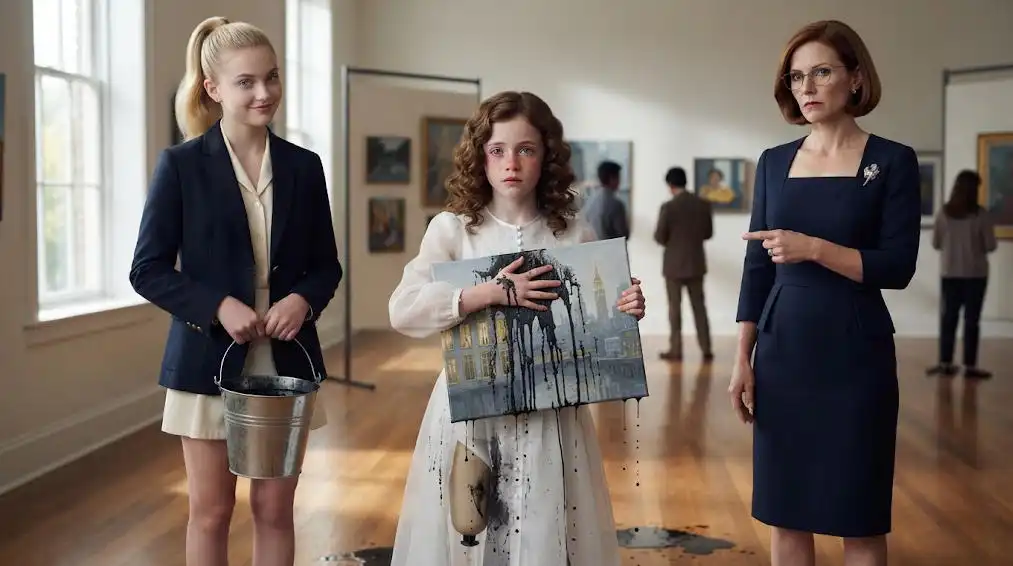
The black water ran down Evelyn Hart’s painting before anyone in the exhibition hall said a word.
One moment, nine-year-old Evelyn was standing beside her finished canvas, watching visitors approach the school’s annual art festival. The next, black rinse water covered the golden windows she had painted over six painstaking weeks.
Her white dress was soaked, too.
It was the last dress her mother had worn to an exhibition before she died.
Across the easel, sixteen-year-old Celeste Whitmore lowered an empty metal bucket. Her blonde ponytail swung over the shoulder of her expensive school blazer.
“Maybe now it matches your dress,” she said.
Evelyn caught the wooden frame with both hands. Water dripped from the bottom edge, pooling around her shoes. She tried to lift the canvas away from the wet floor, but her fingers slipped against the slick wood.
Her left leg had been amputated high above the knee. Beneath her long skirt, her prosthesis helped her stand at the easel, with a forearm crutch resting nearby. She had chosen her mother’s white organza dress because she wanted to feel beautiful at the festival.
More than that, she wanted people to see what she could do.
Now they were staring at her for all the wrong reasons.
Her art teacher, Marianne Voss, approached with an expression of open irritation.
“You look like trash. Get out.”
Evelyn looked at the woman who had spent months telling her that her work was not suitable for the school’s most important exhibition.
“It was my painting.”
Her voice trembled, but she did not move toward the door.
Celeste smiled.
The teacher did not tell her to apologize. She did not ask whether Evelyn was hurt. Instead, she turned toward the head of the exhibition hall and announced that the display needed to be cleaned before the judges arrived.
That was when the first visitor finally stepped forward.
But to understand why Evelyn had been standing there alone, holding a ruined painting while an entire room watched, it helps to understand what had happened during the previous six weeks.
Evelyn had never been interested in being called brave.
Adults had called her brave when she learned to walk with her prosthesis. They called her brave when she returned to school after months of rehabilitation. They called her brave when she stopped hiding behind her father at family gatherings.
She knew they meant well.
But bravery was not what she wanted people to see when she held a paintbrush.
She wanted them to see the light in a window, the way rain changed the color of a street, or the way an ordinary doorway could look welcoming even on the darkest evening.
Her mother, Nora, had understood that.
Nora had been an art conservator, a woman who could spend an entire afternoon examining a single layer of pigment. Before her death, she had left Evelyn a small notebook filled with careful drawings, pigment recipes, and observations about a rare glazing technique known as the blue-ash method.
The technique had nearly disappeared from modern practice. Its layered mineral pigments and unusual binder allowed light to appear as though it were rising from beneath the painted surface.
Evelyn had studied the notebook for months.
She had made mistakes. She had ruined test boards. She had cried when a mixture dried too quickly and turned dull instead of luminous.
Then, gradually, she learned.
Her painting, Every Window Lit, showed a rain-soaked street at dusk. Each window held a different warmth. One glowed amber, another pale gold, and a third carried the faint blue of a room where someone had left a lamp burning beside an empty chair.
At the end of the street stood a small open doorway.
It was not a picture about her disability.
It was a picture about the possibility of being welcomed somewhere.
When she finished it, her father had stood in front of the canvas for a long time.
He had not offered to buy it. He had not told her what it might be worth.
He had simply asked, “What do you want people to notice first?”
“The light,” Evelyn had answered.
“Then keep working until they do.”
She had taken that advice seriously.
Unfortunately, her teacher had different priorities.
Marianne Voss believed that a school’s art festival was as much about reputation as talent. The Whitmore family had donated generously to the academy, helping finance its renovated exhibition wing. Celeste had grown accustomed to having her work displayed at the center of important events.
Voss wanted that arrangement to continue.
Evelyn’s paintings complicated it.
Her work was unusually accomplished for a nine-year-old. More importantly, it had a quiet originality that attracted attention even when Voss tried to place it somewhere inconspicuous.
So the teacher began making small decisions that gradually became impossible to ignore.
She moved Evelyn’s work away from the main gallery wall. She shortened the time allotted to her presentation. When Evelyn asked why her painting had been placed beside the supply closet, Voss replied that the festival needed to maintain a consistent standard.
When Evelyn asked what standard her work had failed to meet, the teacher suggested that she concentrate on improving her technique rather than questioning professional judgment.
Then came the preliminary submission folder.
Six weeks before the festival, Voss had asked Evelyn to hand over her process studies for an originality review. Evelyn had included dated sketches, color tests, and several drawings showing how she had developed the unusual doorway at the center of Every Window Lit.
She trusted her teacher.
She handed over the folder.
A week later, Celeste submitted a new painting.
It featured almost the same arrangement of windows, the same narrow street, and a nearly identical doorway. Even the tiny crooked corner of one upper window appeared in Celeste’s work.
Evelyn noticed immediately.
She brought the two images to Voss and quietly asked how such a similarity could have occurred.
Voss barely looked at them.
“Artists influence one another,” she said. “You should be pleased that someone is working at your level.”
“But she used my doorway.”
“You are nine, Evelyn. You cannot expect every idea you have to belong to you.”
Evelyn went home that afternoon and opened her mother’s notebook.
She considered withdrawing from the festival.
Her father, Adrian Hart, was traveling frequently at the time, overseeing the family’s private art collection. Evelyn knew he painted in a locked studio, but she had never been told that the international art world knew his work under a mysterious signature: A. Vale.
She did not know that he was also the hidden owner of Hart Meridian Galleries, a private network responsible for approximately 80 percent of U.S. fine-art transactions.
Her father had kept his public identity separate from her life. After Nora died, he had promised himself that Evelyn would have the opportunity to develop her own voice before the world attached his name to hers.
He had never told Evelyn to keep her work secret.
He had only taught her to let the work speak first.
So she returned to her canvas.
On the morning of the festival, Evelyn put on her mother’s white dress. She checked the seams, smoothed the organza, and carefully secured the small buttons.
Then she carried Every Window Lit into the exhibition hall.
She had decided that if the judges rejected her painting, at least she would know she had given it a fair chance.
By noon, she understood that the decision had never been about the painting.
Celeste had deliberately emptied the bucket over her work. Voss had watched without intervening. And when Evelyn tried to save the canvas, the teacher had ordered her out.
The black water continued to drip from the frame.
Evelyn refused to let go.
Then the exhibition doors opened.
A line of men in black suits entered the hall, carrying leather portfolios and carefully protected cases. At their head was Elias Reed, one of the most respected art appraisers in the country.
Behind him walked a tall man in a charcoal overcoat and dark sunglasses.
Evelyn recognized her father immediately.
“Dad?”
Adrian stopped.
He looked at the ruined canvas, then at his daughter’s soaked dress and trembling hands.
For several seconds, he said nothing.
Then he removed his expensive overcoat.
He crossed the room, knelt beside Evelyn, and wrapped the coat around her shoulders. The fabric covered the wet organza, and his hands settled gently around her upper arms.
“Are you hurt?”
Evelyn shook her head, although her lower lip was trembling.
Adrian looked at her face rather than the painting.
“You don't have to pretend you're fine with me.”
That was enough.
Evelyn began to cry.
She had held herself together while Celeste emptied the bucket. She had held herself together while Voss called her trash. She had held herself together because she feared that if she cried, everyone would decide that she was too fragile to belong in the exhibition hall.
But her father was holding her now, and she no longer needed to pretend.
Adrian remained beside her until her breathing steadied. Only then did he turn toward the canvas.
“May I see it?”
Evelyn nodded.
He examined the painting without touching the wet surface. His expression changed as he recognized the distinctive layering beneath the blackened glaze.
He knew that technique.
Nora had spent years reconstructing it. Adrian had watched her work late into the night, testing pigments and comparing fragments of historical recipes. He had believed the method would survive through their family only as a piece of private knowledge.
Now he could see it in the work of their daughter.
The painting had been damaged, but its underlying layers had not disappeared completely.
Adrian turned to Elias Reed.
“Please preserve both paintings. Photograph their current condition. No one cleans, moves, or repairs either canvas until the condition has been documented.”
Reed immediately directed the other appraisers to prepare their equipment.
Marianne Voss stepped forward.
“This is a school exhibition,” she said. “You cannot come in here and issue orders.”
Adrian removed his sunglasses.
For the first time, she saw his face clearly.
He was not simply a wealthy parent who had arrived to complain about a teacher.
Elias Reed opened a black velvet case and placed a silver family seal on the registration table. The seal bore the Hart family insignia, a mark associated with the authenticated works and private records of A. Vale.
Reed addressed the man beside Evelyn.
“Mr. Adrian Hart, principal of Hart Meridian Galleries, and the artist known to the international market as A. Vale.”
The room fell silent.
The artist’s identity had been one of the art world’s most closely guarded secrets. Collectors had spent years trying to discover who created the paintings signed A. Vale. Museums had competed for the rare works. Auction houses had built entire exhibitions around them.
And the man standing beside a little girl in a ruined dress was that artist.
He was also the owner of the gallery network that handled 80 percent of American fine-art transactions.
Voss’s expression changed.
Celeste stopped smiling.
Adrian glanced toward the painting hanging on the exhibition’s central wall.
Celeste’s painting.
He studied its composition, then looked back at Evelyn’s damaged canvas.
“Who selected this work for the main display?” he asked.
Voss tried to regain control.
“The selection was made according to artistic merit.”
“Then an independent review should be straightforward.”
He did not shout. He did not threaten to have anyone arrested. Instead, he asked the headmaster to preserve the original submissions, the school’s digital records, and the process folders for both paintings.
The headmaster agreed.
Adrian had no intention of allowing a powerful name to replace evidence. He wanted the truth established in a way that would survive scrutiny after the exhibition ended.
The review began that afternoon.
Independent conservators examined the two canvases. They documented the damage to Evelyn’s painting and confirmed that the black rinse water had affected the upper surface without destroying all the underlying pigment layers.
The blue-ash technique was unmistakable.
It was the same rare method Nora Hart had spent years reconstructing from historical records. The appraisers could not establish authorship from a family resemblance alone, but the material examination confirmed that Evelyn had used the technique shown in her mother’s notebook.
Then the school produced the original submission records.
Evelyn’s dated studies had been uploaded six weeks before the festival. Celeste’s finished painting had been submitted later, yet it reproduced the same unusual arrangement and several distinctive details from Evelyn’s preliminary work.
The investigators also examined the school tablet Celeste had used to prepare her portfolio. A backed-up photograph showed Evelyn’s process sheet on a desk in Voss’s office.
The image had been captured after Evelyn submitted the folder and before Celeste completed her painting.
Finally, the school’s own email records revealed a message from Voss to Celeste advising her to retain the composition while changing the palette.
The evidence did not rest on Adrian’s reputation.
It rested on the dates, the images, the matching details, and the teacher’s own correspondence.
The next morning, the academy convened an independent review attended by school administrators, the Whitmore family, the art appraisers, and representatives of the school’s governing board.
Celeste’s father, Charles Whitmore, arrived expecting the matter to be settled quietly. His family had funded the new exhibition wing, and he assumed that the school would protect its reputation by keeping the dispute private.
Instead, Elias Reed presented the documented findings.
He displayed Evelyn’s original studies beside Celeste’s finished painting. He showed the identical window arrangement, the matching doorway, and the distinctive marks that had appeared in the earlier work.
Then he presented the photograph from Celeste’s school tablet and the email from Voss.
Voss attempted to defend herself.
“I was trying to encourage a promising student,” she said. “Celeste has the resources and discipline to develop her talent.”
“Resources do not create authorship,” Adrian replied.
He turned toward the assembled board.
“The painting on your center wall was copied from Evelyn’s earlier work. Your own records establish that. The teacher responsible for protecting the students’ work instead helped one student appropriate another’s.”
Celeste stared at the documents.
Her father asked her whether she had copied the painting.
For a long moment, she said nothing.
Then she admitted that she had photographed Evelyn’s process sheet after finding the folder in Voss’s office. She had used it because she believed the teacher would protect her.
“I thought nobody would believe her over me,” she said quietly.
Evelyn sat at the other end of the table, Adrian’s coat folded beside her.
She did not feel triumphant.
She felt tired, angry, and relieved that she no longer had to prove she had seen what she had seen.
The board removed Celeste’s painting from the featured exhibition and formally acknowledged Evelyn’s prior authorship. Voss was dismissed following the school’s review, and the documented findings were referred to the relevant professional bodies.
Adrian made another announcement.
His property trust, which had quietly purchased the entire block containing the academy and its neighboring buildings years earlier, would not use its ownership to silence the school or punish its students. But the academy’s lease renewal and future philanthropic support would be tied to an independently monitored anti-bullying policy, accessible art facilities, and a transparent system for evaluating student work.
The school board accepted those conditions.
Adrian also made it clear that he would not employ Voss in any of his institutions or recommend her to his professional partners.
Hart Meridian’s legal team circulated the verified findings to its network of museums, galleries, art schools, and exhibition organizers. The network would no longer invite Voss to judge student exhibitions or recommend her for curatorial appointments.
Other institutions reviewed the evidence and withdrew their own offers.
Within days, Voss had lost her position at the academy, her professional appointments, and the recommendations she had relied on to advance her career. She could no longer use the reputation of a respected art teacher to gain entry into the institutions she had once hoped to lead.
The Whitmore family suffered consequences of its own.
Charles resigned from the academy’s governing board. Their family foundation lost its prominent place in several cultural partnerships, and invitations to the exclusive art events where the Whitmores had once been welcomed without question began disappearing.
Celeste was removed from the festival’s featured program. The school required her to participate in a restorative process and issue a formal apology acknowledging the theft of Evelyn’s work.
She approached Evelyn privately afterward.
“I knew it was yours,” Celeste said. “I did it because I thought I could get away with it.”
Evelyn studied her for a moment.
“I don't owe you forgiveness today.”
Celeste lowered her eyes.
For once, she had no teacher or family name to speak on her behalf.
Meanwhile, Evelyn’s painting went to an independent conservation studio.
The work was slow. The conservators stabilized the canvas, documented the damaged glaze, and carefully removed the black residue where it could be safely lifted without harming the original pigments. They did not attempt to make the painting look untouched.
A faint dark scar remained across its lower edge.
Evelyn asked them to preserve it.
“It happened to the painting,” she explained. “I don't want everyone to pretend it didn't.”
The restored work was titled Every Window Lit: The Blackened Doorway.
Experts authenticated the rare pigment technique, while the original submission records established Evelyn’s authorship. The painting was then offered at a public benefit auction organized to support students facing bullying, discrimination, and barriers to artistic education.
Adrian refused to bid on his daughter’s behalf.
He wanted the market to make its own judgment.
The bidding climbed far beyond the initial estimates. Collectors competed for the painting, not merely because of the scandal surrounding it, but because the work itself had unusual technical and artistic merit.
It sold for $7.4 million.
Hart Meridian covered the auction expenses, allowing the full hammer price to go toward a new charitable initiative called the Open Door Fund. The fund would provide accessible art studios, independent reporting channels for bullied students, and scholarships for young artists whose work might otherwise be overlooked.
The buyer agreed to lend the painting to the fund’s traveling exhibition, ensuring that the work would remain available for the public to see.
The academy issued a formal acknowledgment of Evelyn’s work. The independent findings remained on record, and the school established new procedures for protecting student submissions.
Adrian never asked Evelyn to forget what had happened.
He understood that winning the argument could not instantly erase the memory of standing alone in a crowded room while an adult told her she did not belong.
Instead, he made sure she had something more enduring than an apology.
She had the truth, a recognized body of work, and a place where no one could quietly move her painting into a storage closet.
Several weeks later, Adrian brought her to his private gallery.
The building was magnificent, with soaring ceilings, pale stone floors, and a glass roof that filled the exhibition rooms with soft natural light. Masterworks from different centuries hung along its walls. Visitors moved quietly between the paintings, and conservators worked behind glass in adjoining studios.
It was a gallery with the scale and dignity of the world’s great museums.
On one wall hung Every Window Lit: The Blackened Doorway. The dark scar remained visible beneath the restored glow of its golden windows.
Evelyn stood in front of it wearing her mother’s white dress. The fabric had been carefully cleaned, although a faint gray shadow remained near the hem. She had asked to keep it that way.
Her father approached carrying a small black velvet case.
Inside was a gold-and-onyx insignia reserved for artists whose work had earned a place in Hart Meridian’s permanent master collection.
It was not a prize for being his daughter.
It was recognition of an artist whose work had been examined, authenticated, and accepted on its own merits.
Adrian knelt in front of Evelyn.
“May I?”
She nodded.
He carefully pinned the insignia to the front of her mother’s white dress, just above her heart.
Evelyn looked down at the small emblem, then up at the painting on the wall.
The gallery lights glimmered in the gold around its edges.
For the first time since the school festival, she did not think about hiding her leg or keeping her dress perfectly white.
She stood beside her father, in the gallery where the greatest artists were remembered, wearing the dress her mother had left her and the insignia her own work had earned.
And Adrian Hart, the man whose name had once been hidden from the entire art world, held her hand as the last pin settled into place.
Disclaimer: Mention of any brand or trademark is for identification only and does not imply partnership or endorsement
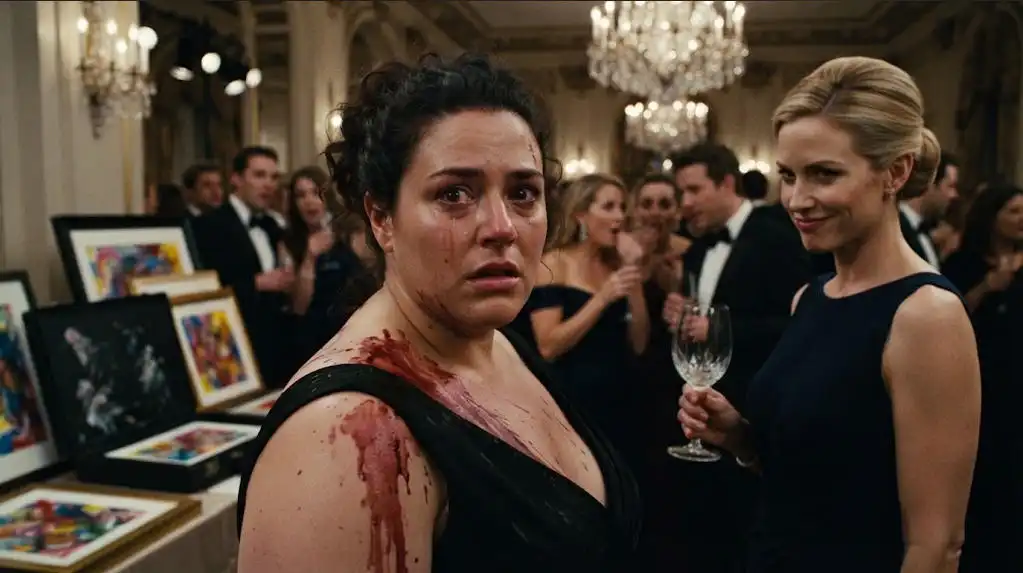
A Wealthy Manhattan Socialite Poured Red Wine on a Plus-Size Artist at a Charity Gala, Calling Her “Cheap and Unworthy.” She Had NO IDEA Who Would Discover Her Paintings... 😱

A Celebrity Trainer Threw CASH in a Plus-Size Nutritionist’s Face at a Luxury LA Gym, Saying She Couldn’t Even Control Her Own Weight. He Had NO IDEA What Her Clients Would Prove... 😱

My Fiancé’s Mother CUT MY Custom Engagement Dress in Front of 200 Guests and Called Me an “Elephant in a Sack.” My Fiancé Just SMILED... 😱