


Brent Holloway lifted the enormous buttercream cake with both hands.
"You're in the way."
Then he slammed it into seven-year-old Ellie Mercer's face.
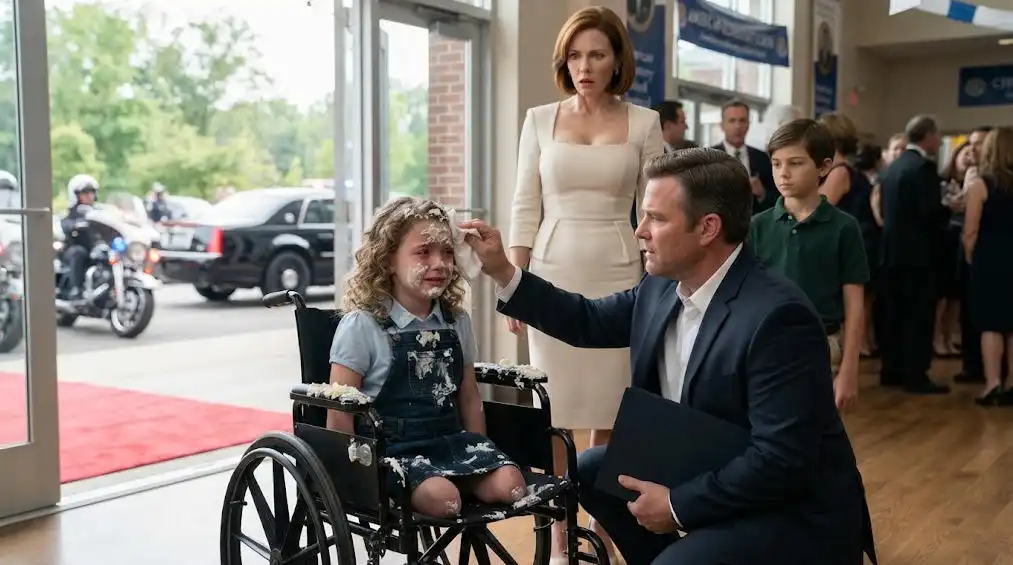
The cake collapsed against her cheeks with a wet, sickening thud. Frosting burst across her light-brown curls, covered her eyes and nose, and smeared down the front of her pale-blue shirt. Cream splattered over the armrests of her wheelchair and streaked across the polished gym floor.
Ellie's chair rolled backward a few inches.
She squeezed her eyes shut, gasped, and raised both hands to her face. When Brent reached toward her again, she shoved his wrist away.
"I didn't do anything."
Her voice broke on the last word.
Around them, parents stood frozen between tables of pastries, raffle baskets, and carefully arranged donor displays. Someone lowered a phone. A woman near the entrance covered her mouth.
Brent's mother, Cynthia Holloway, stepped forward.
She did not ask whether Ellie could see. She did not ask why her son had attacked her.
She looked at the carpet.
"You're getting frosting on the carpet. Get her out."
For several seconds, Ellie simply stared at her.
The little girl had spent the previous evening making cookies at her kitchen counter. She had measured the flour, pressed each cookie into shape, and carefully packed the finished treats into paper boxes tied with blue ribbon.
She had wanted to sell them at the school's charity fundraiser to help pay for accessible playground equipment.
Ellie knew what it meant to sit at the edge of a playground while other children climbed, ran, and scrambled across equipment that had not been designed for her. Both her legs had been amputated, and although she was an energetic, determined child, there were places she could not use without assistance.
She wanted the next child in a wheelchair to have more choices than she had.
That was why she had baked the cookies.
It was not why Cynthia Holloway had organized the fundraiser.
As chair of the parent-teacher association, Cynthia had transformed a school charity event into a carefully staged social showcase. There was a red carpet at the entrance, elaborate display cakes, elegant tablecloths, and name cards identifying the wealthiest donors.
She had invited influential parents and business owners, hoping photographs from the event would strengthen her standing in the community.
Cynthia was particularly proud of the event's polished appearance.
She wanted everything to look expensive, orderly, and impressive.
A little girl in a wheelchair, selling homemade cookies from a modest table, did not fit the image she wanted.
Cynthia had made her feelings clear earlier that afternoon.
When Ellie arrived, Cynthia had looked from the wheelchair to the paper cookie boxes and asked whether the school office had approved her table.
Ellie explained that her teacher had helped her register.
"Well, let's keep everything tidy," Cynthia had replied, already turning toward a group of donors.
Ellie had accepted the dismissal without arguing. She was used to people noticing her wheelchair before noticing her.
But she had hoped this event would be different.
Her father had helped her bake the cookies. He had even burned the first tray slightly because he had become distracted listening to her explain which playground equipment she wanted the school to buy.
When Ellie laughed at him, he had insisted that the second tray would be better.
It was.
The cookies were golden, slightly crisp at the edges, and dotted with chocolate chips.
Before leaving home, Ellie had made one request.
"Can you please not tell anyone you're the governor?"
Daniel Mercer had looked up from tying the ribbon around a box.
"Why not?"
"Because then everyone will be nice to me because of you."
She had said it quietly, as though admitting something she did not want to be true.
"I want them to buy my cookies because they're good."
Daniel understood.
He was the governor of their state, a position that made ordinary family outings complicated. People who had barely acknowledged Ellie sometimes became suddenly attentive when they learned who her father was. Adults praised her in exaggerated voices, asked for photographs, or treated her as though she were made of glass.
Ellie hated it.
She wanted to be a child who baked cookies, argued about games, and made friends without anyone calculating what her father's title might mean.
Daniel promised not to announce his position at the fundraiser. His security detail would remain discreetly nearby, as it routinely did when she attended public events.
Ellie wore a small silver brooch at her collar. Its intricate family crest had been engraved so finely that, from a distance, it looked like an ordinary silver flower.
Nobody at the school had reason to recognize it.
She had gone to the fundraiser as Ellie Mercer, a little girl with a tray of cookies and a cause she cared about.
Now she sat in the middle of the gym with frosting dripping from her eyelashes.
Cynthia pointed toward the exit.
"Do you understand what you've done to this event?"
Ellie wiped at her eyes. Her fingers trembled, but she pushed herself more upright in the wheelchair.
"I brought cookies," she said. "I was trying to help."
Cynthia gave a short, impatient sigh.
"Then you should have stayed out of the way."
Brent looked at his mother, apparently expecting approval. He had grown accustomed to adults making excuses for him. If he interrupted a conversation, someone laughed. If he broke something, someone else cleaned it up. His mother treated his bad behavior as a minor inconvenience caused by other people.
This time, however, no one laughed.
At the registration table, Evelyn Price, the PTA treasurer, had watched everything.
Evelyn was fifty-eight and had volunteered at the school for nearly two decades. She had seen parents argue over bake-sale prices, children spill punch, and elaborate fundraisers descend into chaos.
She had never seen a mother blame a seven-year-old for being attacked.
She took several napkins from a nearby table and hurried toward Ellie.
Cynthia turned sharply.
"Not now, Evelyn."
Evelyn stopped, her face tightening.
For months, she had been afraid of Cynthia.
The chairwoman controlled committee appointments, chose which parents received invitations to exclusive donor events, and made life uncomfortable for anyone who questioned her decisions.
But Evelyn had already discovered something more serious than Cynthia's vanity.
The fundraiser's financial records did not add up.
Donations collected for school improvements had repeatedly been transferred to Holloway Event Services, a company owned by Cynthia's husband, Grant. The invoices claimed the company had provided equipment rentals, decorations, and event-management services.
Some of those services had never been delivered.
Other charges appeared twice.
When Evelyn asked for supporting receipts, Cynthia told her not to worry about details that were above her level of responsibility.
Then Evelyn discovered that her signature had appeared on a financial reconciliation she had never approved.
She made copies of the records and contacted state investigators.
They had spent weeks tracing the payments, comparing bank transfers with invoices, and examining discrepancies in the organization's financial reports. The investigation had expanded beyond bookkeeping mistakes. Investigators suspected that charitable donations were being diverted through false invoices and disguised as legitimate business expenses.
Evelyn had provided them with copies of the ledgers and explained where the originals were kept.
The records were already being watched.
Cynthia simply did not know it.
Now, as Ellie struggled to clean the frosting from her eyes, Evelyn knelt beside the wheelchair and gently offered her a stack of napkins.
Ellie took them with shaking hands.
"Thank you," she whispered.
Then the sirens began.
The sound came from outside the school, growing louder as several state police motorcycles turned into the driveway. Parents moved toward the glass doors. Red and blue lights reflected across the gym floor.
A black armored sedan followed the motorcycles and rolled directly onto the red carpet.
Cynthia immediately straightened her dress.
Whatever this was, she seemed to assume it was an opportunity.
The sedan stopped.
Its rear door opened.
Daniel Mercer stepped out with a dark official folder tucked beneath his left arm and a white handkerchief in his right hand.
He had been on his way to a scheduled briefing nearby. Inside the folder was a copy of an emergency audit authorization issued by the state revenue department that morning. The financial-crimes team had already secured a judge-signed warrant to preserve and seize records connected to the suspected fraud.
His security detail had alerted him to the assault on his daughter.
The motorcade had changed course.
Daniel crossed the red carpet and entered the gym.
Ellie looked up through the frosting.
For the first time since the cake struck her, she stopped trying to wipe her face.
Daniel reached her, bent down, and gently cleaned the cream from her forehead and eyes with his handkerchief.
"I'm here, sweetheart."
Ellie's mouth trembled.
"Dad."
The single word changed the atmosphere in the room.
Cynthia's expression drained of color.
She knew the governor's face from television, official photographs, and local news coverage. She had spent years trying to cultivate connections with influential people, and she recognized the significance of the man kneeling beside the child she had just ordered out of the building.
Ellie Mercer was the governor's daughter.
Cynthia took an unsteady step forward.
"Governor Mercer! I had no idea. There must be some misunderstanding. We were just trying to manage an unfortunate disruption."
Daniel continued wiping the frosting from Ellie's cheek.
When he had cleared enough of her face for her to see comfortably, he looked at Cynthia.
"You saw what happened."
Cynthia opened her mouth.
"Your son picked up a cake and smashed it into my seven-year-old daughter's face," Daniel continued. "You saw it happen. Then you blamed her for the carpet."
"I was concerned about the event," Cynthia said quickly. "We have important donors here, and the situation became—"
"She came here to sell cookies for children who need accessible playground equipment."
Daniel's voice remained controlled, but his expression had hardened.
"She did not deserve this."
Ellie looked down at her hands. She was relieved to see her father, but the room's sudden attention made her feel exposed all over again.
A moment earlier, the adults had watched her cry without helping. Now they were watching her because she belonged to the governor.
She hated that the difference was so obvious.
Daniel noticed her gripping the edge of her seat.
He moved closer, placing himself between her and the crowd.
"You don't have to talk to anyone right now," he told her quietly.
Then he stood.
The state police captain approached with investigators from the state revenue department. The governor lifted the official folder and handed the audit authorization to the lead investigator.
The investigation had not begun because Ellie had been humiliated. It had begun weeks earlier, when Evelyn's records revealed a pattern of suspicious transfers. The assault had brought Daniel to the school, but the financial evidence and the existing warrant were what authorized the search.
Daniel gave a brief, decisive gesture toward the committee offices.
The captain immediately moved forward with the officers. The revenue investigators followed.
"State police," the captain announced. "We have a warrant to search and preserve financial records connected to this investigation. Please step away from the documents."
Cynthia's practiced smile vanished.
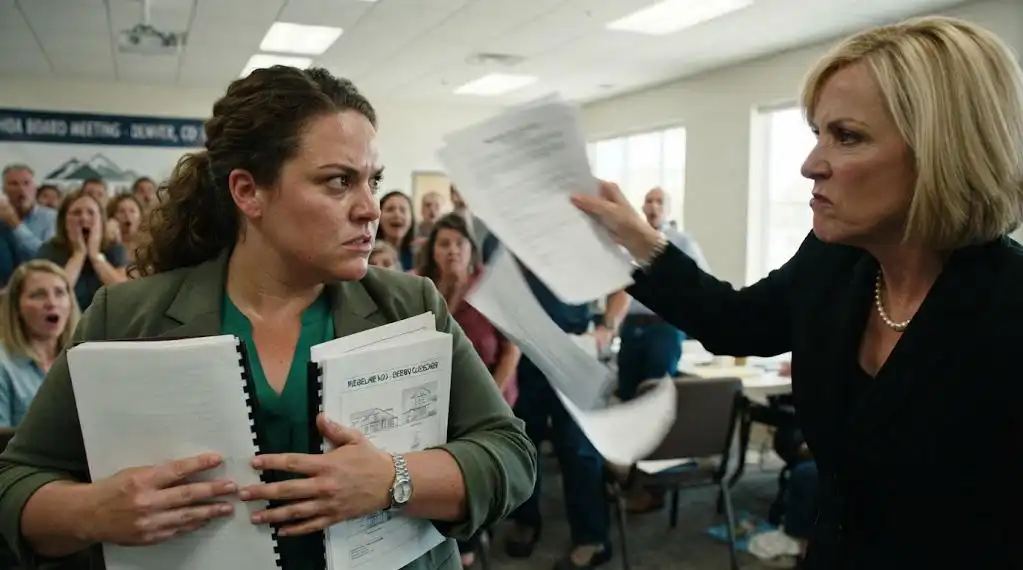
"These are private PTA records!"
"Then the warrant will determine which records are relevant," the captain replied. "Please step aside."
Two officers secured the registration area while the revenue investigators headed toward the committee room behind the main display tables.
Evelyn followed them.
"The original books are in there," she said. "The blue binder is the version Cynthia shows the committee. The red binder has the actual transfers."
Cynthia spun toward her.
"Evelyn, you have no idea what you're talking about."
Evelyn's hands shook, but she did not retreat.
"I know what I signed. And I know what I didn't."
She explained how the figures had been altered, how invoices from Holloway Event Services had been approved for services the school never received, and how money collected for charitable purposes had been redirected.
The investigators entered the committee room and located the original records.
The red binder contained entries that did not match the official ledger. Boxes of invoices listed equipment rentals that vendors could not verify. A laptop held duplicate spreadsheets and correspondence concerning the transfers.
Officers secured the records under the warrant. Revenue investigators catalogued the books, invoices, and electronic files for the audit.
The search was not a dramatic gesture for the crowd. It was the execution of an investigation already supported by evidence.
But for Cynthia, the carefully constructed appearance of her fundraiser was collapsing in front of the very people she had hoped to impress.
Grant Holloway's company had been listed as a vendor for numerous events. Its invoices had made substantial payments appear to be legitimate expenses, while the underlying records suggested that donations were being diverted and tax reporting had been falsified.
The investigators would need to verify every transaction.
They did not need Cynthia's permission to begin.
As the records were carried out, Cynthia turned back toward Daniel.
"Surely we can resolve this privately," she said. "Think of the damage this will do to the school."
Daniel looked at her for a long moment.
"The school deserves to know where its money went."
He did not promise to punish her. He did not order the officers to arrest her on the spot. He left the investigation to the people legally responsible for it.
That made the situation worse for Cynthia, because there was nothing she could negotiate with him.
Her social standing could not make the missing money reappear.
Her husband's company could not produce equipment it had never delivered.
And the two sets of books could not both be true.
Brent had grown quiet. He looked at the frosting covering Ellie's clothes, then at the officers carrying away the records. For the first time that afternoon, his mother had no easy explanation that made everything someone else's fault.
A school counselor took him aside while the adults continued dealing with the investigators.
Ellie watched the activity from her wheelchair.
Her face was cleaner now, although cream remained tangled in her curls and streaked across her shirt. Her eyes were red. She looked exhausted.
Daniel crouched beside her again.
"Do you want to go home?"
She glanced toward the little table holding her cookie boxes.
The cookies were untouched. They had been far enough from the cake display to escape the frosting.
"But I wanted to sell them," she said.
"You still can."
"Not for Cynthia."
"No," Daniel agreed. "Not through her."
He did not tell her that everything would be fine. He could not promise that the school would immediately recover its money or that the other children would never behave cruelly again.
What he could do was make sure her effort was not discarded along with the fraudulent records.
He asked the school staff to keep her cookie boxes safe. Evelyn offered to help arrange a new sale through an independent charity, with the proceeds handled separately from the PTA's accounts.
Ellie considered this.
Then she nodded.
"Okay. I still want to help the playground."
Daniel squeezed her hand.
"Then that's what we'll do."
The legal case took months to unfold.
State revenue investigators conducted a detailed audit, tracing the fundraiser's payments through Holloway Event Services and comparing the company's invoices against bank records, vendor statements, and the original ledgers.
The evidence confirmed that substantial charitable funds had been diverted through fabricated expenses. The records also established that false tax reports had been filed to disguise the transactions.
The case was handled through the appropriate legal process, independently of the governor's personal involvement.
Cynthia was arrested after the investigation established grounds for criminal charges. At trial, the duplicate books, bank transfers, and false invoices corroborated one another. She was convicted of tax fraud and related financial offenses and sentenced to prison.
Grant's company lost contracts as clients withdrew and lenders pulled back their financing. The business could no longer sustain itself under the weight of its liabilities and legal disputes. It eventually filed for bankruptcy.
The school's charity funds were reviewed, and the remaining assets and recoverable money were accounted for through the appropriate process. The PTA was reorganized under new oversight, with financial records available for review and independent handling of future charitable donations.
The polished fundraiser Cynthia had used to cultivate her social circle became the event that exposed the very conduct she had tried to conceal.
But Ellie remembered something else about that day.
She remembered how it felt when a room full of adults watched her cry.
She remembered the difference between being ignored and being noticed only because of her father's title.
She did not want her story to become a publicity campaign.
Daniel understood that, too.
He refused requests to turn her humiliation into a political photo opportunity. He did not arrange a press conference with Ellie beside him or make her repeat the story for cameras. When the school needed to address what had happened, he left the school's staff and investigators to do their jobs.
Ellie was allowed to recover at her own pace.
The cookie sale took place separately, with the money going to a verified nonprofit supporting accessible playground equipment. There were no connections to the discredited PTA accounts, and the proceeds were handled independently.
Word of Ellie's cookies spread among state officials who had learned about her project. Some had tasted them at the sale; others placed orders after hearing that a little girl had spent her evening baking for children she might never meet.
They paid the full price from their own pockets, not from public funds.
By the end of the week, every box had been sold.
Ellie was pleased, although she still wondered whether people were buying the cookies because they liked them or because her father was the governor.
One evening, Daniel sat beside her while she looked at the empty boxes.
"Did they taste them?" she asked.
"Yes."
"Did they really like them?"
He smiled.
"One official ordered another box before he'd even finished the first."
Ellie laughed despite herself.
Daniel never told her that everyone who knew her father would always treat her fairly. He knew better than to make that promise. Instead, he let her decide how much attention she wanted and reminded the people around her that she was a child, not a political accessory.
When she was ready, they returned to the simple things she had missed.
There were cookies to bake, games to play, and afternoons that did not require anyone to know the governor's name.
On the governor's mansion lawn, Ellie sat in her wheelchair, laughing as she and her father tossed a bright blue Frisbee back and forth beneath the late-afternoon sun.
Disclaimer: Mention of any brand or trademark is for identification only and does not imply partnership or endorsement

A Wealthy Manhattan Socialite Poured Red Wine on a Plus-Size Artist at a Charity Gala, Calling Her “Cheap and Unworthy.” She Had NO IDEA Who Would Discover Her Paintings... 😱

A Celebrity Trainer Threw CASH in a Plus-Size Nutritionist’s Face at a Luxury LA Gym, Saying She Couldn’t Even Control Her Own Weight. He Had NO IDEA What Her Clients Would Prove... 😱

My Fiancé’s Mother CUT MY Custom Engagement Dress in Front of 200 Guests and Called Me an “Elephant in a Sack.” My Fiancé Just SMILED... 😱