


The first time Cole Mercer put his foot on Eli Bennett's hand, he was smiling.
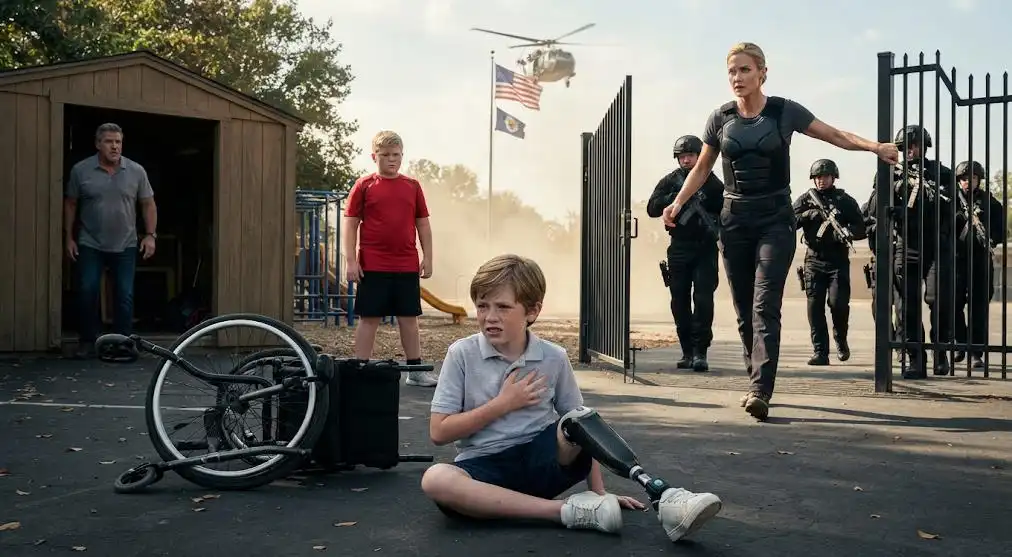
Eli was eight years old. His overturned wheelchair lay a few feet away on the blacktop of Cedar Ridge Academy, one wheel still spinning. He had been trying to crawl back toward it, pushing himself forward with his arms because he refused to let another bad day end with someone carrying him like he was helpless.
His spinal injury had left him paralyzed from the waist down. He wore a carbon-fiber prosthesis on his right lower leg, but his wheelchair remained essential to his independence.
He had almost reached the chair when Cole shoved him again.
Then Cole planted his sneaker on Eli's left hand.
“Stay down.”
The pressure drove Eli's fingers against the rough pavement. He tried to pull away, but Cole shifted his weight and ground his shoe a short distance across the trapped hand.
Eli screamed.
At the edge of the playground, Grant Mercer watched from the shadows beside an equipment shed. He was a broad-shouldered man in a navy polo shirt, the sort of father who could turn a school meeting into an argument simply by refusing to lower his voice.
Instead of stopping his son, Grant laughed.
“That's my boy. Well done.”
Several students stood frozen near the basketball court. One girl covered her mouth. Another began crying.
Their physical education teacher, Ms. Harper, abandoned the equipment she was carrying and sprinted toward the boys.
“Cole! Get off him. Now!”
Cole glanced at her but didn't immediately move.
Grant stepped out from behind the shed, still wearing the satisfied expression of a man watching a lesson go exactly as planned.
“Stay out of it,” he told her. “Boys need to learn how the world works.”
Eli heard those words through the pounding in his ears.
For months, Cole had treated him as a target. He had shoved Eli's wheelchair in the hallways, knocked his books onto the floor, and called him useless whenever teachers were out of earshot.
Every time the school contacted Grant, the response was the same.
His son was building character. Other children needed thicker skin. Nobody should expect the world to accommodate weakness.
Grant had even explained his philosophy to Cole in front of other parents.
“If somebody can't defend himself, that's his problem,” he had said. “You don't become strong by being gentle with people who can't fight back.”
Cole had taken those words seriously.
Eli had taken something else seriously.
His mother had taught him that independence meant learning what he could do for himself, not pretending he never needed anyone.
That was why he had been crawling toward his wheelchair instead of calling for a teacher.
He wanted to get back up on his own.
Now his left hand was trapped beneath Cole's shoe, and the pain was spreading through his fingers.
Eli twisted his shoulder and tried to drag himself backward. His free hand slipped on the pavement.
The chair remained just beyond his reach.
He looked at Cole, then at Grant.
Neither of them was going to help him.
For one awful moment, Eli felt smaller than he ever had before.
Then he remembered the little button on his prosthetic leg.
His mother had installed the emergency locator after his last rehabilitation stay. It was built into the carbon-fiber housing around his right ankle, small enough to pass unnoticed beneath his school clothes.
The device was connected to Northstar Protective Group's encrypted emergency network, with a separate alert routed to the county's school-threat response system.
Claire Bennett had made the arrangement herself.
She had also given Eli a rule.
If you are in real danger, press the beacon. You never have to earn the right to ask for help.
Eli had always hated that he might need it.
His mother was a retired special operations general who now ran Northstar, a private security company responsible for high-risk protective operations and government contracts. Her work had taken her overseas on a classified assignment, and she had been gone for weeks.
She called whenever she could. She sent messages when secure communications permitted it. But she had never appeared at Cedar Ridge Academy, and most of Eli's teachers had never met her.
To them, Claire Bennett was a name on a student's emergency contact form.
To Eli, she was the person who taught him how to transfer into his wheelchair, how to fall without injuring himself, and how to keep trying when a task took him three times as long as it took someone else.
She had also taught him that there was no shame in knowing when a situation was beyond his control.
Eli reached toward his right ankle.
Cole's foot still pinned his left hand.
With his free hand shaking, Eli found the button and pressed it.
A tiny green light blinked once.
“I need you, Mom.”
Cole didn't hear him.
Grant didn't notice the signal.
Neither man understood that the moment Eli pressed that button, the balance of power had already begun to change.
At Northstar's regional operations center, Claire Bennett was reviewing a security briefing when the emergency alert appeared.
The screen showed Eli's name, his medical identification, and his location.
For half a second, Claire didn't move.
Then she saw the priority classification.
Her chair scraped backward.
“Confirm the location.”
An operator checked the incoming signal. “Cedar Ridge Academy. Playground. Personal emergency beacon activated.”
“Call county dispatch. Send the nearest response unit. Get the helicopter redirected.”
The room changed instantly.
Operators began moving. A team already positioned nearby for a school-threat response mobilized under the existing county coordination plan. Claire pulled on her ballistic vest and checked the radio clipped to her shoulder.
She had spent years training herself to make decisions under pressure. She had led people through situations in which hesitation could cost lives.
None of that preparation made it easier to see her son's name flashing on an emergency screen.
She had been absent because of a classified mission. The secrecy had been necessary, but the distinction offered no comfort now.
She had promised Eli that if he ever truly needed her, she would come.
She intended to keep that promise.
There was another reason the response could move quickly.
Grant Mercer had already come to the attention of local authorities.
Two days earlier, after the school warned him that Cole faced suspension for repeated bullying, Grant had left the principal a recorded voicemail threatening to make the school afraid to open its doors if it continued protecting children he considered weak.
The principal had forwarded the message to the district safety officer and the county threat-assessment unit. The investigation had escalated that morning, and a judge had issued an arrest warrant based on the documented threat.
Cedar Ridge had a written campus emergency-response agreement coordinated with the county sheriff's office. Northstar's role was limited: secure an active danger, protect the school community, and detain a suspect when legally authorized until law enforcement assumed custody.
The company did not have unlimited police powers.
Claire had insisted on that distinction when the agreement was signed.
Now the emergency beacon had activated while the warrant remained outstanding.
The county dispatcher confirmed that Grant was on campus for a disciplinary meeting. Deputies were already moving to serve the warrant.
Claire didn't wait for a second report.
She boarded the helicopter with the response team.
On the playground, Ms. Harper was still trying to reach Eli.
Cole finally lifted his foot, but the damage had been done. Eli pulled his left hand against his chest, his fingers trembling uncontrollably.
He tried to sit upright.
“I didn't do anything,” he whispered.
Ms. Harper dropped to her knees beside him.
“I know, sweetheart. Don't move your hand. Help is coming.”
Grant gave an irritated laugh.
“Help? For what? He fell over. Kids fall over.”
Ms. Harper stared at him in disbelief.
“You watched your son step on his hand.”
“He needs to learn not to make himself a target.”
She immediately radioed the school office and requested an ambulance. The principal, Ruth Wallace, ordered the students away from the scene and directed another staff member to preserve the playground security footage.
The school's cameras covered the blacktop from three angles.
They had recorded Cole pushing Eli's wheelchair over.
They had recorded the stomp.
They had recorded Grant standing in the shadows and laughing.
Every important second was there.
Grant had assumed the equipment shed concealed him from the adults around the field.
It had not concealed him from the cameras.
Then the sound began.
A helicopter's rotors thundered over the roof.
The flags beside the athletic field snapped in the rotor wash. Metal hardware rattled against the rooftop parapet as a rope line was lowered.
Cole looked up.
“What is that?”
Grant's expression changed, but only briefly.
“Probably some kind of emergency drill.”
He was still trying to convince himself when the iron gate at the far end of the playground slammed inward.
Claire Bennett drove a boot into the gate's emergency latch and entered the school grounds.
She wore a black ballistic vest over a charcoal tactical shirt, black combat trousers, and heavy boots. Her blonde hair was secured tightly behind her head. Behind her came a disciplined team of armed security professionals, spreading out to secure the playground.
Claire's eyes went straight to Eli.
Then she saw the overturned wheelchair.
She saw his injured hand.
Finally, she saw Grant.
“Hands where I can see them!”
Her voice cut across the playground.
Grant took an instinctive step backward.
“What the hell is this? I'm a parent!”
Two operators moved in. One controlled Grant's arms and drove him to the ground while another secured his hands. Cole tried to pull away from a third operator, who brought him down and controlled his arms.
Rifles came up into alert positions as the remaining team members secured the perimeter. No shots were fired.
For the first time in his life, Grant Mercer was on the receiving end of the kind of overwhelming force he had spent years praising.
He shouted that the team had no right to touch him.
The operators did not argue.
They held him until the sheriff's deputies arrived.
Cole was crying now, struggling against the hands controlling him.
“Dad! Dad, make them stop!”
Grant twisted his head toward him, but the man who had always taught his son that fear belonged to the weak could offer no answer.
Claire was already crossing the playground.
She dropped to her knees beside Eli.
For a moment, the retired general disappeared, leaving only a mother who had arrived to find her child hurt and frightened on the ground.
“Eli.”
He looked up at her.
His face crumpled.
“Mom.”
Claire gathered him carefully into her arms, avoiding his injured hand. She held him close enough for him to feel that she was real, that she had actually come.
“I've got you,” she said. “I'm here.”
Eli tried to hold himself together, but his breathing broke into uneven sobs.
“I was trying to get back into my chair.”
“I know.”
“I almost had it.”
Claire closed her eyes for a moment.
“I know you did.”
He looked at her through his tears.
“I didn't want them to carry me.”
“You don't have to apologize for that.”
She shifted so that she could see his injured hand without moving it unnecessarily.
A Northstar medic arrived with a trauma kit, followed by the ambulance crew. Claire immediately gave them Eli's medical information and explained that the hand had been crushed under a shoe.
“Check circulation and sensation,” she told the medic. “He needs imaging as soon as we can get him transported.”
The medic examined the fingers carefully. Eli flinched when pressure reached the injured knuckles, but he could still feel the medic touching them.
“That is encouraging,” the medic said. “We need the X-rays before we know the extent of the damage.”
Claire nodded, forcing herself to leave the examination to the professionals.
Then Eli caught her sleeve.
“Were you mad that I pressed it?”
She looked down at him.
“No.”
“But I was supposed to try.”
“You did try. You kept trying until you couldn't safely do it anymore.”
He swallowed.
Claire brushed a strand of sandy hair away from his forehead.
“Calling for help didn't take away your courage, Eli. It was another good decision.”
For the first time since the attack began, he stopped trying to hide his tears.
The sheriff's deputies arrived and assumed formal control of the scene.
The outstanding warrant for Grant was verified. The officers also documented the assault, took statements from witnesses, and arranged for the school to preserve its original surveillance recordings.
Grant's attorney would later argue that the incident had been exaggerated, that Cole had acted impulsively, and that Grant had never intended serious harm.
The footage made those arguments difficult to sustain.
It showed the wheelchair being overturned. It showed Cole stepping on Eli's hand and applying pressure. It showed Grant watching from the sideline, laughing and praising his son.
The recording also captured Grant's earlier verbal threats during a confrontation with school staff. The principal supplied the original voicemail, and investigators documented the connection between his threats and his behavior on campus.
Claire made calls to the FBI field office and the appropriate federal threat investigators. She did not ask them to manufacture charges or bypass legal procedures. She asked them to examine the evidence as a connected threat case rather than dismissing the assault as an ordinary schoolyard dispute.
The documented threats warranted federal investigation, while the county prosecutor pursued the assault and terroristic-threat charges.
After the deputies completed their initial procedures, Grant was transferred into FBI custody for the threat investigation. The evidence would determine the charges and the punishment, not Claire's anger.
Cole was referred to the juvenile justice system.
Claire remained with Eli until the ambulance doors closed.
Only then did she turn toward the school principal.
Ruth Wallace looked shaken. She had been responsible for a school where an eight-year-old boy had been injured in front of other students, despite repeated warnings about the bully.
“I am so sorry,” Wallace said. “We should have stopped this earlier.”
Claire's expression was hard.
“Yes,” she replied. “You should have.”
She did not shout. She did not need to.
“I want the original footage preserved. I want every previous complaint, every disciplinary report, and every communication with Grant documented and delivered to the investigators. Nobody deletes anything, and nobody rewrites what happened to make the school look better.”
Wallace nodded.
“We'll cooperate fully.”
“You'll also review how a child with a known history of being targeted ended up alone on the ground while adults stood watching.”
“I understand.”
Claire looked back at the playground.
“I hope you do.”
Then she climbed into the ambulance beside her son.
At the hospital, the X-rays revealed two fractured fingers, significant soft-tissue damage, and injuries to the surrounding ligaments.
The surgeon explained that the bones could be stabilized and that Eli's circulation remained intact. He would need a procedure to align the fractures, followed by rehabilitation and careful monitoring.
There was no need to amputate any fingers.
With treatment, the doctors expected him to regain useful function in his hand.
Claire listened to every word.
She asked questions about pain control, healing time, therapy, and the risk of lasting nerve damage. When the surgeon assured her that Eli's fingers were expected to recover, she finally released the breath she had been holding since the emergency alert.
Eli underwent treatment that evening.
Later, when the hospital room was quiet, Claire sat beside his bed in the same tactical clothing she had worn onto the playground. Her vest rested on a chair. Her hands, which had remained steady throughout the response, were clasped tightly together.
Eli watched her for a while.
“Are you going away again?”
The question hurt more than any accusation could have.
“My work will still require travel,” she said honestly. “I can't promise I'll always be in the same place. But we're going to make sure you have people you can reach, and we're going to review the arrangements so you're not left without help.”
He looked at his bandaged hand.
“I pressed the button.”
“You did.”
“It worked.”
Claire reached across the bed and rested her hand beside his.
“Yes, sweetheart. It worked.”
She didn't promise that nothing bad would ever happen again. She knew better than to offer a child a guarantee the world could break.
Instead, she promised to listen more carefully, to stay involved with the school, and to make sure he understood exactly whom he could call when he needed help.
For Eli, that meant more than a dramatic speech.
It meant his mother was taking his fear seriously.
And for Claire, it meant learning that protecting her son required more than arriving when the alarm sounded. It also required building a world around him in which the alarm would not have to sound again.
The legal process moved forward over the following weeks.
The school released the original camera footage to investigators, and witnesses gave consistent accounts of the attack. Grant's recorded threats strengthened the case against him. The evidence left little room to portray his behavior as a misunderstanding.
He eventually entered a guilty plea to the assault and terroristic-threat charges.
Eight weeks after the attack, the court sentenced him to fourteen years in prison. The judgment also imposed a lifetime prohibition on employment, volunteering, or unsupervised contact involving minors, along with a permanent no-contact order protecting Eli and his school.
Grant had spent years teaching his son that power belonged to whoever could frighten someone else into submission.
Now his own conduct had cost him his freedom, his standing in the community, and the right to place himself around children without strict legal restrictions.
Cole faced consequences through juvenile court. He was expelled from Cedar Ridge, placed under supervised probation, and ordered to attend counseling. A no-contact order kept him away from Eli while the juvenile proceedings continued.
His age and his father's influence were considered, but neither erased what he had done.
Claire did not ask the court to humiliate Cole. She asked that the record remain accurate, that Eli be protected, and that the consequences be real.
The school also changed.
The district replaced its previous security contractor with a veteran-led protection team staffed by former special operations and emergency-response professionals. The new arrangement included clearer threat reporting, better coordination with local authorities, and specific procedures for protecting students with disabilities.
The cameras remained in place, but the school also revised how staff responded to repeated bullying. Reports could no longer disappear into informal conversations or be dismissed because a parent was persuasive.
Eli's recovery was slower than he wanted.
His hand remained wrapped in a padded white dressing as the fractures healed. He attended therapy and gradually regained strength and movement in his fingers. Some days he became frustrated when he couldn't complete tasks he had managed before the injury.
Claire learned to sit beside him without rushing to solve every problem.
When he wanted to transfer into his wheelchair himself, she stood nearby and waited until he asked for assistance. When he needed help, she helped without making him feel that he had failed.
Their relationship changed, not because she became less protective, but because they began talking more honestly about what protection meant.
Eli learned that asking for help did not erase his independence.
Claire learned that keeping a promise to come when called was only one part of being present in her son's life.
On the day Grant was sentenced, Claire wore the dress uniform she had kept from her final command. Three silver stars gleamed on her shoulder.
Eli sat beside her in the rear of a black armored vehicle as it pulled away from the courthouse. His injured hand was wrapped in white bandaging, and his wheelchair was secured nearby.
Outside, the courthouse steps receded behind them. The security team moved ahead through traffic, and the low hum of the armored vehicle filled the cabin.
Eli looked at his mother.
For years, he had known her as the woman who left for difficult missions, the woman whose calls sometimes arrived late at night, and the woman who always told him to keep trying.
Now he could see the stars on her uniform clearly.
He lifted his bandaged hand carefully and touched one of the silver stars on her shoulder.
Claire turned toward him.
Eli smiled, sitting a little taller in his seat, his hand resting proudly against the three stars on his mother's uniform.
Disclaimer: Mention of any brand or trademark is for identification only and does not imply partnership or endorsement
A Wealthy Manhattan Socialite Poured Red Wine on a Plus-Size Artist at a Charity Gala, Calling Her “Cheap and Unworthy.” She Had NO IDEA Who Would Discover Her Paintings... 😱
A Celebrity Trainer Threw CASH in a Plus-Size Nutritionist’s Face at a Luxury LA Gym, Saying She Couldn’t Even Control Her Own Weight. He Had NO IDEA What Her Clients Would Prove... 😱
My Fiancé’s Mother CUT MY Custom Engagement Dress in Front of 200 Guests and Called Me an “Elephant in a Sack.” My Fiancé Just SMILED... 😱