


Lily Bennett had learned to recognize the moment adults decided she was someone they could ignore.
It happened when teachers glanced away as Carter Whitmore mocked her father. It happened when classmates laughed at the empty space where her school crest should have been. And it happened when the headmaster of Cedar Ridge Academy, one of the most expensive private schools near Killeen, Texas, promised to address the bullying but somehow never found the time.
On the morning of the parents’ meeting, eight-year-old Lily stood beside Frank Mercer, the sixty-five-year-old veteran who had raised her since her father died overseas.
She wore a white blouse, a gray skirt, and a plain navy cardigan.
Her official blazer was being repaired. Three days earlier, Carter had yanked her sleeve during an argument in the schoolyard, splitting a seam. The school office had approved the temporary cardigan in writing, but Lily still felt exposed without the embroidered crest.
“Do you think they’ll make me leave?” she asked quietly.
Frank adjusted the collar of her cardigan.
“No one gets to decide you don't belong here just because you're having a difficult week.”
He spoke calmly, but the words carried a weight Lily could not yet understand.
Frank had spent most of his adult life in the military. His left leg had been badly injured during a deployment, and the prosthesis beneath his trousers made long walks painful. He used a black cane, took medication for chronic pain, and sometimes woke from dreams in which he could still hear the radio calls of men who would never come home.
One of those men had been Daniel Bennett, Lily's father.
Daniel had commanded a Special Forces team assigned to protect a larger force during a dangerous overseas withdrawal. When the operation collapsed, Daniel and his men held their position long enough for the others to escape.
Frank was the only member of the team who survived.
Daniel was later awarded the Medal of Honor posthumously.
Before that final deployment, Daniel had asked Frank to look after Lily if he never returned. He had not made the request dramatically. They had been sitting outside their quarters, discussing the ordinary things soldiers discuss when they are trying not to think about what might happen tomorrow.
“You know her,” Daniel had said. “You know what matters to her. If I don't come back, don't let her grow up thinking she has to face everything alone.”
Frank had promised.
After Daniel's death, Frank became Lily's legal guardian. He learned how to braid her hair badly, pack lunches she would actually eat, and distinguish ordinary childhood silence from the silence that meant she was missing her father.
He attended school meetings, managed her medical appointments, and helped her understand the military survivor benefits and educational assistance available to her as the daughter of a fallen servicemember.
He never told her she owed the world something because her father had died for it.
He only told her that her father had loved her, and that she was allowed to live an ordinary, happy life.
That was what Frank had come to Cedar Ridge to protect.
He never expected the hardest part of keeping his promise to happen in a school auditorium.
Evelyn Whitmore spotted Lily almost immediately.
She was the wife of Graham Whitmore, the school board chairman. The Whitmore family had donated generously to Cedar Ridge for years, and Evelyn had become accustomed to treating school rules as instruments she could use against people she disliked.
Her son, Carter, had been bullying Lily for weeks.
He had hidden Lily's pencils, mocked her father's death, and once asked whether Frank was a real grandfather or simply the only person willing to take her.
Lily had reported the incidents. Her teacher had documented them. But each time the school attempted to address the problem, the complaints were softened into descriptions of a disagreement between classmates.
The Whitmores were important donors.
Lily was a little girl without living parents.
Evelyn understood the difference in influence perfectly.
She marched toward Frank and Lily, her heels clicking against the polished floor.
“Why isn't she wearing the proper uniform?”
Frank handed her a copy of the school's written approval.
“Her blazer is being repaired. The office approved this for the next two days.”
Evelyn barely glanced at the paper.
“I don't care what some office assistant approved. Rules are rules.”
“Then you should have no trouble checking with the headmaster.”
Frank's voice was firm but courteous.
That irritated her more than an argument would have.
Evelyn had expected him to apologize, perhaps to promise that he would find the money to replace the blazer immediately. Instead, the disabled veteran stood in front of her without lowering his eyes.
“You people always have an excuse,” she said. “My husband helps keep this school running. We don't pay these fees so that children who can't follow basic standards can drag everyone else down.”
Lily's fingers tightened around Frank's sleeve.
“Ma'am,” he said, “she has done nothing wrong.”
Evelyn stepped closer.
“And who are you to tell me what is wrong?”
Frank didn't answer.
The next moment, Evelyn struck him.
Her right palm connected with his left cheek, snapping his head sideways.
The sound echoed through the auditorium.
Frank staggered half a step. His cane scraped across the floor, and Lily grabbed his jacket with both hands.
For a second, Frank saw nothing but the faces of people who had witnessed the blow and were already deciding whether it was safer to pretend they hadn't.
His cheek burned.
His right hand curled into a fist.
He was angry enough to feel the old instincts waking inside him. His body remembered how to respond to an attack before his mind had caught up.
Then he felt Lily trembling beside him.
She was looking at him with wide, frightened eyes.
Frank slowly opened his hand.
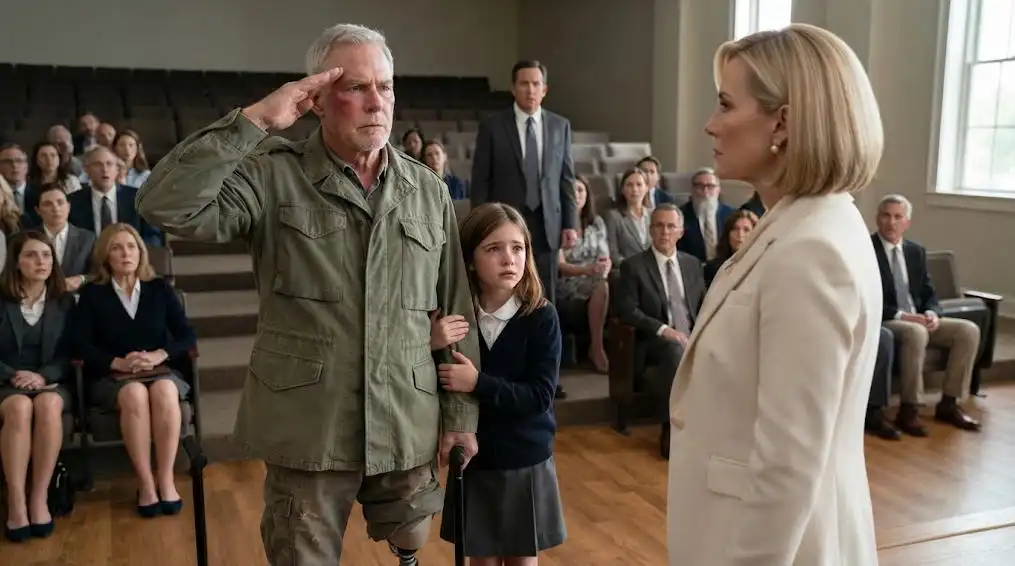
He straightened his back, adjusted his footing around his injured leg, and brought his right hand to his brow in a military salute.
He did not salute Evelyn.
He saluted the man who had trusted him with his daughter.
Evelyn laughed.
“Look at these parasites. Expel the girl before she embarrasses us again.”
She turned toward Paul Landry, Cedar Ridge's headmaster.
“You heard me. I want her removed. Today.”
Landry looked at Frank's reddening cheek, then at Evelyn.
“Mrs. Whitmore, perhaps we should discuss this privately.”
“Privately?” she snapped. “She doesn't belong here. And if you can't enforce the school's standards, perhaps the board should reconsider your position.”
Landry fell silent.
Frank watched him, and the last hope that the headmaster might defend Lily without being forced to do so began to fade.
The school had a written record approving the temporary uniform. It had reports of Carter's behavior. It had teachers who knew Lily had been trying to do the right thing.
Yet the man responsible for protecting the children was more frightened of a donor's family than of failing one of his students.
Lily tugged at Frank's sleeve.
“Please don't let them send me away,” she whispered.
He looked down at her.
The girl who had spent years trying not to inconvenience anyone was now apologizing with her eyes for being the target of someone else's cruelty.
Frank lowered his salute.
“No, sweetheart,” he said softly. “You don't have to apologize for being here.”
He reached inside his jacket and drew out a pair of worn metal dog tags.
Daniel Bennett's name was stamped into the metal.
Frank had carried them for years. Sometimes he held them when he could not sleep. Sometimes he took them out when he needed to remember the promise he had made.
He had never used Daniel's sacrifice to demand privileges.
He had never asked a commanding officer to make life easier for him.
But Evelyn had just struck him in front of the child he had promised to protect, and the headmaster was preparing to surrender her education to the whims of a powerful family.
Frank took out his phone.
There was a secure military duty number he had been given years earlier for emergencies involving fallen servicemembers and their dependents. It was not a number he used casually. Any activation would be recorded and reviewed.
Calling it could reopen questions about his old unit, his access to the emergency channel, and the events surrounding Daniel's final operation.
Frank understood the risk.
He dialed anyway.
When the duty officer answered, Frank gave his identity and the old unit designation. He read Daniel's name and service details from memory, then made his request.
“Mercer here. Get General Hayes on the secure line.”
The duty officer asked him to hold.
Frank waited with the phone against his ear, Daniel's dog tags clenched in his other hand.
Across the room, Evelyn was still talking.
She had no idea that, only a few miles away, a man who owed his life to Daniel Bennett had just received the call.
Ten minutes later, the first military vehicle turned into the school driveway.
Then another followed.
Several military vehicles and a command SUV arrived in quick succession, positioning themselves around the school's entrances and access roads. Uniformed soldiers, fully equipped and carrying their weapons safely slung, formed an orderly line outside the building.
They did not point their weapons at the school staff or rush into classrooms.
But nobody could mistake the seriousness of their arrival.
The parents who had been pretending not to notice Frank's humiliation now stood near the windows, staring.
Evelyn's expression changed.
“What is this?” she demanded.
The auditorium doors opened.
Major General Thomas Hayes walked inside.
He wore his formal duty uniform, and his expression was controlled. Behind him came two military personnel assigned to assist with the situation. The soldiers outside maintained the perimeter while the general entered the room.
Hayes looked first at Frank.
Then he saw the red mark on the veteran's cheek.
His jaw tightened.
He crossed the room and saluted Frank.
Frank returned the salute.
For a moment, neither man spoke.
Then Hayes turned toward Lily and lowered himself slightly so he could meet her eyes.
“Lily Bennett?”
She nodded, uncertain.
“My name is General Hayes. I knew your father.”
Lily stared at him.
“You knew Daddy?”
“Yes,” he replied. “And I owe him my life.”
Hayes had been a young soldier, little more than a new recruit, when Daniel's team helped protect his unit during a disastrous withdrawal overseas. Daniel had personally helped get Hayes and other men to safety.
The team had remained behind to cover the retreat.
They had not all made it home.
Hayes had spent years remembering the man who had made that decision.
When Frank's call reached the installation, the old unit designation and Daniel's name immediately established why the request required his personal attention. Hayes ordered the appropriate military personnel to support the child's immediate safety and came himself.
Now he stood in front of the daughter of the man who had saved him.
“Are you all right?” he asked Lily.
She glanced at Frank.
“I think so.”
It was the sort of answer children gave when they were not entirely sure they were allowed to tell the truth.
Hayes noticed.
He turned toward Landry.
“Headmaster, I understand there has been an incident involving a fallen servicemember's family. I want the child's immediate safety addressed, and I want the school's records preserved. We will coordinate with the civilian authorities regarding what happened here.”
Evelyn recovered enough to step forward.
“This is a private school. You have no authority to come in here and interfere with our policies.”
Hayes looked at her without raising his voice.
“I'm not here to write your school's dress code, ma'am. I'm here because a retired soldier called an emergency military channel after a child under his care was threatened with expulsion and he was struck in front of her.”
He paused.
“The sheriff will determine what happened under civilian law. My responsibility is to make sure the military's support for this child is not obstructed and that the circumstances involving her father's service are handled properly.”
Evelyn glanced toward the doors.
The armed soldiers outside had remained in formation. None had drawn a weapon. Their presence alone had transformed the atmosphere of the room.
For the first time that morning, Evelyn seemed to understand that her husband's donations could not control every person in the building.
Hayes turned back to Frank.
“You could have called sooner.”
Frank looked down at Daniel's dog tags.
“I didn't want to use that line for a school dispute.”
“Then something changed enough for you to use it.”
Frank glanced at Lily.
“Yes, sir. It did.”
Hayes followed his gaze.
He understood.
The general's arrival did not erase what had happened, and it did not give the military authority to arrest a civilian or dictate the school's disciplinary decisions.
Those responsibilities belonged to the appropriate civilian authorities.
Fortunately, several people in the auditorium had finally decided that silence was no longer an acceptable option.
A parent who had witnessed the slap contacted the county sheriff. A school secretary provided the incident information, and the school's security footage was preserved.
When a deputy arrived, Frank gave a straightforward account of the assault. Two parents and a teacher agreed to provide statements.
The footage showed Evelyn's right hand striking Frank's left cheek. It also recorded her demand that Lily be expelled.
The principal confirmed that Lily had been given permission to wear the cardigan while her blazer was being repaired.
When the deputy asked whether the school had documented Carter's bullying, Landry hesitated.
That hesitation told Frank more than any speech could have.
Finally, the headmaster admitted that several complaints had been made.
“Why weren't they properly addressed?” the deputy asked.
Landry glanced toward the empty space where Evelyn had been standing.
“I should have handled them differently.”
It was not enough to repair what had happened, but it was the first honest sentence Frank had heard from him that morning.
Hayes instructed the military personnel to maintain the child's immediate protection arrangements and contacted the installation's casualty-assistance office. The office confirmed Lily's survivor benefits and educational support, and arranged an advocate to help Frank navigate any further school meetings.
Her father's service did not give Lily immunity from ordinary school rules. It did mean her benefits and family circumstances were entitled to proper handling, and there was no excuse for using them as a reason to mistreat her.
The general also made one thing clear to the school.
“No one is asking for special treatment. We are asking you to apply your own rules fairly, investigate the bullying, and stop making this child pay for another person's behavior.”
For the first time, Landry had to answer the question he had been avoiding.
Would he protect the student who needed his help, even if doing so angered the family that funded the school?
He looked at Lily.
“Yes,” he said quietly. “We will review the complaints and the disciplinary decision.”
Frank did not congratulate him.
He had heard promises before.
This time, he intended to see what happened after the meeting ended.
The first consequences arrived within days.
The school board placed Graham Whitmore on leave while an independent review examined the handling of bullying complaints and the family's influence over school decisions. Carter was removed from Lily's class while the school addressed the incidents with the children and their families.
The school also withdrew the threatened expulsion and paid for Lily's damaged uniform to be replaced.
Landry apologized to Frank and Lily in person.
He did not ask them to forgive him immediately.
Frank appreciated that much.
Lily returned to class the following week in a properly fitted uniform blazer. Some classmates stared. Others whispered about the military vehicles and the general.
But her teacher greeted her at the door, asked her to take her usual seat, and began the morning lesson.
It was the ordinary welcome Lily had wanted all along.
For a few days, it seemed that the school might finally learn from the incident.
Then a more serious problem emerged.
Margaret Ellis, the school's financial officer, had been reviewing records connected to the Whitmore Family Foundation. The foundation had made substantial claims about charitable donations and scholarship funding, but the underlying records did not always match the amounts reported.
Some donations appeared to have been recorded as completed even though the money had never arrived. Other funds had passed through a consulting company connected to Graham Whitmore.
Ellis had questioned the discrepancies before. Each time, she had been told that the Whitmores' accountants would resolve them.
After witnessing Evelyn strike Frank and hearing the family described as untouchable, Ellis decided she could no longer risk allowing the records to disappear into another private discussion.
She provided the school's independent auditor with the financial records she was authorized to access. The audit identified discrepancies that warranted referral to federal investigators.
The FBI and IRS Criminal Investigation began examining suspected false charitable deductions, questionable transfers, and potential tax fraud.
The inquiry did not treat Evelyn's insult as a federal crime. The sheriff handled the assault. The federal investigation followed the money.
And the money led investigators back to the Whitmore family.
The review uncovered evidence that the foundation had claimed deductions for donations that had not actually been made and had used questionable transactions to obscure the movement of funds. Investigators also found records bearing Evelyn's signature in her capacity as a foundation officer.
Her family's wealth had helped them intimidate school staff.
It could not make the financial records disappear.
Over the following weeks, the school board's independent review confirmed that staff complaints about Carter's bullying had been repeatedly minimized. The board removed Graham from his leadership position, and he subsequently resigned.
Evelyn faced a local assault case arising from the slap. The federal financial investigation proceeded separately, and federal prosecutors eventually brought tax-related charges against the Whitmores based on the evidence gathered.
Their money had bought influence for years.
It had not bought immunity.
Frank, meanwhile, answered questions about his emergency call. The command reviewed the circumstances in which he had used the secure duty channel, including the fact that he had contacted senior military leadership over a civilian incident.
He had known that scrutiny was possible when he made the call.
He accepted the review without trying to hide what he had done. He explained that he had exhausted the ordinary avenues available to him, that a child in his care was facing expulsion after repeated bullying, and that the incident had escalated to a physical assault.
The review concluded that his request for emergency support had been justified under the circumstances. He was not disciplined.
General Hayes also made certain that Lily's survivor assistance remained available and that Frank had a clear point of contact for any future problems involving her military benefits.
None of this made Frank feel victorious in the way people sometimes imagined.
He still had pain in his leg. He still woke at night thinking about Daniel. And Lily still had to work through the memories of classmates laughing at her and an adult striking the person she trusted most.
Justice did not erase those things.
But it changed what happened next.
Lily no longer had to walk into school wondering whether the next complaint would be ignored. The school had established a formal process for handling bullying, and the board required staff to document complaints rather than dismiss them as ordinary disagreements.
Frank continued to attend meetings when Lily needed him.
The difference was that he no longer had to stand alone in the room.
Six weeks after the incident, Cedar Ridge held a small ceremony in its auditorium.
It was not a celebration of the military vehicles or a spectacle designed to frighten the remaining parents. The school had acknowledged its failures, and the proceedings against the Whitmores were moving forward through the proper channels.
The ceremony was about Daniel Bennett.
Lily had asked to hear her father's name spoken aloud in front of her classmates, without anyone turning it into a cruel joke.
Frank had brought the Medal of Honor from the secure presentation case in which he had kept it safe during her childhood. After Daniel's posthumous award, Frank had helped safeguard the family's most important military keepsakes while Lily was too young to understand their significance.
Now she was old enough to ask questions.
She stood in her school uniform beside Frank, her hands folded in front of her. The new blazer fit properly. Her shoulders were straight, though her eyes shone with tears.
General Hayes stood before her in his formal uniform.
He spoke briefly about Daniel's courage, his leadership, and the men who had trusted him. He did not describe Lily as a debt the country could never repay. He spoke of her father as a man who had made a choice when other people's lives depended on him.
Then he opened the presentation case.
Lily looked at the medal, and her lips trembled.
“It's really his,” she whispered.
“Yes,” Frank said beside her. “It always was.”
General Hayes lifted the Medal of Honor carefully and pinned it to the front of Lily's blazer.
He stepped back.
Then the general brought his hand to his brow and saluted eight-year-old Lily Bennett.
She stood before him, her father's medal resting over her heart, and returned his gaze without lowering her eyes.
Disclaimer: Mention of any brand or trademark is for identification only and does not imply partnership or endorsement
A Wealthy Manhattan Socialite Poured Red Wine on a Plus-Size Artist at a Charity Gala, Calling Her “Cheap and Unworthy.” She Had NO IDEA Who Would Discover Her Paintings... 😱
A Celebrity Trainer Threw CASH in a Plus-Size Nutritionist’s Face at a Luxury LA Gym, Saying She Couldn’t Even Control Her Own Weight. He Had NO IDEA What Her Clients Would Prove... 😱
My Fiancé’s Mother CUT MY Custom Engagement Dress in Front of 200 Guests and Called Me an “Elephant in a Sack.” My Fiancé Just SMILED... 😱