


Graham Vale ground his expensive black leather boot into the muddy envelope at his feet.
Inside were the original blueprints to a house that had stood on the same corner in Youngstown, Ohio, for more than a century.
"Those papers aren't worth anything anymore," he sneered. "And neither is that building."
Seventy-year-old Nora Whitcomb stood trembling beneath the wooden porch of her old diner.
Her swollen, arthritic fingers were still curled around the empty space where the envelope had been moments earlier.
"Pick them up," she demanded.
Graham laughed.
"Excuse me?"
"Those are my husband's drawings. Take your foot off them."
Graham glanced down at the brown paper soaking in the melting snow.
Then he pressed his heel harder.
Nora tried to step forward, but the pain in her knees made her stumble.
"Please," she said, her voice cracking. "They're all I have left of him."
For a moment, Graham simply stared at her.
Then he pointed to the purchase agreement resting on the porch railing.
"Fifty thousand dollars, Nora. That's my final offer. Put your thumbprint on the agreement, take the money, and get out."
Nora shook her head.
"This house isn't yours to take."
Graham's expression changed.
He turned toward the insulated soup container sitting beside the diner entrance.
It was filled with beef-and-vegetable soup, prepared that morning for several elderly neighbors who still depended on Nora's inexpensive meals.
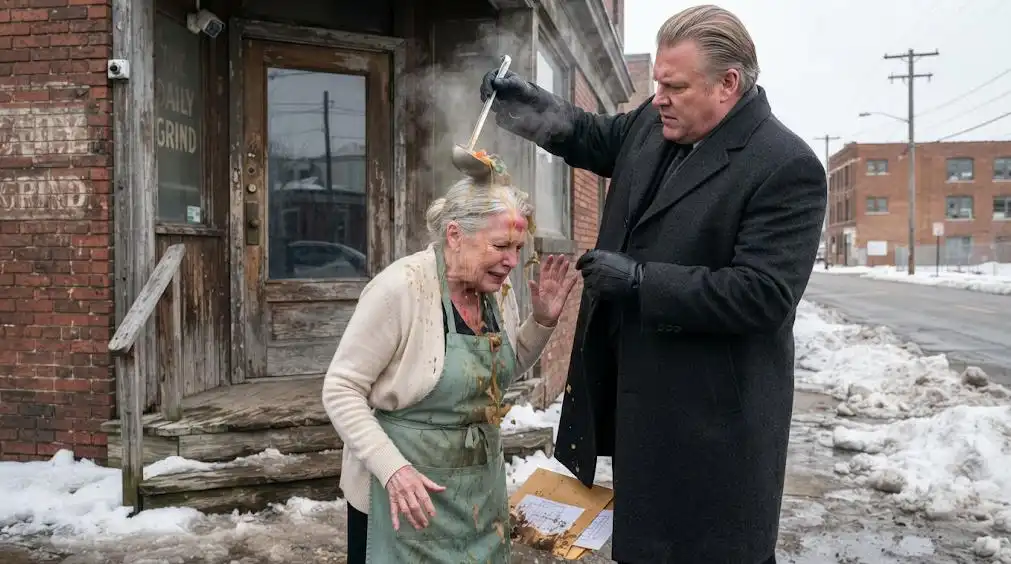
Graham picked up the metal ladle.
Nora frowned.
"What are you doing?"
He stepped closer.
Before she could retreat, he raised the full ladle above her silver hair and turned it upside down.
Scalding beef broth poured directly onto her head.
Nora screamed.
Hot liquid ran through her hair, over her forehead, and down the back of her neck. Pieces of cabbage and beef stuck to her cardigan. Greasy broth soaked the green apron she had worn for years.
Her forehead turned red.
The skin along her neck burned fiercely.
She tried to shield her face with her hands, but her arthritic fingers moved too slowly.
"Get your hands off me!"
She thrust one trembling arm toward Graham, trying to push him away.
His face twisted with anger.
He dropped the empty ladle and shoved her hard.
Nora stumbled backward.
Her left hand caught the wet wooden railing, but her fingers couldn't hold it.
She fell onto the frozen steps, striking her hip and lower back.
For a moment, she couldn't breathe.
Graham leaned over her.
"No children, you old hag! Friday's bulldozer comes. Sleep under a bridge!"
He laughed.
Nora looked up at him, her eyes burning with tears.
For forty years, she had fed hungry people in that building.
Now she was sitting in her own doorway, covered in the soup she had made for them, while a wealthy man threatened to leave her homeless.
She tried to get up.
Her hands shook too badly.
Then a voice thundered from the street.
"Don't touch her!"
A tall man was running toward the porch from a dark blue pickup truck.
He wore a weathered brown work coat and carried an old backpack.
He reached the steps, moved between Graham and Nora, and pulled off his coat.
When he saw the red skin beneath Nora's wet hair, his expression changed from fury to alarm.
He knelt beside her and carefully wrapped the coat around her shoulders, avoiding the burned skin.
"Someone call 911," he said.
Graham stared at him.
"Who the hell are you?"
The stranger didn't answer.
"Nora, can you hear me?" he asked gently.
She nodded, fighting to steady her breathing.
"We need to cool those burns. An ambulance is coming."
Graham gave a dismissive snort.
"That'll teach you what happens when you refuse a generous offer."
The younger man's jaw tightened.
He rose just enough to look Graham in the eye.
"You need to step away from her."
Something in his voice made Graham hesitate.
A neighbor had already emerged from the house next door, speaking urgently into her phone. Across the street, another resident stood filming.
Graham looked from one person to the other.
Then he straightened his expensive coat.
"This property is coming down Friday," he said. "You people can make all the calls you want."
He turned toward his waiting vehicle.
The stranger let him go.
Right now, Nora mattered more.
As the neighbor brought clean, cool water and followed the emergency dispatcher's instructions, the man steadied Nora beside the steps.
Then he opened his backpack.
He removed two old wool-lined work boots.
They were badly worn, with cracked leather, faded brown laces, and patches stitched into the sides.
Inside each boot were two embroidered initials.
S.W.
Nora stared.
Her lips parted.
"Where did you get those?"
The man swallowed.
"You gave them to me, Mrs. Whitcomb."
She looked up at his face.
Blue eyes.
Light brown hair.
A faint scar near his eyebrow.
Something about him seemed familiar, but she couldn't place it.
"Do I know you?"
He smiled through suddenly wet eyes.
"My name is Caleb Reed."
Nora shook her head slowly.
"Caleb?"
"Yes, ma'am."
He held up the boots.
"Fifteen years ago, you told a kid outside this diner that nobody ought to freeze to death just because they couldn't afford supper."
Nora covered her mouth.
"Oh, my goodness."
The stranger sitting beside her wasn't a stranger at all.
He was the homeless boy she had saved during the worst winter storm Youngstown had seen in years.
And he had finally come home.
Fifteen years earlier, sixteen-year-old Caleb Reed had been sleeping wherever he could find shelter.
His mother had died. The relative who was supposed to care for him had abandoned him. After weeks of unstable temporary arrangements, he had ended up on the streets.
One January night, he wandered into Nora's neighborhood with soaked clothes, torn shoes, and no money.
A group of local troublemakers found him sheltering beneath a storefront awning.
Their leader was Russell Vale, the father of the developer who now wanted Nora's property.
Russell kicked Caleb's belongings into the snow and struck him when the boy refused to leave quickly enough.
"Get out of my neighborhood," Russell snarled.
Caleb stumbled down the street.
By the time he reached Whitcomb's Corner Diner, he could barely feel his feet.
The diner was closing.
Nora, then fifty-five, was wiping down the counter when she noticed a figure slumped outside the front window.
She hurried to the door.
"Sweetheart, are you all right?"
Caleb tried to stand.
He couldn't.
Nora wrapped her arms around him and helped carry his weight inside.
She seated him beside the radiator, covered his shoulders with a blanket, and brought him a bowl of hot beef soup.
He ate slowly at first.
Then desperately.
When Nora offered bread, he started crying.
"What's wrong, honey?"
He stared at the bowl.
"I thought you were going to make me pay."
Nora pulled out the chair across from him.
"Not tonight."
She stayed until he finished.
When she discovered that his shoes were soaked through, she went upstairs and brought down a pair of old wool-lined work boots.
They had belonged to her late husband, Samuel Whitcomb.
Samuel had been a steelworker before an illness took his life.
Nora had stitched his initials inside the boots years earlier so they wouldn't get mixed up with other workers' belongings.
Caleb hesitated when she offered them.
"Those were your husband's."
"I know whose they were."
"Then I can't take them."
Nora sat beside him.
"Samuel wouldn't want his boots sitting in a closet while some poor boy freezes."
The following morning, she contacted a youth services counselor who helped arrange a safe placement and a path into vocational education.
Nora paid for Caleb's bus ticket to the state technical school where his training would begin.
Before he boarded the bus, Caleb promised her something.
"One day, I'll come back and do something good with the chance you gave me."
Nora hugged him.
"Then make a good life, Caleb. That's enough."
Over the next fifteen years, Caleb finished school, worked construction jobs, earned an engineering degree, and became an Ohio-licensed professional engineer specializing in historic structural rehabilitation.
He built a small independent contracting company.
He never forgot the woman who had fed him.
He never threw away Samuel Whitcomb's boots.
And whenever a difficult project made him wonder whether all those years of study had been worth it, he remembered the warmth of a diner radiator and a bowl of soup.
Then, earlier that week, Caleb received a message from June Miller, a longtime neighbor who helped Nora with her diner.
The city had condemned Nora's building.
She might lose everything.
Caleb loaded his equipment, put the boots into his backpack, and drove toward Youngstown.
He arrived just in time to see Graham Vale shove Nora onto the steps.
By the time the ambulance reached the diner, Caleb had already given the responding police officer his name and explained what he had witnessed.
Nora was taken to an urgent treatment facility, where a physician examined the scalds on her forehead and neck, treated her skin, and checked the injuries from her fall.
The burns were painful but did not require major surgery.
The bruising around her hip would take longer to heal.
Caleb remained beside her.
When the doctor finally allowed visitors, Nora stared at him across the examination room.
"I can't believe you kept those boots."
Caleb set his backpack beside the chair.
"They were the first things anybody gave me that made me feel like I had somewhere to belong."
Nora looked away, blinking.
"I wish Samuel could have met the man you've become."
Caleb reached for her hand.
"He helped me get here, too."
For a while, neither spoke.
Then Nora noticed the folded city demolition notice sticking out of Caleb's coat pocket.
Her expression darkened.
"You shouldn't have come back for this trouble."
"Tell me what happened to the building."
"It's old, Caleb."
"Old doesn't mean unsalvageable."
She gave a tired laugh.
"That's not what the city says."
A heavy winter snowstorm had damaged the roof several weeks earlier. One of the upper timber beams had cracked near a connection, and water had entered the attic.
An initial contractor estimated that replacing the roof structure, rebuilding the damaged areas, and carrying out the requested stabilization could cost $80,000.
Nora was given seven days to demonstrate how the dangerous conditions would be addressed.
She had barely enough savings to cover her medicine and living expenses.
Then an outside evaluator submitted a report claiming the building's foundation had suffered severe settlement.
The report declared the property beyond economical repair.
On Tuesday afternoon, the city issued an emergency order.
Nora had seventy-two hours before the demolition authorization could take effect, subject to a final Friday hearing.
If the structure couldn't be made safe, the building could be demolished and the cost charged against her property.
Graham Vale had been waiting for that opportunity.
His development company had been assembling nearby parcels for a commercial parking facility.
Nora's corner lot was the missing piece.
He offered her $50,000, roughly thirty percent of what even the distressed property might otherwise have commanded.
He brought a purchase agreement to the diner and tried to intimidate her into placing an inked thumbprint on it.
Nora refused.
She understood that Graham could not simply acquire her land by declaring the building unsafe. But a demolished building, city expense liens, and the loss of her only income would make refusing his next offer nearly impossible.
"That's when he started coming every day," she told Caleb.
Caleb unfolded the inspection report.
He studied the diagrams.
"Who did this evaluation?"
"A man named Martin Sloane. Graham hired him."
Caleb looked at the measurements.
One entry caught his attention.
The report claimed that the northwest foundation corner had settled almost three and a half inches.
He frowned.
"Did the city have anyone independently verify these measurements?"
Nora shook her head.
"Not before they sent the notice."
Caleb carefully folded the paper.
"Then I'd like to measure it myself."
Nora stared at him.
"Can you really help?"
He didn't promise what he couldn't yet prove.
"I can find out whether this report is telling the truth."
Before leaving the clinic, Caleb contacted the police again.
Nora had installed a security camera above her diner entrance years earlier after several break-ins.
June, who had access to the camera system, helped the officers preserve the original recording of Wednesday's assault.
The footage clearly showed Graham grabbing the blueprint envelope, throwing it into the snow, trampling it, pouring scalding soup over Nora's head, and pushing her onto the steps.
The officer documented the recording and arranged for the original file to be retained.
Graham's wealth wouldn't make that footage disappear.
But the assault investigation and the demolition proceeding were separate matters.
Caleb still had to save the building.
Wednesday afternoon, with Nora resting at June's house, Caleb entered the property alongside a city building official under authorization to perform an emergency structural assessment.
He brought a three-dimensional laser scanner, a laser total station, structural testing tools, and two members of his crew.
The old diner smelled of dust, coffee, and damp timber.
In the dining room, sunlight fell across red vinyl booths that had been patched more than once.
A photograph of Samuel Whitcomb hung beside the cash register.
Caleb stopped in front of it.
"Still looking after the place, Sam?" he murmured.
Then he climbed into the basement.
The building's main support system included heavy oak columns and a network of timber beams.
Caleb inspected each major connection.
He looked for rot, crushing, displaced footings, and evidence of long-term structural movement.
The damage was real.
A section of the roof framing had been overstressed by snow accumulation, and several joints required substantial reinforcement.
But the primary oak posts remained sound.
The foundation showed no corresponding pattern of damage to support the evaluator's dramatic settlement claim.
Caleb set up his laser instrument.
He took measurements at multiple points, checked the calibration, and repeated the survey.
Then he compared his findings with a historic municipal survey retrieved from the city's records.
The old reference points provided a useful baseline.
There was no measurable differential settlement of the kind described in Sloane's report.
Caleb checked again.
The result didn't change.
He called Nora.
"The foundation isn't moving."
There was silence.
"Are you sure?"
"Within the limits of the records and today's measurements, there's no evidence of the settlement they reported."
Nora began crying.
Caleb stared at the sound oak columns.
He wasn't finished.
The building was still unsafe in its present condition, and proving one part of the report false wouldn't repair a cracked roof.
But it meant the foundation might not need to be replaced.
And that changed everything.
He spread the original blueprints, carefully dried and photographed after their time in the snow, beside the laser scans.
Within two hours, he had developed the basis for a repair.
Instead of tearing out the entire old structural system, his crew could install a carefully engineered lightweight cold-formed steel frame inside the existing structure.
Steel connector plates and reinforced timber joints would secure the damaged roof framing. Additional bracing would transfer loads into the verified sound support system.
The historic exterior could remain intact.
It was a practical stabilization project, not an $80,000 reconstruction.
Caleb estimated the emergency work could be completed for a fraction of the original price.
But they needed materials.
Labor.
Permits.
Independent inspection.
And time they barely had.
That evening, Caleb presented his stamped preliminary calculations and construction drawings to the city's building department.
The official reviewing them was a woman named Diane Harper.
She had worked in code enforcement for nineteen years and had no patience for incomplete paperwork.
She examined the drawings.
"You're proposing to stabilize the roof in forty-eight hours?"
"Using prefabricated components already in our inventory."
"And your connection designs?"
"Here. The load path is shown on sheets four through seven."
She studied them.
"What about the foundation settlement?"
"I have instrument measurements that contradict the submitted evaluation. I'll provide the full survey record."
Diane tapped her pen against the desk.
"You understand this doesn't make the building safe by itself."
"I do."
"And occupancy stays prohibited until we inspect the completed work."
"Understood."
She looked at him for a long moment.
Then she approved a limited emergency stabilization permit, subject to the required inspections.
Caleb left the office and called his crew.
"Bring the steel."
By Thursday morning, Graham Vale knew his plan was in trouble.
He contacted two local lumber suppliers and pressured them not to extend material credit or deliver to Caleb's project.
One supplier canceled an order of timber.
Another refused to accept a replacement request.
When Caleb called for an explanation, the manager sounded embarrassed.
"Mr. Vale does a lot of business with us. He's threatening to pull his contracts."
Caleb looked at the clock.
The hearing was now less than thirty hours away.
He couldn't afford to fight over lumber.
Instead, he called his own fabrication yard.
His company kept an inventory of cold-formed steel framing sections, brackets, and connectors for emergency rehabilitation projects.
He instructed his crew to load the approved components and prepare additional steel plates according to the engineering drawings.
By late morning, a work truck arrived at Nora's property carrying the first shipment.
Graham responded by filing a complaint alleging that Caleb was performing construction without the required credentials.
A city inspector appeared at the site.
"Who's responsible for this job?"
Caleb stepped forward.
"I am."
"There's been a complaint about unlicensed work."
Caleb produced his Ohio professional engineering registration, his company's contractor documentation, proof of insurance, and the emergency permit.
The inspector checked them against the city's records.
Then he examined the permitted work area.
"You're authorized to proceed within this scope," he said. "Call for inspection before concealing any structural connections."
Caleb nodded.
"Every connection will stay visible until it's checked."
Across the street, Graham watched from his vehicle.
Caleb didn't look at him.
He had beams to save.
The work continued through Thursday.
Caleb supervised the installation of the lightweight steel reinforcement system while his crew rotated through the elevated work positions.
They worked from properly secured platforms and lifts, wearing harnesses and following the engineered installation sequence.
First came the temporary supports.
Then the new steel bracing.
Then the reinforcing plates around the damaged roof connections.
Every joint had to be measured and fitted.
Every fastener had to be installed correctly.
The old oak columns were strong, but the new structure could not simply be bolted anywhere convenient. The loads had to reach the proper bearing points without damaging the historic wood.
Caleb spent much of the next forty-eight hours directing and personally performing critical elevated work, coming down only for essential checks, brief rest, and crew safety rotations.
His shoulders ached.
His hands grew raw beneath his gloves.
At one point, while adjusting a steel collar high above the old dining room, a stiff connection refused to seat against the timber.
A younger carpenter suggested forcing it into place.
Caleb stopped him.
"If we force that plate, we damage the beam we're trying to save."
He climbed down, checked the measurements, and found that a subtle twist in the century-old timber required a revised plate.
They lost nearly an hour fabricating the correct fit.
But the new connection seated properly.
Later that night, another problem appeared.
A newly installed brace showed slight movement during a controlled verification check.
Caleb ordered the crew to stop loading it.
The issue wasn't the main oak support.
It was the connection to an old brick partition that had never been intended to carry the new force.
He reviewed the load path and redirected that brace through the independent steel frame to the sound structural supports.
The correction took several more hours.
The deadline moved closer.
At midnight, Nora arrived with June carrying thermoses of coffee and warm sandwiches prepared in a neighbor's kitchen.
She wore a soft scarf to protect her healing neck.
A doctor had warned her not to expose the burns to cold wind for long.
Caleb climbed down when he saw her.
"You shouldn't be out here."
Nora ignored the warning.
"Neither should you."
She looked through the open doorway at the steel frame rising beneath her damaged roof.
"This is too much, Caleb."
"No, it isn't."
"I know what materials cost. I know what you're paying those men."
Caleb wiped his hands on a rag.
She touched his sleeve.
"Did you spend your own money?"
He hesitated.
Nora closed her eyes.
"Caleb."
He had used the savings he'd been keeping for a replacement company truck to cover the immediate materials and crew expenses.
His company could complete the stabilization without waiting for the grant reimbursement, but the risk was his.
He had also located state historic-building preservation funding guidelines that allowed eligible emergency structural stabilization work to be considered for financial assistance.
The old diner had a documented local history, and Nora had already begun the eligibility process with help from June.
Caleb helped complete the technical portions of the application, including the preservation-sensitive repair specifications.
There was no guarantee that the grant would be approved.
He understood that.
So did Nora.
"You can't gamble your business on an old woman," she whispered.
Caleb looked through the doorway at the worn counter, the patched booths, and the faded photograph of Samuel.
"Fifteen years ago, you gave me a roof when I had nowhere to go. I'm not letting you lose yours."
Nora began to cry.
Not because someone had offered her money.
Because someone had remembered.
She reached into her coat and brought out a folded photograph.
It showed Caleb at sixteen, standing beside the diner door in a pair of oversized wool work boots.
His face was thin.
His smile was uncertain.
Nora handed it to him.
"I kept hoping you'd be all right."
Caleb studied the boy in the photograph.
Then he looked at her.
"I am."
For the first time since the demolition notice arrived, Nora smiled.
"Then finish your work, sweetheart."
Friday morning came gray and bitterly cold.
The crew had worked through two nights.
The building's interior was filled with new steel connections, reinforcement plates, and bracing, carefully integrated into the old timber structure.
Caleb conducted the final measurements.
The reinforced roof connections held.
The installed bracing met the design requirements.
The monitored foundation elevations remained stable.
An independent inspector reviewed the accessible connections, measured fastening details, and observed the verification procedures.
Caleb's final report included the three-dimensional survey, engineering calculations, installation records, and test measurements documenting an A-level result under the project's approved seismic-stabilization performance checklist.
He also attached a separate analysis of Martin Sloane's original report.
The discrepancies were serious.
Sloane's reported foundation elevations could not be reconciled with either the historic municipal benchmark record or the new instrument survey.
Several measurements had been entered in ways inconsistent with the documented survey setup.
Caleb was careful not to claim that an instrument alone proved criminal intent.
He identified the contradictions, documented the methodology, and requested independent review of the original data and its preparation.
The report also made clear that the roof damage had been real and required repair.
What it rejected was the claim that the entire building was beyond saving.
By Friday afternoon, the emergency reinforcement was complete.
Caleb's team had finished the critical work just before the housing committee's scheduled hearing.
He changed into a clean shirt.
His palms were sore.
He had barely slept.
But he carried three things into the municipal hearing room.
A complete engineering report.
Independent inspection findings.
And the repaired original blueprints from Nora's muddy envelope.
Nora entered beside him, leaning on her cane.
Graham Vale was already seated near the front.
His attorney sat beside him.
Martin Sloane, the outside evaluator, occupied a chair in the second row.
The hearing began at 2:30 p.m.
The committee chair, Margaret Collins, reviewed the emergency demolition order.
"The question before us," she explained, "is whether this building remains an immediate danger that requires demolition."
Graham's attorney spoke first.
He argued that the building's age, previous roof damage, and reported foundation movement made it unsafe.
"The owner has been given an opportunity to correct the conditions," he said. "The developer's offer provided a reasonable alternative."
Nora gripped her cane.
Caleb placed a hand over hers.
When his turn came, he approached the table.
"My name is Caleb Reed. I'm an Ohio-licensed professional engineer specializing in the rehabilitation of historic buildings."
He handed the committee his report.
"The roof damage was significant. It required reinforcement. That work has now been performed under the city's emergency permit."
He displayed the laser survey.
Then the foundation measurements.
Then the inspected steel and timber reinforcement connections.
The committee members studied the photographs.
One asked, "What about the reported foundation settlement?"
Caleb opened the original evaluation.
"The report describes almost three and a half inches of differential settlement."
He placed a new chart beside it.
"Our repeated measurements do not support that conclusion."
Sloane leaned forward.
"Old buildings can move unpredictably."
Caleb nodded.
"They can. That's why measurements need to be reproducible and properly referenced."
He showed the historic benchmark comparisons.
Then he pointed out the inconsistencies in the submitted evaluation.
"These are not differences explained by ordinary measurement tolerances."
The room grew quiet.
Caleb continued.
"The primary oak columns are sound. The foundation remains stable within the available measurement evidence. The damaged roof connections have been reinforced, and the completed work has been inspected."
Graham shifted in his chair.
"You're telling this committee a hundred-year-old building is perfect?"
"No," Caleb said. "I'm telling the committee exactly what was damaged, what was repaired, and what the measurements show."
Diane Harper, the city building official who had reviewed the emergency permit, was called to speak.
She confirmed that the stabilization work had been inspected and that the structural conditions identified for emergency demolition had been corrected.
The committee chair turned to Sloane.
"Can you produce the original field records supporting the settlement measurements?"
Sloane hesitated.
"I would need to retrieve them."
"Then your conclusions will require further review."
Graham leaned toward his attorney and whispered angrily.
Caleb stepped away from the table.
He had made the engineering case.
Now Nora needed to speak for herself.
She rose slowly, using her cane.
Her neck was still tender.
The bruising around her hip made standing difficult.
But she refused Caleb's offer to speak for her.
"My husband and I bought that building when nobody wanted that corner," she began.
"We didn't have much. We worked every day."
She glanced down at the old blueprints.
"Samuel used to say a place wasn't worth saving because the bricks were pretty. It was worth saving if people had a reason to walk through the door."
Her voice wavered.
"When the steel mills closed, people lost their jobs. Some lost their homes. We kept a pot of soup on because it was something we could do."
She looked at Graham.
"I know my roof was damaged. I never asked the city to ignore that. I asked for a chance to fix it."
She took a breath.
"This man tried to make me sell my home for fifty thousand dollars. When I refused, he threw my husband's drawings in the mud. He poured boiling soup over my head and pushed me down my own steps."
The committee chair's expression hardened.
The police already had the camera recording, medical documentation, and witness statements.
The assault itself wasn't for the housing committee to adjudicate, but the incident explained the intimidation surrounding Graham's purchase offer.
Nora steadied her hands on the table.
"I don't want somebody else's land. I don't want a handout that isn't mine. I want to live in the home my husband and I worked for."
She looked toward Caleb.
"And somebody who once needed help has come back to help me."
The room was silent.
After reviewing the engineering evidence and independent inspection findings, the committee withdrew the emergency demolition authorization and formally rescinded the outstanding demolition order.
The city also removed the immediate threat of demolition expense charges associated with that order.
The disputed outside evaluation was referred for further professional and legal investigation.
Later that afternoon, following final approval by the building department, Nora received the required safety occupancy authorization.
Her home could be occupied again.
The diner could reopen once its remaining business and food-service checks were completed.
Nora stared at the document.
For several seconds, she couldn't speak.
Then she turned to Caleb.
"Does this mean I can go home?"
He smiled.
"Yes, Mrs. Whitcomb."
"Really home?"
"Really home."
Her knees weakened.
Caleb caught her before she could fall.
She pressed her face against his shoulder and cried.
He held her carefully, keeping his arms away from her healing burns.
The old building was safe.
Her life's work had not been taken away.
And the boy she once rescued had kept his promise.
But there was one more choice Caleb had to make.
After the hearing, Graham arrived at the diner property to arrange the removal of equipment his representatives had previously placed nearby.
The city had prohibited any demolition activity.
Police investigators were reviewing the assault evidence, and the allegations surrounding the false engineering report were now being examined.
Graham looked furious.
When he saw Caleb supervising the formal handover of the stabilized building, he marched toward him.
"You think you've destroyed me?"
Caleb turned.
"I came here to save a building."
Graham pointed toward the newly installed bracing.
"You'll regret getting involved."
Caleb felt fifteen years of anger rise inside him.
He remembered Graham's father kicking his belongings through the snow.
He remembered being sixteen, freezing, hungry, and afraid.
He remembered Nora sitting on the wooden steps with soup running down her face.
For a moment, Caleb wanted to humiliate Graham in front of everyone.
He wanted the man to feel as helpless as Nora had felt.
Then he heard a little girl crying.
A young blond girl sat beside Graham's vehicle, frightened by the shouting.
She was Graham's daughter.
She watched her father with wide, tear-filled eyes.
One of her mittens had fallen onto the wet pavement.
Caleb looked at the child.
Then at Graham.
The anger remained.
But he understood something important.
The girl hadn't poured the soup.
She hadn't falsified any measurements.
And she hadn't tried to take Nora's home.
Caleb walked past Graham, picked up the mitten, and handed it gently to the little girl.
"Here you go."
She took it without speaking.
Then he turned back to Graham.
"What you did to Mrs. Whitcomb will be handled in court. I'm not making your daughter pay for it."
Graham said nothing.
Caleb returned to the building.
He had spent years learning how to reinforce structures that other people wanted to abandon.
He wasn't about to let revenge undo the person Nora had helped him become.
The criminal investigation continued.
The diner camera footage, medical records, and witness statements supported charges arising from Graham's assault on Nora.
Investigators also examined the engineering report.
The discrepancies Caleb documented led to subpoenas for the evaluator's original working records and communications.
Those records eventually revealed that Graham's company had paid Sloane to alter critical findings so the building would appear beyond economical repair.
The supposedly severe foundation settlement had been knowingly misrepresented.
Sloane's professional credentials became the subject of disciplinary proceedings, and he faced criminal consequences for his role in the falsified report.
Graham was prosecuted for the assault and his involvement in the fraudulent documentation.
Nora refused private offers intended to make her abandon her claims.
She pursued her injury compensation through the courts.
Months later, the proceedings resulted in a criminal conviction, an enforceable judgment requiring Graham to compensate Nora for her injuries, and substantial penalties tied to the fraudulent redevelopment scheme.
A court-approved resolution and related licensing actions barred Graham from operating in commercial property development for a defined period, while his contracting credentials and eligibility for municipal projects were revoked.
His development company lost financing, faced claims from creditors and former business partners, and ultimately entered bankruptcy.
Caleb never needed to threaten Graham's family.
He had let the evidence, the engineering, and the legal process do their work.
Meanwhile, Nora faced the slower task of rebuilding an ordinary life.
The emergency reinforcement had saved the structure, but years of neglect still needed attention.
The historic preservation assistance application was eventually approved for eligible portions of the work.
It helped reimburse qualifying stabilization costs and reduce the remaining burden of restoring the property.
Caleb's company completed the additional repairs under the required approvals.
He kept the project accounts transparent and accepted no ownership interest in Nora's home.
When Nora insisted on discussing repayment for the money he'd advanced, he told her they could settle the remaining balance gradually, without putting the building at risk.
June organized neighborhood volunteers to clean the dining room.
A retired carpenter repaired the worn wooden counter.
Several former steelworkers painted the window frames.
A local electrician restored the warm yellow neon sign that had illuminated the corner for decades.
Nora's burns healed, leaving only faint marks.
Her arthritis remained, and she could no longer manage long shifts by herself.
So the diner reopened with help from neighbors and two part-time employees.
Nora served customers when she felt well enough.
On other days, she sat behind the counter and talked with the people who had been coming there for most of their lives.
The prices stayed low.
The community meal notebook remained beneath the cash register.
And the old photograph of Samuel Whitcomb returned to its place on the wall.
Nine months after the demolition hearing, on a quiet Sunday evening, warm yellow neon once again glowed through the windows of Whitcomb's Corner Diner.
The renovated counter shone beneath the pendant lights.
Outside, cars rolled slowly past the familiar old brick building.
Caleb sat on a stool, his work jacket hanging from the back, carefully wiping dust from a pair of battered wool-lined work boots.
The repaired seams were still visible.
Inside the boots, the embroidered initials S.W. had faded but remained intact.
Behind the newly restored counter, seventy-year-old Nora Whitcomb watched him with a soft smile.
She lifted a fresh bowl of steaming beef-and-vegetable soup, leaned forward, and placed it gently in front of Caleb as he continued wiping the old boots.
Disclaimer: Mention of any brand or trademark is for identification only and does not imply partnership or endorsement

A Wealthy Manhattan Socialite Poured Red Wine on a Plus-Size Artist at a Charity Gala, Calling Her “Cheap and Unworthy.” She Had NO IDEA Who Would Discover Her Paintings... 😱

A Celebrity Trainer Threw CASH in a Plus-Size Nutritionist’s Face at a Luxury LA Gym, Saying She Couldn’t Even Control Her Own Weight. He Had NO IDEA What Her Clients Would Prove... 😱

My Fiancé’s Mother CUT MY Custom Engagement Dress in Front of 200 Guests and Called Me an “Elephant in a Sack.” My Fiancé Just SMILED... 😱