


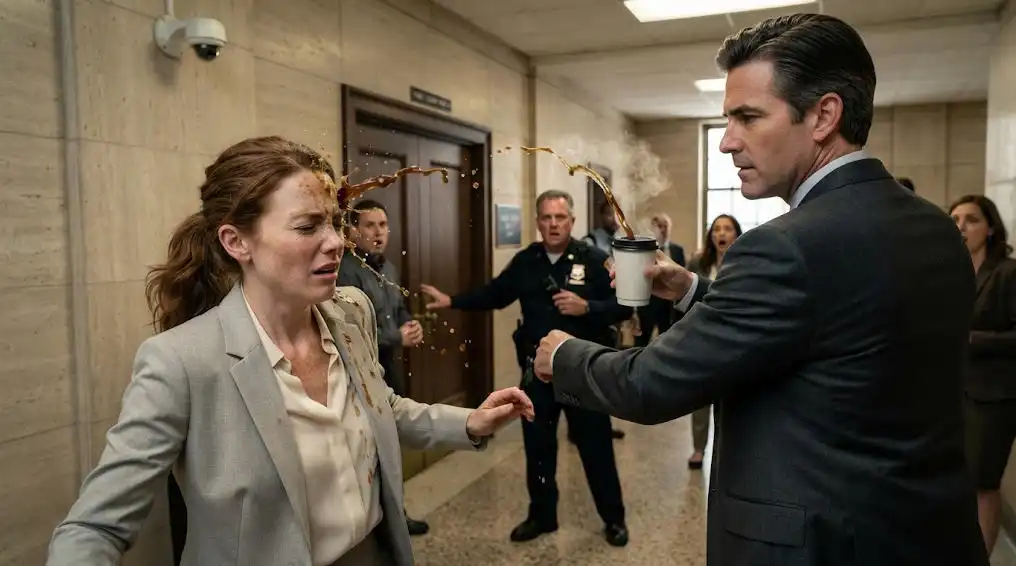
Ten minutes before the judge was supposed to decide whether Mara Bennett could keep her seven-year-old daughter, her billionaire ex-husband threw a cup of scalding coffee directly into her face.
The liquid struck her forehead first.
Then it ran into her eyes, down both cheeks, and beneath the collar of her cream-colored blouse.
Mara screamed.
She stumbled backward, slammed her shoulder against the courthouse wall, and squeezed her burning eyes shut.
For a moment, all she could feel was heat.
Hot liquid soaked into her clothing. Her skin felt as though someone had pressed a scorching iron against it.
When she managed to open her eyes, Grant Whitmore was standing less than three feet away.
He was still holding the nearly empty paper cup.
And he was smiling.
Mara's right hand curled into a fist.
She wanted to hit him.
After years of being frightened, cornered, and told that she was worthless, she wanted to strike him hard enough to wipe that smile from his face.
She took one furious step forward.
Then she saw where Grant was looking.
Not at her burns.
At her clenched hand.
He was waiting for her to lose control.
Mara stopped herself and raised her left forearm defensively.
"Don't touch me."
Grant leaned toward her without lowering his smile.
"You're losing Lily today."
Those five words hurt worse than the coffee.
Lily was their seven-year-old daughter, the little girl who slept with a stuffed rabbit and insisted that the broken stars on her bedroom ceiling were actually secret constellations.
The little girl who still believed her mother could protect her from anything.
Grant had spent almost a year trying to take Lily away.
And Mara was beginning to understand that the coffee hadn't been an impulsive act of anger.
It was another trap.
She looked past him and noticed the security camera mounted above the courthouse corridor.
A uniformed court officer stood near the entrance.
Mara pointed toward the camera.
"Officer, preserve that camera."
The officer, Daniel Pike, immediately reached for his radio.
Grant's smile faltered.
Mara didn't wipe away the coffee.
She stood against the wall, trembling with pain, and watched the officer report what had happened.
For the first time in their entire marriage, she had refused to give Grant the reaction he wanted.
But that was only the beginning.
Because inside the courtroom, Grant had prepared something far more dangerous than a cup of hot coffee.
He had prepared a case designed to convince the judge that Mara was mentally unfit to raise their daughter.
And most of the evidence appeared to come from Mara herself.
Three years earlier, nobody looking at Mara Bennett would have imagined she would someday be fighting a billionaire in family court.
She had married Grant when she was twenty-three.
At the time, he was already wealthy, but his investment businesses had not yet grown into the empire that would eventually make him a billionaire.
He had been charming in public.
He sent flowers to her workplace. He remembered her mother's birthday. He offered to pay for her college courses and told her she would never have to worry about money again.
When Lily was born, Grant gave Mara a diamond bracelet.
Then he told her she didn't need to work anymore.
At first, she thought it was generosity.
Slowly, it became something else.
Grant began monitoring her spending.
He questioned every phone call.
If she disagreed with him at dinner, he would wait until the guests left, then stand close enough that she could feel his breath against her face.
He never shouted when other people were listening.
He rarely struck her.
Instead, he learned exactly how to frighten her without leaving injuries that could easily be documented.
He would trap her between himself and a doorway, grip her arms through her sleeves, or cover her mouth while speaking quietly into her ear.
Sometimes he kept her awake for hours, demanding explanations for things she hadn't done.
When she cried, he called her unstable.
When she begged him to stop, he called her hysterical.
When she finally shouted, he took out his phone and recorded her.
"Look at yourself," he would say afterward. "Who do you think anyone will believe?"
Eventually, Mara began having panic attacks.
She stopped trusting her own memory.
She found herself apologizing before Grant had even told her what she had supposedly done wrong.
And when she sought counseling, he told her that seeing a therapist would only prove she was mentally ill.
But Lily was growing older.
She had begun noticing things.
One evening, when Grant cornered Mara in the kitchen, their daughter appeared in the doorway.
Lily was only six then.
She held a worn stuffed rabbit against her chest.
"Daddy," she whispered, "why does Mommy always get scared when you come home?"
Grant turned toward her.
His expression changed instantly.
"Your mother gets upset over nothing, sweetheart."
That night, Lily crawled into Mara's bed.
"Mommy, if I promise to be really good, will Daddy stop being mad?"
Mara held her daughter until she fell asleep.
The next morning, she began planning their escape.
She took no property from the marriage.
No jewelry.
No cash.
No furniture.
With help from her older sister, she carried two suitcases out of Grant's Manhattan townhouse while he was away.
One suitcase held clothes.
The other contained Lily's schoolbooks, a few photographs, and her stuffed rabbit.
They moved into a small apartment in Queens.
Mara found work as a supermarket cashier.
She learned to stretch groceries across the final days before payday. She repaired Lily's winter coat herself and worked extra shifts whenever the store needed help.
Their apartment had peeling paint and a refrigerator that rattled at night.
But Lily slept through the night more often.
That alone felt like a victory.
Until Grant filed for sole custody.
His petition accused Mara of suffering from serious psychiatric problems.
He alleged that she was emotionally volatile, financially incapable of providing for Lily, and dangerously obsessed with keeping their daughter away from him.
His lawyers requested exclusive decision-making authority and primary physical custody.
Grant hired a team of attorneys who specialized in high-conflict custody litigation.
Mara barely had enough money for a consultation.
A women's legal assistance program eventually connected her with Tessa Greene, a family-law attorney who agreed to represent her under a deferred-fee arrangement.
Tessa was forty-six, with short blond hair and the kind of calm voice Mara had once mistaken for indifference.
After reviewing Grant's filings, Tessa spread the documents across her desk.
"Some of this is very carefully constructed," she said.
Mara stared at a photograph showing her crying on the front steps of Grant's townhouse.
"He took that after he threatened to keep Lily from me."
"Do you have proof?"
Mara shook her head.
Grant had been careful.
He owned the house, controlled most of the cameras, and arranged situations in which only her reactions appeared on video.
Tessa studied another document.
It appeared to be a psychological assessment claiming that Mara suffered from a severe mental disorder.
"Have you ever received this diagnosis?"
"No."
"Have you ever been hospitalized for psychiatric treatment?"
"No."
Mara's voice broke.
"I went to counseling because I couldn't stop shaking after he yelled at me. That's all."
Tessa looked at her.
"Then we're going to challenge this."
But the case grew more difficult.
Grant repeatedly delayed financial disclosures.
Although a temporary support order required him to contribute substantial funds toward Lily's expenses, he withheld payments while his lawyers fought over financial calculations.
Mara continued working long shifts at the supermarket.
Meanwhile, Grant's attorneys produced videos that appeared to show her becoming increasingly unstable.
Some clips had been shortened.
Others were accompanied by descriptions that left out what Grant had said or done immediately beforehand.
Every time Mara attempted to explain herself, she felt trapped.
If she became emotional, she appeared unstable.
If she remained quiet, Grant's attorneys described her as evasive.
And if she resisted his demands, he accused her of interfering with his relationship with Lily.
Then something happened that changed Mara's approach.
Lily returned from a scheduled visit with her father unusually quiet.
At bedtime, she took off the old teddy-bear necklace she had worn since kindergarten.
The pendant had belonged to Mara's mother.
It was small, brass-colored, and scratched around the edges, with a tiny hinged compartment in the back.
Lily rubbed its worn surface between her fingers.
"Mommy, Daddy said the judge will send you away if I tell people what he says."
Mara felt her stomach tighten.
"What did he tell you to say?"
Lily looked down.
"That you scare me."
"Do I?"
Lily shook her head immediately.
"No. But he said I have to tell them."
The next morning, Mara called Tessa.
She also contacted Lily's pediatrician, who had already documented the child's nightmares, stomachaches, and fear surrounding visits.
Mara had been afraid to put Lily in the middle of another confrontation.
But she was even more frightened that Grant was pressuring their daughter in private while telling everyone that Mara was the dangerous parent.
After discussing the risks with Tessa, Mara obtained a tiny voice-recording device designed for personal safety.
She fitted it inside the old teddy-bear pendant.
She explained to Lily that it was for emergencies, not a secret assignment.
"You don't have to record anything for me," Mara told her. "But if someone frightens you and you need help explaining what happened, you can press this button."
Lily practiced once and understood how it worked.
Mara knew the recording might never be accepted as evidence.
The rules surrounding recordings involving children were complicated, and Tessa warned her that the court could reject it.
But after the threats Lily had described, Mara believed she needed a way to establish what happened when nobody else was present.
She also continued documenting the visits through messages, medical appointments, and conversations with Lily's attorney.
For several weeks, the pendant recorded nothing important.
Then, after one scheduled visit, Lily quietly handed it to her mother.
"I pushed the button," she whispered.
Mara didn't ask Lily to repeat what had happened.
She simply held her.
Later that evening, after Lily went to sleep, Mara listened to the recording.
It lasted eleven minutes and four seconds.
By the end, Mara was sitting on the kitchen floor, shaking.
The recording began during a tense exchange near the entrance of Grant's townhouse, when Mara had arrived to collect Lily.
It captured his words before the edited video he later used against her had even begun.
It also captured how he spoke to Lily when he believed nobody outside the house could hear him.
Mara called Tessa immediately.
The attorney listened to the complete file the following morning.
She didn't celebrate.
Instead, she asked Mara several careful questions about the recorder, how it had been used, and what concerns had prompted her to provide it.
Then she arranged for the original audio file and memory card to be preserved.
An independent audio specialist examined the file for indications of editing and documented its continuous recording and original timestamps.
Tessa also notified Lily's attorney, who spoke privately with the child.
The recording was important.
But it was not automatically admissible.
Grant's lawyers could challenge the consent, the authenticity, and even the circumstances under which Lily had worn the device.
Mara understood the danger.
The one thing that might finally expose Grant could also be thrown out of court.
And the final custody hearing was approaching.
On the morning of that hearing, Mara woke at five.
She dressed in the same inexpensive gray blazer she had worn to almost every important appointment since leaving Grant.
She packed the evidence documents into an old canvas tote.
Lily ate cereal at the kitchen table, wearing her pink pajamas.
"Are you going to tell the judge Daddy gets angry?" Lily asked.
Mara sat beside her.
"I'm going to tell the truth."
"What if he doesn't believe you?"
Mara reached for her hand.
"Then I'll keep trying to make sure you're safe."
Lily looked worried.
"Do I have to live with Daddy if the judge believes his lawyers?"
Mara couldn't promise what a judge would decide.
So she gave her daughter the only honest answer she had.
"I'm going to do everything I can to protect you."
Lily hugged her.
Before leaving home, Mara carefully collected the scratched teddy-bear necklace, which had already been documented as evidence.
Lily handed it over reluctantly.
"Can I have it back when it's over?"
"Of course, sweetheart."
Lily's attorney had arranged for her to wait in the supervised family waiting room rather than sit through the adults' testimony.
Mara's sister would remain nearby.
Everything was supposed to be prepared.
Tessa had organized the exhibits.
The court had the necessary filings.
And Mara had spent the previous evening practicing how to answer questions without allowing Grant's attorneys to provoke her.
Then Grant met her in the courthouse corridor.
He was holding the cup of black coffee.
And ten minutes before the hearing, he threw it in her face.
By the time Tessa arrived, Mara was leaning against the wall, struggling to breathe evenly.
Coffee still dripped from her chin.
Her makeup was smeared.
The skin across her upper cheek was turning red.
"Mara, your face. We need to get you treated."
"I know," Mara whispered. "But he wanted me to hit him."
Tessa looked toward Grant, who was already speaking urgently to one of his attorneys.
"Then we're not giving him the reaction he wanted."
Officer Pike approached them.
He confirmed that he had witnessed the confrontation and reported it to courthouse security.
The relevant camera footage had been flagged for preservation.
Tessa immediately requested that the court retain the original recording and arrange for it to be authenticated.
Mara's hands were still shaking.
"Do we have to go in looking like this?" she asked.
Tessa studied her face.
"We have to get your injury documented. And we have to tell the judge what happened."
Mara looked at the courtroom doors.
"I want him to see exactly what Grant did."
Tessa hesitated.
"The burn needs attention."
"I know."
Mara swallowed.
"But please don't let them pretend this didn't happen."
With the court officer's report made and her immediate safety assessed, Mara entered the courtroom before attempting to repair her appearance.
She still had coffee on her cheeks.
Her blouse was stained.
Her eyes were swollen and red.
Grant was already seated beside his attorneys.
He looked at her only once.
Then he turned away.
The judge, Honorable Caroline Mercer, was a woman in her late fifties with silver-blond hair and a reputation for being meticulous about evidence.
She noticed Mara's appearance immediately.
"Ms. Bennett, are you injured?"
Tessa stood.
"Your Honor, there was an assault in the courthouse corridor moments before this hearing. We have requested preservation of the security footage."
Grant's lead attorney, Richard Vale, rose.
"Your Honor, my client disputes the characterization of that incident."
The judge's expression hardened.
"Then the court will examine the available evidence."
She directed that the reported incident be documented and that appropriate medical attention be made available.
But the scheduled hearing proceeded with the evidence already before the court.
Grant's attorneys had been preparing for this day for months.
They weren't about to surrender their case.
Vale began by portraying Grant as an attentive, financially responsible father.
He described Mara as emotionally unpredictable.
Then he displayed a video.
On the large courtroom monitor, Mara appeared outside the townhouse, crying and shouting.
Her face was twisted with distress.
Her voice was loud.
"Get away from us!"
The clip ended abruptly.
Vale turned toward the judge.
"This is one example of Ms. Bennett's volatile behavior in the presence of the child."
Mara stared at the screen.
She remembered that afternoon.
She remembered why she had been screaming.
But the clip showed only nineteen seconds.
None of what had happened before.
Vale introduced photographs of Mara crying during exchanges with Grant.
He presented screenshots of text messages in which she seemed to threaten to prevent Grant from seeing Lily.
Then he displayed the purported psychiatric assessment.
"The evidence demonstrates that Ms. Bennett has longstanding difficulty regulating her emotions," Vale argued. "Mr. Whitmore is seeking custody because he is concerned about his daughter's safety."
Grant lowered his eyes.
He looked devastated.
Like a father who had tried everything to help his troubled ex-wife.
Mara knew that expression.
She had seen him use it with friends, doctors, and marriage counselors.
It was the face he wore when he wanted someone to believe that her fear was irrational.
Tessa objected to the purported assessment's foundation and disputed the accuracy of the edited material.
Vale insisted that the evidence was reliable.
The judge permitted questioning on the disputed exhibits but made clear she had not accepted the lawyer's descriptions as established facts.
Mara sat perfectly still.
She could feel the burn developing across her cheek.
A small blister had begun forming near her cheekbone.
Her instinct was to put a hand over it.
But when she looked at Grant, she remembered that he had expected her to walk into court screaming.
She kept her hands folded.
The judge looked toward her.
"Ms. Bennett, do you wish to respond?"
Mara stood slowly.
"Yes, Your Honor. I want to present two recordings myself."
Tessa requested permission to call Mara to testify and establish the evidence.
The judge agreed.
As Mara moved toward the witness stand, she placed the old teddy-bear necklace beside Tessa's evidence folder.
Grant saw it.
For the first time that morning, he stopped moving.
His eyes fixed on the pendant.
Vale immediately rose.
"Your Honor, we dispute whether that audio was lawfully obtained."
The judge turned toward Mara.
"Then I need to know exactly how it was recorded."
Mara explained the necklace.
She described Lily's nightmares, the threats their daughter had reported, and the pediatrician's documentation.
She told the judge why she had feared for Lily's safety and why she believed a recording might be necessary.
"I didn't want my daughter collecting evidence against her father," Mara said, her voice wavering. "I wanted her to have a way to show an adult what was happening if she was frightened."
Vale questioned her sharply.
"Isn't it true that you secretly put a recording device on a seven-year-old child?"
"Yes," Mara answered.
"And didn't tell Mr. Whitmore?"
"No."
"Because you wanted to spy on him?"
Mara shook her head.
"Because my daughter was afraid of him."
Vale stepped closer to the lectern.
"Your Honor, the mother is admitting that she arranged an undisclosed recording."
Tessa rose.
"The court has evidence of specific safety concerns predating the recording. The child was a participant in the conversation, understood the device, and the recording was made for her protection. We request a ruling after the relevant foundation is established."
Lily's attorney confirmed that she had spoken privately with the child.
Lily understood what the recorder did.
She had activated it herself when frightened, and she wanted the court to know what her father had said.
The judge examined the prior pediatrician's records and the timeline of Mara's reports.
She considered the narrow legal question of whether the recording had been made in good faith on the child's behalf and whether the circumstances justified that decision.
Mara waited.
Her face throbbed.
She knew the court might decide that the recording could not be used.
And if that happened, the most important evidence she possessed might remain unheard.
Finally, Judge Mercer spoke.
"I am satisfied that there is an adequate foundation to consider the recording under the circumstances established here. The court will hear the relevant portions and allow both sides to address them."
Mara closed her eyes.
Not from relief alone.
From the terror of knowing what everyone was about to hear.
Tessa introduced the original recording, its documented preservation history, and the specialist's examination.
Then the audio began.
At first there were ordinary sounds.
A door opening.
Footsteps.
Lily's small voice.
"Daddy, can I go home now?"
Then Grant answered.
"You're going to tell them your mother scares you."
A pause.
"But she doesn't."
The next sound made Mara grip the edge of the witness stand.
Grant's voice rose sharply.
"Don't argue with me, Lily!"
There was a scraping sound, followed by a frightened whimper.
"You want to stay with me, don't you? Then you're going to tell the judge your mother screams at you."
Lily began crying.
"I don't want Mommy to go away."
Grant's voice became colder.
"Your mother is sick. If she keeps fighting me, I'll make sure she never sees you again."
The courtroom fell quiet.
In the recording, Mara arrived at the entrance for the scheduled exchange.
She could be heard asking what was happening.
Grant immediately began attacking her.
"You can't even control yourself. Look at you. You shake, you cry, you scream. Nobody is going to give a child to a woman like that."
Mara's recorded voice was frightened.
"Grant, please. Lily's right there."
"You should have thought of that before you left me."
He continued.
"You have a supermarket paycheck. I have the best lawyers in New York. I can make you look insane whenever I want."
There was another sound.
Lily crying harder.
Then Mara's voice rose.
"Get away from us!"
Exactly the words the court had heard in Grant's nineteen-second video.
But now everyone knew what had happened before those words.
The recording continued without interruption.
It captured Grant threatening to use Mara's past anxiety against her.
It captured him pressuring Lily to lie about being frightened of her mother.
And it captured the unmistakable difference between Grant's behavior in private and the careful, concerned expression he wore in public.
Judge Mercer stopped the playback after the relevant sequence.
"Mr. Vale, is that the incident shown in your client's video exhibit?"
Vale hesitated.
"The voices appear to correspond, Your Honor. We would need to examine the full circumstances."
Tessa already had the original timestamps.
The specialist had documented the uninterrupted audio.
The date matched Grant's video.
And the exact words Mara shouted could be heard in both recordings.
The judge looked at Grant.
"Mr. Whitmore, is that your voice?"
Grant shifted in his chair.
"I was under a lot of stress."
"Is it your voice?"
After a long silence, he answered.
"Yes."
Mara looked down at her hands.
The man who had spent years telling her that nobody would believe her had just acknowledged his own voice.
But Tessa wasn't finished.
She turned to the psychiatric document Grant's attorneys had submitted.
The clinic named on its letterhead had provided a written response to her inquiry before the hearing.
The clinic confirmed Mara had attended counseling.
It also confirmed that the supposed psychiatric assessment was not an authentic clinic record.
No psychiatrist there had evaluated Mara for the condition alleged in the document.
The supposed signature did not match the clinician's records.
And the form itself was not one the clinic used.
Mara had sought treatment for anxiety and trauma symptoms following prolonged intimidation and coercive control.
Those symptoms did not establish that she was incapable of safely raising Lily.
Tessa also produced the original text-message conversation.
Grant's screenshots had removed surrounding messages, making Mara's insistence on safe exchanges appear to be irrational threats.
The complete conversation showed her asking Grant not to frighten Lily and requesting supervised arrangements after the child's distress.
Piece by piece, the supposedly overwhelming case against Mara began to collapse.
Grant's attorney objected repeatedly.
But each objection now raised another question about the reliability of the material his own side had submitted.
The court recessed to review the newly documented assault in the hallway.
A medical professional examined Mara during the break and treated the scalded areas, taking care to protect the blistering skin.
Her eyes were checked and cooled.
The injury was photographed.
Her stained blouse and ruined makeup remained largely unchanged, and she returned to the courtroom looking exhausted.
Officer Pike then testified about the hallway confrontation.
The courthouse security custodian authenticated the preserved footage.
The video had no audio.
It didn't need any.
On the screen, Grant could be seen facing Mara with the coffee cup.
He deliberately tipped its contents toward her face.
Mara recoiled and struck the wall.
The footage showed her taking an angry step forward.
Then stopping.
It showed her raising an arm defensively.
It showed her pointing to the security camera.
And it showed Officer Pike responding to her request.
Vale tried to suggest that Grant had accidentally spilled the coffee during an argument.
Judge Mercer replayed the relevant seconds.
The cup's deliberate movement was unmistakable.
"That does not appear accidental," she said.
Tessa asked Mara to explain why she had stopped herself from reacting physically.
Mara's voice trembled.
"Because he was waiting for me to hit him."
She glanced toward Grant.
"He wanted me to lose my temper so he could tell you I was dangerous."
The judge watched her carefully.
Mara swallowed before continuing.
"For years, he told me that crying meant I was crazy. That being afraid meant I was unstable. And when I finally screamed, he recorded me and told everyone I was the problem."
A tear slipped down the unburned side of her face.
She didn't apologize for it.
"I was scared of him, Your Honor. My daughter was scared of him. I went to counseling because I needed help surviving what was happening in our house."
She looked directly at the judge.
"That doesn't make me an unfit mother."
Tessa allowed the silence to settle.
Then Mara asked to compare the two recordings.
She identified the moment in the old audio when Grant threatened to take Lily away.
She identified his accusations about her mental health.
Then she directed the court's attention to the hallway video, showing him physically assaulting her immediately before a hearing in which he intended to portray her as violent and unstable.
Both recordings involved the same behavior.
Grant threatened her.
He provoked her.
He tried to turn her fear into evidence against her.
The first recording captured what had happened behind closed doors.
The second captured what happened when he believed he could control the consequences even inside a courthouse.
Mara personally brought the sealed original recording media and the authenticated security-video copy to the clerk for presentation to the judge, her hands shaking around the evidence envelopes.
She had been terrified that the old audio might be excluded.
She had endured a fresh injury that morning.
But she had not abandoned the evidence.
Judge Mercer examined both exhibits carefully.
"Ms. Bennett, is there anything else you want this court to understand?"
Mara looked toward the door.
Beyond it, somewhere in the supervised waiting area, Lily was waiting to learn whether she could go home with her mother.
"Yes," Mara said.
"I know I'm not rich. I know my apartment is small. Sometimes I work late, and sometimes I have to tell Lily we can't buy something she wants."
Her voice grew steadier.
"But she has a bed. She has food. She goes to school. I help her with homework. I take her to the doctor when she's sick."
Mara looked at Grant.
"And when she's frightened, she knows she can tell me the truth."
Grant stared at the table.
"For a long time," Mara continued, "I thought being a good mother meant never letting Lily see me afraid."
She shook her head.
"I was wrong. What matters is what I do when I'm afraid."
Tessa had no further questions.
The judge reviewed the accumulated evidence, including the testimony, medical documentation, original communications, the child's attorney's submissions, and both recordings.
The hearing continued into the afternoon.
Grant's attorneys attempted to minimize the audio as an angry family disagreement.
They argued that Mara's anxiety still raised legitimate parenting concerns.
But the evidence did not support their allegations that she was incapable of caring for Lily.
The supposed psychiatric assessment had been discredited.
The edited video had concealed crucial context.
And the courthouse surveillance showed an intentional physical assault minutes before the hearing.
Grant's own explanations had become increasingly inconsistent.
At last, Judge Mercer returned to her decision.
She began with the central question.
What arrangement served Lily's safety and best interests?
She explained that wealth alone did not determine parental fitness.
Neither did living in an expensive house, employing private tutors, or hiring prominent attorneys.
A parent's ability to provide emotional and physical safety mattered.
And intimidation, manipulation, and attempts to pressure a child into giving false statements were deeply relevant to that determination.
The court found that Grant had engaged in a sustained pattern of coercive and abusive conduct.
His behavior had caused serious emotional harm.
His threats toward Mara had directly involved their daughter.
The video manipulation and questionable clinical document substantially undermined the reliability of his case.
And his conduct in the courthouse demonstrated that the behavior was not confined to distant events in the marriage.
Mara sat motionless.
She was almost afraid to breathe.
Then the judge announced the custody ruling.
"Ms. Bennett is awarded sole legal and physical custody of Lily."
Mara covered her mouth.
The judge continued.
"Given the established pattern of threats, intimidation, and conduct detrimental to the child's safety, Mr. Whitmore's request for custody is denied."
Grant looked sharply toward his attorney.
But the judge had not finished.
"No visitation will be authorized under this order, including supervised visitation. Any future request for parenting time will require a separate application and a showing that the safety concerns have been addressed."
Mara's shoulders began to shake.
She had asked the court for sole custody.
She had spent months fearing that a fabricated diagnosis would cost her everything.
And now, for the first time, she heard a judge say that Lily would remain in her care.
The judge also granted a final order of protection requiring Grant to stay away from Mara and Lily and prohibiting contact except as specifically authorized by a court.
The order addressed their home, Lily's school, and Mara's workplace.
The court directed that the disputed clinical document and related evidence be referred for further examination by the appropriate authorities.
The financial issues were also addressed.
Grant's unpaid support obligations had accumulated while he challenged payment calculations and concealed financial information through layers of corporate filings.
The court ordered enforcement of the outstanding support and awarded substantial litigation costs arising from the prolonged custody dispute.
The combined financial relief totaled more than $300,000, covering back support and awarded legal expenses, with Grant also responsible for medical expenses associated with the documented assault as ordered.
The money would not erase what had happened.
But it meant Mara would no longer have to choose between legal representation, overdue bills, and necessities for Lily.
It also meant Grant could no longer use withheld support as a weapon to make her surrender custody.
Judge Mercer looked toward him.
"Mr. Whitmore, these orders are effective immediately."
For several seconds, Grant didn't move.
Then his chair scraped violently backward.
"This is ridiculous!"
His attorney reached toward him.
"Grant, sit down."
Grant slammed both fists onto the counsel table.
The sound cracked across the courtroom.
"Do you have any idea who I am?"
He struck the table again, scattering papers.
"I built everything! I paid for everything! And you're giving my daughter to a grocery-store cashier?"
Officer Pike and another court officer moved toward him.
"Sir, step back from the table."
Grant jerked his arm away.
"Don't touch me!"
The officers restrained his arms and forced him back from the table as he continued shouting.
A moment later, he was placed in handcuffs and removed for his disruptive and threatening behavior.
The judge ordered the disturbance documented and made clear that any further proceedings arising from the assault or courtroom misconduct would be handled separately.
Mara watched in silence.
The courtroom had finally seen the anger she had lived with behind closed doors.
Not as a story told by a frightened woman.
Not as an allegation dismissed by an expensive attorney.
But as something Grant could no longer conceal.
Tessa leaned toward her.
"It's over for today, Mara."
Mara let out a long, trembling breath.
She looked at the empty chair where Grant had been sitting.
For years, she had imagined that defeating him would make her feel powerful.
Instead, she felt exhausted.
Her face throbbed.
Her hands hurt from gripping the witness stand.
And all she wanted was to see her daughter.
"Can I go get Lily?" she asked.
Tessa nodded.
"Yes. The custody order is being processed, and her attorney has been informed. You can take her home."
Mara began crying.
Not the frightened, helpless tears Grant had once recorded to humiliate her.
These came with relief so intense that she could barely stand.
Tessa placed a steady hand against her shoulder.
"You did what you came here to do."
Mara shook her head.
"I almost hit him."
"But you didn't."
"I wanted to."
"Of course you did. He hurt you."
Mara stared at the brown stains on her blouse.
"I thought if I got angry, I would lose everything."
Tessa gently shook her head.
"You were allowed to be angry. You just refused to let him decide what you did with it."
Mara closed her eyes.
For years, Grant had trained her to believe that any emotion he didn't approve of was evidence of weakness.
Now she understood the difference between feeling anger and allowing someone else to control her actions.
Before leaving, she collected copies of the court's orders and the medical instructions for her burns.
The original recording evidence remained secured through the court's evidence process.
The battered teddy-bear necklace would be returned when its handling was complete.
Mara signed the necessary paperwork with a hand that still trembled.
She didn't know exactly what her life would look like next month.
She would still have to work.
Her apartment would still be small.
She would need follow-up medical care.
And Lily would need patience and support while she recovered from everything she had heard and experienced.
But the most important question had been answered.
Her daughter was staying with her.
When Mara finally stepped out of the courtroom, the corridor was quieter than it had been that morning.
Lily was waiting just outside the doors with her stuffed rabbit tucked beneath one arm.
Her little blond head turned at the sound of approaching footsteps.
"Mommy?"
Mara stopped.
For one heartbreaking moment, she saw herself through her daughter's eyes.
The ruined makeup.
The stained blouse.
The swollen, reddened skin.
Lily's expression changed.
"Mommy, what happened to your face?"
Mara knelt carefully in front of her, wincing as the movement pulled at her sore shoulder.
"Someone hurt me, sweetheart. But the doctors checked me, and I'm going to be okay."
Lily's eyes filled with tears.
"Did Daddy get mad?"
Mara didn't lie.
"Yes."
The little girl clutched her rabbit.
"Is he going to take me away?"
Mara reached gently toward her.
"No, baby."
Her voice cracked.
"The judge said you're coming home with me."
Lily stared at her for a second, as though she wasn't certain she had heard correctly.
"Really?"
"Really."
"Do I have to go back to Daddy's house?"
"Not under the judge's order, sweetheart."
Lily began to cry.
Mara held her close, careful not to press her burned cheek against the little girl's face.
"I'm sorry you were so scared," Mara whispered.
Lily wrapped both arms around her mother's shoulders.
"I thought you weren't coming back."
Mara's chest tightened.
"I'm here."
She stayed with her daughter until the little girl's breathing slowed.
Then Lily stepped back and looked at her mother's stained face.
"Does it hurt?"
"A little," Mara said.
"Can I help?"
Mara smiled through her tears.
"You already have."
Lily squeezed her stuffed rabbit.
From her pocket, Mara took a clean, soft cloth the medical professional had given her.
She carefully wiped the remaining coffee and smeared makeup from the uninjured parts of her face, avoiding the tender burn, until she could look at her daughter without the dark streaks Grant had left behind.
Then, standing outside the family courtroom, Mara Bennett reached down and took her seven-year-old daughter's hand.
Lily held on tightly.
And together, they walked away from the courtroom doors.
Disclaimer: Mention of any brand or trademark is for identification only and does not imply partnership or endorsement

A Wealthy Manhattan Socialite Poured Red Wine on a Plus-Size Artist at a Charity Gala, Calling Her “Cheap and Unworthy.” She Had NO IDEA Who Would Discover Her Paintings... 😱

A Celebrity Trainer Threw CASH in a Plus-Size Nutritionist’s Face at a Luxury LA Gym, Saying She Couldn’t Even Control Her Own Weight. He Had NO IDEA What Her Clients Would Prove... 😱
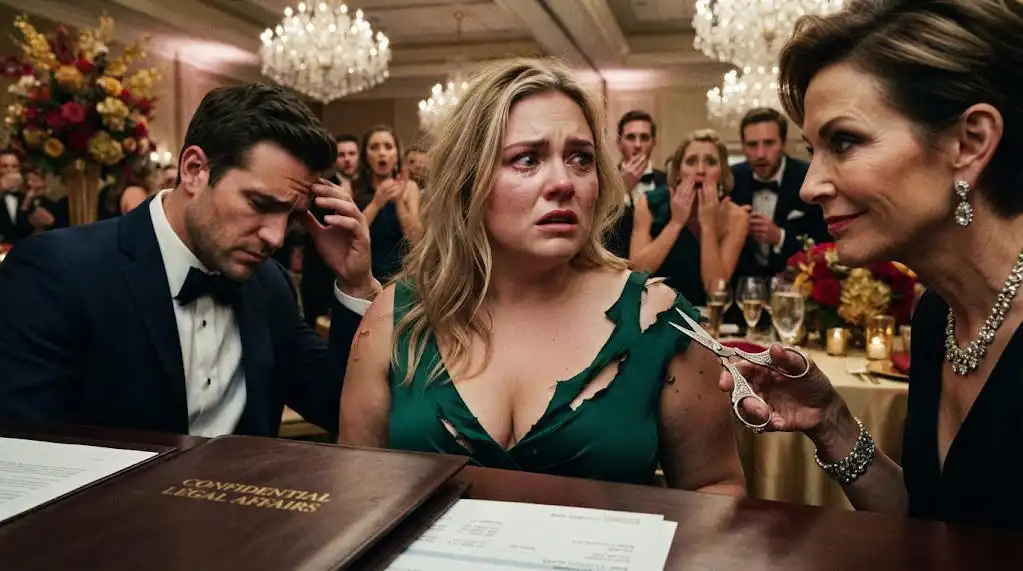
My Fiancé’s Mother CUT MY Custom Engagement Dress in Front of 200 Guests and Called Me an “Elephant in a Sack.” My Fiancé Just SMILED... 😱