


The quarter struck the floor first.
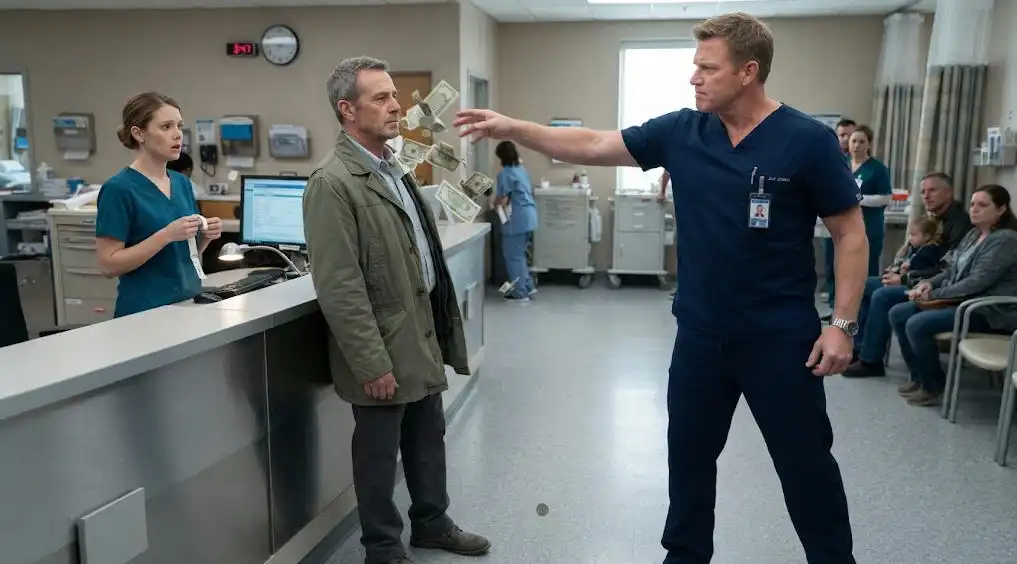
It bounced beneath the triage counter, spun in a tight circle, and finally settled beside Daniel Mercer's scuffed shoe. A second earlier, Dr. Grant Holloway had swept the eighteen dollars Daniel placed on the counter into the air and thrown the money directly at his face.
“Go wait to die in a slum.”
The words echoed through Lakefront Private Medical Center's emergency department in Chicago.
Daniel blinked as a folded bill slid down his coat. He was fifty years old, dressed in a faded olive jacket and worn trousers, with gray showing at his temples. To everyone watching, he looked like another uninsured man who had arrived at the wrong hospital with too little money.
Holloway, the hospital's chief of emergency medicine, stood behind the triage counter in immaculate navy scrubs. His silver watch gleamed under the fluorescent lights.
“The deposit is $2,500,” Holloway had told Daniel moments earlier. “Until it's paid, nobody touches your chart.”
Daniel had reported chest pressure and dizziness. He had asked for a medical screening examination. Holloway had not asked how long the symptoms had lasted, whether Daniel was struggling to breathe, or whether he had any history of heart problems.
He had asked about money.
Nurse Laura Hayes had tried to intervene.
“Doctor, he says he has chest pressure. We should at least—”
“Do you want to pay his bill?” Holloway had interrupted.
Laura's hand tightened around the unused triage wristband. She looked toward the waiting room, where several patients were watching, then lowered her eyes.
Daniel had counted out his eighteen dollars. Holloway had treated the amount as an insult.
Now the doctor pointed toward the exit.
“Get out of my department.”
Daniel didn't argue. He bent down, picked up the quarter, and closed it in his palm.
Holloway mistook the quiet movement for surrender.
He had no idea that the man in the worn coat was Daniel Mercer, director of the Illinois Department of Public Health.
And Daniel had not come to the hospital for treatment alone.
For six weeks, his department had been investigating complaints from patients who said Lakefront's emergency department demanded substantial deposits before examining people who lacked insurance or couldn't pay immediately. Several complaints described the same pattern: patients reported serious symptoms, staff members attempted to help, and Holloway intervened to stop the process.
Some patients eventually left. Others waited until someone else agreed to pay.
The department couldn't assume every allegation was true. A complaint was a starting point, not a verdict. Daniel wanted to know whether the alleged practice was still happening, and he wanted evidence of what staff actually did when an apparently poor patient arrived.
Then an unexpected source had come forward.
Nora Bennett, a former accounts-payable supervisor at Lakefront, had contacted investigators after noticing irregularities in the hospital's vendor payments. During her work, she had maintained a handwritten ledger recording payments and internal references that did not match the hospital's ordinary purchasing explanations.
Several entries carried the initials of senior hospital personnel.
Nora had provided the ledger to investigators under a signed statement explaining where it came from and how she had maintained it. Auditors compared its dates and amounts with independently obtained invoices and payment records. The matches were serious enough to prompt a criminal investigation into suspected kickbacks and related financial misconduct.
But the ledger raised another question.
Were the hospital's financial arrangements connected to its treatment of patients who couldn't pay?
The department had collected complaints, interviewed former employees, and reviewed available records. Investigators had assembled enough corroborating material for prosecutors to seek judicial authorization for the operation and the preservation of relevant records.
Daniel agreed to conduct an authorized undercover visit.
He wore ordinary clothes, carried only the small amount of cash specified in the inspection plan, and used a state-issued recording device concealed beneath his coat's lapel. The device had been approved for the operation. A state police team and government auditors waited outside, ready to act once Daniel confirmed what was happening inside.
The paper ledger was secured in an evidence sleeve inside his coat. The original financial records and supporting documentation were already part of the investigation.
Daniel had hoped the hospital might surprise him by doing the right thing.
Instead, Holloway had thrown eighteen dollars into his face.
Daniel straightened with the quarter still in his hand.
He didn't raise his voice. He didn't threaten the doctor. He simply reached inside his coat, withdrew his official credential, and turned it toward Holloway.
“You refused emergency care on camera.”
The doctor's expression changed.
For a moment, Holloway stared at the credential as if it were a prop in an elaborate joke. Then he looked at Daniel's face again, searching for some sign that the situation could still be controlled.
“This is a private facility,” he said.
Daniel held the credential steady.
“Private facilities still have obligations.”
Under federal emergency-care requirements, a covered hospital emergency department cannot make an upfront payment a condition of providing the required medical screening examination. Financial arrangements belong in the appropriate part of the process, not in place of an emergency assessment.
Holloway knew the rule. That was why his next response was so revealing.
“I followed hospital policy.”
“Then the policy will be part of the investigation.”
Holloway glanced toward Laura, apparently expecting her to support him. She said nothing.
Daniel turned toward the glass entrance.
“State police, come in.”
The automatic doors slid open.
Two state troopers entered first, followed by the audit team. The lead trooper approached the counter while another officer secured the entrance area. The auditors moved toward Daniel, carrying document folders and evidence-preservation materials.
For the first time that afternoon, Holloway stepped away from the counter.
“What is this?” he demanded. “You can't walk into my hospital and—”
“The officers have judicial authorization,” Daniel said. “The financial investigation was underway before I entered this building.”
The lead trooper identified himself and informed Holloway that he was being arrested under the existing warrant connected to the kickback investigation.
Holloway looked from the officer to Daniel.
“This is because I asked him to pay?”
“No,” Daniel replied. “It's because investigators have evidence of a financial scheme, and because what happened here is now documented. You will have the opportunity to answer the allegations through the proper process.”
The distinction mattered. The recording did not, by itself, prove every allegation in the financial investigation. The ledger did not, by itself, establish every instance of denied treatment. Together with independently corroborated financial records, witness accounts, and the evidence now being preserved, they formed a much larger picture.
Holloway tried one final defense.
“He never proved he couldn't pay. We have standards.”
Laura looked up.
“Doctor, he told you he had chest pressure.”
Holloway turned sharply toward her.
“Stay out of this.”
For the first time since Daniel had entered the hospital, Laura didn't lower her eyes.
“I tried to send him to triage. You stopped me.”
The trooper asked Laura to remain available for an interview. An auditor explained that the team would preserve the electronic triage records and examine whether similar encounters had been classified as billing holds rather than actual arrivals requiring assessment.
Laura nodded.
“I can show them the shift logs.”
That statement changed the investigation's immediate scope. The team now had a witness who could identify the records needed to test whether Holloway's behavior was isolated or part of a continuing practice.
Daniel reached across the counter.
He caught Holloway's plastic name badge and tore it from the clip on his chest. The small plastic fastener snapped. Daniel placed the badge on the counter beside the quarter.
Then he turned to the lead trooper.
“Execute the warrant.”
The officer directed Holloway to turn around and place his hands behind his back.
Holloway resisted verbally, insisting that the hospital's lawyers would have him released. But he eventually turned as instructed. The officers secured his hands and escorted him away from the triage desk.
The patients watched in silence.
Daniel didn't celebrate. The arrest was one step in an investigation, not the final judgment. A criminal case would require prosecutors to establish the allegations through the legal process.
The audit team began its work immediately.
First, they documented the scene and secured the recording device. The device's identification information and recording time were entered into the evidence log. The video showed Holloway receiving a request for emergency screening, demanding payment, throwing the money, and directing Daniel to leave.
The footage preserved the exact sequence of events, including the doctor's words and the nurse's attempted intervention.
Next, the auditors received the sealed ledger and recorded its transfer into their custody. They checked the relevant entries against financial records already obtained during the investigation. The dates, amounts, and vendor references corresponded with transactions that had raised concerns before Daniel ever entered the hospital.
The ledger was not treated as a magical document that proved everything. It was a source whose entries could be tested against other records.
The results strengthened the case.
Several payments appeared to have passed through vendors whose invoices did not adequately explain the amounts involved. Internal references connected those payments to senior hospital personnel, including Holloway. Other entries raised questions about the hospital's management and purchasing practices.
The auditors also preserved the triage logs Laura identified. Investigators would examine those records to determine how frequently patients who couldn't pay had been held back from screening and who had authorized the practice.
By late afternoon, the financial investigation and the documented refusal of emergency screening had converged into a clear enforcement action.
Holloway was taken into custody and booked. His arrest sent a shock through Lakefront's leadership.
The hospital's chief operating officer, Victor Hale, was named in the financial records. Investigators secured relevant records associated with his office, and the state placed him under administrative scrutiny while the inquiry continued. His involvement and any potential charges would be determined through the evidence and legal process, not through assumption.
Meanwhile, Daniel faced a problem that could not be solved by arresting one doctor.
The emergency department was still operating. Patients still needed care.
Closing the hospital would have punished the very people the investigation was meant to protect.
Daniel met with the hospital's remaining administrators and state inspectors. He issued an emergency compliance order requiring the hospital to provide appropriate emergency screening without demanding an upfront deposit and to establish an emergency-assistance pathway for patients who could not afford care.
Under the interim arrangement, patients would receive the required screening and stabilization before financial assistance was handled. Qualifying low-income patients could be directed to charity-care support and other available assistance without having to produce money at the entrance.
Independent state oversight would monitor compliance. The hospital would have to preserve its records, cooperate with the investigation, and demonstrate that its triage process was functioning properly.
A hospital administrator warned that the order would provoke legal challenges and damage Lakefront's reputation.
Daniel understood the stakes.
Lakefront employed hundreds of people. It served a large area of Chicago. Its leadership had influential connections, and the investigation threatened to expose failures extending beyond one emergency department.
By the end of the day, his phone was filling with calls from hospital executives, lawyers, and officials seeking explanations. Some warned that the operation would disrupt the private hospital network. Others questioned whether he had gone too far.
He knew that every decision would be scrutinized. If the evidence failed, he would have to answer for the operation. If the state moved too slowly, more patients could face the same barrier.
He signed the compliance order anyway.
The hospital opened a dedicated emergency-assistance desk beside triage. A new notice instructed patients that emergency screening would not be withheld because they couldn't pay upfront. Staff members were told to route financial questions to the assistance team rather than use them to delay the medical assessment.
Laura was assigned to help establish the revised intake process under independent supervision. She watched as the first patient who had been worried about the cost was directed to triage instead of being sent back to the billing counter.
The quarter Daniel had picked up lay beside Holloway's discarded badge, waiting to be documented with the other physical evidence from the incident.
It was an ordinary coin, worth very little.
But the scene it belonged to had helped expose a system in which the ability to pay had been allowed to overshadow the need for emergency care.
Daniel gave a brief statement to the press, confirming that the arrest and audit were proceeding through the appropriate authorities. He did not declare anyone guilty before trial. He said the state would release verified findings as the legal process allowed and that the hospital would remain under oversight until it demonstrated compliance.
The pressure did not disappear. The investigation would continue, the hospital's leadership would face difficult questions, and the political consequences of challenging a powerful private institution were only beginning.
Daniel accepted that responsibility as part of the job.
Near evening, he left Lakefront with the audit team and drove to the next facility on his inspection schedule. His coat was still the same faded olive green. His official credential rested inside its pocket, and the next hospital's inspection file was open on his lap.
At the next hospital, the glass entrance doors slid apart.
Daniel stepped inside, walked toward the reception desk, and began the next inspection.
Disclaimer: Mention of any brand or trademark is for identification only and does not imply partnership or endorsement
A Wealthy Manhattan Socialite Poured Red Wine on a Plus-Size Artist at a Charity Gala, Calling Her “Cheap and Unworthy.” She Had NO IDEA Who Would Discover Her Paintings... 😱

A Celebrity Trainer Threw CASH in a Plus-Size Nutritionist’s Face at a Luxury LA Gym, Saying She Couldn’t Even Control Her Own Weight. He Had NO IDEA What Her Clients Would Prove... 😱
My Fiancé’s Mother CUT MY Custom Engagement Dress in Front of 200 Guests and Called Me an “Elephant in a Sack.” My Fiancé Just SMILED... 😱