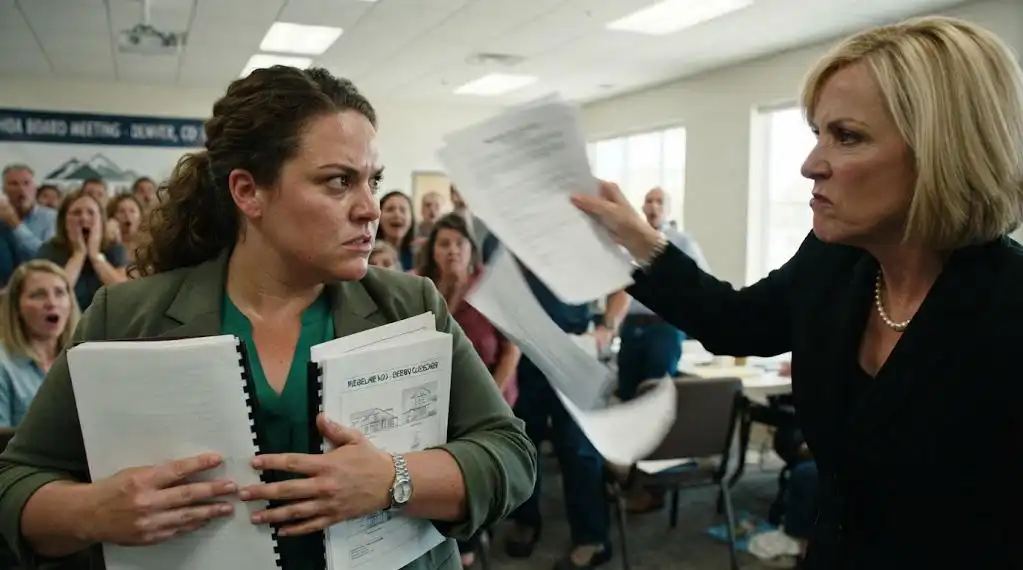



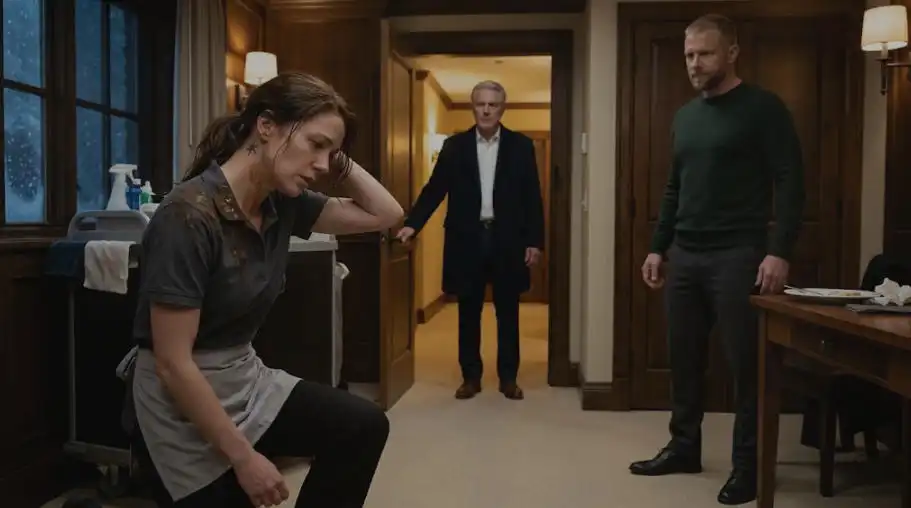
The Housekeeper, the Hidden Ledger, and the Killer Trapped in the Snow The man in Room 307 dumped an entire plate of beef stew over Mara Whitlock's head.
“Clean it up,” he said. “That's your job.”
Mara stood motionless beside her housekeeping cart. Thick brown gravy slid down her dark hair, soaked the collar of her charcoal uniform, and dripped onto the expensive cream-colored carpet.
The guest smiled.
What he didn't know was that Mara had recognized the black case beneath his desk.
And what neither of them realized was that a federal judge standing in the hallway had just caught a glimpse of the faded tattoo on the back of her neck.
For the first time in eleven months, Mara's carefully constructed hiding place was beginning to collapse.
And outside, a blizzard had buried the only road off the mountain.
At thirty-four, Mara had learned that survival depended on noticing things other people ignored.
An unfamiliar vehicle parked twice on the same street.
A stranger who remembered her name before she introduced herself.
A guest who asked where the staff slept instead of where breakfast was served.
She noticed everything.
It was how she had stayed alive since leaving her husband, Adrian Voss.
Eleven months earlier, Mara had been the senior accountant for a network of investment companies headquartered in Denver.
Her husband controlled the businesses.
On paper, they owned trucking companies, construction firms, and luxury properties.
In reality, those businesses concealed one of the largest criminal organizations operating across several western states.
Mara had helped maintain the books.
At first, Adrian told her the unusual transactions were aggressive tax arrangements. Then she discovered payments to corrupt officials, transfers connected to missing witnesses, and an account used to finance contract killings.
When she confronted him, Adrian locked the office door.
“You're my wife,” he told her. “You don't get to decide which secrets belong to you.”
Three weeks later, an employee who had threatened to contact federal investigators was found dead.
Mara stopped asking questions.
Instead, she started preparing to disappear.
Adrian insisted on keeping a microfilmed backup of the organization's financial records. He distrusted cloud storage and wanted a private record of every payment, including those he denied making.
Mara was responsible for updating that archive.
She knew which transactions were real, which companies existed only on paper, and whose signatures appeared on the original documents.
Before leaving, she took the most incriminating strip of microfilm.
It contained years of transactions, internal account references, payment authorizations, and the names behind dozens of shell companies.
She sealed the film inside a narrow waterproof sleeve and stitched it into the lining of her bra.
Then she abandoned her marriage, her career, and almost everything she owned.
She returned to her maiden name and eventually found work at Blackridge Summit Lodge, an isolated luxury hotel in the Colorado Rockies.
The building stood above the tree line, surrounded by pine forests and steep, snow-covered slopes.
Guests came for privacy.
Mara came because almost nobody asked questions.
For months, that had been enough.
Until the stranger checked into Room 307.
He registered as Daniel Pike.
Mid-forties. Close-cropped blond hair. Neatly trimmed beard. Forest-green cashmere sweater. Expensive luggage.
Nothing about him initially appeared unusual.
Except he requested a room near the service elevator.
Then he asked the front desk manager, Diane Calder, whether housekeeping employees stayed overnight during storms.
Diane mentioned the question to Mara.
“Probably doesn't want strangers wandering around while he's sleeping,” she said.
Mara didn't answer.
She had already noticed that Pike's black hard-sided suitcase was built like professional equipment luggage.
And during her first inspection of his room, she saw something else.
A small compass engraved on the inside of a gold ring.
One of its eight points was missing.
Her husband's organization had used that broken compass as an identifying mark.
Mara had a faded version tattooed beneath her hairline, near the left side of her neck.
Adrian had insisted she get it shortly after their wedding.
“Now you belong to the family,” he'd said.
She had spent years trying to forget those words.
By the following afternoon, the storm had intensified.
The mountain highway closed.
The regional phone lines failed.
The hotel's internet connection disappeared.
Diane gathered the staff and explained the emergency arrangements.
Eighteen guests and six employees were trapped inside.
The lodge had backup generators, emergency food supplies, and an avalanche-rated refuge built into the lower level.
“We've handled worse,” Diane assured everyone.
Mara wanted to believe her.
Then Room 307 called housekeeping.
The guest claimed that his dinner had been delivered cold and spilled across the furniture.
He demanded immediate cleaning.
Mara could have sent another employee.
But she knew running would tell him she was afraid.
She took her cart upstairs.
Pike opened the door before she knocked.
“About time.”
The room was almost spotless.
An untouched plate of beef stew sat on the desk.
Mara glanced at it.
“I was told there'd been a spill.”
“There will be.”
Before she could retreat, he lifted the plate and tipped its contents over her head.
Warm food struck her hair and shoulders.
Her breath caught.
Pike laughed quietly.
“Go ahead. Lose your temper.”
Mara gripped the handle of her cart.
She understood the trap.
He wanted her angry. He wanted her to reveal something, strike him, or give him an excuse to isolate her from the other employees.
She forced her hands to relax.
“I'll call the manager,” she said.
Pike moved closer.
“You won't be calling anybody.”
Mara turned toward the open doorway.
As she wiped food from the back of her neck, her hair shifted.
The broken-compass tattoo became visible.
A man walking past the room stopped.
He was in his early sixties, with neatly combed silver hair and a navy wool coat.
He had been on his way to the front desk.
His name was Nathaniel Rowan.
He was a United States district judge.
Six years earlier, Rowan had presided over a federal racketeering case involving an organization known informally among investigators as the Compass Syndicate.
One sealed exhibit had shown the same broken-compass tattoo on the body of a murdered financial courier.
The photograph had stayed with him.
Now the mark was on the neck of a terrified hotel housekeeper.
And the man standing over her had just humiliated her for no apparent reason.
Rowan paused only a second.
Then he continued down the hallway.
Pike watched him leave.
For the first time, his smile disappeared.
Mara escaped into a housekeeping supply room.
She locked the door.
Only then did she allow herself to shake.
Her hands smelled of gravy.
Her uniform was stained.
Her old tattoo burned with the memory of everything she had fled.
She took a clean towel from a shelf and pressed it against her face.
Then someone knocked.
Three quiet taps.
“Ms. Whitlock? My name is Nathaniel Rowan. I'm staying in Room 309.”
Mara stayed silent.
“I saw what happened,” he continued. “You don't have to speak to me. But I believe that man is dangerous.”
Her pulse accelerated.
“How would you know?”
There was a pause.
“Because I've seen that tattoo before.”
Mara's knees nearly buckled.
She opened the door a few inches.
Rowan stood alone.
He held his identification where she could see it, then gave her enough time to examine it.
“I'm a federal judge,” he said. “I handled a case involving that symbol.”
Mara stared at him.
“Then you know what happens to people who talk.”
“I know what happened to one person who tried.”
She nearly slammed the door.
But Rowan didn't reach toward her.
Instead, he said, “You get to decide whether we keep talking.”
Something about those words stopped her.
For years, every man who knew her secret had demanded obedience.
This one had offered a choice.
Mara opened the door.
She told him only part of the truth at first.
Her husband had controlled a criminal financial network.
She had worked inside it.
She had fled with records that could prove the organization's activities.
And the guest in Room 307 was not Daniel Pike.
“I think his name is Silas Kade,” she said.
She had seen his photograph attached to an internal security payment years earlier.
Kade had worked as an enforcer for the organization.
Rowan listened without interruption.
“Where are the records?”
“Somewhere he hasn't found.”
“Do you still have them?”
Mara nodded.
“Then preserving them matters. But keeping everyone alive matters more.”
She told him about the suitcase.
During the confrontation, its lid had been partially open beneath the desk.
Inside, fitted into black foam beside a handgun, was a long cylindrical firearm attachment.
Mara recognized it as a suppressor.
Rowan's expression tightened.
He had a satellite telephone in his travel bag.
Federal court security officers had issued it after threats connected to one of his previous cases.
He retrieved it and stepped onto a sheltered exterior balcony, where the open sky offered the best chance of reaching a satellite.
For several seconds, he heard a connection.
“This is Judge Nathaniel Rowan. I need the U.S. Marshals. Blackridge Summit Lodge, Colorado. There's a credible threat to—”
The signal broke.
He tried again.
Nothing.
Wind-driven snow had buried part of the balcony, and the signal could not be reestablished from the protected doorway.
When Rowan returned inside, he could not confirm whether anyone had received enough of the message to locate them.
But he had one piece of information Mara hadn't known.
The tattoo wasn't merely a gang symbol.
It had appeared in financial records and testimony connected to multiple federal investigations.
Her husband's operation was much larger than she had understood.
And if she was telling the truth about the microfilm, those investigations might finally be connected.
At 6:40 p.m., the lodge lost its main electrical supply.
The backup generators came online.
Emergency lights illuminated the hallways.
Diane began checking rooms.
Mara noticed that the service elevator was standing open on the lower floor.
Someone had used it without requesting staff assistance.
Then she found the mechanical-room access door unlatched.
A brass key normally kept in the maintenance office was missing.
She remembered Pike asking about the hotel's overnight staffing.
She remembered his room near the service elevator.
And suddenly, the questions formed a pattern.
He wasn't simply looking for an opportunity to kill her.
He was studying the building.
Mara went to the basement corridor.
At the far end, beyond the laundry room, she heard a metallic sound behind the mechanical-room door.
She stayed out of sight.
Through a narrow gap, she saw Pike placing a small equipment case beside the service machinery.
He opened it.
Inside was an unfamiliar device attached to bundled components.
Mara could not identify its mechanism.
But she recognized the manufacturer label on the case.
She had processed payments for specialized equipment under that supplier's name while working for Adrian.
The invoices had been disguised as industrial maintenance expenses.
Now she understood their real purpose.
Pike wasn't planning to make one woman's death look accidental.
He intended to destroy the hotel and everyone who might have witnessed his presence.
The blizzard would delay rescue.
Damaged infrastructure could conceal evidence.
And a catastrophic building failure could be blamed on the storm.
Mara backed away.
Her shoe touched an empty metal bucket.
It rolled across the floor.
The noise echoed.
Behind the mechanical-room door, the metallic sounds stopped.
Then Pike called softly.
“Mara?”
She ran.
Diane listened to Mara's warning with growing alarm.
“Are you telling me someone brought explosives into my hotel?”
“I'm telling you nobody goes into that mechanical room. Get everyone to the avalanche refuge.”
Diane looked toward Rowan.
He gave a short nod.
“Treat this as an immediate threat. Don't touch anything down there. We need everybody away from that part of the building.”
Diane activated the hotel's emergency shelter procedure.
Staff members began guiding guests down the protected west stairwell.
The reinforced refuge was separated from the mechanical plant by concrete walls and heavy fire doors.
It had independent ventilation, water, emergency lighting, and a battery-operated radio.
Mara helped an elderly couple descend the stairs.
Then she stopped outside the refuge entrance.
A teenage kitchen employee was missing.
Diane checked the staff roster.
“Cora went back for her coat.”
Mara looked toward the kitchen passage.
“I'll get her.”
Rowan caught her arm gently.
“Your husband sent a professional killer here. You don't need to prove you're brave.”
“I'm not proving anything.”
She pulled away.
“I'm making sure he doesn't take someone else with him.”
She found Cora near the kitchen lockers and sent her down the west stairwell.
Then Mara heard Pike's footsteps approaching from the service corridor.
He had discovered the evacuation.
And he was furious.
Mara ducked into a linen storage room and locked the door.
Through the narrow window, she watched Pike pass.
His coat hung open.
A pistol was visible in his hand.
He moved toward the emergency refuge.
Mara's first instinct was to hide.
Then she realized that if Pike reached the shelter entrance, the people inside would have nowhere else to go.
She couldn't let him reach them.
But before confronting him, she had another choice to make.
She returned to Rowan, who was waiting at the refuge's outer security door.
In the privacy of a small staff restroom, Mara removed the waterproof film sleeve from the stitched lining of her bra.
She returned holding the tiny package.
It weighed almost nothing.
Eleven months of fear rested inside it.
“Adrian kept every transaction,” she whispered. “Even the payments he ordered people to hide.”
Rowan examined the sealed sleeve without opening it.
He obtained a clean property envelope from the hotel office.
Mara placed the sleeve inside, wrote down where it had been kept, and signed and dated the envelope flap.
Rowan recorded the time and signed as the receiving witness.
They agreed that neither would open the package.
Investigators would need to preserve and authenticate it properly.
“You know this doesn't automatically make you innocent,” Rowan said.
“I know.”
“You may have to answer for records you signed.”
Mara looked down at her stained uniform.
“I've been answering to the wrong people for years.”
She closed his hand around the envelope.
“Make sure the right people see it.”
Then she turned back toward the service corridor.
Pike reached the stairwell junction just as Mara stepped into view.
He raised his pistol.
“Where is it?”
Mara knew exactly what he meant.
“The ledger?”
“Don't play games.”
“Then leave the people downstairs alone.”
Pike gave a humorless laugh.
“They're already part of this.”
From behind a fire door, Rowan appeared.
“Put the gun down.”
Pike swung toward him.
Rowan held both hands in view.
“I'm Judge Nathaniel Rowan. I contacted federal authorities about this location.”
It was a dangerous bluff.
Rowan had no confirmation that his earlier message had been received.
But Pike hesitated.
The hesitation gave Mara the second she needed.
She seized the emergency door handle and pulled the heavy fire door shut between the killer and the refuge stairwell.
The door's automatic latch engaged.
Pike lunged for it.
Too late.
He slammed his palm against the metal.
The protected route was blocked.
The guests were temporarily beyond his reach.
Now only Mara stood on his side of the corridor.
Pike slowly turned.
“You should have run when you had the chance.”
Mara backed toward the kitchen.
“I have the ledger,” she lied.
Pike's eyes narrowed.
“Show me.”
“You want the ledger? Come get it.”
She turned and ran.
Mara knew the hotel better than he did.
She knew which service passages doubled back.
Which doors opened into storage rooms.
Which corridors ended at loading docks buried beneath six feet of snow.
And she knew about the old ice cellar beyond the kitchen.
The cellar had been built decades earlier to store ice for the hotel's original dining operation.
A modern refrigeration system kept the room well below freezing, although it was no longer used for regular food storage.
Its thick insulated steel door still had an old exterior storm bar.
Diane had complained about it during a maintenance inspection.
The hardware was obsolete and the room was kept out of routine service because the old locking arrangement was unsafe.
Mara had remembered that detail.
She had also memorized the narrow service passage that curved around the cellar's outer wall.
Now it was the only advantage she had left.
Pike pursued her past the kitchen counters.
His footsteps struck the tile.
Mara reached the cellar entrance.
The steel door stood open.
Cold air rolled across the floor.
She looked back.
Pike was only a few steps away.
“It's inside,” she said.
He pointed his gun toward her chest.
“Then get it.”
Mara stepped through the doorway.
Pike followed.
Inside, towering metal shelving racks cast long shadows across the frost-covered floor.
Mara ducked behind one of the racks.
Pike fired.
The shot struck the metal framework above her.
She dropped low, crawled through the space beneath the shelving, and slipped toward the narrow side service passage.
Pike rushed forward, expecting to find her trapped at the rear wall.
Instead, he saw an empty aisle.
Then he heard something behind him.
A door moving.
Mara had reached the exterior side of the entrance.
She threw her weight against the insulated steel door.
Pike spun around.
He sprinted toward it.
His shoulder struck the inner surface just as the door slammed shut.
Mara dropped the old storm bar into place.
The door shuddered.
A heavy impact shook the frame.
Then another.
Pike shouted from inside.
“Mara! Open it!”
She backed away, breathing hard.
He struck the door again.
The reinforced steel did not give.
His voice rose.
“You'll die here too!”
Mara pressed one hand against the cold wall.
For a moment, she remembered Adrian standing over her in his office, telling her she belonged to him.
She looked at the locked door.
“No,” she said quietly. “I don't.”
Rowan found her near the kitchen entrance.
She was sitting on the floor, exhausted.
Her hands trembled uncontrollably.
“Is he inside?”
Mara nodded.
“He has a gun. Don't open it.”
Rowan immediately warned Diane over the hotel's internal emergency radio.
They kept the cellar isolated.
No employee approached it.
In the refuge, Diane made contact with a ski-patrol emergency team through the battery-powered mountain radio.
The connection was weak, but the team received the lodge's location and the warning about a suspected explosive device.
The guests remained sheltered.
The mechanical room was left untouched.
For the next hour, Mara sat with Rowan outside the secured kitchen passage.
Occasionally, Pike shouted from the cellar.
Then the shouting stopped.
Mara stared at the door.
“Is he dead?”
Rowan shook his head.
“We don't know. And we're not opening that door without responders here.”
Seventy-eight minutes after the emergency call, a tracked rescue vehicle reached the lodge from a lower mountain station.
Two state troopers and emergency medical personnel entered the building.
Additional specialists followed when weather permitted.
The troopers approached the cellar with protective equipment and secured the entrance before opening it.
Silas Kade was found collapsed against the inner wall.
He was barely conscious, severely chilled, and unable to stand without assistance.
His pistol lay nearby.
He was treated for hypothermia and placed under arrest.
Later, investigators discovered the explosive device in the mechanical room.
Specialists determined that the components had not been fully activated.
The equipment was secured without an explosion.
All eighteen guests and six employees survived.
Mara watched through a window as officers carried Kade toward the waiting rescue vehicle.
His hands were restrained.
His expensive forest-green sweater was stiff with frost.
For months, she had imagined dying alone in the snow.
Instead, the man sent to kill her was the one being taken down the mountain.
The federal investigation that followed lasted nearly two years.
Mara's microfilm was examined by forensic document specialists.
Investigators compared its records with bank transactions, archived corporate filings, communications recovered through warrants, and testimony from financial employees.
The records matched.
More importantly, they connected activities that investigators had previously treated as separate cases.
Payments to corrupt officials.
Shell-company transfers.
False construction contracts.
And money sent to individuals associated with threats against witnesses.
The evidence did not stand on Mara's word alone.
Her records led investigators to independent documents and witnesses.
Within several weeks, coordinated federal operations resulted in arrests across multiple states.
Properties were seized through court proceedings.
Financial accounts were restrained.
Executives began cooperating with prosecutors.
Adrian Voss was arrested at his Denver residence.
He initially claimed Mara had stolen company information to retaliate against him after their divorce.
But the original banking records supported the microfilm.
Several former associates testified against him.
And the payments involving Silas Kade linked the hotel incident to the wider organization.
Mara testified for three days.
She explained the accounting system, identified the false entries, and admitted which documents she had personally prepared.
She also acknowledged that she had helped conceal illegal transactions before deciding to flee.
Her cooperation did not erase her responsibility.
She entered a negotiated guilty plea involving her own financial misconduct.
The sentencing court considered her cooperation, the evidence of coercion, and the danger she had faced. She received a probationary sentence.
Adrian was convicted of racketeering conspiracy and several financial offenses. He received a lengthy federal prison sentence.
Kade was separately convicted for his role in the hotel attack and related offenses.
Other prosecutions and forfeiture proceedings dismantled the organization's major operations.
Judge Rowan did not preside over any of those proceedings.
Because he had witnessed events at Blackridge Summit Lodge, he provided a statement to investigators and stepped aside from any matter in which his involvement could create a conflict.
Before Mara entered federal witness protection, Rowan visited her once.
They met in a secure office.
He brought no documents.
No legal advice.
Only a paperback novel.
“Something to read when things get quiet,” he said.
Mara looked at the cover.
“Does it have a happy ending?”
Rowan smiled faintly.
“It has an ending where the main character gets to decide what happens next.”
She took the book.
For once, she didn't ask whether she could trust someone.
She simply said, “Thank you.”
Eighteen months later, a woman sat beside the window of a small café in a sunlit American town.
Her dark brown hair was cut just above her shoulders.
A paperback lay open beside a half-finished cup of coffee.
Outside, children rode bicycles past flower boxes.
There were no mountain storms.
No locked hotel rooms.
No strangers watching the entrances.
Following a formal security assessment and her cooperation with prosecutors, Mara had entered the federal Witness Security Program.
Her new identity came with strict rules.
She could not contact people from her former life without authorization.
She could not return to places where Adrian's associates might recognize her.
She had to begin again.
It was not a magical escape from everything she had done or endured.
Some nights, she still woke from dreams of the ice cellar.
Sometimes she instinctively checked the café's rear exit.
But the fear no longer dictated every minute of her day.
When the waitress approached, Mara ordered another coffee.
“Anything else?”
Mara glanced at the open novel.
“No, thanks. I'm good.”
A warm breeze moved through the doorway as another customer entered.
Mara didn't turn around to see who it was.
She reached for her coffee, turned the page, and kept reading.
For the first time in years, the next chapter belonged to her.
Disclaimer: Mention of any brand or trademark is for identification only and does not imply partnership or endorsement
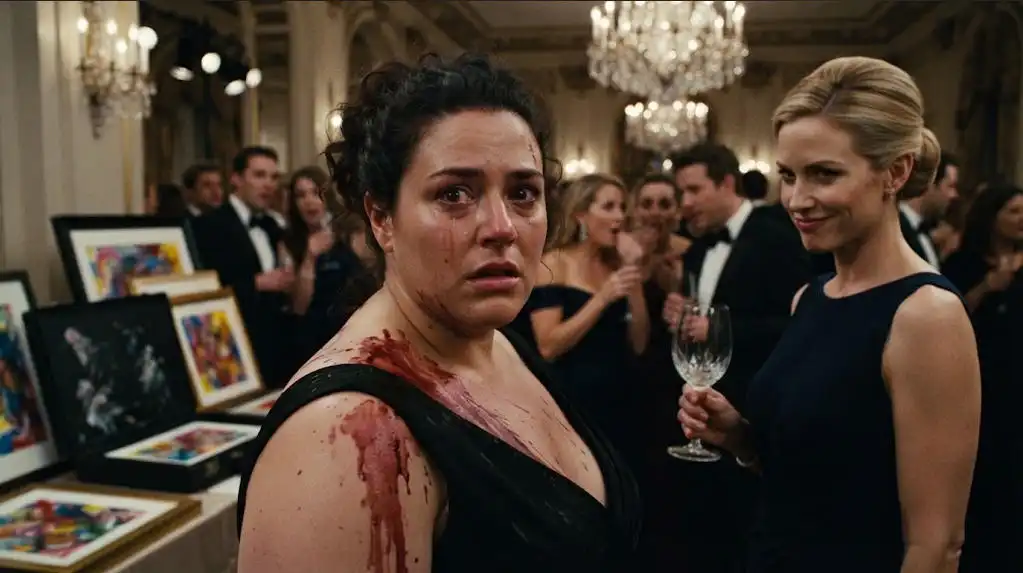
A Wealthy Manhattan Socialite Poured Red Wine on a Plus-Size Artist at a Charity Gala, Calling Her “Cheap and Unworthy.” She Had NO IDEA Who Would Discover Her Paintings... 😱
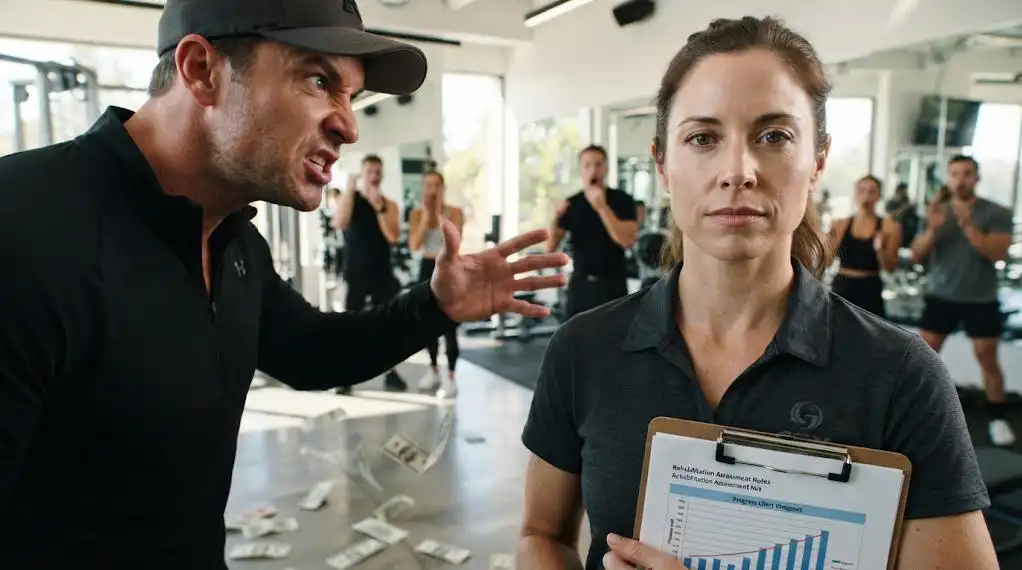
A Celebrity Trainer Threw CASH in a Plus-Size Nutritionist’s Face at a Luxury LA Gym, Saying She Couldn’t Even Control Her Own Weight. He Had NO IDEA What Her Clients Would Prove... 😱
My Fiancé’s Mother CUT MY Custom Engagement Dress in Front of 200 Guests and Called Me an “Elephant in a Sack.” My Fiancé Just SMILED... 😱