


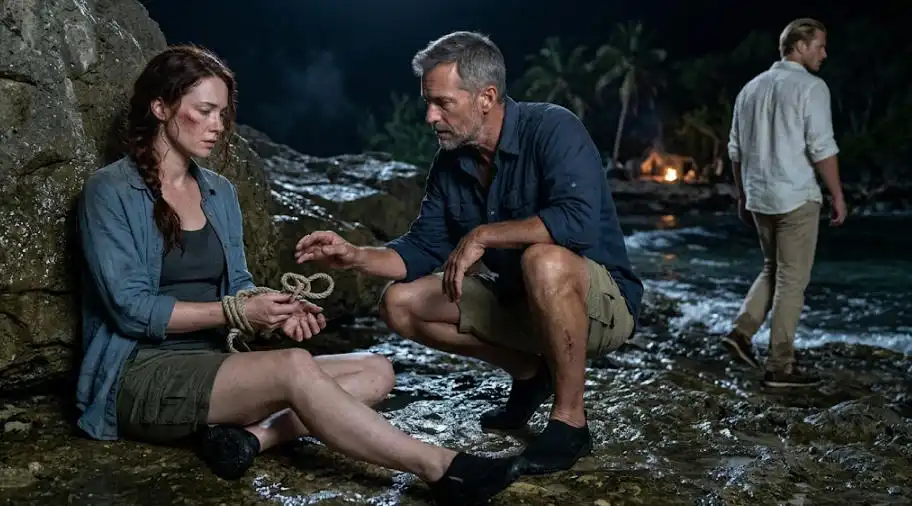
The Island He Thought He Owned Dane Whitmore dumped a bowl of cold rice and fish over Mara Vale's head, then kicked her canteen across the sand.
"Nobody eats or drinks here unless I say so."
Mara staggered backward, one hand pressed against her bruised ribs. Rice slid down her tangled auburn hair and onto her faded blue shirt.
Three men laughed behind him.
Forty-eight hours earlier, Mara had been dancing aboard a luxury cruise ship.
Now she was stranded on an uninhabited Caribbean island, surrounded by men who controlled the food, the medicine, and every remaining emergency supply.
And the man standing over her had just decided she wasn't going to survive.
What Dane didn't know was that the woman he considered the weakest person on the island had been taught to survive by one of the most respected wilderness instructors in America.
And somewhere beneath the water, evidence of an entirely different crime was waiting to be found.
At thirty-three, Mara Vale had spent most of her adult life trying to escape her childhood.
Her father, Elias Keene, had once operated a respected wilderness survival school in Wyoming.
Former soldiers, firefighters, and rescue instructors traveled there to learn from him.
He believed civilization was something people borrowed.
"Take away the power, the roads, and the grocery stores," he used to tell Mara, "and you'll find out what you actually know."
Mara hated that lesson.
When she was fourteen, a deadly winter expedition accident destroyed her family.
Her mother died during the emergency. Investigations, lawsuits, and mounting debts eventually forced her father to close the school.
For months, their family lived in an unheated cabin while Elias took seasonal rescue jobs to pay the bills.
Mara remembered the hunger more clearly than the snow.
She remembered watching her father divide the last can of beans into two bowls, then pretending he had already eaten.
By eighteen, she had left Wyoming.
She took her mother's maiden name, Vale, and worked wherever dancing could pay the rent.
Eventually, she found a position performing aboard the Northstar, an upscale expedition cruise ship traveling through the Bahamas.
Her father died seven months before the voyage.
She carried one thing from him: a folded, water-resistant page torn from his old survival notebook.
At the bottom, in his familiar handwriting, were seven words.
Never surrender the part of you that knows.
The explosion struck the Northstar shortly after midnight.
Mara had just finished her final performance when a violent concussion shook the lower decks.
Lights failed.
Passengers screamed.
A service corridor filled with smoke.
The ship listed toward a shallow reef as crew members struggled to launch the lifeboats.
Mara remembered one detail that had seemed strange even before the disaster.
Minutes before the explosion, she had seen Dane Whitmore leaving a restricted lower-deck passage.
He carried a small black waterproof case.
When a crew member challenged him, Dane snapped, "I left something in my cabin."
But his cabin was three decks above.
Mara barely had time to wonder about it.
Then the ship shuddered beneath her feet.
She helped an elderly passenger named June Mercer into a lifeboat before climbing aboard herself.
Dane was already inside.
His two private security guards and several of his wealthy friends occupied most of the seats.
When the damaged lifeboat finally reached a deserted island several hours later, eleven exhausted survivors stumbled onto the beach.
The Northstar remained partially submerged against the distant reef.
Some passengers had escaped in other boats. No one on the island knew whether those people had been rescued.
Dane immediately took control.
His family owned a controlling interest in the company behind the Northstar, and he spoke as though that made him captain of everything left afloat.
His guards carried the emergency food, water containers, blankets, medical kit, and signal equipment into a sheltered cove.
Dane stationed them at the entrance.
"We ration this properly," he announced. "Nobody touches anything without permission."
At first, Mara thought he was being practical.
Then June asked for an extra cup of water.
Dane refused.
"She's had her share."
"She's seventy-two," Mara protested.
"Then she should know how to follow rules."
A lean, gray-haired man standing near the palm trees looked up.
He was in his early fifties, with a weathered face, a short beard, and a noticeable limp.
His name was Grant Holloway.
He had said almost nothing since the sinking.
Now he stepped forward.
"Your supplies belong to the survivors," he said quietly. "Not your family."
Dane smirked.
"You want to run the camp, old man?"
"No. I want everyone to live."
Dane's guards moved closer.
Grant studied them for a moment, then walked away without another word.
Mara initially mistook his silence for surrender.
She would later discover that Grant had spent much of his life surviving places far more dangerous than this island.
By the second afternoon, the rationing had become punishment.
Dane's friends received generous portions.
The others got whatever remained.
When Mara challenged him, Dane had her expelled from the cove.
"No blanket. No food. No water," he ordered.
One guard tossed her faded blue overshirt onto the sand.
"Good luck out there."
Mara walked inland wearing olive cargo shorts and a charcoal sleeveless top beneath the shirt she had recovered.
She still had a pair of black rubber water shoes from the lifeboat.
Everything else was gone.
The memory of her childhood returned with terrible clarity.
The empty cupboards.
The cold cabin.
Her father telling her he wasn't hungry.
For a moment, she almost went back and begged Dane for a ration.
Instead, she unfolded her father's notebook page.
A small sketch showed a limestone formation, with an arrow pointing beneath the shaded side of a ridge.
Follow the green. Check below the rock, not above it.
Mara remembered his voice.
"Water travels even when people can't see it."
She followed a line of unusually healthy vegetation into the island's interior.
Behind a limestone ledge, she found a slow freshwater seep.
It wasn't much.
But it was clean enough to collect and treat, and it flowed steadily into a shallow stone basin.
Mara sat down and cried.
Not because she had found water.
Because, for the first time in nineteen years, she wished she could tell her father he had been right.
She filled her canteen, treated what she collected using an old survival method her father had taught her, and carried a portion back toward the beach.
June needed it.
And Mara refused to let an old woman suffer just because Dane enjoyed watching people beg.
Dane caught her at the edge of camp.
"Where'd you get that?"
"There's freshwater inland."
"Show me."
"Everyone can use it. But you don't get to own it."
His expression hardened.
"Everything on this island goes through me."
He grabbed the canteen.
Mara held on.
One of his guards shoved her against a palm trunk.
Dane struck her across the face and knocked her to the sand.
When she tried to stand, another blow caught her in the ribs.
June screamed for him to stop.
Dane picked up a bowl of cold rice and fish from the camp table.
"Maybe this will teach you some manners."
He emptied it over Mara's head.
Then he kicked her canteen away.
Mara's fingers closed around a short length of rope lying beside the supplies.
Dane reached down to drag her upright.
In one practiced movement, she caught his wrist and worked the rope into a tight, unusual loop.
His arm stopped abruptly.
He gasped and dropped to one knee.
"What the hell did you do?"
Mara kept the rope controlled without tightening it further.
"You can steal the water. You can't steal what I know."
For the first time, Dane looked frightened.
One of his guards moved forward, but Mara released the loop before anyone could make the confrontation worse.
Dane stumbled backward, clutching his wrist.
His friends had stopped laughing.
And he would not forgive her for making him look helpless in front of them.
That night, Dane returned with two guards.
Grant had gone inland to survey higher ground and search for a place to signal aircraft.
Mara was gathering shellfish near the rocky shoreline when the men surrounded her.
Dane pointed toward an isolated cluster of tidal rocks.
"Tie her there."
One guard hesitated.
"The water comes all the way up at night."
Dane didn't blink.
"Then she'd better learn to swim."
Mara fought, but she was exhausted and outnumbered.
They forced her against a large rock and secured her wrists with a length of lifeboat rope.
Dane tightened the restraint.
"Nobody will hear you out here."
When they turned toward camp, Mara forced herself to breathe slowly.
Her father's notebook was still folded inside her shirt.
She looked down at the rope.
Her hands were restrained, but her fingers could still reach part of the line.
She began forming a small reversal in the loose section.
Three short movements.
One long turn.
A concealed finishing loop.
Her father had called the technique a deadman's knot.
He had learned its older military form during survival training, then altered the finishing loop into his own distinctive emergency-release variation.
"This isn't for winning fights," he had told her. "It's for keeping your options when somebody thinks they've taken them all."
Mara had practiced it hundreds of times as a child.
She had never imagined using it with the tide rising around her feet.
The rope shifted.
Not enough to free her.
Enough to give her hope.
Then a voice came from the darkness.
"Who taught you that knot?"
Mara froze.
Grant Holloway stood several feet away, half-hidden by the rocks.
His eyes weren't on her face.
They were fixed on the unusual finishing loop.
"My father," she whispered.
Grant stepped closer.
"What's his name?"
"Elias Keene."
Something changed in the older man's expression.
He took a careful breath.
"Elias Keene was my instructor."
Mara stared at him.
Grant crouched beside the rope.
"Your father taught me that finishing loop twenty-six years ago. He said he'd only ever taught it to one other person."
Mara swallowed.
"Me."
Grant looked at her as though he had found someone he had spent decades searching for.
"You're his daughter."
A wave struck the base of the rock.
Grant immediately returned his attention to the restraint.
"All right, Mara. We're getting you out."
He worked with the slack she had created, freed her wrists, and supported her as she stepped away from the rising water.
His left leg buckled slightly.
Mara caught his arm.
In the moonlight, she noticed an old circular scar above his left calf.
"Your leg."
"Old gunshot injury."
He gave her a faint smile.
"Your dad helped me through the recovery. He wouldn't let me quit."
They sheltered in a narrow cave above the high-tide line.
Grant gave Mara a small portion of food he had collected inland and a cup of treated water.
Then he told her about Elias.
Grant had served in special operations before becoming a military survival instructor.
Early in his career, a serious injury had nearly ended his service.
Elias Keene had been brought in to assist with a remote recovery exercise.
Instead of treating Grant like a ruined soldier, Elias taught him how to move through rough terrain with limited strength.
"He didn't teach me how to be fearless," Grant said. "He taught me how to work while I was afraid."
Mara looked at the water in her cup.
"He couldn't save my mother."
"I know."
"After that, he lost everything."
"Not everything."
Grant nodded toward the folded page in her shirt.
"He kept teaching. He spent his last years rebuilding the little piece of ground he could still call his own."
Mara had never known that.
She had ignored the estate attorney's letters after her father's death, assuming they contained another list of debts.
Grant continued, "He used to tell me about his daughter. Said she was the fastest student he'd ever had with rope."
Mara laughed once, painfully.
"I became a dancer."
"He would have been proud you kept going."
For the first time since the shipwreck, Mara didn't feel entirely alone.
Then Grant showed her something he had discovered while surveying the camp.
He pulled a damaged orange emergency locator beacon from his bag.
The beacon's activation housing had been deliberately broken.
There were fresh tool marks along the casing.
"It didn't break when the boat hit the beach," Grant said.
"How do you know?"
"The damaged part was protected inside its mounting bracket. Someone opened that bracket and struck the housing afterward."
Mara remembered seeing Dane handling the equipment on their first morning.
She also remembered the black case near the ship's restricted service corridor.
"Grant, I think there's something wrong with the explosion."
He looked at her.
"Tell me exactly what you saw."
They spent the following morning reconstructing the disaster.
Mara described the restricted corridor, the black case, and Dane's explanation about his cabin.
Grant recorded her account in his waterproof field notebook.
He also recorded the beacon's identification number, the location of the damage, and the names of witnesses who had seen Dane handling it.
When June quietly joined them later, she supplied another detail.
She had heard Dane arguing with one of his friends on the first day.
"He said the search teams weren't supposed to find us this soon," June recalled.
At the time, she thought he was complaining about rescue delays.
Now the sentence sounded very different.
But they still lacked proof of what had happened aboard the Northstar.
The following afternoon, Mara found their next clue.
She was collecting shellfish on the rocky shore when she noticed a dark metallic fragment lodged beneath a broken section of coral.
It had been washed into shallow water from the wreck's direction.
A small stamped number remained visible beneath the scorching.
Mara stared toward the distant ship.
At low tide, part of the vessel's damaged lower-deck structure was visible near the reef.
She remembered the black case.
And she made a decision Grant would later call the bravest and most reckless thing she had done on the island.
She went back into the water.
Grant refused to let her approach the wreck alone.
They waited for the calmer part of the tide and moved along the shallow reef, keeping within sight of the beach.
Mara used a length of rope to remain connected to Grant.
The damaged Northstar lay tilted across the coral.
Broken fixtures moved beneath the surface.
Mara's chest tightened.
The sound of the explosion returned in her memory.
She remembered the passengers running, the lights going out, and the awful sensation of the floor shifting beneath her feet.
For several seconds, she couldn't move.
Grant watched her from the shallows.
"We can leave," he said.
Mara shook her head.
"Dane tried to leave me for the tide. If he did something to that ship, he doesn't get to walk away from it."
She entered the water again.
Near a damaged lower-deck opening, she spotted another scorched piece caught beneath a bent metal panel.
It resembled the fragment she had found on shore.
She retrieved it without entering the unstable hull.
Back on land, Grant examined the pieces.
They appeared to belong to the casing of an electronic initiation device, not ordinary passenger equipment.
One fragment carried part of a manufacturer code.
Another had a distinctive damaged connector.
Mara wrapped both pieces separately using clean material from Grant's small field kit.
They placed the packages in a waterproof bag.
Grant wrote down the recovery times, locations, and identifying marks. Both signed the entries.
"We can't prove who used this yet," he cautioned.
Mara looked across the beach.
"But somebody brought it aboard."
"And somebody may have wanted that explosion."
That night, they returned to the ruined beacon.
Mara recognized the shape of a damaged mark beside its mounting bracket.
Dane had used a bright orange-handled utility tool around the lifeboat supplies.
She remembered him folding it shut immediately after handling the beacon.
Grant carefully recorded the observation, but refused to call it conclusive.
"Memory helps us know where to look," he said. "It doesn't replace evidence."
Mara understood.
Her father had taught her much the same thing about wilderness tracks.
One footprint could mislead you.
A pattern was harder to explain away.
On the fourth morning, the sound of a helicopter rolled over the island.
Mara ran to the ridge.
A rescue aircraft was sweeping along the coastline.
Survivors from another lifeboat had reached an inhabited island, allowing regional search teams to narrow the area where the missing passengers might have drifted.
Grant and Mara had already spread an orange lifeboat canopy across an open stretch of beach.
Together, they raised a reflective signal toward the aircraft.
The helicopter banked.
Then turned back.
Mara nearly collapsed with relief.
They had been seen.
But Dane reached the landing area first.
He had gathered his belongings and ordered his guards to clear a path.
When the rescue crew approached, he introduced himself as the owner representative of the Northstar.
"I'm in charge of these people," he announced.
The crew chief ignored his claim.
"We're checking everyone. Injured passengers first."
Dane tried to step forward anyway.
"Do you have any idea who my father is?"
Mara came down from the ridge carrying the waterproof evidence bag.
Grant walked beside her, his injured leg slowing his pace.
June followed.
Dane saw them and stopped.
For one second, his face revealed genuine confusion.
He had expected Mara to die on those rocks.
"You're supposed to be dead," he muttered.
Mara stopped directly in front of him.
"No, Dane. That's what you wanted."
He reached for her bag.
Mara moved it beyond his grasp.
"Don't touch the evidence."
The crew chief stepped between them.
"What evidence?"
Mara opened the bag just enough to show the separately wrapped fragments.
"These came from the wreck of the Northstar. We believe they're part of an initiation device."
Dane went pale.
"She's lying."
Grant handed the crew chief his field notebook.
"There's also a destroyed emergency locator beacon, documented witness statements, and an account of Mr. Whitmore entering a restricted service corridor shortly before the explosion."
Dane looked between them.
"You can't prove any of that."
Mara met his eyes.
"Then you won't mind the investigators checking."
The crew chief radioed the rescue coordinator.
A response came back confirming that police and maritime investigators were already preparing to interview survivors about the unexplained sinking.
The crew separated Dane from Mara and the other witnesses for transport.
Dane tried one final tactic.
"My family will make this go away."
Grant looked at him.
"No. Your family can hire you a lawyer."
Mara closed the waterproof bag.
"Let the evidence speak."
When the helicopter reached Nassau, police investigators met the survivors.
Dane Whitmore was taken into custody shortly after landing, following preliminary interviews and the first review of the evidence.
The island investigation had only begun.
Over the following weeks, the full truth emerged.
Marine specialists confirmed that the recovered fragments belonged to an electronic initiation assembly.
The manufacturer code and procurement records led to a contractor whose equipment had been purchased through a shell company associated with Dane.
Salvage investigators recovered additional damaged components from the ship's lower service compartment.
Laboratory examinations found that their fracture surfaces were consistent with the pieces Mara had retrieved.
Investigators also recovered access logs from a protected onboard data unit.
Those records placed Dane's authorized security credential at the restricted service entrance shortly before the explosion.
Financial investigators uncovered his motive.
Dane controlled a major interest in the holding company that owned the financially troubled Northstar.
The vessel had accumulated substantial debt, and a recently amended agreed-value insurance policy would have produced a significant payout following a covered total loss.
Investigators concluded that Dane had arranged the explosion to destroy the ship and trigger a fraudulent insurance claim.
He had intended to escape in a lifeboat before the vessel was lost.
The actual explosion happened sooner than he expected.
It endangered passengers and crew members who were still aboard.
The deliberate destruction of the lifeboat beacon, the controlled rations, and the attack on Mara became separate parts of the investigation.
June and two other survivors corroborated Mara's account of the violence on the island.
The damaged beacon was examined independently, and a recovered message exchange showed that Dane had discussed disabling emergency tracking equipment before the voyage.
His father could not erase the records.
His lawyers could not explain the evidence away.
Following formal charges, Dane remained in custody pending proceedings involving the maritime disaster, attempted insurance fraud, and the attacks on the survivors.
His two guards were also investigated for their involvement in Mara's assault and confinement.
Mara testified.
She had spent years avoiding anything that reminded her of helplessness.
Now she sat in a room full of investigators and described exactly what had happened, without allowing Dane's wealth to frighten her into silence.
Six months after the rescue, Mara traveled to Wyoming.
Grant accompanied her.
They drove along an old mountain road to a wooden gate she hadn't seen since she was a teenager.
A weathered sign stood beside it.
KEENE WILDERNESS TRAINING GROUNDS
Mara stepped out of the truck.
The old classrooms were gone.
The larger training compound had been sold decades earlier.
But the small mountain property her father had managed to buy back in his final years remained.
His estate attorney had confirmed that the land, a modest savings account, and the rights to his extensive training manuals were now hers.
Those were the assets Elias Keene had left to his only child.
Mara stood beside the gate and cried.
"I thought he died with nothing."
Grant shook his head.
"He spent the last ten years making sure he could leave you a place to begin again."
Then Grant told her something else.
After leaving military instruction, he had founded a specialist survival-training and emergency-preparedness company.
He later sold it to a large defense and rescue-services group.
The sale, followed by years of investments, had made him extraordinarily wealthy.
He had deliberately kept that part of his life private.
Mara stared at him.
"You were sitting on that beach wearing the same clothes for four days, and you could have bought the ship?"
Grant smiled.
"Didn't do me much good out there, did it?"
He offered to help her rebuild her father's school.
Not as a favor.
As a partnership.
The land and Elias's teaching materials would belong to Mara. Grant would provide capital, instructors, and professional connections.
Mara would direct the curriculum.
For several days, she considered refusing.
She had spent almost twenty years insisting she wanted nothing to do with wilderness survival.
But she kept thinking about June.
About the broken emergency beacon.
About the difference between a person who controlled supplies and a person who knew how to keep others alive.
Finally, she called Grant.
"Let's build it."
Three years later, the Keene International Survival Institute had become one of the world's most respected private wilderness survival schools.
Its students included expedition guides, search-and-rescue volunteers, disaster-response professionals, and ordinary families.
Its programs focused on practical survival, ethical leadership, and keeping vulnerable people alive when resources were limited.
Mara insisted that every advanced student learn how to share emergency supplies fairly.
Grant still taught occasional field courses.
His old leg injury never completely disappeared, and he often sat on a low bench while the younger instructors demonstrated difficult terrain movements.
One autumn afternoon, Mara walked past a group of students practicing rope skills.
A teenage girl struggled with a complicated finishing loop.
"I can't get it," the girl said.
Mara knelt beside her.
"Try again. Slower this time."
She guided the girl's hands through the movement.
The rope settled into the distinctive pattern Elias Keene had taught more than a quarter-century earlier.
The girl smiled.
"That's a strange knot."
Mara looked toward the mountains.
"Yeah," she said softly. "My dad taught me that one."
Inside the classroom, a framed page from Elias's old notebook hung above the entrance.
Beneath the faded drawings were the words Mara had carried through the shipwreck.
Never surrender the part of you that knows.
And on the training field below, the girl untied the rope, took a breath, and began again.
Disclaimer: Mention of any brand or trademark is for identification only and does not imply partnership or endorsement
A Wealthy Manhattan Socialite Poured Red Wine on a Plus-Size Artist at a Charity Gala, Calling Her “Cheap and Unworthy.” She Had NO IDEA Who Would Discover Her Paintings... 😱
A Celebrity Trainer Threw CASH in a Plus-Size Nutritionist’s Face at a Luxury LA Gym, Saying She Couldn’t Even Control Her Own Weight. He Had NO IDEA What Her Clients Would Prove... 😱
My Fiancé’s Mother CUT MY Custom Engagement Dress in Front of 200 Guests and Called Me an “Elephant in a Sack.” My Fiancé Just SMILED... 😱