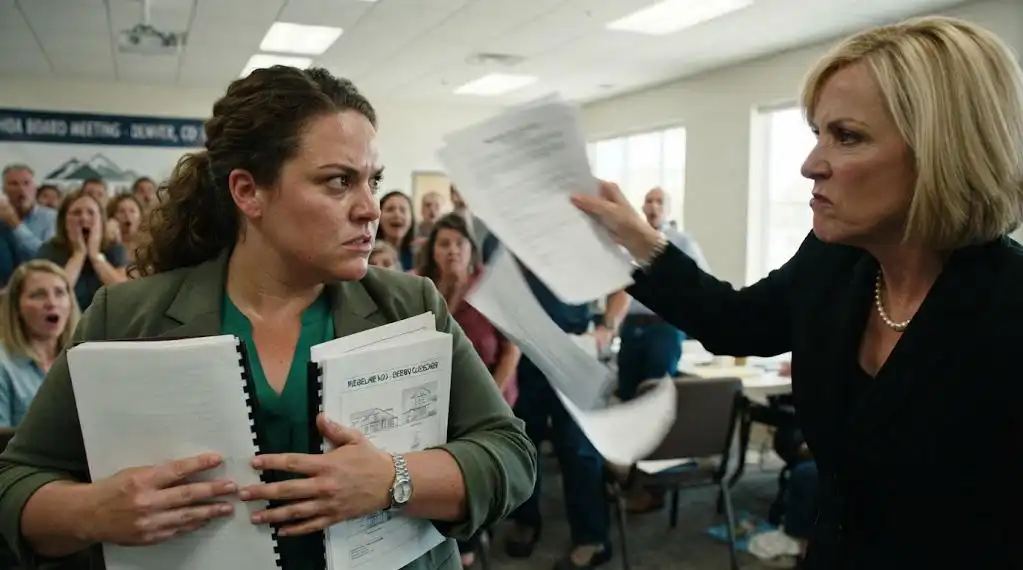




The Mother They Tried to Erase Felicity Crane knocked the little paper bag out of Tessa Rowan’s hands.
Two homemade cinnamon-apple muffins rolled across the polished floor of the private academy.
“Did you think I wouldn't find out?” the headmistress snapped.
Tessa, thirty-seven, stood frozen in her white kitchen uniform. Beyond the glass doors, her five-year-old daughter was walking toward the playground.
“Please,” Tessa whispered. “They're just muffins. Ivy used to love them.”
Felicity crushed one beneath her black heel.
“Your daughter doesn't need anything from you anymore.”
Then she leaned closer.
“And if you want to keep this job, you'll remember that.”
Tessa didn't argue.
She knelt, gathered the broken pieces, and watched through the glass as Ivy disappeared around the corner without ever knowing her mother had been there.
What Felicity didn't know was that Tessa had already started keeping evidence.
And the woman arriving to inspect the academy that morning was about to recognize something Tessa had carried since childhood.
Something neither woman understood could lead back to a little girl who had vanished thirty-three years earlier.
The Mother Behind the Kitchen Door Crestwood Academy stood on a wooded estate outside Princeton, New Jersey.
Its stone buildings, landscaped gardens, and supervised weekday residential program served the children of executives, diplomats, and wealthy families who frequently traveled.
Parents paid extraordinary tuition for privacy and personal attention.
Tessa earned nineteen dollars an hour preparing vegetables, washing equipment, and helping the chef assemble meals.
Seven weeks earlier, she had accepted the kitchen job for one reason.
Her daughter lived in the academy's residential wing.
Every weekday, Tessa arrived before breakfast and positioned herself near a narrow service window overlooking the kindergarten courtyard.
Sometimes she saw Ivy running with her classmates.
Sometimes she caught a glimpse of her daughter's sandy-blond hair through the classroom windows.
And sometimes she saw nothing at all.
Those were the hardest days.
She hadn't held Ivy in almost three months.
Her ex-husband, Victor Whitlock, had made certain of that.
Victor was the founder of a wealthy educational technology company called BrightPlate Systems. His software helped private schools manage food inventories, student allergies, and meal schedules.
Business magazines praised him as a visionary.
Tessa knew another version of the story.
She had designed the original system on an aging laptop at their kitchen table.
Back then, she was a young software developer who also ran a small catering business. Her idea had been simple: help schools prevent dangerous ingredient substitutions while reducing wasted food.
Victor had offered to handle investors and sales.
She trusted him.
When the company grew, he persuaded her to sign documents he described as routine corporate restructuring.
Years later, when their marriage collapsed, she discovered that nearly all the valuable intellectual property had been transferred into companies controlled by Victor.
Then came a business loan carrying her name.
Four hundred eighty thousand dollars.
Tessa insisted she had never authorized it.
Victor claimed otherwise.
He threatened to report her for financial fraud and destroy her ability to support Ivy.
During their separation, Victor brought a temporary custody agreement to Tessa's apartment.
He told her that signing it was the only way to keep their daughter out of the financial investigation.
The agreement gave Victor primary physical custody while the dispute proceeded through family court.
Tessa would still have supervised visitation rights.
Or so she believed.
Once the court entered an interim order, Victor enrolled Ivy at Crestwood and began telling the school that Tessa was unstable.
Felicity repeatedly canceled scheduled visits, claiming Ivy was sick, unavailable, or refusing to see her mother.
Tessa had requested copies of every cancellation.
None arrived.
Unable to afford private counsel, she contacted a nonprofit legal clinic. An attorney named Simone Keller agreed to review her case, but the next court hearing was still weeks away.
Until then, Tessa needed her wages.
And she needed to know Ivy was safe.
So she endured Felicity's insults.
She endured the extra shifts.
She endured being instructed to clean the dining room after wealthy parents had finished their meals.
She even endured Felicity forbidding her from entering the courtyard.
But she couldn't endure the thought of Ivy believing her mother had simply stopped coming.
The Song Nobody Was Supposed to Know On Monday morning, Tessa was peeling apples in the kitchen when a familiar melody escaped her lips.
“Sleep, little sparrow, the moon knows the way home…”
It was an old lullaby.
She didn't remember who had first taught it to her.
Her earliest clear memories came from a children's home where she'd lived before being adopted at age five.
One of the caregivers had told her that she used to sing the same tune to herself at bedtime.
Years later, Tessa had sung it to Ivy.
Whenever her daughter had nightmares, the melody brought her back to sleep.
Tessa continued humming as she worked.
She didn't notice the elegant woman standing in the kitchen doorway.
Celia Wren, sixty-four, wore a tailored navy jacket over an ivory blouse. Her silver hair was gathered into a low, immaculate knot.
She chaired Crestwood's governing board, and her family's investment group controlled a multibillion-dollar portfolio of manufacturing, real estate, and technology businesses.
That morning, Celia was conducting a scheduled inspection of the academy's residential program.
She had been asking Felicity about the children's meals when she heard the tune.
Her face went still.
“Where did you learn that song?”
Tessa turned, startled.
“My grandmother, maybe. Or someone at the children's home.”
“Which children's home?”
“St. Agnes Children's House. It's been closed for years.”
Celia gripped the doorframe.
Felicity immediately stepped between them.
“Mrs. Wren, she's a kitchen assistant. I'll have someone else answer your questions.”
Celia didn't move.
“How old are you?” she asked Tessa.
“Thirty-seven.”
“Do you know where you were born?”
Tessa shook her head.
“My adoption records weren't complete.”
Celia's expression changed again.
Then she noticed a small silver charm hanging beneath Tessa's collar.
It was shaped like an old-fashioned padlock, with a tiny uneven star carved into the metal.
Tessa quickly tucked it away.
“It's just something I've had since I was little.”
Celia said nothing more.
But as Felicity led her toward the dining hall, the older woman stopped beside her attorney, who had accompanied her for the inspection.
“Margaret,” Celia said quietly, “find out what happened to the children from St. Agnes.”
Her attorney looked surprised.
“Is there a particular reason?”
Celia stared back toward the kitchen.
“I heard a song I haven't heard in thirty-three years.”
The Arrangement The next afternoon, Felicity summoned Tessa into her office.
Victor Whitlock was waiting.
He sat comfortably in a leather chair, wearing a charcoal suit and an expensive watch.
On Felicity's desk lay a folder labeled with Ivy's name.
Tessa stopped in the doorway.
“Why is he here?”
Victor smiled.
“Because we need to discuss your behavior.”
Felicity folded her hands.
“You've been approaching your daughter without authorization.”
“I haven't approached her,” Tessa answered. “I've barely been allowed to see her.”
“You've been leaving food for her.”
“She's my daughter.”
Victor stood.
“That's exactly the problem, Tess. You keep acting like the custody agreement doesn't exist.”
Tessa faced him.
“The agreement says I can see Ivy twice a month.”
“Under approved supervision,” Felicity interrupted.
“And you've canceled every visit.”
Felicity's eyes hardened.
“Be very careful about accusing me of anything.”
Victor walked closer.
“You want to stay employed here? Stop making trouble.”
Tessa looked at the folder.
A visitation log was visible beneath its cover.
Beside two scheduled dates were entries stating that Tessa had failed to attend.
Her stomach tightened.
She had been at Crestwood on both dates.
She had clocked in for work.
And on one of those days, she'd waited outside the visitor entrance for forty minutes before a security employee told her Ivy wasn't available.
Tessa pointed at the paper.
“Those entries aren't true.”
Felicity closed the folder.
“This meeting is over.”
Tessa walked out without another word.
But she remembered both dates.
That evening, she emailed her work schedules, visitor confirmation messages, and photographs of the unanswered visitation notices to Simone Keller.
“Don't confront them alone again,” Simone advised over the phone.
“Then what am I supposed to do?”
“Keep the original records. I'll request the academy's visitor logs and ask the court to review the cancellations.”
Tessa hesitated.
“There's something else.”
She opened a secure folder on her phone.
Inside was an audio recording from the afternoon Victor had pressured her to sign the custody agreement.
She had recorded their conversation while sitting across from him in her own apartment and had preserved the original file.
Simone listened.
Then she said, “Tessa, why didn't you send this sooner?”
“Because he told me he'd make sure I never saw Ivy again.”
Simone paused.
“We're going to need this.”
Tessa copied the original file into the clinic's secure evidence portal that night.
For the first time in months, she felt something stronger than fear.
Two Silver Locks While Tessa gathered evidence, Celia's attorney and an independent investigator were examining an entirely different mystery.
Thirty-three years earlier, Celia's three-year-old daughter had disappeared while being cared for by a trusted family employee.
The employee vanished.
The police investigated for years but never located the child.
Celia had searched through private investigators, missing-children organizations, and genetic registries.
Nothing had brought her daughter home.
She had never thrown away the little girl's bedroom furniture.
And she had never stopped carrying a small silver padlock-shaped charm.
Her late husband had commissioned two matching silver long-life locks from a jeweler shortly after their daughter was born.
One belonged to Celia.
The other had been placed around the child's neck.
Both had the same imperfect, hand-carved star.
Now her investigator had found an archived intake record from St. Agnes.
A frightened girl, estimated to be nearly four, had arrived at the children's home thirty-three years earlier with no verified family information.
The medical report described a small scar near her left knee.
The accompanying property inventory listed an unusual silver padlock charm.
And the child had repeatedly sung a lullaby about a sparrow finding its way home.
Celia sat silently as the investigator placed copies of the records in front of her.
“This is not proof of identity,” her attorney warned. “But the details are significant.”
Celia looked down at the photograph from the intake file.
“What happened to her?”
“She was adopted the following year by the Rowans.”
“And now?”
“She's thirty-seven. She has a young daughter. She's going through a custody dispute.”
Celia closed her eyes.
Her attorney carefully contacted Tessa through the legal clinic. She explained that a woman searching for a missing child might be biologically related to her, and asked whether Tessa wanted to participate in a voluntary, confidential kinship test.
Tessa agreed.
She had spent her entire life wondering where she came from.
A supervised cheek-swab collection was arranged, and an accredited laboratory received samples from both women.
Celia requested expedited analysis.
She told her attorney not to disclose her identity publicly before the results were confirmed.
At the same time, another problem surfaced.
Crestwood's finance officer had raised concerns about payments from a BrightPlate-affiliated company into a consulting account connected to Felicity.
An outside auditor retained by the governing board began examining the academy's financial records.
The transactions were labeled as consulting fees.
But the supposed consulting work had no reports, contracts of substance, or documented services.
The academy's accounting records showed that $240,000 had passed through a school-affiliated account before being transferred to a private entity controlled by Felicity.
Several dates matched the cancellation of Tessa's visitation appointments.
Celia asked for every related document to be preserved.
She did not yet know how much of the arrangement could be proved.
But she knew Felicity had lied about more than kitchen rules.
The Pool The following Monday, the academy's residential wing was preparing for an afternoon family gathering.
Tessa had been assigned to help prepare refreshments.
She noticed that the kitchen had made cinnamon-apple muffins, the same kind Ivy loved.
For days, she'd debated whether to leave another snack for her daughter.
She knew Felicity might fire her.
But that morning, Tessa had seen Ivy through the dining room window.
Her little girl was sitting alone, holding a paper drawing.
Even from a distance, Tessa recognized what Ivy had drawn.
Two people holding hands beneath a yellow star.
She couldn't bear another day of silence.
During her break, Tessa placed one muffin in a small paper bag and walked toward the residential wing.
She intended to hand it to the staff member responsible for Ivy's afternoon snack.
She never reached the door.
Felicity caught her beside the indoor swimming pool.
“Are you deliberately trying to get yourself fired?”
Tessa stopped.
“I'm giving her something I made.”
“I told you to stay away from that child.”
“Her name is Ivy.”
Felicity stepped closer.
“You signed her over. Start acting like it.”
Tessa's face tightened.
“I signed a temporary agreement because Victor threatened me.”
“That's your problem.”
“No,” Tessa answered. “What you've done to keep us apart is your problem.”
Felicity glanced toward the nearby corridor.
Several staff members were finishing preparations for the gathering.
Beyond them, Celia Wren had just entered with her attorney and a member of the academy's governing board.
Felicity lowered her voice.
“Give me that bag.”
Tessa held it against her chest.
“You can fire me. But you don't get to tell Ivy I stopped loving her.”
Felicity grabbed her arm.
Tessa pulled away.
The headmistress shoved her backward.
Tessa lost her footing at the pool's edge.
She fell into the water.
The paper bag landed on the tile.
For several seconds, Tessa struggled to get her feet beneath her. Her soaked uniform pulled awkwardly around her legs as she reached for the pool wall.
Her necklace slipped over her head.
The little silver long-life lock broke free.
It sank through the clear blue water.
Felicity stood above her.
“Get out. You're fired,” she said. “I'm calling the police.”
Tessa caught the edge of the pool.
“Then tell them to keep the security footage,” she gasped.
Felicity stopped.
Tessa looked directly at a nearby staff member.
“Please. Don't let anyone erase it.”
The employee turned toward the security office.
A woman's voice cut across the room.
“Stop right there.”
Celia Wren stood beside the pool.
She had seen the shove.
But she was looking at something beneath the water.
The silver lock lay on a pale blue tile just below the surface.
Celia stared at it.
Her hand slowly moved to the chain beneath her jacket.
From under her blouse, she drew another silver lock.
The same shape.
The same hand-carved star.
Her fingers trembled.
“Where did you get that?” she whispered.
Tessa held onto the pool wall.
“I've had it since I was a little girl.”
Celia looked at her face.
Then she looked toward Margaret, her attorney.
Margaret was holding a sealed laboratory report delivered that morning.
Celia's voice barely carried.
“Margaret. The results.”
Her attorney opened the report.
She looked at the conclusion.
Then nodded.
Celia pressed one hand against her mouth.
For thirty-three years, she had imagined finding her daughter in hospital corridors, train stations, and crowded streets.
She had never imagined finding her in a swimming pool, wearing a kitchen uniform, after another woman had pushed her into the water.
“That's My Daughter.” Felicity recovered first.
“Mrs. Wren, this employee has repeatedly violated school policy. I was handling a disciplinary situation.”
Celia slowly turned toward her.
“You pushed her into a swimming pool.”
“She became aggressive.”
“I watched you.”
Felicity went pale.
Celia pointed toward the security camera.
“Preserve that recording. No one touches the system until the footage has been secured.”
The staff member at the security office acknowledged the instruction.
Celia then took the laboratory report from Margaret.
The accredited test supported a biological mother-daughter relationship with greater than 99.99 percent probability.
The archival medical records, adoption history, and two silver locks supplied the missing context.
Celia approached the pool steps.
“Tessa.”
Tessa looked up.
“My daughter disappeared thirty-three years ago,” Celia said, her voice shaking. “She was three years old. She had a silver lock just like yours.”
Tessa stared at her.
Celia lifted the second charm.
“I've been looking for her ever since.”
“Why are you telling me this?”
Celia swallowed.
“Because the records match. And because the DNA test confirms what I was afraid to hope.”
Her voice broke.
“Tessa, you're my daughter.”
The room went silent.
Felicity looked from Celia to Tessa.
“No. There must be some mistake.”
Celia faced her.
“You have spent months keeping my daughter away from her own child.”
“Mrs. Wren, I had no idea...”
“That she was related to me?” Celia asked. “Would that have made the way you treated her acceptable?”
Felicity had no answer.
Celia's expression hardened.
“You were responsible for protecting children and treating their families fairly. Instead, you used this school to punish a mother who could barely afford to defend herself.”
Tessa pulled herself up the pool steps.
Water streamed from her uniform onto the tile.
Margaret offered her a towel.
Tessa took it, but her eyes remained fixed on Felicity.
“I have something you need to hear.”
From a waterproof pouch inside her work uniform, she removed her phone.
She opened the recording she had already preserved with Simone Keller.
Victor's voice filled the room.
“Sign the custody papers, Tessa. Or I'll make sure the bank holds you responsible for the whole loan.”
Then came Tessa's recorded reply.
“You used my name without permission.”
Victor laughed.
“Prove it.”
A pause followed.
Then Victor spoke again.
“Felicity will make sure you don't get near Ivy. You can fight me in court if you want, but you'll run out of money first.”
The recording ended.
Felicity reached for the back of a chair.
Celia stared at her.
“You took money to do this?”
Felicity said nothing.
Margaret opened the audit folder she had brought for that morning's board meeting.
“We've already identified suspicious transfers,” she said. “The board's accountants have secured the relevant records. The authorities will need to verify the recipient accounts.”
Tessa stepped forward.
“You told my daughter I wasn't coming.”
Felicity looked away.
“You marked me absent when I was standing outside your building.”
Still no answer.
Tessa's voice cracked, but she didn't stop.
“You made a five-year-old think her mother didn't want her.”
Celia moved beside Tessa.
For the first time, she didn't stand above her.
She stood with her.
Then Celia turned to the board representative.
“Remove Mrs. Crane from her duties pending the investigation. Arrange safe supervision for the children, and give law enforcement full access to the preserved evidence.”
Felicity began protesting.
But the staff member who had witnessed the shove stepped forward.
“I saw what happened,” she said. “I'll give a statement.”
Tessa finally looked at Celia.
There were a hundred questions she wanted to ask.
Why had she been taken?
Why had no one found her?
Why had she spent most of her life believing she belonged to nobody?
Instead, she whispered one thing.
“Can you help me get Ivy back?”
Celia gently took her hand.
“I'll help you find the truth,” she said. “And we'll do it the right way.”
The Evidence Victor Couldn't Buy The consequences did not arrive overnight.
That afternoon, Tessa gave a formal statement about the incident at the pool.
The academy preserved the original camera footage, and investigators documented the location of the silver lock before it was returned to her.
Tessa's phone recording was copied for investigators using a documented evidence procedure. Simone retained the original file and its creation information.
The audio was later examined and corroborated by other records.
Felicity was suspended immediately and dismissed after the board's investigation.
A forensic accountant traced the $240,000 payment trail from a BrightPlate-related company through the school-affiliated account to Felicity's private business.
Bank records obtained through lawful investigative process confirmed substantial deposits into her personal account.
Emails recovered from school accounts showed Felicity had agreed to restrict Tessa's access to Ivy in exchange for the payments.
The visitor logs had also been altered.
The school's electronic entry records and Tessa's employment timecards established that she had appeared on dates Felicity had marked her absent.
Victor's problems grew worse.
Simone sought emergency family-court relief and submitted the recording, visitation evidence, and the results of the criminal investigation as they became available.
The court ordered an independent assessment of Ivy's circumstances.
A child specialist found no evidence that Ivy feared her mother.
Instead, Ivy asked why Tessa had stopped visiting.
The court initially restored supervised contact.
At their first meeting, Ivy stood in a small family room holding the same drawing Tessa had seen through the dining room window.
When she saw her mother, she ran.
“Mommy!”
Tessa dropped to her knees.
Ivy wrapped both arms around her neck.
“Daddy said you were too busy.”
Tessa closed her eyes.
“I was trying to get to you, sweetheart.”
“Did you forget our song?”
“Never.”
Ivy pressed her face into Tessa's shoulder.
“Then sing it.”
Tessa held her close.
“Sleep, little sparrow, the moon knows the way home…”
Ivy joined in before she reached the last word.
The Company Built on Her Work With the criminal investigation underway, an independent intellectual-property attorney helped Tessa examine Victor's company records.
The evidence was more extensive than she had expected.
Old source files, dated development notes, emails to early investors, and software registration records showed that Tessa had created BrightPlate's original commercial system.
The company had been founded using the software she developed.
The patents, licensing agreements, and revenue-generating products could be traced back to her work.
The supposed corporate restructuring Victor had persuaded her to sign contained documents with signatures she disputed.
Investigators also found that the disputed bank loan had been supported by falsified authorizations.
The recordings and documents established a pattern of coercion and financial deception.
Victor's public image as a self-made technology founder collapsed under the weight of the evidence.
His fortune had been built on software Tessa created, while she washed dishes in the school where their daughter slept.
Civil proceedings resulted in a substantial settlement recognizing her ownership interests and compensating her for the misappropriation of her work.
The fraudulent debt was challenged and ultimately removed from her responsibility.
The criminal investigation led to charges against Victor involving financial fraud and conspiracy.
Felicity was charged in connection with the corrupt payments, falsified records, and the pool incident.
After lengthy proceedings, both pleaded guilty to criminal offenses arising from their respective conduct and received prison sentences.
Their convictions did not automatically settle the custody case.
But the evidence they had tried to conceal became central to it.
After reviewing the coercive agreement, the manipulated visitation records, the financial misconduct, and Ivy's welfare, the family court replaced the temporary arrangement.
Tessa was awarded primary legal and physical custody.
Victor's future contact with Ivy was placed under court supervision and subject to conditions intended to protect the child.
For Tessa, the court's decision mattered more than any settlement figure.
Because this time, no one could tell her she had signed away her right to be a mother.
The Mother Who Had Waited Thirty-Three Years One evening, several months later, Celia asked Tessa to visit the family estate.
For the first time, Tessa entered through the front doors not as an employee, a visitor, or someone seeking permission.
Celia was waiting in the entrance hall.
On a small table stood an old photograph of a laughing three-year-old girl.
The child had auburn hair and a small silver charm around her neck.
Tessa studied the photograph.
“She looks like Ivy,” she whispered.
Celia nodded.
“She looks like you.”
Tessa touched the frame.
For thirty-three years, she had wondered whether someone had missed her.
Now she knew.
Celia led her into a quiet room where a wooden music box sat on a shelf.
She opened it.
The familiar lullaby began to play.
Tessa covered her mouth.
“That song…”
“Your grandfather made the music box,” Celia said. “I used to sing along when you couldn't sleep.”
Tessa's eyes filled.
“I thought I made up the words.”
“No, sweetheart. You remembered them.”
Celia reached for her hand.
“I searched for you for so long. And then, when I heard you singing in that kitchen, I was afraid to believe it.”
Tessa was quiet for a moment.
Then she asked the question she'd carried since childhood.
“Why didn't you come for me?”
Celia's face crumpled.
“I tried. Every year. Every lead. Every place they told me to look.”
She took a careful breath.
“But I wasn't there when you needed me. I know finding you now doesn't give those years back.”
Tessa looked at the two silver locks lying together on the table.
“I don't know how to be your daughter.”
Celia squeezed her hand.
“Then we don't have to figure it out all at once.”
For a moment, neither spoke.
Then Tessa stepped forward and embraced her mother.
Celia held her as though she had spent thirty-three years waiting for permission.
Finally Home By autumn, Tessa and Ivy were moving into a private guesthouse on Celia's estate while Tessa planned their longer-term home.
Tessa had begun rebuilding her professional career.
This time, she was developing her own technology under contracts reviewed by lawyers she had chosen herself.
Her name appeared on the ownership documents.
No one else signed for her.
The money from her settlement gave her freedom, but she refused to let wealth become the reason her daughter trusted her.
She kept small routines.
Breakfast together.
Drawing pictures before bedtime.
Baking cinnamon-apple muffins on Saturday mornings.
And singing the same lullaby every night.
On their first evening at the estate, Ivy stood in the grand entrance hall wearing a yellow cardigan and holding her mother's hand.
Celia waited beside the staircase.
Ivy looked up.
“Mommy, is this where Grandma lives?”
Tessa smiled.
“Yes, sweetheart.”
“Can we stay together?”
Tessa knelt.
She brushed a strand of sandy-blond hair away from her daughter's eyes.
“We're staying together.”
Ivy wrapped her arms around her mother.
Tessa held her tightly.
Celia stepped forward and gently put her arms around both of them.
The three stood beneath the warm entrance lights, surrounded by a home that had waited decades for one of them to return.
Later that night, Tessa tucked Ivy into bed.
Her daughter reached for the little silver lock around Tessa's neck.
“What's that, Mommy?”
“Something my mother gave me a long time ago.”
“Did you lose it?”
Tessa glanced toward the doorway, where Celia stood watching.
“For a while,” she said softly. “But it found its way home.”
Ivy settled against her pillow.
“Sing our song?”
Tessa kissed her forehead.
Then, with her own mother listening from the doorway, she began.
“Sleep, little sparrow, the moon knows the way home…”
This time, when Ivy fell asleep, Tessa did not have to leave.
She turned off the bedside lamp, sat beside her daughter, and stayed.
Disclaimer: Mention of any brand or trademark is for identification only and does not imply partnership or endorsement

A Wealthy Manhattan Socialite Poured Red Wine on a Plus-Size Artist at a Charity Gala, Calling Her “Cheap and Unworthy.” She Had NO IDEA Who Would Discover Her Paintings... 😱

A Celebrity Trainer Threw CASH in a Plus-Size Nutritionist’s Face at a Luxury LA Gym, Saying She Couldn’t Even Control Her Own Weight. He Had NO IDEA What Her Clients Would Prove... 😱

My Fiancé’s Mother CUT MY Custom Engagement Dress in Front of 200 Guests and Called Me an “Elephant in a Sack.” My Fiancé Just SMILED... 😱