


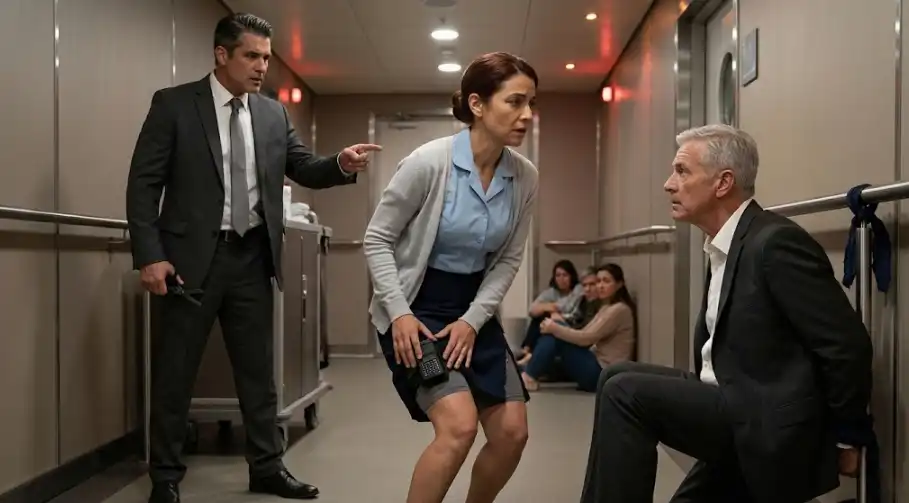
The Cleaner, the Classified Radio, and the Hostage Crisis at Sea The security chief pulled a pair of emergency shears from his belt and cut straight through the cleaner’s uniform skirt.
“Hold still,” Damon Rourke snapped.
Forty-three-year-old Mara Ellison stumbled backward, clutching her cleaning cart as a strip of navy fabric fell to the polished floor.
Twenty frightened passengers watched from the emergency shelter of the Meridian Crown, a luxury cruise ship sailing through the Caribbean.
“You can't just cut her clothes,” a gray-haired man protested.
Damon turned toward him.
“Mr. Calder, you're putting everyone here at risk. Sit down.”
Then he grabbed the torn fabric and tied the man's wrist to a steel handrail.
Mara's skirt hung open along her right thigh.
And beneath it, strapped securely against her leg, was a small black communication device unlike anything found in ordinary civilian equipment.
The gray-haired man's expression changed.
He leaned forward.
“That's a Sentinel Nine.”
Damon froze.
For the first time since the armed men boarded the ship, the security chief looked genuinely afraid.
Not of the hijackers.
Of the woman he had just humiliated.
Six hours earlier, Mara had been polishing brass handrails outside the ship's observation lounge.
She worked nights because they were quiet.
No crowds. No sudden applause. No people demanding to know who she used to be.
Her supervisor knew her as a reliable cleaner who never complained, rarely spoke, and sometimes needed a few minutes alone when the ship's emergency alarms were tested.
What he didn't know was that Mara had once been one of the most respected crisis negotiators in a classified multinational rescue unit.
Eight years earlier, she had been Lieutenant Mara Ellison, lead negotiator for Sentinel Nine.
Then came Port Caldera.
Seventeen hostages. One unauthorized tactical decision. One civilian who never made it home.
The official report said Mara had ordered the disastrous intervention.
She hadn't.
But the man who had actually given that order made sure the evidence pointed toward her.
His name was Damon Rourke.
And now he was the security chief aboard the Meridian Crown.
Mara had nearly turned down the cleaning job when she discovered his name on the crew roster.
But she needed the health insurance, the steady paycheck, and the anonymity.
She had spent years in treatment for post-traumatic stress disorder. She still attended remote counseling sessions whenever the ship had a stable connection.
Cleaning gave her a routine she could control.
Damon had recognized her on her first day.
He'd waited until the other employees were gone before cornering her inside a supply room.
“Funny place for a decorated officer to end up.”
“I'm here to work,” Mara answered.
“Then stick to cleaning.”
He glanced at the old scar disappearing beneath the collar of her blouse.
“And don't start telling stories about Port Caldera.”
Mara said nothing.
She had learned that silence could get her through an entire day.
It had never brought her peace.
The Meridian Crown was carrying more than twelve hundred people, including 380 wealthy guests attending a private international charity summit.
Among them was Reed Calder, sixty-one, founder of Calder Global Security.
His company protected commercial ports, diplomatic facilities, and international shipping routes.
Long before building his fortune, Reed had served as a communications and encryption specialist with Sentinel Nine.
He had helped design the unit's emergency communication protocols.
But Mara didn't know he was aboard.
Nor did she know that Reed had spent years trying to obtain an independent review of the Port Caldera operation.
The original recordings had been sealed after the investigation.
The copies available to civilian investigators were incomplete.
And without a working Sentinel Nine authentication key, the surviving encrypted command records couldn't be conclusively attributed to their original transmitters.
Mara carried that missing key.
It was contained inside the old thigh-mounted emergency communicator she had been legally authorized to retain under a restricted maritime crisis-response agreement.
The device had no ordinary telephone function.
Its emergency channel was intended for authenticated distress transmissions when conventional systems failed.
Mara had never activated it after leaving the unit.
She carried it because, years earlier, a communications failure had cost a woman her life.
And despite everything, she couldn't bring herself to be completely unreachable.
At 8:17 p.m., the first alarm sounded.
Mara was replacing cleaning supplies near the observation lounge when two sharp bangs echoed from the lower service deck.
The music stopped.
A man's voice came over the public-address system.
“Everyone stay where you are.”
Then the announcement broke off.
Within minutes, armed hijackers had taken control of the central entertainment deck.
They had entered through a service tender whose inspection clearance bore Damon Rourke's electronic authorization.
Damon had approved the tender's boarding paperwork without completing the required secondary inspection.
He had been more interested in keeping the evening's VIP reception on schedule.
Now the attackers controlled key interior corridors and had disrupted the ship's main external communications.
They demanded that the captain divert toward a remote island anchorage.
More dangerously, they wanted the emergency fire partitions separating the VIP lounge from the central access corridor released.
The captain refused.
If those doors opened, hundreds of guests would be exposed to the hijackers.
Mara recognized the layout immediately.
She had spent her first week aboard studying evacuation diagrams, service entrances, and emergency exits.
Old habits.
When the attack began, she helped guide Reed Calder and twenty other passengers through a staff passage into a reinforced emergency shelter.
Reed had been among the VIPs initially seized by the attackers. He had slipped away during a brief distraction caused by the crew's evacuation effort.
Mara closed the shelter door behind them.
“Stay away from the glass,” she told the passengers. “Keep the center aisle clear.”
Her voice was steady.
Her hands weren't.
A woman began crying.
Someone dropped a champagne glass.
The crash sounded exactly like breaking glass at Port Caldera.
For one terrible second, Mara smelled concrete dust that wasn't there.
She heard a woman's voice from eight years earlier.
Please don't let them come through the door.
Mara gripped the edge of her cleaning cart until her fingers hurt.
Then she forced herself to look around the shelter.
Twenty-one people.
One reinforced door.
Two service exits.
And a frightened security officer standing beside the control panel.
She began counting everyone again.
Damon arrived seven minutes later with two armed security guards.
His jacket was open, his face damp with perspiration.
“Who authorized you to move these people?” he demanded.
“I did,” Mara said.
“You're housekeeping.”
“The main corridor wasn't secure.”
“I didn't ask for your opinion.”
Damon ordered a junior officer to begin the emergency power bypass requested by the hijackers.
Mara looked at the panel.
“Don't do that.”
Damon ignored her.
“That bypass releases the fire partitions when the system switches to manual isolation,” she continued. “It will open a direct route to the VIP lounge.”
“That's not how this ship works.”
“It is. Check the diagram inside the panel.”
The junior officer hesitated.
Damon stepped between him and Mara.
“I run security here.”
Reed Calder moved toward the control panel.
“She's asking you to verify something before you put hundreds of people at risk.”
Damon grabbed Reed's arm.
“Sir, I need you to sit down.”
“Then stop trying to open those doors.”
Damon saw his carefully constructed authority slipping.
Worse, the woman threatening it was Mara Ellison.
The person he had spent eight years discrediting.
He pushed Reed into a chair near the handrail.
“For your own safety, you're staying right here.”
He took emergency shears from his belt.
Mara noticed two unused restraint straps hanging from his equipment bag.
He didn't touch them.
Instead, he seized the hem of her navy housekeeping skirt.
“Your uniform is company property. We need a restraint.”
“Use the straps,” she said.
“Hold still.”
The blades cut through the side seam.
Mara flinched as Damon tore away a long strip of fabric.
Her gray undershorts became visible beneath the damaged skirt.
Then came the black device strapped against her right thigh.
Reed Calder stared at its unusual casing, the recessed emergency switch, and the small silver contact points near its antenna.
His face went pale.
“That's a Sentinel Nine.”
Mara instinctively covered the device with her hand.
“Don't touch that.”
Damon looked down.
Recognition struck him immediately.
He knew exactly what she was carrying.
And what its encrypted records might prove.
“She's with them!” Damon shouted.
Both guards turned toward Mara.
“Why would a cleaner have classified military equipment?” he demanded. “She's been hiding it on the ship.”
He pointed toward the shelter door.
“Put her outside the safe zone. Now.”
Mara's breathing accelerated.
She could hear her pulse over the distant alarms.
For a moment, the shelter disappeared.
She was back in Port Caldera.
A narrow stairwell.
A frightened mother pleading through a radio.
Damon shouting that he knew better.
Then the sound of an unauthorized entry.
Mara pressed her palm against the communicator.
She had carried it through every sleepless night since that mission.
Now, with hundreds of people facing the same kind of mistake, she was terrified she would freeze again.
“If you push me out,” she said, “the only working channel goes with me.”
Damon stepped forward.
Reed pulled against the fabric binding his wrist.
“Get your hands off her.”
Damon turned.
“You don't understand what that equipment is.”
Reed's voice hardened.
“I helped build its encryption system.”
The room went quiet.
Damon's expression shifted.
Reed looked directly at Mara.
“What's your call sign?”
Mara swallowed.
“Nightingale Four.”
Reed stopped moving.
Eight years earlier, Nightingale Four had been the operator who kept transmitting after the Port Caldera extraction collapsed.
The official report credited Damon with maintaining the negotiations.
But the encrypted emergency traffic told a different story.
Someone using Nightingale Four's authenticated channel had repeatedly ordered the tactical team to hold its position.
The unauthorized entry order had come from another command transmitter.
Reed had seen references to those encrypted transmissions during his own review.
He had never been able to authenticate the original source.
Until now.
He pointed to the device.
“Can it still authenticate?”
Mara nodded.
“If I reach an open deck.”
“Then we need to get you there.”
Damon's jaw tightened.
“No one's going anywhere.”
The hijackers transmitted another demand.
The fire partitions were to be released within twelve minutes.
Otherwise, they would disable the ship's emergency ventilation controls in the crowded VIP lounge.
The captain's voice came through an internal line.
“Security, confirm your position. We need options.”
Damon seized the handset.
“We're preparing the bypass.”
Mara stepped toward him.
“Captain, don't authorize that. You'll expose the passengers.”
Damon cut the connection.
“You don't give orders on my ship.”
Mara stared at the dead handset.
Eight years earlier, she had obeyed her chain of command while Damon interfered with an operation.
She had watched the consequences unfold.
She had spent years wondering whether she could have stopped him sooner.
Now the same choice stood in front of her.
Stay quiet.
Or act.
Mara looked at the frightened passengers, then at the access hatch leading toward the upper promenade.
She turned to the junior security officer.
“There's a printed emergency diagram behind that panel. Read the note beside manual isolation.”
The officer opened it.
His eyes moved down the page.
Then he looked at Damon.
“Sir, she's right. The partitions release automatically during that bypass sequence.”
Damon reached for the page.
“That's an outdated instruction.”
“The revision date is from last month,” the officer replied.
It was the first time anyone had openly contradicted Damon.
Reed looked at Mara.
“Go.”
She took the first step toward the service hatch.
Damon lunged for her communicator.
“If that thing connects, we're all finished!”
Mara twisted away.
He grabbed the damaged edge of her skirt.
She caught herself against the cleaning cart.
The sudden movement tore part of her cardigan against the metal hatch.
For an instant, the fabric slipped from her left shoulder.
Reed saw a long, pale, distinctive scar curving across her upper back.
He recognized its description.
During the Port Caldera mission, Nightingale Four had been injured while pulling an officer away from an exposed stairwell.
That officer had been Damon Rourke.
The injury report, signed by the field medic, recorded its exact location.
Reed had read it.
He looked from the scar to Damon.
“My God,” he whispered.
Mara pulled her cardigan back into place.
Damon saw Reed's expression.
And his panic turned into something uglier.
He raised the emergency shears toward the communicator.
“I should've destroyed that thing years ago.”
Mara didn't wait.
She drove her cleaning cart between Damon and the frightened passengers.
The cart struck his knees and knocked him off balance.
He stumbled against the steel handrail.
As Damon tried to reach around the cart, Mara caught his wrist with the long aluminum mop handle.
She pinned his forearm against the padded side of the service partition.
The shears dropped.
Damon tried to twist free.
Mara had already pulled a thick microfiber cleaning cloth from her belt.
She looped it around his wrist and secured his arm to the fixed rail, keeping him there long enough for the junior security officer to intervene.
“Hold him,” she said.
The younger officer complied.
Damon stared at Mara.
“You can't do this to me.”
Mara's hands were shaking.
“I already let you stop me once.”
She retrieved her communicator.
Then she turned to Reed.
“Get those restraints off your wrist. Keep everyone behind the fire door.”
Reed nodded.
Mara climbed through the service hatch.
The upper service passage was nearly empty.
Emergency lights glowed above the doors.
Through the ventilation grilles came the muffled sounds of frightened people and urgent voices over the ship's internal radios.
Mara moved toward the exterior promenade access.
Halfway down the corridor, another alarm sounded.
She stopped.
A terrible memory swept over her.
The last call from Port Caldera.
A woman asking whether the officers were coming.
Mara leaned against the wall.
Her chest tightened.
For several seconds, she couldn't move.
She knew what was happening.
She had practiced grounding techniques with her therapist for years.
She put one hand against the cool steel wall.
Named five things she could see.
Four she could feel.
Three she could hear.
Then she looked at the communicator.
Her voice broke.
“Not again.”
She forced herself through the final service door.
Cool Caribbean air struck her face.
Beyond the railing, the sea was dark.
She pressed the emergency switch.
A small indicator illuminated.
The transmitter began searching for its authenticated satellite emergency link.
Once.
Twice.
Then it connected.
“Sentinel Nine emergency relay. Nightingale Four requesting immediate maritime assistance.”
A soft electronic tone sounded.
Mara entered the ship's verified coordinates from the communicator's onboard positioning receiver.
She sent the emergency priority code, vessel identification, passenger count, and location.
An encrypted acknowledgment appeared.
DISTRESS RECEIVED. POSITION VERIFIED.
The communicator's return channel activated.
“Coastal rescue coordination receiving. Confirm immediate threat.”
Mara closed her eyes for half a second.
Then her old professional voice returned.
“Passenger vessel Meridian Crown. Armed takeover. Hundreds confined near central access. Security command compromised. Do not authorize a remote fire-control bypass. We need maritime interception and a trained negotiation team.”
The coordinator confirmed that a Bahamian maritime patrol already operating in the area was being redirected.
Additional rescue vessels were alerted.
The ship was no longer isolated.
But the hijackers still controlled the interior.
And the deadline was approaching.
Mara wasn't finished.
She stayed on the authenticated channel while the rescue coordination center established a protected connection to the captain through the ship's remaining internal systems.
Mara gave the captain a clear instruction.
“Keep the fire partitions secured. I'm going to buy you time.”
The captain agreed.
Through the internal communications panel, she requested direct contact with the hijackers' spokesman.
She didn't threaten him.
Didn't insult him.
Didn't promise what she couldn't deliver.
“My name is Mara Ellison,” she said. “I'm authorized to communicate for the captain. You need a safe route off this ship. Opening those partitions makes that harder, not easier.”
The man answered angrily.
“We want the doors open.”
“You'll get a corridor full of frightened people,” Mara replied. “Some will run. Some won't be able to move. You'll lose control of the crowd before you reach the exit.”
Silence.
“I'm offering you a controlled alternative,” she continued. “Keep the doors closed, release the people nearest your exit, and I'll arrange direct contact with the maritime response commander.”
He demanded proof that outside help was coming.
Mara arranged for the coastal coordinator to speak on the same line without revealing the patrol's exact approach.
The exchange was tense.
It bought four minutes.
Then six.
By the time the hijackers agreed to keep the partitions closed while discussing a withdrawal route, the responding maritime unit had established contact with the ship's captain.
The captain coordinated the next steps with the rescue commander.
Crew members began moving passengers away from the threatened areas.
The attackers were contained without the fire partitions being released.
After a prolonged standoff, the hijackers surrendered their weapons to the boarding authorities.
The passengers were evacuated from the affected decks in controlled groups.
More than twelve hundred people had been aboard.
Not one passenger was lost during the rescue.
But the crisis had uncovered something else.
Back inside the shelter, Reed Calder had used the restored emergency relay to contact the authorized archival verification desk that maintained Sentinel Nine's original encrypted command records.
He supplied the communicator's active authentication identifier and requested preservation and verification of the Port Caldera records.
The archive confirmed that Nightingale Four's original transmissions carried Mara Ellison's personal command signature.
They included three authenticated instructions to delay tactical entry.
The order to proceed came from a separate command channel assigned to Damon Rourke.
The timestamps matched the surviving operational log and the independent communications record.
They also matched the field medic's report documenting Mara's injury while rescuing Damon after his unauthorized decision.
These records did not need Damon to confess.
They needed an independent investigator to verify them.
And now the original source could be authenticated.
Reed stood beside the bound security chief as the confirmation arrived.
“You signed the report blaming her,” Reed said.
Damon stared at the floor.
“You don't know what happened in that stairwell.”
“I know whose channel ordered the entry. And I know who ordered them to wait.”
Damon said nothing.
The junior officer who had witnessed the attempted bypass submitted his written statement to the maritime authorities.
The ship's electronic inspection logs established that Damon had approved the suspicious service tender without the required secondary check.
Security-camera recordings showed his attempt to remove Mara from the emergency shelter and destroy her communicator.
The cut uniform, the discarded shears, the damaged equipment bag, and the relevant control-panel records were photographed and preserved.
What had begun as a desperate attempt to avoid responsibility had created a second, independently documented case against him.
When the Meridian Crown reached a secure Bahamian port, maritime police boarded to begin the formal investigation.
The hijackers were taken into custody.
Damon was arrested by Bahamian officers as part of an INTERPOL-coordinated international investigation.
Prosecutors filed charges under applicable maritime and public-safety laws, including allegations arising from reckless endangerment and interference with emergency response operations.
Additional investigators examined the falsified Port Caldera report.
The ship's operator suspended Damon immediately and later terminated his employment.
Months afterward, the independent review formally overturned the finding that Mara had ordered the failed Port Caldera entry.
The original report was corrected.
Damon faced further proceedings over the falsified records, while the maritime case continued separately.
For Mara, the hardest moment came when she received a call from the sister of the civilian who had died.
The woman didn't ask for another explanation of the tactical failure.
She simply said, “I wish we'd known you tried to stop them.”
Mara sat quietly for a long time after the call.
Then she answered.
“So do I.”
Three weeks after the cruise, Reed Calder visited Mara at a quiet waterfront café.
He placed a contract on the table.
Not a publicity appearance.
Not a ceremonial advisory position.
He wanted her to lead a new civilian crisis-negotiation division at Calder Global Security, working alongside licensed emergency responders and government rescue agencies.
The salary was more than ten times what she had earned as a cleaner.
Mara stared at the contract.
“I still have bad days,” she told him.
“Then we plan for bad days.”
“I can't promise I'll never freeze.”
“Neither can anyone else.”
Reed paused.
“I don't need a legend, Mara. I need someone who knows when an order is wrong and has the courage to challenge it.”
She didn't sign that afternoon.
She spoke with her therapist.
She reviewed the job's operational safeguards and insisted on a deputy with authority to take over whenever she needed to step back.
Reed agreed.
Two weeks later, Mara accepted.
Her recovery hadn't erased the memories of Port Caldera.
But she no longer had to build her entire life around avoiding them.
Six months later, a private rescue helicopter stood on a coastal staging pad in Florida.
Beyond the airfield, emergency teams were preparing to reach families stranded by severe flooding.
The helicopter was part of a privately funded support operation working under the local incident command.
Beside it stood Mara Ellison.
She wore a fitted navy rescue uniform, black boots, and a communication headset.
Her auburn hair was secured beneath a flight helmet.
A digital map rested in her hands.
A young operations officer approached.
“Ma'am, the ground team says the access road is gone. They're asking for an alternate extraction point.”
Mara studied the map.
“Move the pickup to the school roof. Confirm the weight limit and keep the medical team ready.”
The officer relayed her instructions.
The helicopter crew began its final checks.
Mara looked toward the horizon.
For a moment, the familiar sound of the engine pulled at an old memory.
She felt the fear.
She acknowledged it.
Then she pressed her headset.
“Rescue One, this is Ellison. Confirm your route before departure.”
The pilot answered.
“Route confirmed. Standing by.”
Mara stepped beside the open helicopter door.
“Proceed.”
The rotor blades gathered speed.
And as the helicopter lifted into the morning light, Mara stood beneath the spinning wash, one hand holding her headset firmly in place, directing the next rescue.
Disclaimer: Mention of any brand or trademark is for identification only and does not imply partnership or endorsement

A Wealthy Manhattan Socialite Poured Red Wine on a Plus-Size Artist at a Charity Gala, Calling Her “Cheap and Unworthy.” She Had NO IDEA Who Would Discover Her Paintings... 😱

A Celebrity Trainer Threw CASH in a Plus-Size Nutritionist’s Face at a Luxury LA Gym, Saying She Couldn’t Even Control Her Own Weight. He Had NO IDEA What Her Clients Would Prove... 😱

My Fiancé’s Mother CUT MY Custom Engagement Dress in Front of 200 Guests and Called Me an “Elephant in a Sack.” My Fiancé Just SMILED... 😱