


Grant Heller had never met Claire Mercer. He had no idea what she did for a living, why she was traveling without an entourage, or why a small black device inside her coat could trigger a response that reached far beyond the airplane cabin.
He knew only that he was angry, drunk, and convinced that everyone around him was in his way.
That was enough for him to make the worst decision of his life.
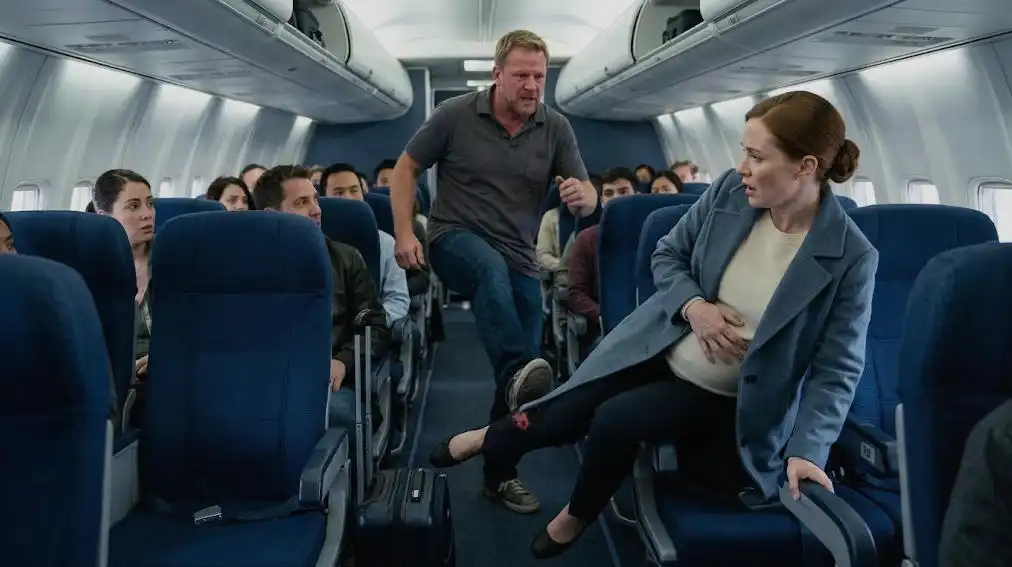
Claire was standing beside her aisle seat when he came lumbering down the narrow passage. She had pulled her small carry-on from beneath the seat and was turning it toward the space in front of her, trying to keep it from obstructing the aisle.
The man approaching her was large, unsteady, and visibly intoxicated. His charcoal polo shirt was wrinkled, his face was flushed, and his shoulders moved with the aggressive impatience of someone who expected the world to make room for him.
Claire shifted toward her seat.
It wasn't fast enough for him.
“Move, damn you!”
Grant drove his right foot into the side of her suitcase.
The bag shot forward along the aisle, its wheels rattling against the floor before it struck the base of another row.
Several passengers turned.
Claire looked toward the suitcase, startled. She had expected irritation, perhaps a rude remark. She had not expected a grown man to kick her belongings across an airplane.
She began to move out of his way.
Grant kicked her instead.
His shoe struck the outside of her left calf with enough force to send her leg into the metal frame of the seat. Pain flashed up her lower leg. The impact knocked her sideways, and she fell hard into the aisle seat.
A sharp cry escaped her before she could stop it.
Her right hand caught the armrest. Her left arm immediately folded across her abdomen.
For several seconds, the cabin seemed to shrink to the space around her seat.
Claire looked down.
The fabric over her left calf had torn where her leg struck the seat frame. Blood was beginning to show through the small opening, and swelling was already developing around the impact.
She was seven months pregnant.
The thought that mattered most was not her leg.
It was the child she was carrying.
She held her abdomen and waited for the first wave of pain to pass, trying to distinguish the shock of the impact from anything happening inside her body.
Grant didn't apologize.
He didn't even look concerned.
He stood over her with his chest rising and falling, apparently offended that she had been in his path.
A flight attendant named Megan Price hurried toward them.
“Sir, step back!”
Megan placed herself between Grant and Claire. She caught his forearm when he tried to push past her, then shifted her feet to keep herself between the two passengers.
Grant jerked his arm away.
“Nobody can touch me.”
He said it loudly, as though volume alone could make it true.
Megan held her position. Another crew member, Mark Ellis, appeared from farther down the cabin after hearing the commotion. He moved toward the aisle while Megan kept Grant occupied.
Behind them, Claire reached for a folded paper napkin and pressed it against her bleeding calf.
Her face had gone pale. She could feel her heartbeat in her throat, and every small movement of her injured leg sent another sharp pulse of pain through it.
She had spent most of her adult life in rooms where people measured every word before speaking.
At thirty-seven, Claire was the chief executive officer of Aegis Strategic Systems, one of the country's leading defense contractors. Her company managed a vast network of specialized manufacturers, secure suppliers, advanced guidance components, and other systems that supported critical American defense programs.
Her job required her to understand how thousands of moving parts could depend on a single decision.
That morning, she had attended a closed-door meeting at the Pentagon concerning a highly classified defense program. The discussion had lasted longer than expected. By the time it ended, she had little time to reach her commercial flight back to Aegis headquarters in Huntsville, Alabama.
The trip had been arranged without a visible security entourage. The purpose was discretion. Her participation in the meeting was restricted, and unnecessary attention could expose information about the program and its schedule.
She wore an ordinary blue-gray coat, carried a small suitcase, and looked like any other professional traveler trying to get home.
But the absence of visible guards did not mean the absence of protection.
Because Claire was one of a small number of people whose knowledge and responsibilities were considered critical to an active national-defense program, an authorized emergency protection protocol had been established for her travel.
It was not intended to settle personal disputes or give her special privileges over ordinary passengers.
It existed for the moment when an ordinary journey became a genuine threat to a protected person.
Claire had hoped she would never need it.
Now, with blood soaking into the napkin at her calf and an enraged man still trying to push past a flight attendant, she understood that the situation had crossed that threshold.
Megan glanced back at her.
“Can you tell me where you're hurt?”
“My left leg,” Claire answered. Her voice was controlled, although she had to pause to breathe through the pain. “Please keep him away from me.”
“We will. Don't try to stand.”
Megan turned back toward Grant.
He was still protesting, insisting that Claire had blocked the aisle and that everyone was making an unreasonable fuss over a simple disagreement.
Mark moved beside him, giving Megan additional support. Grant remained physically larger than either attendant, but he was no longer free to move toward Claire without encountering both of them.
Claire looked at the suitcase lying farther up the aisle.
Then she looked at the man who had kicked it, followed by the man who had kicked her.
There was no confusion about what had happened.
She had tried to make room. He had attacked her anyway.
Claire reached into the inner pocket of her coat.
Her fingers found the small, matte-black communications device she carried for authorized emergency use. Its casing was compact, with a sealed cryptographic insignia etched into the surface. Under a protective cover was a red emergency key.
She brought it into her right hand.
Megan noticed the device but did not interrupt her. She was still trying to keep Grant under control.
Claire opened the cover with her thumb.
For one brief moment, she thought about the baby.
Then she pressed the red button.
A small indicator illuminated.
The device transmitted an authenticated emergency signal through a restricted Department of Defense communications channel. The signal identified the registered device, supplied the necessary location information, and activated the protection protocol associated with Claire's classified travel.
It did not need to explain the entire incident in a spoken message. The authentication itself told the receiving operations center that a protected principal had activated an emergency alert.
Within seconds, the alert reached the appropriate duty personnel.
The response was not based on Claire's wealth, her title, or a private demand that someone punish a rude passenger. The protocol existed because a violent attack on a protected strategic principal could present a security risk that ordinary cabin procedures were not designed to assess on their own.
The operations center authenticated the signal, initiated the designated response, and coordinated with the aviation authorities responsible for the aircraft's route.
In the cockpit, the captain received an urgent instruction through the appropriate aviation communications chain.
The message required an immediate diversion and a controlled landing at Langley.
Captain Daniel Brooks had flown commercial aircraft for nearly two decades. He had dealt with medical emergencies, severe turbulence, and passengers who had to be removed from flights.
He had never received an instruction quite like this one.
He did not announce classified details to the cabin. He confirmed the instruction, reviewed the aircraft's status, and began coordinating the descent.
A few moments later, his voice came over the intercom.
“Cabin crew, prepare for an immediate diversion.”
The words traveled through the cabin.
Passengers exchanged uneasy looks. Megan glanced toward the forward galley, then back at Grant.
Grant's expression changed, but he still did not understand what was happening.
He assumed the captain had been informed of the disturbance and was preparing to land so the crew could remove him.
That possibility should have frightened him.
Instead, he scoffed.
Claire kept the communications device in her right hand. With her left, she continued to protect her abdomen.
The pain in her calf was getting worse. The napkin was no longer enough to conceal the blood, and the muscles around the injury had begun to tighten.
She tried to focus on her breathing.
One breath in.
One breath out.
Then she felt a sudden movement beneath her hand.
The baby had kicked.
Under ordinary circumstances, she might have smiled at the familiar sensation. Now it made her throat tighten. She could not tell whether the movement was entirely normal or whether the violence of the attack had caused a problem.
She had spent years making decisions under pressure. She had negotiated with people who controlled factories, budgets, and strategic programs. She had learned not to mistake panic for useful information.
But this was different.
She could manage a production failure. She could call an emergency meeting, move resources, or find another supplier.
She could not personally verify that her child was safe.
Megan returned with the onboard first-aid kit. She knelt beside Claire's seat and applied pressure around the injured area without forcing Claire to move her leg.
“Help is coming,” Megan said. “We'll get you checked as soon as we land.”
Claire nodded.
“Thank you.”
Across the aisle, Grant continued arguing.
He complained that the attendants had treated him like a criminal. He insisted that he had merely tried to get past someone who was standing in his way. When Mark instructed him to remain still, Grant responded with another angry gesture.
But the cabin had changed.
People who had initially watched with the uneasy curiosity of strangers now understood that the woman in the aisle seat had been injured in an unprovoked physical attack. Several passengers offered to provide statements. One quietly explained to Megan that he had seen Grant kick the suitcase and then Claire's leg.
The facts were becoming harder for Grant to deny.
He had not simply bumped into someone.
He had deliberately used his foot to knock away her property and then struck her body.
The plane began its controlled descent.
Outside the windows, the sky was pale and clear, with layers of cloud scattered across the distant horizon.
Then two gray military fighters appeared.
At first, they were only dark shapes beyond the passenger windows. A moment later, they moved into clear view, one on each side of the commercial aircraft, maintaining a controlled escort formation.
They did not come so close that their presence endangered the passenger plane. They held their positions at a safe distance, matching its course as the aircraft continued toward the designated military airfield.
The sight traveled through the cabin faster than any announcement.
A passenger near the window leaned toward the glass.
Someone else whispered.
Grant turned his head.
For the first time since the attack, he stopped talking.
He stared through the window at the fighter holding position beside the aircraft.
His face had lost some of its color.
“What the hell are those?” he muttered.
No one answered him.
He looked from the window to the flight attendants, then toward Claire.
She was still sitting in her seat, her injured leg extended as comfortably as possible, the small black device held close to her body.
He had assumed she was powerless because she had not shouted back at him.
He had mistaken her ordinary coat for an ordinary life.
Now he was beginning to understand that the situation was much larger than a disagreement over space in an airplane aisle.
The alcohol had not vanished from his bloodstream, but fear was beginning to cut through his bravado.
He tried to speak again.
“I didn't do anything that serious.”
Mark looked at him.
“You kicked her.”
Grant opened his mouth, then closed it.
There was no useful response.
The two fighters continued their escort as the commercial aircraft approached Langley. Captain Brooks followed the diversion instructions, reduced altitude, and prepared for landing. The cabin crew secured the passengers and kept Grant away from Claire.
The aircraft touched down safely.
It taxied to a designated apron where emergency medical personnel and a coordinated protective-response team were waiting.
The fighters separated from the passenger plane after the aircraft had landed and continued through their assigned procedures. The commercial jet came to a complete stop. The engines wound down, and the cabin fell into a tense quiet.
For a moment, nobody moved.
Then the cabin door opened.
A fully equipped military special-response team entered alongside federal agents. They wore protective equipment, carried themselves with disciplined precision, and moved according to a plan that had been coordinated before the aircraft reached the ground.
They did not rush blindly through the cabin or point weapons at frightened passengers.
The team leader identified the target, confirmed Grant's position, and directed the officers toward him.
Grant was standing near the aisle under the supervision of Mark and Megan.
When he saw the armed personnel, his remaining confidence collapsed.
“What's this about?” he demanded. “I was just trying to get past her.”
A federal agent stepped forward.
“Keep your hands where I can see them.”
Grant hesitated.
Two officers moved into position. One controlled his right arm while the other secured his left. Grant tried to twist away, but the officers brought him under control and placed his hands behind his back.
The handcuffs closed.
He began speaking rapidly, switching from outrage to excuses. He blamed the alcohol, the narrow aisle, and Claire's suitcase. He insisted that the situation had been exaggerated.
None of those explanations changed what the witnesses had seen.
The team leader announced the emergency custody designation: endangering a nationally protected strategic principal.
The designation activated the protective response. It was not a substitute for the formal criminal process. The assault, the resistance to the crew, the witness accounts, and the circumstances of the incident would be documented for the authorities responsible for determining the formal charges.
But Grant was no longer free to walk away.
He had announced to an entire cabin that nobody could touch him.
Now he stood handcuffed between trained officers, unable to control even where he was taken next.
The agents began securing the incident details. They recorded the crew's account, identified passengers who had witnessed the kicks, and arranged for the relevant emergency communications records to be preserved. The captain's report would establish the circumstances of the diversion, while the witnesses would describe what had happened before the alert was activated.
The response was forceful, but it was not arbitrary.
The man was being taken into custody because he had committed an assault and created a serious security incident, not because a powerful woman had decided that he deserved humiliation.
Claire watched from her seat while the team removed him from the cabin.
She felt no satisfaction in the weapons or the uniforms themselves.
What mattered was that he could no longer reach her.
What mattered was that someone had finally made him stop.
A medical team entered as the security personnel cleared the aisle. One of the medics, a white American man named Ethan Walker, knelt beside Claire and assessed her injury.
Her left calf had swollen considerably. The skin around the cut was bruised, and even the slightest movement caused pain. He checked the wound, stabilized her leg, and explained that the damage appeared consistent with a significant soft-tissue injury. She would need a full medical assessment at the hospital.
Then he turned his attention to her pregnancy.
A portable fetal monitor was brought in. The medic and medical team worked carefully, avoiding unnecessary movement of her injured leg while checking the baby's condition.
Claire lay back as much as the seat allowed.
For several seconds, she could hear little beyond the movement of medical equipment and the voices around her.
Then the reassuring fetal heartbeat came through.
The medic looked at her.
“We have a heartbeat. It sounds reassuring, but you still need a full evaluation at the hospital.”
Claire closed her eyes briefly.
She had not realized how tightly she had been holding her breath.
“Thank you,” she whispered.
The baby had been subjected to a sudden, frightening physical incident, and Claire would need further monitoring. But there was no immediate indication that the child had been injured.
The relief did not erase what had happened. Her leg still hurt, her coat was rumpled, and the ordinary flight home had become a military diversion.
But she could breathe again.
Before she was moved, a federal agent approached to confirm the next steps.
“We'll preserve the witness statements and the incident records,” the agent told her. “You'll be able to provide a formal statement when you're medically cleared.”
Claire looked toward the open cabin door, where Grant was being escorted across the apron.
“Please make sure the witnesses are recorded,” she said. “I want him held accountable for what he did. I don't want anyone changing the facts to make this easier or more dramatic.”
The agent nodded.
“That is the plan.”
Claire was not asking for a personal favor.
She was asking that the evidence be preserved, that the assault be investigated, and that the law be allowed to take its course.
The distinction mattered to her.
She had spent her career dealing with systems that could not function on personal feelings alone. In her world, a decision had to be supported, a process had to be followed, and a failure had to be traced to its cause.
The same principles applied here.
Grant had made a choice.
Now he would have to answer for it.
Outside, the response team moved him across the tarmac toward a waiting vehicle. He was still trying to protest, but his voice had lost its force. The officers kept his hands secured behind him and maintained control of his movements.
When they brought him to the ground to complete the transfer, he finally understood that no amount of shouting would reverse what had happened.
The man who had swaggered through the cabin, kicked a pregnant woman's suitcase away, and struck her leg was now pinned facedown on the airport tarmac.
His bravado disappeared completely.
As the officers held him in place, he lost control of his bladder. A dark wet patch spread across the front of his jeans.
He lay there, terrified and humiliated, with armed officers securing him and the military airfield stretching around him.
A short distance away, a medical evacuation helicopter waited with its rotors beginning to turn.
Claire had been placed on a stretcher. Her injured left leg was carefully supported, and a military medic stayed beside her as the team prepared to lift her into the helicopter for transport to medical care.
The wind from the rotor blades pushed against her blue-gray coat and moved loose strands of auburn hair around her face. She kept one hand over her abdomen while the medic guided the stretcher toward the open helicopter door.
Below her, Grant remained pinned to the tarmac, his hands secured behind his back and the dark stain spreading across his jeans.
He had spent the flight believing that his size, his anger, and his refusal to respect anyone else's boundaries made him untouchable.
Now he could only watch as the woman he had attacked was carried to safety, while the officers who had arrived to protect her made certain that he was going nowhere.
Disclaimer: Mention of any brand or trademark is for identification only and does not imply partnership or endorsement
A Wealthy Manhattan Socialite Poured Red Wine on a Plus-Size Artist at a Charity Gala, Calling Her “Cheap and Unworthy.” She Had NO IDEA Who Would Discover Her Paintings... 😱
A Celebrity Trainer Threw CASH in a Plus-Size Nutritionist’s Face at a Luxury LA Gym, Saying She Couldn’t Even Control Her Own Weight. He Had NO IDEA What Her Clients Would Prove... 😱
My Fiancé’s Mother CUT MY Custom Engagement Dress in Front of 200 Guests and Called Me an “Elephant in a Sack.” My Fiancé Just SMILED... 😱