


The sound of tearing wool cut through the steady hum of the airplane.
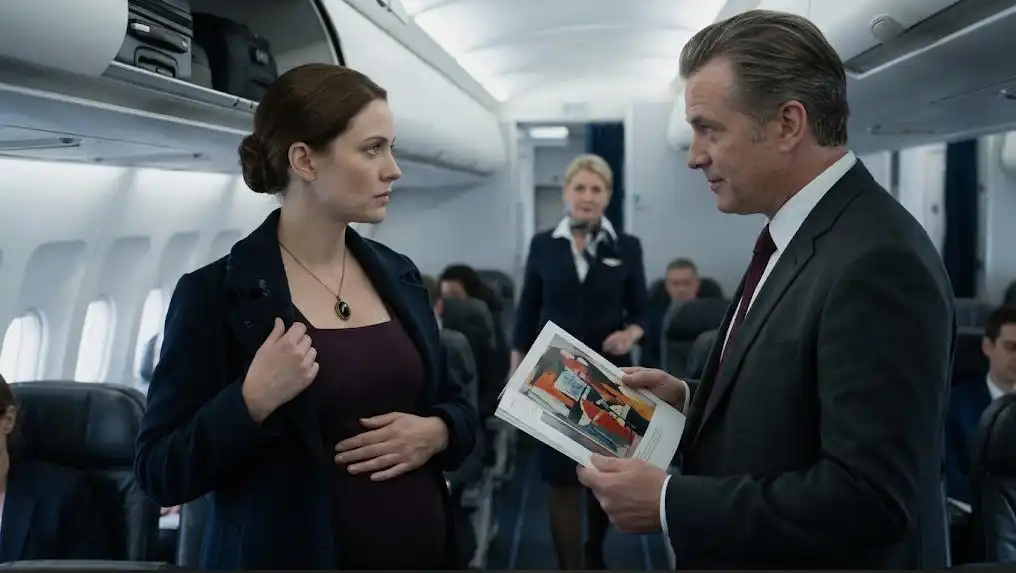
Graham Pike had both hands twisted into Evelyn Vale’s coat lapels. He yanked them apart, ripping the collar seam and dragging the neckline of her blouse sideways. The edge of her maternity bra showed beneath the displaced fabric. Her antique pendant swung against her chest.
Evelyn was thirty-five years old and six months pregnant.
She immediately turned her body away from him, placing one forearm protectively across her abdomen while clutching her damaged coat with the other hand. For one brief moment, the humiliation of having her clothing torn open in front of a cabin full of strangers showed on her face.
Then she looked directly at him.
“You little nobody. That necklace is wasted on you!”
Graham said it loudly enough for everyone nearby to hear.
He was a wealthy gallery owner, or at least that was how he introduced himself at charity dinners, private viewings, and the expensive restaurants where he liked to be recognized. His suits were tailored, his watch cost more than many people’s cars, and he had perfected the expression of a man who believed money entitled him to obedience.
Evelyn gave him none.
A flight attendant hurried down the aisle.
“Sir, step away from her.”
Graham released the coat and straightened his cuffs as though he had merely brushed against someone in a crowded shop.
Evelyn kept her arm over her belly. She was furious, but she refused to give him the frightened reaction he seemed to want.
What Graham did not understand was that the necklace had been the beginning of his mistake, not the end of it.
Ten minutes earlier, he had noticed the pendant while Evelyn was settling into her seat on the flight from New York to Geneva.
It was not an ostentatious piece. The oval black stone had softened edges from age, the gold surrounding it was worn in places, and the three tiny diamonds were almost invisible unless the light struck them correctly.
To Evelyn, it was a family heirloom.
To Graham, it was an opportunity.
He leaned across the armrest and examined it without asking permission.
“Interesting piece,” he said. “I collect important historical jewelry. Five hundred dollars.”
Evelyn looked at him, unsure whether he was serious.
“No, thank you.”
He smiled as if she had misunderstood the conversation.
“I'll give you five thousand. Cash, if you prefer. You clearly don't know what you have.”
“I know exactly what I have. It isn't for sale.”
His smile tightened.
Graham was accustomed to people reconsidering their decisions when he increased an offer. He had built his public reputation by purchasing inexpensive paintings, surrounding them with expensive publicity, and persuading buyers that scarcity and exclusivity were the same thing as artistic merit.
He had also learned that an inflated valuation could be useful even when the underlying artwork was mediocre. A gallery could buy a painting through one company, arrange a sale through another, and use the resulting valuation to support financing elsewhere. When the ownership records were unreliable and the companies shared hidden financial interests, the arrangement could become a vehicle for laundering money.
Graham knew how to make complicated paperwork look impressive.
He was less skilled at recognizing when someone else understood it better than he did.
Evelyn turned back toward the window, ending the conversation.
He took that as an insult.
The argument resumed when they reached the overhead compartment.
Evelyn had placed her small carry-on inside. Graham wanted the remaining space for his leather portfolio and a rigid document case. Instead of asking her to adjust her bag, he shoved it sideways.
“Please don't crush my things,” Evelyn said.
“Move your bag.”
“There's enough room if you turn your case.”
“I said move it.”
She remained where she was.
Graham had spent years treating every refusal as a challenge to his standing. In his world, the person who yielded first lost. He could not bear the possibility that a pregnant woman in an ordinary navy coat might simply decline to do what he wanted.
He seized her coat and tore it open.
Now, in the aisle, with the damage done, he expected the same familiar outcome. Someone would apologize to keep the peace. The woman would retreat. He would regain the space and the attention.
Instead, the flight attendant stepped between them.
“Sir, I need you to move away from her.”
Graham made an irritated gesture but took half a step back.
Mara Collins, the attendant, turned toward Evelyn.
“Are you hurt? Did he strike your abdomen?”
“No,” Evelyn answered. Her voice was controlled, though she was still breathing faster than usual. “He tore my coat.”
Mara removed her own navy uniform jacket and offered it to her.
Evelyn accepted it gratefully. She draped it over her shoulders, covering the torn neckline while keeping one hand near her abdomen. She was conscious of the eyes around her. Some passengers looked concerned. Others looked away, embarrassed to have witnessed the assault.
Graham seemed almost offended that the scene had not ended in his favor.
He turned toward the passengers across the aisle and opened his leather portfolio.
“Since we're all interested in quality,” he announced, “perhaps you'd like to see something worth discussing.”
He pulled out a glossy auction catalogue and opened it to a large photograph of an abstract painting titled The Blue Orchard, attributed to the postwar American artist Adrian Bell.
The painting was the centerpiece of his upcoming Geneva sale. His catalogue assigned it an estimate of thirty million dollars.
He pointed at the image with a theatrical flourish.
“Geneva will make me untouchable.”
Evelyn looked at the catalogue.
Then she noticed the provenance certificate printed beneath the photograph.
The number was familiar.
She had reviewed it in a confidential report before leaving New York.
The certificate claimed that The Blue Orchard had been stored in a private bonded vault for fifteen years before entering a sequence of discreet private collections. The documents looked polished, but one reference number had already been assigned to a different work in the consortium's verified archive.
That discrepancy had been only one part of a larger concern.
Several institutions had submitted records showing gaps in the ownership history of works consigned by Pike Modern. Transfers had passed through companies with overlapping directors and identical registered addresses. A preliminary financial review had identified payments that appeared inconsistent with the stated sales.
The Geneva auction was supposed to be the final opportunity to verify the collection before the lots entered the market.
Evelyn had been traveling there to oversee that review.
She reached into her handbag and removed a compact black communications device.
Graham laughed.
“Calling your husband?”
Evelyn ignored him. She checked the device's connection through the aircraft's approved satellite Wi-Fi, pressed the secure channel, and placed her thumb against the authentication surface.
A silver crest appeared on the screen.
She lifted the device.
“Geneva, this is Evelyn Vale. Invoke emergency authority.”
A brief tone confirmed that the encrypted channel had connected.
The response came from Geneva headquarters.
“Chair Vale, we have your preliminary file open.”
Graham stopped smiling.
Evelyn's family name was not unfamiliar to him. He had seen it on committee announcements and high-value auction reports. But he had never associated the name with the quiet woman whose coat he had just torn.
For years, the public face of the Meridian Auction House had been its auctioneers, curators, and celebrity specialists. The real authority sat behind a much smaller door.
Evelyn Vale was the principal heir to Meridian, the largest high-value auction house and museum-lending alliance in the world. She chaired its Supreme Authentication Committee, whose decisions governed which major works could receive the network's final authentication seal.
The seal mattered far beyond a single auction.
Member auction houses relied on it when accepting major consignments. Museum lenders relied on it when deciding whether to loan valuable works. Insurers and financial institutions used its records when evaluating the risk attached to expensive collections.
A work could remain physically beautiful after losing that seal.
It could also become nearly impossible to sell.
Evelyn had never needed to be photographed at every gala to hold that authority. She preferred to work quietly, and she had chosen this flight without an entourage because the Geneva review was supposed to be a technical matter, not a public spectacle.
Graham had seen the pendant.
He had mistaken its owner for someone he could intimidate.
Now Evelyn addressed the headquarters director through her communicator.
“The provenance certificate for The Blue Orchard conflicts with the verified archive. The ownership chain also intersects with the shell entities identified in the preliminary compliance review. I am invoking the emergency authority on the entire Pike Modern collection.”
There was a brief pause.
“Confirm scope,” the director replied.
“All works held, consigned, or beneficially controlled by Graham Pike or his associated entities. Place every identified lot on the global no-sale list immediately. The network will permanently refuse to auction those works. Preserve the underlying records for the formal compliance review.”
“Understood, Chair Vale. The order is being issued.”
This was not a seizure of Graham's physical property. Evelyn was not pretending to confiscate paintings or replace the work of law enforcement. She was exercising the authority of the network she controlled to refuse authentication and refuse its auction services.
The distinction did not make the consequences any less severe.
Within minutes, the Geneva sale received its first cancellation notices.
The auction house's internal system flagged the Pike Modern lots. Other member houses received the restriction. Museum lenders suspended pending loans involving the same collection. Insurers began reviewing policies tied to the disputed provenance, and institutions that depended on Meridian's certification declined to handle the works until the records could be resolved.
Evelyn did not need to announce her decision to the world personally.
The system did it for her.
Graham's phone vibrated.
He glanced at the screen, dismissed the notification, and looked at Evelyn.
“You can't blacklist an entire collection because someone annoyed you on an airplane.”
“The review was open before you touched me,” Evelyn replied. “The provenance and financial records are why your works are barred.”
He stared at her.
“You're Evelyn Vale?”
“I chair the committee that signs the final authentication certificates for the Geneva sale.”
His expression changed in stages. First disbelief. Then calculation. Finally, the realization that the people he had spent years trying to impress had never regarded his approval as necessary.
He had planned his entire trip around an auction whose final authentication authority was sitting in front of him.
And he had just assaulted her.
“Listen,” he said, lowering his voice. “We can settle this. I can correct the paperwork. Whatever the problem is, we'll fix it.”
Evelyn watched him for a moment.
“You had the opportunity to correct your records before you brought them to market.”
He opened his mouth, but his phone rang again.
This time, he answered.
His auction liaison in Geneva spoke quickly. The principal lots were blocked. The auction could not proceed as planned. The network's refusal covered the entire collection, not just The Blue Orchard.
Graham demanded to speak to someone higher up.
There was no one higher up in the chain of authentication authority he needed.
The hours that followed were worse than the initial cancellation.
His gallery had borrowed heavily against the expected proceeds of the Geneva sale. The financing supported new acquisitions, operating expenses, and the inflated valuations on which much of his business depended. Once the auction was blocked, the lender froze the credit line pending review. The insurer suspended coverage on disputed consignments, and two museum partners withdrew from pending arrangements.
His paintings had not vanished. They were still in storage, still in frames, still covered in paint.
But the market that had given them their supposed value no longer trusted the records attached to them.
Without reputable auction access, dependable insurance, or financing against the expected sale, the collection that Graham had presented as a fortune became a liability.
His operations director sent him a message shortly before the aircraft began its descent.
The bank has frozen the line. We cannot meet payroll or carry the current inventory. The gallery is closing. Staff have been sent home.
Graham read it twice.
Then he called the director.
He argued, threatened, and demanded that someone find a way around the order. The answer did not change. The gallery's creditors were no longer willing to finance the business, and the network's permanent refusal meant there was no credible route to the Geneva sale he had promised them.
Pike Modern's doors would close. Its employees would lose their jobs. The loans would remain due, and Graham would have to answer for the financial records that had brought the collection under review.
His entire public image had been built around the idea that he could assign value to anything.
Now the people who had financed that image were asking what any of it was worth.
Evelyn spent the remaining flight with Mara's jacket over her damaged coat. She checked in with the Geneva team, confirmed that the disputed records would be preserved, and asked that the review proceed independently of the assault investigation.
She wanted the evidence handled correctly. Her humiliation was not a substitute for proof, and the assault did not erase the financial questions that had existed before she boarded the plane.
By the time the aircraft landed, the auction was canceled, Pike Modern's operations had collapsed, and the permanent refusal was in effect throughout the Meridian network.
Airport police boarded after the aircraft reached the gate.
The flight crew provided their account of the assault. Passenger witnesses were identified, and Evelyn's torn coat was preserved as evidence of the damage. Officers informed Graham that he was being arrested on assault and property-damage charges.
A medical professional checked Evelyn before she left the aircraft. There was no immediate sign of injury, but she was advised to follow up with her obstetrician because of the incident. She rested one hand over her abdomen and listened carefully to the instructions.
Graham, meanwhile, was staring at another message on his phone.
His gallery was finished. His lenders had withdrawn. His Geneva auction was gone. The paintings he had expected to turn into millions could no longer enter the market through the network that had once given his claims credibility.
He looked at Evelyn as though she might still reverse the decision.
She did not.
The officers approached him to take him into custody. For a moment, he seemed unable to accept that the people around him were no longer waiting for his instructions.
Then he turned abruptly and began striking his forehead against the padded cabin partition.
One blow.
Then another.
He kept doing it in a frantic, desperate rhythm, as if he could force the world to return to the version in which his money and confidence had made him untouchable. The officers reached for his shoulders while he twisted toward the wall again.
Mara's navy jacket rested over Evelyn's torn coat. Evelyn sat upright in her seat, one hand resting protectively over her belly, the antique pendant still visible at her throat.
She watched Graham Pike desperately hammer his head against the cabin wall, her face cold and unreadable, while the officers moved to restrain him.
Disclaimer: Mention of any brand or trademark is for identification only and does not imply partnership or endorsement
A Wealthy Manhattan Socialite Poured Red Wine on a Plus-Size Artist at a Charity Gala, Calling Her “Cheap and Unworthy.” She Had NO IDEA Who Would Discover Her Paintings... 😱
A Celebrity Trainer Threw CASH in a Plus-Size Nutritionist’s Face at a Luxury LA Gym, Saying She Couldn’t Even Control Her Own Weight. He Had NO IDEA What Her Clients Would Prove... 😱
My Fiancé’s Mother CUT MY Custom Engagement Dress in Front of 200 Guests and Called Me an “Elephant in a Sack.” My Fiancé Just SMILED... 😱