

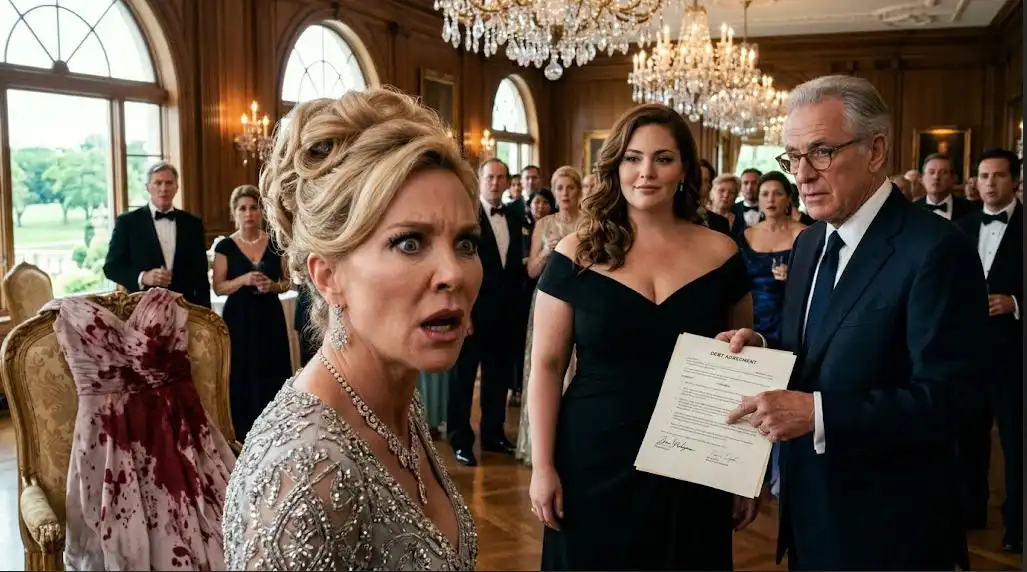
Samantha Whitmore was still laughing when the club president opened the sealed financial agreement.
She had spent years making people feel small inside the Hampton Country Club.
Now, nearly two hundred guests watched her discover that the woman she had thrown out was the one person who could help save the club.
Three days earlier, Samantha had poured red wine down my dress and ordered security to remove me from the building.
She had believed that my job, my appearance, and my quiet manner made me powerless.
She was about to learn how badly she had misjudged me.
My name is Harper Collins, and horses had been part of my life since childhood.
When I was nine, my grandfather took me to a small riding stable outside the city. I was nervous around the larger horses, and I remember clinging to the saddle while he walked beside me.
“Confidence doesn't mean you're never afraid,” he told me. “It means you learn to listen, stay steady, and keep going.”
I never forgot those words.
By my twenties, I had become a qualified riding instructor. I specialized in helping young riders develop balance, patience, and confidence.
I loved watching a nervous child enter the stable afraid to touch a horse and leave several weeks later smiling proudly from the saddle.
For some children, riding was a sport.
For others, it was the first place they discovered they could do something difficult and succeed.
I wanted to make that experience available to more families.
My work eventually brought me to the Hampton Country Club, an exclusive private club with a prestigious equestrian program, beautiful stables, and a long history of hosting charity events.
The club served wealthy families, prominent businesspeople, and donors who supported youth sports and local community programs.
Its facilities were impressive.
The stables overlooked rolling green fields. The main building had polished oak floors, a grand staircase, and a ballroom with enormous windows overlooking the gardens.
But behind the elegant appearance, the club had begun to struggle financially.
Membership renewals were declining.
Maintenance costs were rising.
Several large events had failed to generate the revenue expected.
And the club's leadership had delayed dealing with mounting debt for far too long.
When I first joined the equestrian program, I didn't know any of this.
I simply wanted to teach.
I arrived early, checked the tack, reviewed each student's lesson plan, and made sure the horses were properly cared for.
I stayed late when a child needed extra help.
I helped nervous parents understand how to support young riders without putting too much pressure on them.
I also volunteered at several youth charity events, where I organized riding demonstrations and introductory lessons for children who otherwise could not afford them.
The work was meaningful.
Unfortunately, not everyone at the club valued it.
Samantha Whitmore chaired the club's charity committee.
She was wealthy, socially connected, and exceptionally skilled at making her preferences sound like official policy.
She believed the club should be a place where the right people could see and be seen.
The charity work mattered to her, but so did the photographs, the guest lists, and the prestige attached to her title.
She was particularly dismissive of anyone she considered socially inferior.
And she had decided that I belonged in that category.
The first time she made a comment about my weight, we were preparing for a youth riding fundraiser.
She watched me arrange the demonstration equipment, then looked me up and down.
“Harper, perhaps you should let someone else handle the photographs. We want the event to look polished.”
I thought I had misunderstood.
“I'm coordinating the riding demonstration,” I replied. “I'll be with the students.”
“Of course. Just leave the public-facing parts to the committee.”
She smiled as if she had offered helpful advice.
I returned to work.
A week later, she removed my name from the program as the lead instructor for the demonstration.
When I asked why, she said the committee had decided that a more suitable representative should appear in the promotional materials.
The replacement had no experience teaching children to ride.
I raised the concern with the event coordinator, who quietly restored my name to the program.
Samantha was furious.
After that, she made a point of reminding me that I was not a member of the club's social elite.
At committee gatherings, she introduced me as “one of our stable employees,” even when I had been invited to discuss the equestrian program.
When donors asked about the youth lessons I had developed, she redirected the conversation toward the committee's fundraising achievements.
She also began excluding me from events that directly affected the program I managed.
I could have left.
There were other riding facilities in the area.
But the club had excellent horses, experienced stable staff, and facilities that gave our students opportunities they could not easily find elsewhere.
I had worked hard to establish the youth program.
I didn't want Samantha's arrogance to undo that work.
So I focused on the children and ignored the insults as best I could.
What Samantha didn't know was that I had another life outside the stables.
Years earlier, my father had sold a technology business and placed part of the proceeds into a family investment company. After his death, I inherited a substantial interest in that company.
I had invested conservatively, studied the businesses in which we held interests, and gradually taken on more responsibility for managing the portfolio.
I never discussed money at the club.
I drove an ordinary car.
I wore practical riding clothes.
I spent most of my days in boots that were usually covered in dust or mud.
I didn't want students, parents, or colleagues treating me differently because of my finances.
My wealth was not a teaching qualification.
It was not proof that I was a better person.
And it certainly wasn't something I needed to display to earn basic respect.
Then I began noticing the club's financial problems.
At first, it was small things.
A supplier asking when an overdue invoice would be paid.
A maintenance contractor postponing work because the club had not settled an earlier bill.
A stable employee mentioning that a planned equipment replacement had been delayed again.
I asked the club's finance director whether the equestrian program should prepare for budget reductions.
He looked uncomfortable.
“We're reviewing several options,” he said. “Nothing has been finalized.”
I accepted the answer.
But a few weeks later, I received an unexpected call from an investment adviser who managed part of my portfolio.
The club had outstanding obligations to several lenders, and one of those lenders was preparing to sell a substantial secured debt position.
The club was at risk of default.
The debt was legally documented, but its repayment prospects had deteriorated because of the club's financial condition.
The adviser asked whether I wanted to review the opportunity.
I initially hesitated.
I had no interest in becoming involved in the club's politics.
But I also knew what would happen if the club collapsed.
The stables might close.
The horses would need new homes.
The youth program could disappear.
Employees who had devoted years to the facility might lose their jobs.
I asked for the financial documents.
I reviewed the debt agreements, the security arrangements, the outstanding obligations, and the club's available assets.
I commissioned an independent financial review and consulted my attorney about the risks.
The numbers were troubling.
The club had borrowed heavily to support expensive renovations and prestigious events, assuming membership income would recover quickly.
It hadn't.
Several major fundraising events had underperformed.
Operating costs had increased.
The club was struggling to meet its obligations.
Buying the debt would not guarantee a profit.
If the club failed, the recovery could be difficult and expensive.
But if the club could restructure its obligations, improve its finances, and rebuild its membership, there was a path forward.
I decided to acquire the secured debt position through my investment company.
The transaction was negotiated at arm's length and documented by the relevant advisers.
After closing, my investment company became the club's largest creditor.
I did not announce my involvement.
I wanted the financial review completed before making any commitments.
I also wanted to understand whether the board was willing to confront the problems that had brought the club to the edge of insolvency.
My proposal was straightforward.
I would support a restructuring plan, provide emergency financing under a properly documented agreement, and work with the board on a realistic recovery strategy.
In return, the club would accept independent financial oversight, transparent governance, and meaningful accountability for its leadership.
The club's board was already discussing emergency options.
My adviser informed the president that a potential financing arrangement was available, subject to due diligence and formal approval.
The identity of the investor remained confidential during the preliminary negotiations.
Samantha knew the club was in trouble.
She simply refused to acknowledge how serious the situation had become.
At committee meetings, she continued talking about the annual charity gala as though a successful evening would solve every problem.
“We need to maintain our reputation,” she insisted. “The club cannot afford to look desperate.”
One board member pointed out that several creditors were demanding payment.
Samantha waved him off.
“Every organization has cash-flow issues. We need better fundraising, not panic.”
She then proposed spending additional money on elaborate decorations and a celebrity appearance for the upcoming gala.
The finance director warned that the budget was already under pressure.
Samantha accused him of lacking ambition.
I heard about the discussion from a member of the equestrian committee.
I was deeply concerned.
The club needed careful financial management, not another expensive performance designed to make wealthy guests feel important.
I asked whether the youth program's budget was secure.
Nobody could give me a clear answer.
Then the invitation to the charity gala arrived.
I had helped coordinate the equestrian demonstration and had been asked to attend as a representative of the program.
I accepted.
I hoped the gala would raise enough money to protect the youth initiative.
I also hoped the board would soon finalize a sensible rescue plan.
I had no idea that the evening would become the turning point in both the club's future and my own.
On the night of the gala, the ballroom glittered beneath crystal chandeliers.
Waiters moved between tables carrying champagne and hors d'oeuvres.
A string quartet played near the windows.
The guests wore formal evening attire, and the charity committee had arranged a display celebrating the club's history.
Samantha stood near the entrance in a deep-red evening gown, greeting donors as if she were hosting a royal reception.
She looked immaculate.
She also looked delighted with herself.
When I arrived, wearing a simple navy evening dress, she glanced at me and frowned.
“Harper. I wasn't expecting you.”
“I was invited to represent the equestrian program.”
“Yes, well, tonight is primarily for major donors.”
“I understand. I'll be with the program representatives.”
She gave a thin smile.
“Try not to get in the way of the photographs.”
I walked past her.
For the first hour, the evening proceeded normally.
I spoke with several donors who had supported the youth riding lessons. I thanked them for their contributions and explained how the program helped children develop confidence, discipline, and responsibility.
One couple asked whether the club would continue offering subsidized lessons next season.
“I hope so,” I replied. “We're doing everything we can to keep the program running.”
Samantha overheard us.
“Let's not make promises we can't keep,” she interrupted. “The committee will decide which programs deserve continued funding.”
The couple exchanged uncomfortable glances.
I said nothing.
Later, during the reception, I approached the committee table to ask about the schedule for the youth program's presentation.
Samantha was speaking with several donors.
She turned toward me.
“Harper, this really isn't the place for stable business.”
“I'm asking about the presentation schedule.”
“Then ask someone whose job it is to organize the program.”
“I am one of the people organizing it.”
Her expression hardened.
“Don't argue with me in front of guests.”
“I wasn't arguing.”
She looked around, apparently noticing that several people were listening.
Then she picked up her glass of red wine.
“You know what your problem is?” she asked.
I stared at her.
“You think doing ordinary work makes you important.”
The conversation around us began to fade.
“Samantha, please. I'm here for the charity program.”
She laughed.
“You're here because someone thought it would look good to invite a riding instructor. Don't confuse that with belonging.”
I felt my cheeks grow warm.
A few guests lowered their eyes.
Others turned to watch.
I could have walked away.
Instead, I told her quietly that I expected to be treated with the same courtesy as every other guest.
That was when she tipped the glass.
Red wine spilled across the front of my dress.
I gasped and stepped backward.
Samantha held the empty glass in one hand.
“There,” she said. “Perhaps now you'll remember your place.”
Someone near the stage exclaimed, “Samantha!”
She ignored the protest.
“Security, please escort her out. We cannot have people embarrassing our donors.”
I looked around the ballroom.
Two hundred people had witnessed what happened.
Some appeared shocked.
A few guests raised their phones.
Most simply watched.
I wanted to shout.
I wanted to tell Samantha exactly who she was and what I thought of her behavior.
Instead, I took a napkin from a nearby table and pressed it against the wine on my dress.
Then I looked directly at her.
“You should be very careful about confusing a title with authority.”
She laughed.
“Are you threatening me?”
“No,” I replied. “I'm giving you a chance to think about what you've just done.”
She gestured toward security again.
“Get her out.”
The security supervisor approached me politely.
“Ms. Collins, would you please come with me?”
I nodded.
I wasn't going to create a scene for Samantha's entertainment.
As I walked toward the doors, I heard her speaking to the guests.
“Honestly, some people simply don't understand how a private club operates.”
The doors closed behind me.
I stood in the cool night air for several seconds, staring at the wine stains on my dress.
I had spent years helping the club's young riders build confidence.
I had worked through holidays, weekends, and long afternoons in the rain.
I had tried to make the equestrian program a place where children felt welcome.
And now, a woman who had contributed far less to that work had publicly treated me as though I were disposable.
I felt the sting of humiliation.
But beneath it was something steadier.
Resolve.
I called my attorney.
“I'm ready to proceed with the rescue agreement,” I said.
He asked whether I wanted to change any of the proposed terms.
“No. The club needs a sustainable plan, and the board needs to understand that the financing comes with responsibilities.”
“We'll prepare the final documents.”
“Thank you.”
Then I called my investment adviser.
I instructed him to confirm the status of the debt acquisition and coordinate with the club's financial advisers.
I did not ask anyone to punish Samantha.
I did not demand that the board remove her simply because she had insulted me.
I wanted the club's financial situation addressed through the proper process.
If Samantha had violated the club's conduct policies, the board could investigate that behavior separately.
If the charity committee had failed to meet its responsibilities, its governance could be reviewed.
The financing agreement would not replace those procedures.
It would make them possible.
Three days later, I returned to the club.
This time, I wore an elegant black gown.
My attorney accompanied me, along with the financial advisers who had helped structure the rescue agreement.
The board had called an extraordinary meeting before the evening's scheduled reception.
The club president had agreed to present the financing proposal to the board and explain the conditions attached to it.
Samantha was already in the ballroom when we entered.
She spotted me immediately.
Her face twisted with irritation.
“You again?”
I continued walking.
She stepped in front of me.
“I thought security had made it perfectly clear that you weren't welcome here.”
My attorney answered calmly.
“Ms. Collins is attending at the invitation of the board.”
Samantha looked him up and down.
“And you are?”
“Her legal counsel.”
Samantha laughed.
“Is this some kind of publicity stunt?”
The club president rose from the head table.
“Everyone, may I have your attention?”
Conversations stopped.
He explained that the club had been facing a serious financial crisis.
Outstanding debts, delayed payments, and declining revenue had left it in danger of default.
Without new financing and a credible restructuring plan, the club could face severe financial consequences, including the possible sale of assets or a formal insolvency process.
The room grew quiet.
Samantha looked increasingly uncomfortable.
The president continued.
“After an extensive review, we have secured a proposed rescue arrangement from the investment company that now holds the club's largest secured debt position.”
He turned toward me.
“Harper Collins is the principal representative of that company.”
For several seconds, nobody moved.
A donor near the front whispered, “The riding instructor?”
Samantha stared at me.
“You?”
I nodded.
My attorney placed the signed debt agreement and financing proposal on the table.
“The creditor's position is documented,” he explained. “The proposed rescue financing is subject to the board's approval and the agreed restructuring conditions. These include independent financial oversight, transparent reporting, and governance reforms.”
Samantha shook her head.
“This is absurd. Harper has no experience running a country club.”
I met her gaze.
“I didn't offer to run the club's daily operations. I offered to help prevent it from collapsing.”
“But you're demanding changes!”
“I'm requiring accountability in exchange for taking financial risk.”
She turned toward the president.
“You cannot allow this woman to dictate our policies.”
The president looked tired.
“Ms. Whitmore, the club needs a credible financial recovery plan. We have reviewed the proposal with our advisers, and the board must consider it on its merits.”
My attorney then addressed the room.
“The financing agreement does not give Ms. Collins unilateral authority to remove committee members. Any governance changes must follow the club's bylaws. However, the board has also received a formal report concerning the conduct at the previous gala.”
Samantha went still.
The report included statements from several witnesses, photographs of the wine-stained dress, and accounts from guests who had seen Samantha pour the wine and order security to remove me.
The board had also received complaints from other members about Samantha's conduct at previous events.
The chairman of the governance committee stood.
“We have reviewed the evidence. The question before us is whether Ms. Whitmore's behavior is consistent with the standards required of the charity committee chair.”
Samantha immediately protested.
“This is a personal vendetta!”
The committee chairman shook his head.
“The review concerns documented conduct, not personal relationships. You were entrusted with representing the club. The evidence indicates that you used your position to humiliate a guest and attempted to have her removed without a legitimate basis.”
“I was protecting the club's reputation!”
“Pouring wine on a guest is not a reputation-management strategy,” he replied.
A few people shifted uncomfortably.
Samantha turned toward me.
“You planned this!”
“No,” I said. “You poured the wine. I left. The board reviewed what happened.”
She opened her mouth, but no words came.
The governance committee presented its recommendation.
The board would vote on removing Samantha as charity chair and terminating her committee privileges. A separate vote would address the club's permanent membership sanctions under its bylaws.
The president called the first vote.
Hands rose around the table.
The result was decisive.
Samantha was removed as chair of the charity committee, effective immediately.
The president then called the vote on the rescue financing proposal.
The board approved the agreement subject to its final legal and financial conditions.
My investment company would provide the agreed emergency financing and restructure the debt under the documented terms.
In exchange, the club would implement the financial controls and governance reforms required by the agreement.
The board also commissioned a wider review of the charity committee's spending and decision-making practices.
Samantha sat frozen.
She had entered the evening believing she controlled the room.
Now the board had removed her title, the rescue plan was moving forward without her leadership, and her conduct was formally documented.
But the story did not end there.
The membership committee later completed its review and determined that Samantha's conduct violated the club's standards. Following the procedures set out in the bylaws, the club permanently revoked her membership.
She was no longer the charity chair.
She was no longer permitted to attend club events as a member.
And she could no longer use the club's name to reinforce her social standing.
Security did not drag her through the ballroom.
They simply escorted her out after the meeting ended.
As she passed me, she stopped.
“You've taken everything from me.”
I looked at her.
“No, Samantha. I didn't take your title. The board voted on it. I didn't create the financial crisis. The records established that. And I didn't pour wine on you.”
She looked away.
I continued.
“You had every opportunity to treat people with dignity. You chose not to.”
She left without another word.
The following months were not glamorous.
Rescuing the club required difficult decisions.
The board reviewed operating expenses, renegotiated contracts, and established a realistic repayment schedule.
Several unnecessary expenditures were eliminated.
The membership team developed a more sustainable renewal strategy.
The equestrian program received a proper budget review, and the club established clearer criteria for allocating charitable funds.
I attended the meetings as the representative of the largest creditor and financing investor.
I did not dictate every decision.
The board remained responsible for managing the club in accordance with its governing documents.
My role was to ensure that the rescue financing was used responsibly and that the agreed reforms were implemented.
Slowly, the club stabilized.
Vendors began receiving payments according to the restructuring plan.
Maintenance work resumed.
Membership renewals improved as members gained confidence that the club had a credible future.
The stables remained open.
And the youth riding program survived.
That was the outcome I had wanted from the beginning.
But I also wanted to do something more.
For years, I had watched talented young riders lose opportunities because their families could not afford private lessons, competition fees, or the equipment required to participate.
Some children were told that equestrian sport was only for wealthy families.
Others lacked access to experienced instructors who understood how to support nervous beginners.
I knew how much a horse could teach a young person about patience, courage, and responsibility.
I wanted more children to experience it.
So I established the Harper Collins Youth Equestrian Empowerment Fund.
The fund was created as an independent charitable initiative with transparent financial oversight and clear eligibility criteria.
It would provide lesson scholarships, riding equipment, transportation assistance, and access to qualified instructors for young people who otherwise could not afford to participate.
The club agreed to provide facilities for several of the fund's programs under a formal agreement.
The first group of scholarship recipients arrived on a bright spring morning.
Some were nervous.
Some could barely contain their excitement.
One little girl stood beside a gentle chestnut pony, staring at the saddle.
“I'm scared I'll fall,” she admitted.
I knelt beside her.
“It's normal to be nervous. We'll go slowly, and your instructor will stay beside you.”
She looked at the horse again.
“What if I can't do it?”
I smiled.
“You don't have to prove anything today. You just have to try the first step.”
She took a breath and reached out to stroke the pony's neck.
A few minutes later, she was sitting in the saddle with an instructor walking beside her.
Her face lit up.
I watched her ride around the arena, and I felt the same happiness I had felt when I first began teaching.
This was why I had stayed.
This was why I had invested in the club.
Not for the chandeliers.
Not for the charity gala photographs.
Not for a title or a seat at an exclusive table.
For the children.
For the horses.
For the chance to make a difference in someone's life.
Several months later, the club hosted another charity event.
This time, the guest list included families from the youth riding program, local supporters, and donors who wanted to contribute to the new fund.
The ballroom was elegant, but the atmosphere was different.
The event focused on the young riders and the opportunities the fund had created.
There were photographs of children learning to groom horses, instructors helping beginners mount safely, and scholarship recipients proudly holding their riding certificates.
I stood near the entrance and watched guests greet the children.
One of the parents approached me.
“Harper, I don't know how to thank you. My daughter has been talking about her riding lessons every day.”
I smiled.
“She's the one doing the hard work. We're just giving her the opportunity.”
Across the room, the club president raised his glass.
He thanked the donors, the staff, the instructors, and the volunteers who had helped restore the club's finances and rebuild its reputation.
Then he acknowledged the new youth fund.
The applause was warm and genuine.
I thought about the night Samantha had poured wine on my dress.
I remembered the sting of humiliation, the silent faces, and the walk out through the club's front doors.
At the time, I had felt as though the entire room had decided I did not belong.
Now I understood that belonging had never been something Samantha could grant or take away.
She had held a title.
I held a financial claim that gave me the ability to help rescue the club.
But neither of those things was the true measure of a person's worth.
The real measure was what we chose to do with the power we had.
Samantha had used hers to humiliate people.
I chose to use mine to preserve the club, protect the equestrian program, and create opportunities for children who had been told that they did not belong.
That evening, after the guests had left, I walked out to the stables.
The air smelled of fresh hay and spring grass.
A young rider was helping brush a pony before returning it to its stall.
She looked up and waved.
“Goodnight, Harper!”
“Goodnight. I'll see you next week.”
I watched her lead the pony inside.
Then I stood quietly beside the paddock, listening to the horses move in the evening light.
My grandfather's words returned to me.
Confidence doesn't mean you're never afraid.
It means you learn to listen, stay steady, and keep going.
I had learned that lesson on horseback.
I had learned it again in the ballroom.
And I would carry it into every decision that followed.
The Hampton Country Club survived because its leadership finally faced the truth about its finances.
Samantha lost her position because the board held her accountable for her conduct.
And the children in our equestrian program gained opportunities that would last far longer than any charity title.
I had returned to the club as its largest creditor.
I left that chapter of my life knowing I had helped build something more valuable than a balance sheet.
I had helped create a place where young people could learn that courage was not reserved for the wealthy, dignity was not reserved for the beautiful, and opportunity should not depend on a family's social standing.
And if anyone ever asked me what I had gained from that terrible evening, I would tell them the truth.
I had gained the chance to turn humiliation into something useful.
Not by humiliating Samantha in return.
By making sure that the club she had treated as her private kingdom became a place where more people could belong.
Choose your side: HARPER WAS RIGHT TO HOLD SAMANTHA ACCOUNTABLE AND SAVE THE CLUB, or SAMANTHA DESERVED ANOTHER CHANCE BECAUSE OF HER CHARITY WORK.
Comment your choice and share this story with someone who believes that true class is measured by how we treat people, not by the exclusivity of the rooms we enter.
Disclaimer: Mention of any brand or trademark is for identification only and does not imply partnership or endorsement

A Luxury Boutique Manager Called a Plus-Size Game Developer “Too Poor to Shop Here” and THREW AWAY Her Credit Card. She Had NO IDEA Who Just Bought the Mall... 😱
My Wealthy Aunt Let Her Daughter CUT MY HAIR at Thanksgiving and Called Me a “Family Embarrassment.” Then Grandpa’s Lawyer Opened the REAL Will... 😱

My Fiancé Slapped Me and Let His Rich Mistress Smash My Handmade Engagement Cake in Front of 100 Guests. He Had NO IDEA What I Owned... 😱