
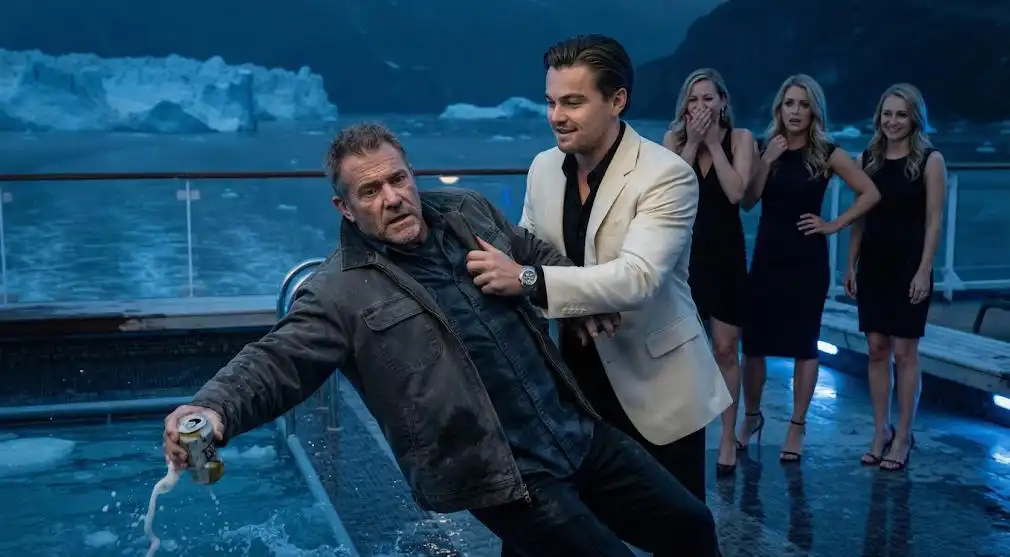
The beer was still cold in Everett Cole's hand when Grant Whitaker took it from him.
Everett had just turned toward the railing to watch a dark iceberg slide past the Northstar's upper deck. He never saw Grant approach until the younger man's fingers closed around the can.
Grant snatched it away, sloshing beer over his own knuckles, then shoved Everett hard in the chest.
“You old bum. Go take a cold bath and come to your senses!”
Everett's heels slipped. His arms flew outward, searching for something to grab, but there was only empty air behind him. A second later, he hit the outdoor pool with a splash that sent water over the stone edge.
Laughter rose from the party.
Grant stood above him, holding the stolen beer. His three female companions laughed, too, although one of them, a red-haired woman in a burgundy dress, stopped when she saw Everett's head disappear beneath the water for a moment.
Everett surfaced coughing.
The cold shocked the breath out of him. His jacket had become a heavy, dragging weight, and water streamed down his face. For one humiliating second, he could hear nothing but the laughter and the pounding of his own heart.
Then anger caught up with the shock.
He had been pushed into a pool like a dog being thrown out of someone's way. Fifty-five years old, with a lifetime of hard work behind him, he was being treated as if his presence alone had spoiled the evening.
Grant leaned over the edge and extended a hand, his expression suggesting that the whole thing had been harmless fun.
Everett slapped the hand away.
“You don't get to put your hands on me.”
His voice shook, partly from the cold and partly from the effort of keeping his anger under control.
Grant's smile tightened. He lifted the beer can in a mock toast, then turned back toward his companions as if Everett had already ceased to matter.
Everett gripped the pool edge and pulled himself out. His boots slipped once on the wet stone, but he braced a forearm against the ledge, got one knee onto the deck, and hauled himself upright.
He wanted to hit Grant. The thought arrived hot and immediate.
Instead, he stood there dripping, breathing hard, and refused to give the younger man another reason to laugh.
Then he walked away.
He had not spent years saving money for this trip to fight with a stranger.
The Northstar was making a ten-day voyage along Alaska's glacier coast. Everett had purchased the cheapest lower-deck cabin, one without a window, because he didn't need a luxury suite. He needed only a place to sleep and a chance to see the northern lights.
For years, he had worked odd jobs repairing docks, maintaining boats, and taking whatever honest work came his way. His old canvas jacket had survived more winters than he could count. His hands were scarred, his back ached when the weather changed, and his retirement savings were modest.
But he had spent twenty-two years in the Navy as a deep-sea salvage diver, entering places where visibility vanished, metal groaned under pressure, and a single careless movement could cost a life.
He had left that world behind. These days, he preferred quiet mornings, simple meals, and work that ended with everyone coming home alive.
The trip to Alaska was supposed to be a reward for all those years.
He had imagined standing at the railing beneath a sky full of green light, with no alarms, no orders, and no one demanding anything from him.
Instead, he had been pushed into a swimming pool by a man who thought the price of his ticket made him more important than everyone else.
Everett reached the stairwell, pulled off his soaked jacket, wrung out one sleeve, and stopped to catch his breath.
That was when the ship shuddered.
The first jolt was so violent that the railing vibrated beneath his hand. A second impact followed, accompanied by a deep metallic groan that seemed to travel up through the soles of his boots.
Glasses shattered on the deck.
The lights blinked twice.
Then an alarm began to howl.
Everett turned toward the sea. The Northstar had been steering around a low iceberg in a narrow channel. Now the ship's bow swung awkwardly, and a tremor passed through the hull.
He knew that sound.
It was the sound of a large structure taking damage.
Crew members hurried past him toward the interior stairs. One shouted for passengers to move away from the outer decks. Another was speaking urgently into a radio.
Everett followed the flow of people toward the main passage, still wearing his soaked shirt and trousers.
A few minutes later, the lights failed completely.
Emergency lamps flickered on, painting the corridor in a dim red glow. Water sloshed across the lower stair landing, carrying a plastic crate and several loose pieces of insulation.
A crewman grabbed a handrail as another wave of water surged up from below.
“The lower machinery space is flooding!” he shouted.
Everett moved closer.
At the emergency control station, Chief Engineer Nora Bennett was bent over a panel, her gray-streaked hair tied back and her sleeves rolled above her elbows. She was speaking into a radio while trying to make sense of a row of unresponsive indicators.
Captain Richard Hale stood beside her, issuing instructions so quickly that two crew members started moving in opposite directions.
“What happened?” Everett asked.
Neither answered him at first.
Nora finally turned. “We struck a submerged rock shelf while avoiding the ice. The hull is breached below the waterline.”
“Can you isolate it?”
“We're trying.”
She pointed to the schematic mounted beside the panel. Seawater was pouring into a lower machinery compartment. A watertight door separated that compartment from the space containing the ship's backup generator.
The door should have closed automatically.
It had jammed halfway down.
The remote hydraulic control was no longer responding. The manual override wheel was mounted low inside a narrow access passage that was already underwater.
“If we don't get that door shut,” Nora explained, “the water will reach the generator compartment. We'll lose the pumps, the control systems, and whatever power we still have to work with.”
“How long?”
“Four minutes, perhaps less.”
Captain Hale pressed the radio to his mouth and demanded an update from the bridge. He received an answer, interrupted it, and began shouting another order.
Nora ignored the confusion and tried the manual controls again.
Nothing moved.
A sailor named Owen Price descended the first few steps toward the flooded passage with a safety line attached to his waist. He managed to reach the submerged landing before the freezing current forced him back. He came up gasping, his hands shaking so badly that he struggled to unclip the line.
“I can't see anything down there,” he said. “The current is pulling sideways. I couldn't find the wheel.”
Nora looked toward the crew locker.
The ship carried emergency breathing equipment, but it was not suitable for a submerged entry through a flooded machinery passage. The maintenance diving kit was inaccessible beyond the damaged section, and assembling an alternative setup would take longer than they had.
There was no qualified rescue diver ready to go.
Everett looked at the schematic again.
He recognized the layout of the access passage, not the exact ship design but the principle behind it. He had spent years working around watertight compartments, jammed mechanisms, and underwater spaces where a person had to find the right piece of metal by touch alone.
He stepped beside Nora.
“Where exactly is the override?”
She pointed to a marked recess at the bottom of the service stairs. “There. A quarter turn should release the reserve hydraulic pressure. That should pull the door shut.”
“Is the wheel seized?”
“We believe the linkage is bent, and the wheel hasn't responded.”
“Then somebody has to reach it.”
Nora looked at his soaked clothes, his gray hair, and his trembling hands.
“You're not going down there.”
Everett met her eyes.
“I used to do underwater salvage for the Navy.”
“That water is near freezing. There's no visibility, no breathing gear, and no guarantee you'll find your way back.”
“I know what the water is.”
He did not say it to frighten her. He said it because he understood the risk better than most people in the corridor.
Behind them, Grant Whitaker had finally stopped pretending that the emergency was an inconvenience.
He was standing near a group of passengers being directed toward the muster stations. His face had gone pale, and he kept looking toward the exits.
When a deck officer explained that the crew was organizing evacuation preparations, Grant pulled a wad of cash from his wallet.
“Take this,” he said. “Get me onto the first launch. I can pay more than anyone else here.”
The officer pushed the money back against his chest.
“Evacuation isn't for sale. Follow the crew's instructions.”
Grant stared at him, apparently unable to understand why the money had failed.
Everett watched for only a moment.
He could have stayed where he was. He could have let Grant face the same helplessness he had inflicted on someone else. Nobody would have blamed him for refusing to risk his life for strangers, least of all for the man who had just humiliated him.
But the people behind the emergency barrier were not all Grant Whitaker.
There were older passengers who could barely manage the stairs. There were families clutching children. There were crew members working with equipment that was failing faster than they could repair it.
And there was a generator that needed to stay dry.
Everett pushed through the frightened crowd toward the service stairs.
“Show me the access,” he told Nora.
She hurried after him.
“Mr. Cole, listen to me. You have no suit, no air supply, and no proper safety equipment. If you lose your orientation, we may never get you out.”
“Then keep someone at the top of the stairs who knows what they're looking for.”
He paused at the landing and studied the passage. The water had climbed several steps, and loose debris moved in the current below.
His hands were shaking from the cold, but his eyes had become steady.
“Tell me where the wheel is in relation to the handrail.”
Nora pointed out the route on the diagram, explaining the narrow turn beneath the landing and the position of the valve housing. Everett repeated the directions back to her. He asked about the door's travel direction and the expected response from the hydraulic system.
When he understood the layout, he nodded once.
A crewman secured a thin safety line around Everett's waist. It would provide a reference for the people above, not air or protection from the cold. Two crew members took hold of the line while Nora remained beside the controls.
Everett did not put on a diving suit or a breathing apparatus. He had neither time nor access to either.
He took one deep breath.
Then he went down the stairs and disappeared into the black water.
The cold struck him with such force that his chest seized. His soaked clothes dragged at his limbs, and the current pressed him against the rail. He kept one hand on the metal, using it to orient himself as he moved beneath the surface.
The water was cloudy with silt, insulation, and fragments of broken equipment. He could not see the bottom of the passage. He had to feel his way forward, searching for the recess Nora had described.
His fingers brushed a pipe.
Then a jagged edge of metal.
Then the rounded housing of the hydraulic valve.
He found the wheel.
It was larger than he had expected, with thick spokes and a corroded central fitting. He wrapped both hands around it and pulled.
Nothing happened.
He changed his grip and tried again, bracing one boot against the bulkhead.
The wheel gave a fraction of an inch, then locked solid.
His lungs were beginning to burn.
Everett forced himself to release the wheel and follow the rail back toward the landing. His head broke through the surface inside a small pocket of trapped air near the stairs. He dragged in a breath, coughing as cold water ran from his mouth.
Above him, Nora shouted something.
He could barely hear her over the alarm and the pounding of water in the passage.
“Did you find it?” she called.
Everett raised one hand.
“Yes.”
“Can you turn it?”
He looked at the water, then at the crew holding his safety line.
“Not yet.”
His fingers were already losing their sensitivity. The cold had moved past the sharp shock of immersion into a deeper, more dangerous numbness. He knew he could not keep making repeated attempts indefinitely.
He also knew the wheel had moved.
That meant it was not completely locked.
He took another breath, drew his shoulders back, and submerged again.
This time he followed the handrail directly to the valve. He found the wheel by touch and planted both feet against the bulkhead to give himself leverage.
He pulled with both hands.
The metal resisted.
He shifted his grip, twisted his torso, and pushed one spoke downward while drawing another toward himself. His shoulders strained. The safety line tugged against his waist as the current dragged at his legs.
The wheel moved a fraction.
Everett stopped, reset his grip, and pulled again.
A sharp pain burst through both ears. The pressure and the violent vibration of the damaged hydraulic system struck him at once. For a moment, his sense of direction disappeared. The water seemed to spin around him, and a high, piercing sensation filled his head.
He nearly let go.
Then he felt the wheel move again.
He could no longer afford to think about the pain. His hands were numb, his lungs were screaming, and his body was beginning to lose the fight against the cold.
He locked his feet against the bulkhead, tightened his grip, and forced the wheel through the remaining turn.
Something released inside the mechanism.
A deep hydraulic thud traveled through the metal.
The watertight door began to descend.
Everett felt the vibration through the bulkhead before he understood what had happened. The door's movement changed the current around him, pulling debris away from the opening. He kept one hand on the valve until the mechanism reached its stop.
Then the door slammed shut.
The force of the closing mechanism sent another painful shock through his ears. A dark haze crossed his vision.
He tried to turn back toward the stairs, but his legs no longer seemed to respond properly.
Above him, the safety line snapped taut.
Nora and the two crew members pulled as Everett released the rail and allowed himself to be guided toward the landing. His head broke the surface, and he gasped once before collapsing against the steps.
The crew hauled him onto the dry landing.
For several seconds, Everett could not understand why everyone was shouting.
He saw Nora's mouth moving. He saw a crewman point toward the control panel. He saw the captain turn sharply as the emergency lights steadied.
But the sounds had become distant and distorted, as though the entire ship had been moved beneath a thick layer of water.
Then the backup generator indicator remained green.
The flooding alarm for the protected compartment stopped.
Nora checked the hydraulic pressure, then the door-position indicator. The door was fully closed. The water was no longer advancing into the generator compartment.
The pumps resumed operation, and the emergency lighting stabilized.
The Northstar was still damaged. It had lost propulsion, and the captain could not safely steer it through the ice-filled channel. But the ship had retained enough power to keep its critical systems running and communicate with the Coast Guard.
It had time.
Time was what Everett had bought them.
“Get medical assistance down here!” Nora shouted.
A medical team rushed to the landing. They cut away the soaked outer layers that could be removed safely, wrapped Everett in blankets, and began treating him for severe cold exposure.
When a medic examined his ears, she found signs of serious pressure injury. Everett flinched when she touched the area behind one ear.
“Can you hear me?” she asked.
He could see her speaking, but the words reached him only as muffled vibrations.
The medic leaned closer and repeated the question.
Everett shook his head.
His hearing had been badly damaged. The medic warned that his eardrums might have ruptured and that it was too early to know how much hearing would return.
Everett closed his eyes.
He had gone into that water knowing he might not come out. He had not expected to emerge with the world sounding so far away.
But the generator was still running, and the ship was still afloat.
That mattered.
The Coast Guard cutter arrived as the Northstar drifted under emergency power. Rescue crews came aboard, checked the damaged hull, and began transferring passengers and injured crew members to safety.
Captain Hale, now quieter than he had been during the emergency, approached Everett as the medical team prepared him for transfer.
“I owe you my life,” he said.
Everett could not hear the sentence clearly, but he understood the captain's expression.
He gave a small nod toward Nora and the crew.
“They kept the ship together,” he said, his own voice sounding strange to him. “I only turned a wheel.”
Nora looked at him for a moment, her face tired and wet with condensation.
“That wheel was the difference between us having time and us losing everything.”
Everett did not answer. He was too cold, too exhausted, and too angry about the ringing silence in his ears to find anything worth saying.
Across the deck, Grant Whitaker was discovering that money had very limited uses on a disabled ship.
He had repeatedly demanded special treatment, first trying to purchase a place on the earliest rescue launch, then attempting to push ahead of passengers who were already being directed to safety. Each time, crew members turned him back.
When he finally reached the Coast Guard cutter, no one hurried to accommodate him.
The passengers who had witnessed the pool incident were giving statements to ship security. The deck cameras had recorded the shove, including the moment Grant took Everett's beer and pushed him into the water. Several witnesses confirmed what the footage showed.
The red-haired woman who had laughed at the pool, Claire, gave her statement without trying to excuse herself.
“I thought it was funny,” she admitted. “It wasn't.”
Grant tried to explain that he had been joking.
Nobody seemed interested.
An Alaska State Trooper, Dana Mercer, met the rescued passengers aboard the cutter and reviewed the initial accounts with the ship's security officer. After hearing the witnesses and reviewing the available footage, she placed Grant under arrest on suspicion of assault and disorderly conduct.
He protested loudly.
He demanded to speak to someone in charge. He insisted that his family would make calls. He asked whether the officer understood who he was.
Trooper Mercer remained unmoved.
The people around him stepped away, leaving him standing alone as she led him toward a secure area.
The same passengers who had laughed at Everett's humiliation now watched Grant without sympathy. His companions did not follow him. No one offered to pay his way out of trouble, and no one spoke up to turn the shove into a harmless joke.
For once, he had to face the consequences of his own actions without being able to buy his way around them.
Before Everett was transferred for medical treatment, Captain Hale made sure that his account of the rescue was recorded and that the ship's security footage and witness statements were preserved for the assault investigation. Everett also agreed to provide his own statement once his condition allowed.
He had saved people who had laughed at him. That did not mean he had to pretend the humiliation never happened.
Nor did saving the ship erase the damage he had suffered.
The Coast Guard arranged for Everett to be airlifted to shore for urgent medical assessment. He was wrapped in a thick thermal blanket and helped into the rescue helicopter, his exhausted body strapped securely into a seat.
As the helicopter lifted away from the cutter, he looked through the window.
The sea below was black, broken by pale fragments of floating ice. Beyond it, Alaska's dark mountains rose against the night.
Then the northern lights appeared.
Green ribbons spread across the sky, flowing and folding above the frozen coastline. They were brighter and more beautiful than any photograph Everett had ever seen. The light moved silently over the mountains and water, filling the helicopter window with a color he had spent years hoping to witness.
Everett rested his head against the seat.
The rotor noise reached him only as a distant, muffled pulse. Voices were indistinct. The world that had been full of laughter, alarms, shouting, and rushing water had become extraordinarily quiet.
He pulled the thick blanket closer around his shoulders and kept his eyes on the aurora.
He had bought the cheapest ticket on the ship to see this sky.
He had lost something precious to reach it.
And, at last, beneath the green light of Alaska, Everett Cole sat in the rescue helicopter and watched the northern lights dance across the window, while the damaged world around him fell almost completely silent.
Disclaimer: Mention of any brand or trademark is for identification only and does not imply partnership or endorsement
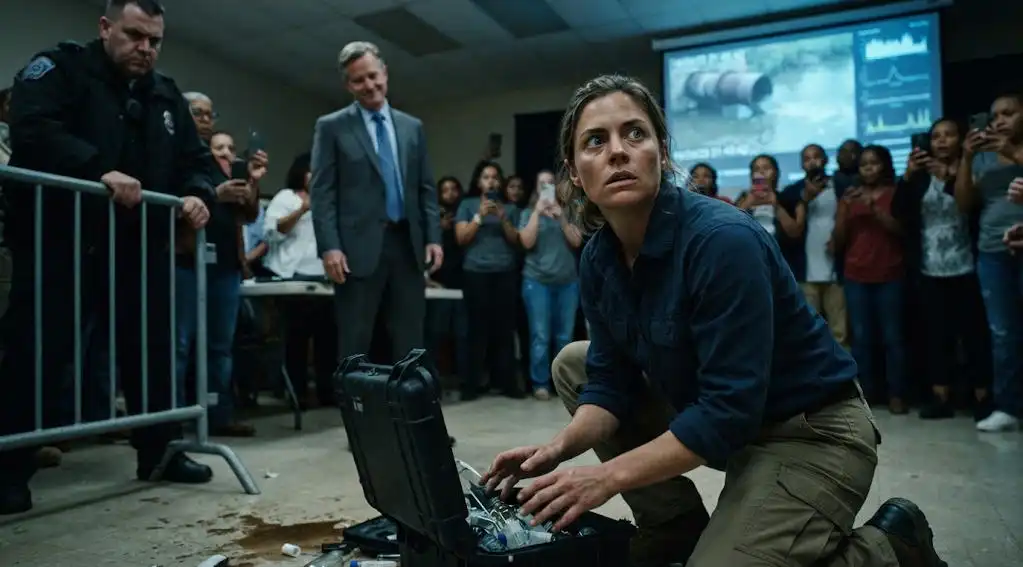
A Chemical Plant Guard Mocked an OVERWEIGHT Water Scientist and Smashed Her Sample Case in Public. He Had NO IDEA What She’d Already Recorded 😱
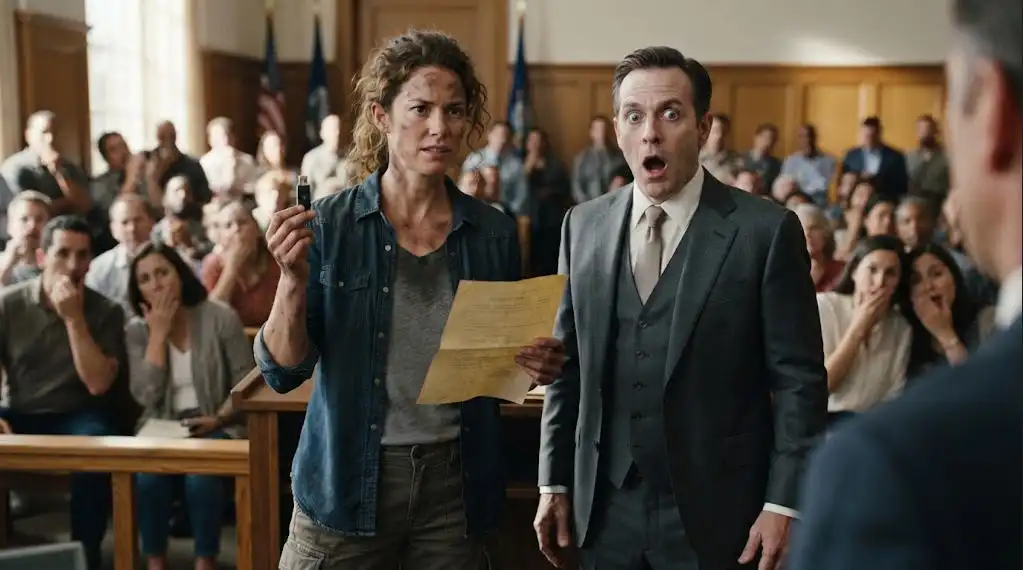
A Polished Developer Had His Men Shove a Postpartum Home Repairwoman Into the Mud. He Had NO IDEA What She Was Bringing to City Hall 😱

A Quiet Las Vegas Hotel Auditor Was DRENCHED in Red Wine by a Powerful VP in Front of Dozens of Guests. He Had NO IDEA What She’d Already Saved... 😱