

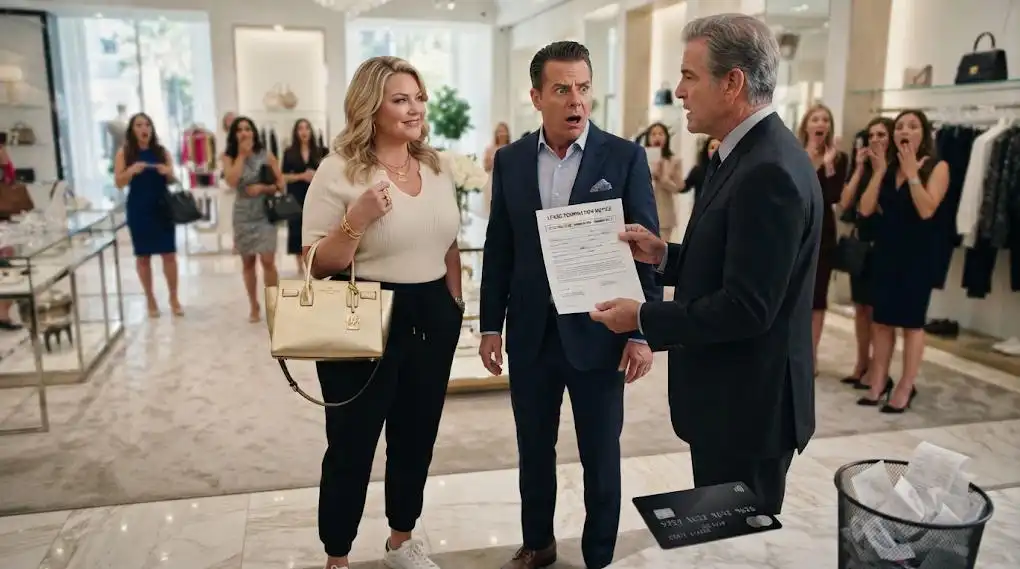
Brittany was still pointing toward the entrance when the shopping center's attorney placed the lease on the counter.
“You cannot terminate my store!” she shouted.
Marcus Reed remained perfectly calm.
“Then perhaps you should have read the agreement before deciding that some customers were beneath you.”
Brittany looked at him, then at me.
I was still wearing the gray joggers and white sneakers I'd worn into the boutique that morning.
The same clothes she had mocked.
The same clothes she had used to decide that I couldn't possibly belong in her store.
Now, the attorney was explaining the contractual grounds for ending the boutique's lease, and the regional director was reviewing the video of Brittany throwing my credit card into the trash.
Brittany's expression changed from outrage to fear.
“Lily,” she whispered, “please. I didn't know.”
I looked at her.
“That was the problem, Brittany. You decided how much respect I deserved before you knew anything about me.”
Two hours earlier, I had walked into that boutique expecting to buy my mother a handbag.
I hadn't expected to become the day's entertainment.
My name is Lily Carter, and I build video games for a living.
I started my first independent game studio in a cramped apartment, working through nights and weekends while friends asked when I planned to find a real job.
I was never the person who looked like a traditional technology executive.
I preferred comfortable clothes, skipped unnecessary networking events, and spent more time thinking about gameplay systems than designer labels.
I was also plus-size, something strangers occasionally seemed to regard as an invitation to comment on my body.
I had learned to ignore most of it.
My work mattered more than their opinions.
At twenty-four, I released my first commercial game, a strategy adventure that allowed players to build virtual worlds and solve increasingly complicated challenges.
The game found an audience through online communities and word of mouth.
I reinvested the revenue into a larger team.
We hired programmers, artists, sound designers, and writers who believed that games could be both entertaining and emotionally meaningful.
Our second release became a major commercial success.
Then a technology investor named Marcus Reed contacted me.
Marcus had spent decades investing in technology companies. He was known for asking difficult questions and refusing to be impressed by a founder's presentation alone.
During our first meeting, he barely looked at the projected revenue.
Instead, he asked me why players returned to the game after finishing the main story.
I explained the community features, the creative tools, and the ways players could build their own experiences.
He listened for nearly an hour.
Then he closed his notebook.
“You understand your customers,” he said. “Now we need to make sure your business can survive your success.”
He invested in the company.
More importantly, he became my mentor.
He taught me to read contracts, evaluate acquisition opportunities, understand commercial property valuations, and distinguish between an exciting investment and a sustainable one.
He also taught me something I never forgot.
“People will make assumptions about you based on whatever they can see,” he told me once. “Your clothes, your age, your background. Let them. Just make sure you understand the facts better than they do.”
Over the following years, my company expanded.
We released new games, developed licensing partnerships, and built a technology platform that supported independent creators.
I became wealthy, but I didn't suddenly become interested in proving it.
I still wore sneakers to the office.
I still ate lunch with the development team.
And I still spent hours reviewing game mechanics because I enjoyed the work.
My wealth gave me choices.
It did not give me a new personality.
Eventually, Marcus encouraged me to diversify my investments.
“You've built a successful technology business,” he said. “You should understand what your money is doing outside it, too.”
I began studying commercial real estate.
At first, the numbers felt unfamiliar.
There were rental agreements, maintenance reserves, tenant improvement allowances, financing costs, and complicated operating budgets.
But I enjoyed the analytical challenge.
I approached property investment the same way I approached game development: understand the system, identify the weak points, and never assume the first explanation is the right one.
That was how I became interested in a luxury shopping center near Rodeo Drive in Beverly Hills.
The property was beautiful, with polished stone corridors, glass storefronts, private fitting suites, and a mix of luxury retailers.
It also had problems.
Several tenants were struggling with rising occupancy costs.
Management had allowed operating expenses to increase without sufficiently reviewing long-term efficiency.
A few commercial leases were nearing renewal, and the ownership group wanted to sell before it had to invest heavily in renovations.
Marcus's investment firm had been reviewing the property for months.
He invited me to examine the acquisition opportunity.
The numbers were promising, but the risks were real.
The purchase price was substantial.
The property required capital improvements.
Some leases were profitable, while others needed renegotiation.
We commissioned independent valuations, reviewed the lease portfolio, assessed the financing, and examined the property's operating history.
I asked particularly difficult questions about tenant retention and the shopping center's reputation.
A luxury retail property depended on more than expensive storefronts.
It needed customers to feel welcome.
It needed reliable tenants.
And it needed management that understood the difference between exclusivity and arrogance.
We eventually structured an acquisition through my holding company, with Marcus's firm serving as the managing partner and operating adviser.
The transaction was negotiated at arm's length, financing was arranged, and the legal documents were prepared.
The closing was scheduled for the same day I decided to visit the boutique.
I had no intention of buying a shopping center because someone insulted me.
The investment was the result of months of due diligence.
But the incident that morning would reveal something important about one of its tenants.
The boutique was called Bellamy & Rowe.
It sold custom handbags, luxury accessories, and limited-edition leather goods.
My mother had admired one of its handcrafted bags during a shopping trip several months earlier.
She never bought it.
She had spent most of her life telling me that expensive things were unnecessary and that money was better spent on people who needed help.
I wanted to surprise her with a custom version of the bag for her birthday.
That morning, I had finished an overnight development session with my team.
We had been working through a difficult technical issue, and I had barely slept.
I changed into comfortable joggers and sneakers, grabbed my wallet, and drove to Beverly Hills.
I wasn't planning to attend a business meeting.
I was buying a present for my mother.
When I entered Bellamy & Rowe, the store smelled of polished leather and expensive perfume.
Handbags sat beneath soft display lighting.
A sales associate glanced up and offered a polite greeting.
Before she could help me, Brittany approached from behind the counter.
She was the store manager, a woman in her early forties who wore a sharply tailored suit and a name badge polished to a shine.
Her eyes moved from my sneakers to my joggers.
Then she looked at my body.
“Can I help you?” she asked, in a tone that suggested she hoped the answer was no.
“I'd like to ask about a custom handbag.”
“Which one?”
I showed her a photograph on my phone.
She barely glanced at it.
“That collection is by appointment.”
“I'd be happy to make an appointment.”
She looked me up and down again.
“Do you know how much those bags cost?”
I kept my voice polite.
“Yes. I'd like to discuss the price and customization options.”
Brittany gave a short laugh.
“Listen, we have a very specific clientele. Our customers generally understand luxury.”
“I understand that. That's why I'm asking about the product.”
She folded her arms.
“Perhaps you should try a department store. They have plenty of affordable bags.”
The sales associate looked uncomfortable.
I could have left.
Instead, I asked whether another employee could show me the available leather samples.
Brittany's expression hardened.
“You're not listening. We don't encourage people to browse if they aren't serious buyers.”
“I am a serious buyer.”
She laughed again.
“Then dress like one.”
I stared at her.
I had been insulted before, but there was something particularly humiliating about being treated as though my body and clothing made me unworthy of a conversation.
“I'd like to speak to your regional manager,” I said.
Brittany stepped closer.
“I'm the manager here.”
“Then I'd like your name and the appropriate customer relations contact.”
She looked toward the entrance.
“You know what? We're done.”
I took out my black premium credit card, intending to make it clear that I could pay for the purchase.
Brittany snatched it from my hand.
“Let's see if this little piece of plastic even works.”
Before I could react, she tossed it into the wastebasket beside the counter.
The card struck the side of the bin and landed on top of a crumpled receipt.
A woman near the display gasped.
Another shopper lifted her phone.
Brittany pointed toward the entrance.
“Security! Remove her.”
I stared at the wastebasket.
Then I looked at Brittany.
“Pick up the card.”
She smirked.
“Excuse me?”
“Pick up my card and return it.”
“You can retrieve it yourself.”
I reached into the bin, took out the card, and wiped it with a tissue.
My hands were shaking, but my voice remained steady.
“I'm going to make a formal complaint about this incident.”
Brittany rolled her eyes.
“Do whatever you want. Nobody is going to take your word over mine.”
I looked at the shoppers who had witnessed what happened.
One woman stepped forward.
“I saw everything,” she said. “You took her card and threw it away.”
Another customer nodded.
“So did I.”
Brittany's face tightened.
“Everyone needs to mind their own business.”
I placed my card back in my wallet.
Then I walked outside.
The Beverly Hills sun was bright, and shoppers moved along the sidewalk carrying glossy bags from nearby boutiques.
I stood beside the storefront for a moment, trying to settle my breathing.
I wasn't upset because I had failed to buy a handbag.
I was upset because Brittany had treated basic courtesy as something reserved for people she considered worthy.
I had spent years building a business in which people with different backgrounds and personalities worked together to create something valuable.
I knew how much effort went into doing a job well.
I also knew that one employee's behavior could damage an entire brand.
I took out my phone and called Marcus.
He answered immediately.
“Lily. Are you on your way to the closing?”
“I will be. But I need to tell you about something that just happened.”
I described the incident.
He listened without interrupting.
When I finished, he asked whether I had the store manager's name and whether witnesses had recorded the incident.
“Yes.”
“Good. Send the details to the acquisition team's legal counsel. Don't make any decisions about the tenant until the incident is reviewed against the lease.”
I paused.
“You're not going to tell me to forget it?”
“No,” he said. “But we aren't going to misuse our authority, either. If the tenant has breached the agreement, the lawyers can establish that. If the lease doesn't permit termination, we follow the contract.”
That was why I trusted him.
Marcus never confused having power with having the right to do anything he wanted.
I sent the details to the legal team, including the names of the witnesses who had offered to provide statements.
Then I went to the closing meeting.
The acquisition documents were ready.
Our lawyers reviewed the final conditions, the financing arrangements, and the transfer of ownership.
After the necessary signatures and confirmations, the transaction closed.
My holding company became the controlling owner of the shopping center, while Marcus's investment firm was appointed to manage the property under our operating agreement.
We had purchased the entire center.
But we had also inherited its existing leases, obligations, and tenant relationships.
We couldn't simply throw out a store because I disliked its manager.
Any action had to be grounded in the lease and applicable law.
The incident at Bellamy & Rowe was therefore referred to the new property management team for formal review.
The team obtained the witness statements and requested the store's response.
It also discovered that the shopping center had previously received complaints about the boutique's treatment of customers.
Some complaints described employees making insulting comments about customers' clothing.
Others reported that shoppers had been denied assistance based on assumptions about their ability to pay.
The earlier complaints had not resulted in a complete investigation.
Now the new management team reviewed them alongside the evidence from that morning.
The regional director of Bellamy & Rowe was contacted.
He was initially defensive.
“Brittany is an experienced manager,” he said. “I'm sure there's been a misunderstanding.”
The attorney sent him the witness accounts and the available video.
After reviewing the evidence, he agreed to meet.
Meanwhile, the property's lawyers examined the boutique's lease.
The agreement contained a tenant conduct provision requiring retailers to comply with the shopping center's customer-service standards and prohibiting conduct that materially damaged the center's reputation.
It also provided a process for addressing material breaches, including formal notice and termination under specified circumstances.
The legal team reviewed whether Brittany's actions, combined with the documented prior complaints, constituted a material breach.
They did not assume that a single rude interaction automatically entitled the landlord to terminate a commercial lease.
They examined the evidence, the contract language, and the procedures required.
By early afternoon, the team concluded that there were grounds to issue a formal notice of breach and pursue termination under the agreement.
The regional director was also informed that Brittany's conduct was subject to an internal employment review.
He arrived at the shopping center shortly before the property management team entered the boutique.
That was when Brittany saw Marcus walk through the doors.
She immediately changed her expression.
“Mr. Reed! Welcome to Bellamy & Rowe.”
She hurried toward him, smiling brightly.
“We're delighted to have the new ownership visiting. Is there anything I can arrange for you?”
Marcus didn't return her smile.
He looked toward me.
“Brittany, do you recognize this customer?”
Her smile faltered.
“Yes.”
“Would you tell me what happened this morning?”
Brittany swallowed.
“She was behaving aggressively. I asked her to leave.”
I stepped forward.
“Did you take my credit card?”
“I was trying to verify—”
“Did you throw it into the wastebasket?”
She glanced at the regional director.
“It was a misunderstanding.”
The regional director looked at her.
“Brittany, answer the question.”
She lowered her eyes.
“Yes.”
“Did you tell her she didn't belong in the store because of her clothing?”
Brittany hesitated.
“I may have made a comment about our clientele.”
Marcus nodded once.
“Then we have a starting point.”
The shopping center's attorney introduced himself and explained that the property team had reviewed the incident and the prior complaints.
He placed the relevant lease provisions on the counter.
“Based on the evidence gathered, the landlord has determined that there are grounds to initiate termination under the tenant conduct provisions of this agreement. This notice sets out the breach and the applicable contractual process.”
Brittany stared at the document.
“You can't do this. This store has been here for years.”
“The agreement governs the tenancy,” the attorney replied. “The notice explains the grounds and the next steps.”
She turned toward me.
“You did this because I wouldn't sell you a bag.”
“No,” I said. “I asked to buy a bag. You decided I wasn't worth serving.”
She looked at my clothes.
Then at Marcus.
Then at the attorney.
Her face began to crumple.
“Please. I have worked here for twelve years.”
I believed her.
I also knew that the length of someone's employment did not erase the consequences of their conduct.
“You can explain your actions through the proper process,” I said. “But you cannot pretend they didn't happen.”
The regional director asked Brittany to step into the back office with him.
The company completed its employment review that afternoon. After examining the footage, witness statements, and prior complaints, it removed Brittany from her management position for serious misconduct.
Her employment ended under the company's established procedures.
The store's lease termination proceeded under the contractual notice and review process.
Brittany returned to the sales floor with tears running down her face.
She approached me one last time.
“Please, Lily. I need this job.”
I looked at her.
“I understand that losing a job is serious.”
“Then help me. Tell them it was a misunderstanding.”
“I won't lie about what happened.”
She began crying harder.
“I didn't know you were an investor.”
I felt a familiar sadness.
“Would you have treated me differently if you had known?”
She didn't answer.
I continued.
“That is the part you need to think about.”
The property team completed the documentation and arranged for the store's affairs to be handled under the applicable lease procedures.
There was no need for a public spectacle.
The legal notice had been served.
The employment decision had been made.
And the process would continue according to the agreement.
Marcus walked beside me as we left the boutique.
“You all right?” he asked.
I thought about the morning.
“I will be.”
He nodded.
“Remember, the point of owning a business isn't to prove that you can punish people. It's to create a place where the right behavior is expected.”
I smiled.
“I know.”
Over the following weeks, the property management team reviewed the shopping center's tenant standards and customer-service policies.
We established a clearer process for complaints.
Retailers were required to train their staff on respectful customer treatment, and repeated violations could trigger formal action under their leases.
We also reviewed the center's financial performance, renegotiated several service contracts, and invested in improvements that made the property more welcoming without compromising its luxury positioning.
I wanted the shopping center to remain successful.
But I wanted its success to be built on more than polished marble and expensive handbags.
People should be able to walk through the doors without wondering whether their clothes made them acceptable.
A customer who wore sneakers deserved the same courtesy as a customer who arrived in a designer suit.
A young person saving for a first luxury purchase deserved the same respectful explanation of a product as someone buying ten bags at once.
And an employee who encountered a customer they didn't immediately understand still had a professional responsibility to treat that person with dignity.
Those standards weren't complicated.
They simply required people to remember that the customer in front of them was a human being.
Several months later, I returned to Bellamy & Rowe.
The store had undergone a management review, and the retailer was preparing to close the location under the lease termination process.
I wasn't there to gloat.
I had come to purchase the custom handbag I'd originally wanted for my mother.
A new sales associate greeted me.
She wore a simple black uniform and spoke with genuine warmth.
“Welcome. How may I help you today?”
I showed her the photograph on my phone.
“I'm interested in having this bag made in a deep burgundy leather. It's a gift for my mother.”
She smiled.
“That sounds lovely. Let me show you the available materials.”
We spent nearly an hour reviewing leather samples, stitching, hardware, and lining options.
She explained the craftsmanship behind each choice and answered every question without making me feel rushed.
I selected a rich burgundy leather with a soft gold clasp.
The bag would be elegant without being flashy.
It would be practical enough for my mother to use every day.
And it would remind her of the woman who had taught me that kindness was worth more than status.
When the order was complete, I thanked the associate.
She handed me the receipt and smiled.
“We look forward to making it for you.”
I left the boutique carrying my order confirmation.
Outside, Beverly Hills was bright with afternoon sunlight.
Marcus was waiting near the entrance.
“Did you get what you came for?” he asked.
“Yes.”
“Good.”
He glanced toward the store.
“Do you feel better now?”
I thought about it.
I had no desire to see Brittany suffer.
I hadn't bought the shopping center to settle a personal score.
The acquisition had been a serious investment, and our responsibility was to manage it well.
But I was glad that the incident had forced the property team to examine how the center's tenants treated people.
“I feel like the right thing happened,” I said. “Not because I own the property, but because the evidence was taken seriously.”
Marcus smiled.
“That's the answer I was hoping for.”
A year later, my gaming company launched a new development program for aspiring game creators.
We offered mentorship, technical training, and small grants to independent developers who lacked access to industry connections.
I wanted talented people to have opportunities based on their ideas and determination, not on whether they already knew someone influential.
The program grew quickly.
Some participants were students.
Others were parents returning to work after years away from the industry.
Several were self-taught developers who had spent years creating games on old laptops in their bedrooms.
Their backgrounds were different.
Their talent was real.
And I loved watching them discover what they could build when someone took their work seriously.
One afternoon, a young developer arrived at our office wearing sweatpants and worn sneakers.
He looked nervous as he sat across from me.
“I know I don't look very professional,” he said. “I was worried that might count against me.”
I looked at him.
“Did you bring your game?”
He nodded and opened his laptop.
“Then let's see what you've built.”
He smiled, relieved.
We spent the next hour discussing his design choices, the challenges he'd solved, and the improvements he wanted to make.
His clothing never entered the conversation again.
That evening, I thought about Brittany.
She had believed my clothes told her everything she needed to know about me.
She had mistaken appearance for ability, and status for character.
She had thrown away my credit card because she thought I was beneath her.
But the most important thing I learned from that experience wasn't that I could buy a shopping center.
It was that I never wanted to become the kind of person who believed owning one gave me the right to look down on anyone else.
Wealth can purchase property.
It can create opportunities.
It can provide security and independence.
But it cannot purchase good judgment, and it cannot turn cruelty into class.
When my mother's custom handbag finally arrived, I wrapped it in a simple cream box and gave it to her at Sunday dinner.
She opened it slowly.
Her fingers traced the stitching.
“Lily, this is beautiful.”
“I'm glad you like it.”
She looked at me.
“Was it expensive?”
I laughed.
“It's a special gift.”
She hugged me.
Then she asked how work was going, and I told her about the new developers in our mentorship program.
She listened as I described their projects.
When I finished, she smiled.
“You've always been happiest when you're helping someone build something.”
I thought about the game studio, the shopping center, and the people whose lives intersected with mine.
She was right.
I liked building things.
I liked creating opportunities.
And I liked knowing that the work I did could make a difference beyond my own bank account.
Brittany had tried to make me feel small because I wore joggers and sneakers.
She had assumed I was unworthy of her attention.
In the end, the acquisition changed who controlled the property, and the documented incident changed the future of her employment and the boutique's tenancy.
But I didn't walk away believing that everyone who had ever judged me deserved to be punished.
I walked away knowing that respect should never depend on a person's appearance, and that people entrusted with power must be held accountable for how they use it.
The next time I visited the shopping center, I wore my favorite gray joggers again.
I walked through the polished corridors, stopped to admire a window display, and bought a coffee from a small café near the entrance.
Nobody asked whether I could afford it.
Nobody looked me up and down.
The employees simply smiled and asked what I wanted.
And that ordinary moment felt better than any dramatic confrontation could have.
Because the real victory was never the shopping center.
It was the freedom to walk into a room without needing to prove I belonged there.
Choose your side: LILY WAS RIGHT TO ENFORCE THE CONTRACT AND HOLD BRITTANY ACCOUNTABLE, or BRITTANY DESERVED ANOTHER CHANCE BECAUSE SHE WAS ONLY DOING HER JOB.
Comment your choice and share this story with someone who believes that a person's character matters far more than their clothes, their body, or their bank balance.
Disclaimer: Mention of any brand or trademark is for identification only and does not imply partnership or endorsement

My Wealthy Aunt Let Her Daughter CUT MY HAIR at Thanksgiving and Called Me a “Family Embarrassment.” Then Grandpa’s Lawyer Opened the REAL Will... 😱
A Snobbish Charity Queen Dumped Red Wine on a Plus-Size Riding Instructor and Kicked Her Out. She Had NO IDEA Who Held the Club’s Debt... 😱

My Fiancé Slapped Me and Let His Rich Mistress Smash My Handmade Engagement Cake in Front of 100 Guests. He Had NO IDEA What I Owned... 😱