


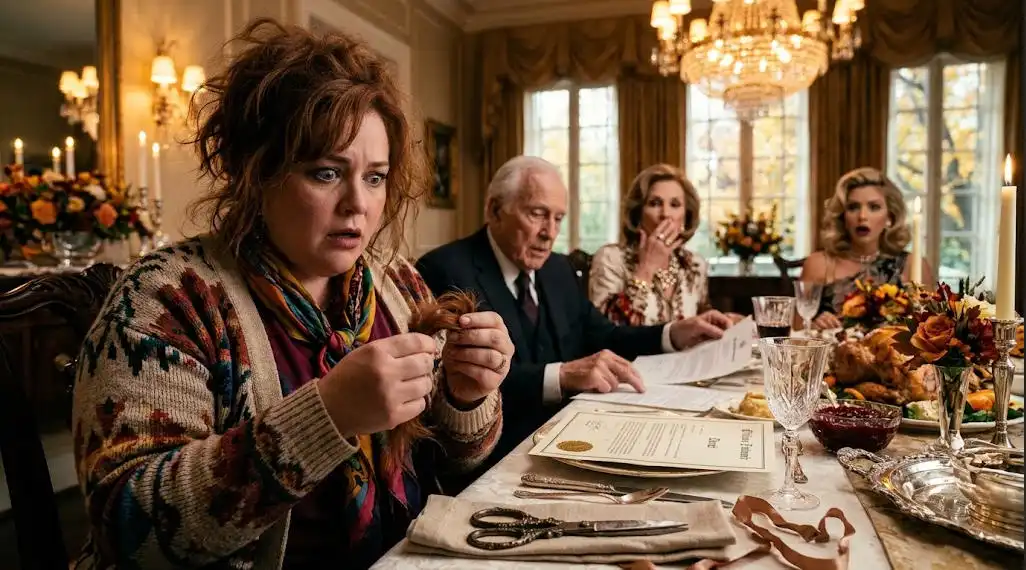
The scissors made one final snip.
A lock of my hair landed beside my Thanksgiving plate.
My cousin Ashley burst out laughing, and my aunt Linda raised her wineglass as if her daughter had just delivered the evening's finest entertainment.
“Honestly, Zoe,” Linda said, looking me up and down. “You should thank her. Perhaps now you'll look a little less frumpy.”
Around the enormous dining table, several relatives laughed nervously.
I sat frozen in my chair, holding the severed hair in my hands.
Then the grandfather clock struck seven.
The front doors opened.
My grandfather's estate attorney walked into the dining room carrying a leather briefcase.
And my aunt, who had spent the entire evening explaining how she planned to spend an inheritance she hadn't received, stood up with a triumphant smile.
She had no idea that the man holding the briefcase was about to dismantle every assumption she had made about our family.
My name is Zoe Bennett.
I was thirty-two, a public-school art teacher in Dallas, and the granddaughter of Samuel Bennett, a man whose business empire had made our family extraordinarily wealthy.
But I had never lived like my aunt Linda.
I drove an ordinary car.
I bought clothes when I needed them, not when a designer released a new collection.
I spent my summers teaching free art workshops to children whose families couldn't afford private lessons.
And I had been overweight for most of my adult life.
To Linda, those facts were evidence that I had somehow failed.
To my grandfather, they were evidence that I had chosen a life that mattered to me.
I wish I could say he had always been able to protect me from my relatives.
He hadn't.
But he had always made sure I understood one thing.
My worth was not determined by my appearance, my salary, or the size of my home.
That lesson became the foundation of everything that followed.
My aunt Linda had always considered herself the most important member of our family.
She was polished, wealthy, and socially ambitious. She belonged to exclusive clubs, hosted expensive dinner parties, and knew precisely which people to invite when she wanted an event photographed.
Her daughter, Ashley, had inherited the same sense of entitlement.
They lived for appearances.
A handbag was never just a handbag. It was a declaration of status.
A house was never just a home. It was proof that the owner had won some invisible competition.
And a person who didn't fit their definition of success was someone they felt entitled to correct.
I had been their favorite target since childhood.
At family gatherings, Linda commented on my weight.
When I announced that I wanted to become an art teacher, she asked why I would waste my education on children who couldn't afford private schools.
When I showed Grandpa a series of watercolor paintings I had created, Ashley glanced at them and said they looked like something children made in kindergarten.
Grandpa bought one of my paintings and hung it in his study.
He never asked me to become someone else.
He simply asked me to keep painting.
That was one reason I loved him so deeply.
While my aunt measured people by their bank accounts, Grandpa paid attention to what they did when nobody was watching.
He remembered the names of his employees.
He sent handwritten notes to people who helped him.
He asked the housekeeper about her children and listened to the answers.
And he took a particular interest in my work with children.
One summer, I invited him to visit a free art workshop I was running at a neighborhood community center.
He arrived without announcing himself to anyone.
He sat at a small table while a seven-year-old girl showed him a painting of a purple horse beneath a bright orange sun.
“That's a magnificent horse,” he told her.
She frowned at the painting.
“It's supposed to be a pony.”
Grandpa nodded solemnly.
“Then it's the finest pony I've seen all week.”
The girl laughed.
Later, as we walked outside, he turned toward me.
“Do you know why I liked that painting?”
“Because the pony was magnificent?”
“Because she wasn't afraid to use the colors she wanted.”
He smiled.
“Never let other people convince you that your work has to look like theirs to have value.”
I remembered those words long after he was gone.
My grandfather died six weeks before the Thanksgiving dinner that changed our family.
He had been ill for some time, and his death left a silence in my life that I struggled to explain.
I missed his phone calls.
I missed the way he asked about my students before asking about my own day.
I missed sitting in his study while he listened to me talk about paintings, classroom projects, and children who had finally found the courage to share their work.
After his funeral, Linda moved quickly.
She had been spending more time at Grandpa's Dallas-area estate during his final months, claiming she was helping manage the household.
She had gradually begun treating the mansion as her own.
She instructed staff to rearrange rooms.
She discussed expensive renovations.
She invited friends over to inspect the gardens and guest suites.
And she repeatedly told relatives that Grandpa had promised her the house.
“He knew I was the one who took care of him,” she said at one family gathering. “Naturally, the estate will remain with me.”
Nobody challenged her.
I didn't know what Grandpa's final estate arrangements contained. He had always handled his affairs privately, and I had never asked him what he intended to leave me.
I didn't want to turn our relationship into a negotiation over money.
I had loved him when I believed he had left me nothing.
I would have loved him just as much if he had left me a single book.
Linda interpreted my silence differently.
She assumed I had no claim to the estate.
She also seemed to believe that because I was a public-school teacher, I lacked the knowledge or confidence to question her decisions.
A week before Thanksgiving, she called me.
“Zoe, we need to discuss the estate paperwork.”
“What paperwork?”
“Some routine documents. The lawyer needs everything settled so we can move forward.”
“Then I'll speak to the lawyer directly.”
There was a pause.
“You don't need to make this difficult.”
“I'm not. I just want to understand what I'm signing.”
Her voice sharpened.
“Your grandfather trusted me to handle these things. You should be grateful I'm taking care of the family.”
I declined to sign anything without independent legal review.
She hung up.
The next day, Ashley sent me a message.
Don't embarrass yourself trying to claim Grandpa's money. Everyone knows who he wanted to inherit.
I didn't reply.
I was grieving.
I wasn't interested in fighting with relatives who viewed his death as a financial opportunity.
But I began to wonder why they were so determined to get my signature.
I contacted Grandpa's longtime estate attorney, Mr. Charles Whitmore, and asked whether any documents required my immediate attention.
He assured me that the estate was being administered through the proper legal process.
He also told me that a formal meeting had been scheduled for Thanksgiving evening, as my grandfather had specifically instructed in his estate planning documents.
“Your grandfather left detailed instructions,” he said. “You should attend the meeting. Please don't sign anything your aunt has presented without having it reviewed.”
I thanked him.
I still didn't know what Grandpa had arranged.
I only knew that Linda seemed increasingly desperate to control the situation.
Then Thanksgiving arrived.
The mansion looked as though it belonged on the cover of a luxury magazine.
White roses filled the entrance hall.
A long dining table had been set beneath crystal chandeliers.
Silver serving dishes gleamed beside the china.
A fire crackled in the sitting room, and the enormous windows overlooked the estate's carefully maintained gardens.
Linda had invited relatives, family friends, and several people who had done business with Grandpa.
She wanted everyone to see her as the new head of the family.
I arrived wearing a dark-green dress and a pair of comfortable black shoes.
My hair was shoulder-length, and I had spent the afternoon helping one of my students finish a painting for a school exhibition before driving to the estate.
Linda noticed me immediately.
“Zoe, you're late.”
“I'm five minutes early.”
She looked at my dress.
“Did you seriously wear that?”
I glanced down.
“It's a dress, Linda.”
“Yes, I can see that.”
Ashley appeared beside her mother in a cream designer outfit.
She looked me up and down and smiled.
“Mom, at least Zoe didn't wear one of her paint-splattered art teacher outfits.”
They laughed.
I walked into the dining room and took my seat.
For the first hour, the conversation revolved around Grandpa's business holdings, the estate, and Linda's plans for the mansion.
She spoke about replacing the kitchen, redesigning the guest suites, and turning the study into a private lounge.
“I've always loved this house,” she announced. “It would be a shame for it to go to someone who doesn't know how to maintain it.”
She looked directly at me.
I kept eating.
Ashley leaned toward a cousin.
“Imagine Zoe trying to pay the property taxes on a place like this with a teacher's salary.”
The cousin shifted uncomfortably.
I set down my fork.
“I haven't made any claims about the estate. I don't know why you're discussing my finances.”
Linda smiled.
“Because we all know how these things work. Some people understand wealth, and some people don't.”
I looked at her.
“Grandpa understood both.”
Her smile vanished.
“Don't lecture me about your grandfather.”
“I wasn't.”
Ashley rolled her eyes.
“You always do this. You act like you're morally superior because you teach children to paint.”
I felt my face grow warm.
“I love my work.”
“And that's wonderful,” Linda said with exaggerated sweetness. “But loving your work doesn't make you successful.”
The conversation around the table faded.
I wanted to leave.
But I had promised Mr. Whitmore I would attend the meeting, and I wasn't going to let Linda chase me away from it.
Then Ashley stood behind my chair.
“Honestly, Zoe, your hair is such a mess.”
I turned.
“Please sit down.”
She picked up a pair of scissors from the sideboard, where they had been used to open a decorative package.
I stared at her.
“Ashley, put those down.”
She laughed.
“Relax. I'm helping you.”
Before I could stand, she grabbed a section of my hair and cut.
The scissors snapped shut.
A thick lock fell onto my shoulder and slid into my lap.
For one awful moment, I couldn't breathe.
Ashley held the scissors up.
“There. You look less like a frumpy schoolteacher now.”
Linda burst out laughing.
“At least someone in this family knows how to fix a problem.”
I gathered the severed hair in my hands.
My eyes burned.
I had spent years trying to make peace with people who treated my feelings as a source of entertainment.
I had tolerated their comments because I wanted to preserve family relationships.
I had swallowed my anger because Grandpa had always hoped we would get along.
But Grandpa wasn't there anymore.
And the people sitting around his table had decided that his absence gave them permission to do whatever they wanted.
Linda raised her wineglass.
“To the future of the Bennett family.”
A few relatives reluctantly lifted their glasses.
She pointed at me.
“Zoe, perhaps after tonight you can stop pretending that you're entitled to the same things as the rest of us.”
I placed the hair on the table.
“You don't get to decide what I'm entitled to.”
Her eyes narrowed.
“Excuse me?”
“You heard me.”
She pointed toward the front doors.
“Get out of my father's house.”
I looked at her.
“Is it your house?”
Her face reddened.
“Of course it is. Who do you think has been managing everything?”
“Managing isn't the same as owning.”
Ashley laughed.
“Oh, listen to her. She's suddenly a lawyer.”
“No,” I said. “I'm someone who knows the difference between a claim and a fact.”
Linda slammed her glass onto the table.
“Security!”
Before anyone could respond, the grandfather clock struck seven.
The front doors opened.
Mr. Whitmore entered carrying a leather briefcase.
He was a tall, silver-haired attorney who had represented my grandfather for more than thirty years. Two members of his legal team followed him into the room.
Linda immediately straightened her jacket.
“Charles. Thank goodness you're here.”
He greeted the guests politely.
Then he noticed the scissors on the table and the severed lock of my hair.
His expression changed.
“Miss Bennett, are you all right?”
I swallowed.
“My cousin cut my hair.”
He looked toward Ashley.
“Without your permission?”
“Yes.”
Ashley shrugged.
“It was a joke.”
Mr. Whitmore closed his briefcase.
“I see.”
Linda stepped forward.
“Charles, let's get to the important business. My father left the mansion to me, and we need to finalize the paperwork.”
Mr. Whitmore did not sit down.
“Mrs. Whitmore, your father's estate plan is more complicated than you appear to believe.”
She laughed.
“There's nothing complicated about it. He promised me the house.”
“Your father made several estate-planning decisions during his lifetime. The controlling documents are the properly executed trust and will, not informal conversations about future intentions.”
Linda's smile faltered.
Mr. Whitmore placed a sealed envelope on the table.
“This meeting was scheduled at your father's express direction. He wanted the final documents presented to the family together.”
He opened the envelope.
The room became silent.
He explained that my grandfather had established a comprehensive family trust, with provisions governing his business interests, investment portfolio, real estate, and charitable commitments.
He had reviewed the arrangement with independent legal and financial advisers.
The final amendment had been executed before his death, with the required formalities and documentation.
The trust named me as its principal beneficiary.
Linda shook her head.
“No. That's impossible.”
Mr. Whitmore continued reading.
The estate included the Dallas-area mansion, substantial investment holdings, commercial property interests, and controlling interests in several family businesses.
The combined value was estimated at more than a billion dollars, subject to the usual administration, valuation, and tax requirements.
The trust directed that the principal assets pass to me, with specific provisions protecting the estate from improper transfers and ensuring that the charitable commitments Grandpa had made would be honored.
Linda stared at him.
“Read that again.”
He did.
Every word remained the same.
Ashley dropped into her chair.
“But he promised Mom the mansion!”
Mr. Whitmore turned to her.
“Your grandfather allowed your mother to reside at the estate temporarily while he was alive. The written arrangement did not grant her ownership. That permission was subject to termination under the terms of the estate documents.”
Linda's face had gone pale.
“You can't simply throw me out.”
“No one is doing that tonight,” he replied. “The trustee will follow the documented process and applicable law. You will receive the notices required by the occupancy agreement.”
He then turned toward me.
“Zoe, your grandfather also left a personal letter.”
My hands began to tremble.
Mr. Whitmore handed me a folded sheet of paper.
The handwriting was unmistakable.
I had seen it on birthday cards, postcards, and notes tucked into the books he gave me.
I opened the letter.
My dear Zoe,
If you are reading this, I am no longer there to tell you how proud I am of you.
I have watched you choose kindness when cruelty would have been easier. I have watched you give your time to children who needed someone to believe in them. I have watched you build a meaningful life without asking anyone to applaud you.
I have also watched people in this family mistake wealth for character.
I cannot choose how others behave, and I cannot make them love you as they should. But I can make sure the resources I leave behind are placed in hands that understand responsibility.
I am leaving you the principal family estate because I trust you to use it wisely. I do not expect you to preserve every business exactly as I built it. I expect you to make thoughtful decisions, treat people fairly, and remember that money is a responsibility, not a measure of human worth.
Never let anyone convince you that you must become smaller to make them feel important.
Keep painting. Keep teaching. Keep your heart open, but do not confuse kindness with surrender.
With all my love,
Grandpa.
By the time I reached the final line, tears were running down my face.
I pressed the letter against my chest.
For six weeks, I had felt as though I had lost the person who understood me best.
Now I knew he had thought carefully about what would happen after he was gone.
He had not left me the estate because I was the thinnest, the most fashionable, or the most socially successful grandchild.
He had left it to me because he trusted my judgment.
Linda suddenly stood.
“This is manipulation. Zoe has been poisoning him against us.”
Mr. Whitmore closed the letter's envelope.
“The documents were prepared with independent legal counsel, signed in accordance with the applicable requirements, and reviewed before your father's death. The estate plan reflects his documented intentions.”
“You're lying!”
“Mrs. Whitmore, I strongly advise you not to make accusations without evidence.”
Ashley turned toward me.
“Zoe, you can't seriously believe you're entitled to all of this.”
I looked at her.
“I didn't write the trust.”
“You're going to take the house from us?”
“The house was never yours.”
Linda slammed her hand against the table.
“You ungrateful girl! After everything this family has done for you!”
I looked at the lock of hair lying beside my plate.
“Is this what you mean by everything?”
Nobody answered.
Mr. Whitmore explained the next steps.
The trust would be administered according to its terms. The property title would be transferred as required, the investment holdings would be managed through the trust, and the estate's liabilities would be settled before distributions were finalized.
The occupancy agreement also required formal notice to anyone living at the mansion under my grandfather's temporary permission.
Linda and Ashley would have an opportunity to arrange their departure.
If they refused to leave after the legal notice expired, the trustee would pursue the appropriate court process.
There would be no midnight confrontation.
No arbitrary lockout.
No revenge disguised as law.
The documents were clear, and the process would be followed.
Linda looked around the table, apparently expecting someone to defend her.
A cousin finally spoke.
“Linda, you shouldn't have treated Zoe that way.”
Another relative nodded.
“And cutting her hair was completely unacceptable.”
Ashley stared at them.
“You're all taking her side?”
“No,” the cousin replied. “We're saying what happened was wrong.”
For the first time that evening, Linda had no ready answer.
She turned toward me.
“You're really going to let a lawyer tell us what to do?”
I wiped my eyes.
“I'm going to let the law determine who owns the property and what happens next.”
Then I stood.
“I won't be signing anything tonight. Any estate documents will be reviewed through my attorney.”
I looked at Ashley.
“And I won't pretend that what you did was funny.”
She lowered her eyes.
I left the dining room with Grandpa's letter in my hand.
For the first time since his death, I felt that I could grieve without worrying about what my relatives might do next.
The weeks that followed were complicated.
The estate required a proper valuation, the transfer of assets, and careful administration of the trust.
My attorneys worked with the estate's financial advisers to ensure that the holdings were transferred according to the documents.
The mansion's ownership was formally updated.
The investment portfolio was placed under the trust's administration.
The family businesses continued operating while the trustees reviewed their financial performance and long-term plans.
I did not suddenly wake up knowing how to manage a billion-dollar estate.
I hired experienced professionals, asked difficult questions, and took time to understand the responsibilities I had inherited.
I also refused to let anyone pressure me into making rushed decisions.
Linda and Ashley received formal notice concerning their right to occupy the mansion.
They challenged the arrangement and insisted that Grandpa had promised them permanent residence.
The trustee responded through counsel, providing the written agreement and the relevant trust provisions.
When the notice period expired, they still refused to leave.
The trustee then pursued the appropriate legal process.
The court reviewed the documents and authorized possession in accordance with the applicable law.
Only after the required procedures were completed did Linda and Ashley have to vacate the mansion.
Their belongings were packed and removed under an agreed schedule.
The locks were changed after possession was lawfully restored to the trust.
There were no dramatic midnight arrests.
There was no need for anyone to drag them down the front steps.
The documents, the notices, and the court's order did what my aunt's insults never could.
They established the truth.
Linda had never owned the mansion.
She had merely been allowed to live there.
And that permission had ended.
The family also learned that Grandpa's estate plan had included specific safeguards against unauthorized transfers of property and assets.
Any attempt to misrepresent ownership or dispose of trust property would be reviewed by the trustee and handled through the appropriate legal channels.
Linda's plans to sell the estate's furnishings and renovate the mansion for herself came to nothing.
Ashley stopped sending me messages about the inheritance.
Neither woman received the fortune they had assumed would be theirs.
I did not celebrate their financial disappointment.
I was relieved that the estate had been protected and that I could finally make decisions without their interference.
The most important decision, however, had nothing to do with the mansion.
It concerned the children I taught.
For years, I had watched talented young artists struggle because their families couldn't afford supplies, after-school classes, or private instruction.
Some children had never owned a complete set of paints.
Others were embarrassed to show their work because they believed art belonged to people who could afford expensive lessons.
I wanted to change that.
Using a portion of the resources available through my inheritance, I established a charitable organization dedicated to providing free art education and creative support for children.
I called it the Bennett Children's Art Studio.
The organization offered free painting classes, drawing workshops, sculpture sessions, and therapeutic art activities led by qualified professionals.
We partnered with schools, libraries, and community centers across the Dallas area.
Children could attend regardless of their family's income.
We supplied the materials.
We provided the instruction.
And we made sure that no child was turned away because a parent couldn't afford the fee.
I also created a small program for children who were struggling emotionally or socially.
It wasn't a replacement for professional mental-health care.
It was a welcoming space where children could explore their feelings through art, build confidence, and connect with supportive adults.
The first studio opened in a renovated community building with large windows, sturdy tables, and shelves filled with paints, brushes, paper, and clay.
On opening day, I arrived early.
I arranged the supplies by color.
I placed clean paper at every seat.
I hung several paintings created by local children along the walls.
Then I stood in the doorway and waited.
The first student to arrive was a shy eight-year-old girl carrying a drawing folded into quarters.
She approached me cautiously.
“Do I have to be good at art to come here?”
I knelt beside her.
“No. You just have to be willing to try.”
She unfolded her drawing.
It showed a small house beneath an enormous purple sky.
The lines were uneven.
The colors spilled outside the shapes.
And the whole thing was wonderful.
“Can I paint something bigger?” she asked.
I smiled.
“As big as you want.”
She ran toward the supply table.
Watching her reminded me of Grandpa's favorite story about the little girl who painted the purple pony.
He had understood something my aunt never did.
A person's potential cannot be measured by how polished they look.
It cannot be measured by their clothes, their weight, or the money in their bank account.
It reveals itself in the things they are willing to learn, the kindness they offer, and the courage they find when someone gives them room to grow.
Over the following year, the studio expanded.
More children enrolled.
Local artists volunteered their time.
Teachers referred students who needed a safe place to explore their creativity.
The estate's resources allowed us to provide scholarships, supplies, and transportation assistance for families who needed it.
The mansion, meanwhile, became a quieter place.
I kept Grandpa's study almost exactly as it had been.
His books remained on the shelves.
His favorite chair stayed beside the window.
And my watercolor painting of a small garden hung on the wall where he had placed it years earlier.
Sometimes, after a long day at the studio, I sat in that chair and read his letter again.
I never stopped missing him.
But I no longer felt that his death had left me alone in a family that didn't understand me.
He had given me more than money.
He had given me the freedom to build something meaningful without asking my relatives for permission.
A year after the Thanksgiving dinner, the studio hosted an exhibition of the children's artwork.
Parents filled the room.
Teachers chatted beside the displays.
The children proudly explained their paintings to visitors.
One little boy had painted a huge blue whale floating above a city.
Another had created a sculpture from recycled cardboard.
The girl who had once been afraid to show me her purple house stood beside a bright landscape filled with orange trees and a brilliant pink sun.
She looked at me and smiled.
“Look, Ms. Bennett. I used all the colors this time.”
I felt tears gather in my eyes.
“You certainly did.”
Across the room, a parent thanked me for giving her son a place where he felt confident.
I told her that the children were the ones doing the brave work.
I was simply making sure they had the tools and the space to do it.
Later that evening, I returned to the mansion.
I walked through the dining room where Ashley had cut my hair.
The table had been restored.
The chairs were polished.
The chandelier cast warm light across the floor.
There was no sign of the Thanksgiving humiliation.
But I remembered it clearly.
I remembered holding the severed lock of hair.
I remembered Linda laughing.
I remembered how small I had felt when she ordered me out of a house she didn't own.
And I remembered the sound of the front doors opening at seven o'clock.
I had inherited a fortune.
I had gained control of the family estate.
I had protected the assets Grandpa had entrusted to me.
But none of those things had created my worth.
They had simply given me the opportunity to live according to it.
I had once believed that being kind meant tolerating every insult.
I now understood that kindness without boundaries could become an invitation for others to take advantage.
I could love my grandfather's memory without obeying the relatives who had mistreated me.
I could forgive people without returning the keys to a house they had never owned.
And I could use wealth to create opportunities rather than to prove that I was better than anyone else.
Before going upstairs, I stopped in Grandpa's study.
My painting was still on the wall.
Beneath it sat a small note he had written years earlier.
Keep painting. Keep teaching. Keep your heart open.
I ran my fingers over the edge of the frame and smiled.
The next morning, I would return to the studio.
There would be children waiting to paint, new projects to plan, and a hundred small problems that needed solving.
I would still be Zoe, the art teacher who loved messy tables, bright colors, and watching children discover what they could do.
The inheritance had changed my circumstances.
It had not changed the person I wanted to be.
And that was the part of Grandpa's legacy I intended to protect most carefully.
Choose your side: ZOE WAS RIGHT TO ENFORCE THE TRUST AND PROTECT HER INHERITANCE, or FAMILY SHOULD ALWAYS GET ANOTHER CHANCE, NO MATTER HOW THEY TREAT YOU.
Comment your choice and share this story with someone who believes that kindness is a strength, but protecting your dignity is a right.
Disclaimer: Mention of any brand or trademark is for identification only and does not imply partnership or endorsement

A Luxury Boutique Manager Called a Plus-Size Game Developer “Too Poor to Shop Here” and THREW AWAY Her Credit Card. She Had NO IDEA Who Just Bought the Mall... 😱
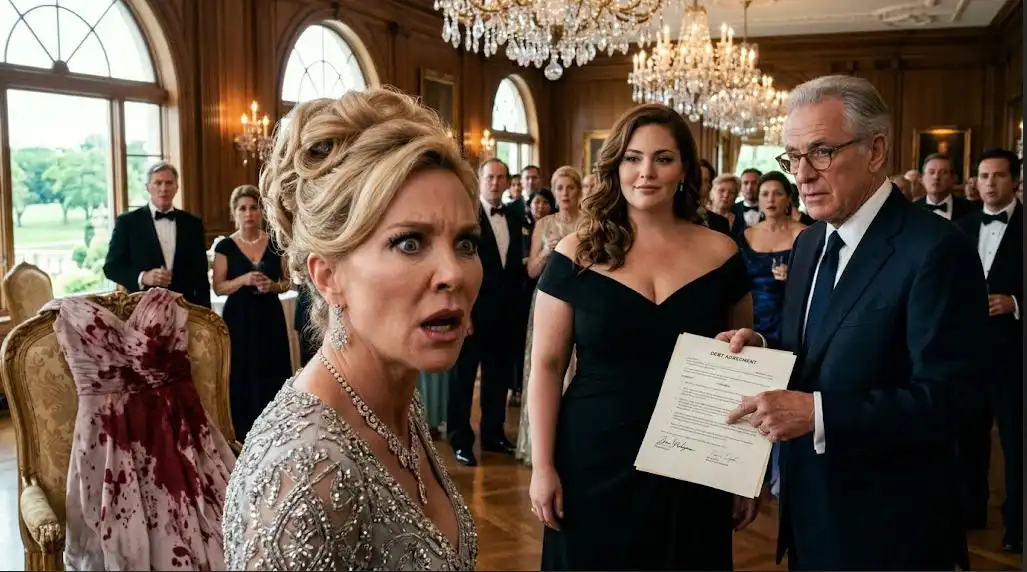
A Snobbish Charity Queen Dumped Red Wine on a Plus-Size Riding Instructor and Kicked Her Out. She Had NO IDEA Who Held the Club’s Debt... 😱

My Fiancé Slapped Me and Let His Rich Mistress Smash My Handmade Engagement Cake in Front of 100 Guests. He Had NO IDEA What I Owned... 😱