
The door opened so quietly that the room heard it before anyone saw him.
Not because he made noise.
Because everyone else suddenly stopped breathing.
Denise still had two fingers around my wrist.
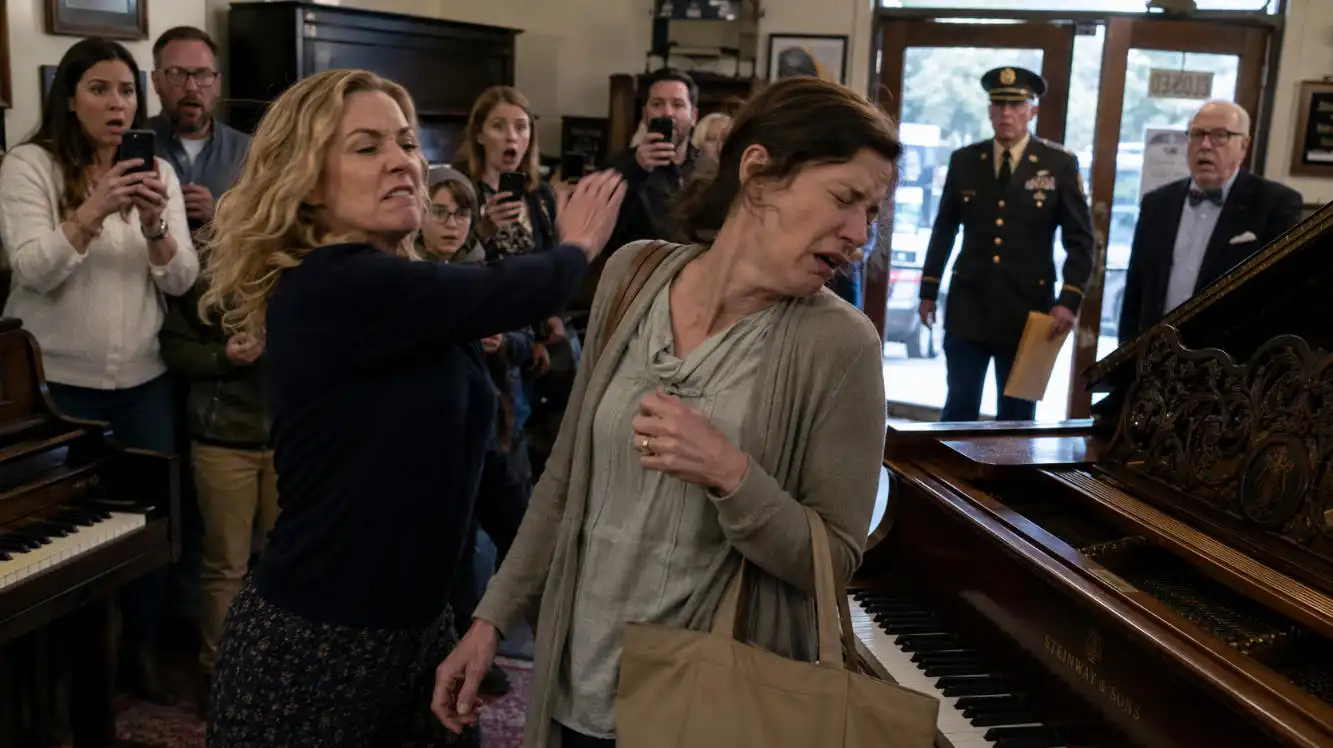
Mr. Calloway was still pointing at my tote bag like he had just uncovered a criminal empire instead of a tired widow with grocery receipts and piano stickers.
And the tall man in the dark military coat stood in the doorway, looking at me like he had finally found someone he had been searching for.
“Touch her again,” he said, calm as stone, “and this entire store changes hands before sunset.”
Denise laughed first.
A sharp, ugly sound.
“Oh, please,” she said. “Another one of Nora’s charity friends?”
Mr. Calloway smiled too, but his smile was nervous.
Because the man had not raised his voice.
Powerful people rarely need to.
The parents stood frozen against the wall.
Six children sat on the carpet with their recital folders pressed to their chests.
One mother still had her phone raised, recording everything.
I kept my eyes on the piano keys.
Not on Denise.
Not on Mr. Calloway.
Not even on the man at the door.
Because if I looked at him too long, I knew I might cry.
My name is Nora Whitaker.
For three years, I had taught piano in the back room of Calloway Fine Music, a place that smelled like lemon polish, old wood, and quiet judgment.
I was the widow teacher.
The cheap teacher.
The one parents chose when they could not afford Denise’s “elite classical track.”
Mr. Calloway owned the store, wore expensive cufflinks, and spoke to struggling families like kindness was a billable service.
Denise Mercer was his favorite instructor.
She had glossy hair, a framed conservatory certificate, and a smile that only appeared when someone else was embarrassed.
They both hated that my little room stayed full.
I did not have marble diplomas.
I did not correct children by making them cry.
I taught them to listen.
I taught them that music could hold grief without letting grief win.
That made people come back.
And Denise could not stand it.
“She plays funeral music,” she once whispered loud enough for the hallway to hear.
Mr. Calloway replied, “Grief sells to a certain kind of parent.”
That was the first time I started writing things down.
I did not fight.
I did not complain.
I kept copies of lesson schedules.
I photographed altered invoices.
I saved every message where Denise tried to push my students into her private studio.
And two weeks before the slap, I placed a small voice recorder inside my old sheet music folder.
Not because I wanted revenge.
Because Mr. Calloway had started telling parents that I was “unstable.”
Because Denise had told one mother I was “using my dead husband for sympathy.”
Because someone had been moving expensive accessories from the front showroom into strange places near my lesson room.
I had seen enough life to know when a storm was being built.
Last Friday, the storm came.
It was recital prep day.
The store was busy.
Parents stood shoulder to shoulder near the hallway.
Children walked in wearing dress shoes and nervous faces.
I had just helped little Emma Keller play the first eight bars of “America the Beautiful” without stopping.
She turned around with the biggest smile.
“Mrs. Nora, did I do it?”
“You did,” I told her. “And you did it with courage.”
That was when Denise walked in.
She was holding a velvet-lined key cover from the antique Steinway in the front display room.
That piano was the pride of the store.
A restored 1890s Steinway Mr. Calloway bragged about to every wealthy customer, even though he rarely let anyone touch it.
Denise’s eyes were bright.
Too bright.
“Oh my goodness,” she said.
Then she looked down at my open tote bag.
The velvet cover was suddenly inside it.
I saw her hand move.
So did Emma.
But Emma was eight.
And frightened.
Denise gasped.
“Nora,” she said, loud enough for the front showroom to hear. “How could you?”
I stared at the bag.
My heartbeat slowed.
Not because I was calm.
Because sometimes humiliation makes the world go strangely quiet.
Mr. Calloway appeared within seconds, as if he had been waiting just outside.
“What happened?” he asked.
Denise pointed at my bag.
“She stole from the Steinway.”
A father near the doorway muttered, “No way.”
A mother whispered, “That can’t be right.”
But phones came up anyway.
That is how public shame works now.
People may doubt the accusation.
But they still record the fall.
I reached for my tote.
Denise slapped my hand.
The crack echoed off the practice room walls.
Then she slapped my face.
My cheek burned.
Emma screamed.
One boy started crying.
Mr. Calloway did not move to stop her.
Instead, he said, “Search the purse.”
I looked at him.
“You know I didn’t steal anything.”
He leaned closer, lowering his voice just enough to sound civilized while still making sure everyone heard.
“Nora, people in desperate circumstances make desperate choices.”
Denise folded her arms.
“She wears the same black dress every week,” she said. “We all know she needs money.”
Then her eyes dropped to my left hand.
My wedding ring.
A simple gold band.
The only piece of my husband I still touched every day.
Denise smiled.
“Maybe check the ring too,” she said. “Could be fake. Maybe she pawned the real one already.”
That was the sentence that broke something in the room.
Not in me.
In everyone else.
A grandmother near the wall covered her mouth.
The father who had spoken earlier stepped forward.
“Enough,” he said.
But Mr. Calloway lifted one hand.
“This is a business matter.”
Business.
That was what he called it.
A widow slapped in front of children.
A teacher accused in front of parents.
A woman’s grief used like a dirty rag.
Business.
I looked at my old sheet music folder under the bench.
The recorder was still inside.
Running.
Denise did not know that.
Mr. Calloway did not know that.
And neither of them knew that the man standing outside the glass door had heard almost everything.
His name was Adrian Vale.
But at that moment, no one in the room knew what that name meant.
I only knew him from one photograph.
My husband, Daniel, had kept it inside his Bible.
Two young men in dusty uniforms, standing beside a battered upright piano in a military chapel overseas.
Daniel had written on the back:
“Adrian Vale. The only man who heard what you sounded like before the world went quiet.”
I had never met Adrian.
Daniel had served with him years before he married me.
After my husband died, I found letters I had never seen.
In them, Daniel wrote about me.
Not as a widow.
Not as a tired piano teacher.
As “the woman who can make a broken room breathe again.”
As “my piano genius.”
I thought grief had made those words bigger than reality.
So I put the letters away.
I kept teaching children scales.
I kept paying rent.
I kept breathing.
What I did not know was that Adrian had been looking for me.
For years.
He had left the military.
He had become one of the most respected conductors in the world.
Carnegie Hall.
Vienna.
London.
Television specials my students’ grandparents watched on PBS.
And somewhere along the way, Daniel’s old letters had reached him through a veterans’ memorial foundation.
Adrian had come to the store that day not to rescue me.
He had come to hear me play.
He had arrived early.
He had stood outside the glass door.
And he had watched Denise build her lie with her own hands.
Now he walked into the room.
Every step was measured.
He placed a sealed cream envelope on the piano.
Denise rolled her eyes.
“What is that supposed to be?”
Adrian did not answer her.
He looked at me.
“Nora Whitaker?”
My throat tightened.
“Yes.”
“I served with Daniel.”
The room changed.
Just a little.
The air softened around my husband’s name.
Adrian continued.
“He told me that if I ever heard you play, I would understand what courage sounded like.”
I pressed one hand to the bench.
Denise scoffed.
“This is touching, but she still stole from the store.”
Adrian finally turned to her.
“No,” he said. “She didn’t.”
Mr. Calloway’s jaw tightened.
“And you know that how?”
Adrian pointed to the ceiling corner.
“Your hallway camera faces this room.”
Mr. Calloway’s face flickered.
“Those cameras are for internal security.”
“Perfect,” Adrian said. “Then you can pull the footage.”
Denise stepped back.
Just one inch.
Small guilty movements are sometimes louder than confessions.
Mr. Calloway cleared his throat.
“That system has been unreliable.”
One of the parents spoke up.
“My husband installs security systems. That camera light is on.”
Another parent said, “I’ve been recording since Denise walked in.”
Then Emma, tiny Emma, raised a trembling hand.
“She put it in Mrs. Nora’s bag.”
Denise spun toward her.
“You little liar.”
That was when Adrian’s voice dropped.
“Do not speak to that child again.”
No yelling.
No drama.
Just command.
The kind that makes a room obey.
Mr. Calloway reached for the envelope.
Adrian placed his hand over it.
“Before you open that, I suggest you call your attorney.”
Mr. Calloway laughed weakly.
“My attorney?”
“Yes.”
Adrian looked around the room.
“Because I purchased the controlling debt on this business this morning.”
Silence.
Absolute silence.
Even the children stopped crying.
Mr. Calloway blinked.
“That’s impossible.”
Adrian removed a second document from inside his coat.
“Your expansion loan defaulted twice. Your silent investor sold the note. I bought it through a veterans’ arts trust.”
Denise stared at Mr. Calloway.
“You said the store was fine.”
He snapped, “Be quiet.”
But his voice cracked.
Adrian placed the document on top of the piano.
“Under the loan agreement, fraudulent conduct, reputational harm, and criminal misuse of insured inventory allow immediate operational intervention.”
He looked at my tote bag.
“Framing an employee for theft in front of witnesses qualifies.”
Mr. Calloway’s face went gray.
Denise shook her head.
“No. No, she’s just some back-room teacher.”
Adrian opened the cream envelope.
Inside was an invitation.
Embossed.
Formal.
Beautiful.
It was addressed to me.
Nora Whitaker.
Guest Soloist.
Veterans Memorial Symphony Benefit.
Featured arrangement: Daniel’s March.
My knees nearly gave out.
Daniel’s March.
My husband used to hum it while washing dishes.
I had written it after his funeral and never played it for anyone except my empty living room.
“How did you…” I whispered.
Adrian’s eyes softened.
“Daniel mailed me the first page years ago. He said someday the world should hear the rest.”
The room blurred.
For three years, I had believed the happiest part of my music had been buried with my husband.
And now this stranger, this soldier, this conductor, had carried it back to me.
But the legal hammer had only just started.
A police officer arrived ten minutes later.
Then Mr. Calloway’s attorney.
Then the insurance representative for the antique Steinway.
By then, three parents had emailed their videos.
The hallway camera footage was pulled.
It showed Denise removing the velvet cover from the locked display area.
It showed Mr. Calloway watching her do it.
It showed them speaking in the hallway before entering my lesson room.
And the recorder in my sheet music folder captured the rest.
Denise’s voice, fifteen minutes before the accusation:
“She’s stealing my students.”
Mr. Calloway’s voice:
“Then we make parents afraid to leave their children alone with her.”
Denise:
“What about the Steinway cover?”
Mr. Calloway:
“Small enough to plant. Expensive enough to scare her.”
There it was.
Not gossip.
Not misunderstanding.
Evidence.
Clear.
Specific.
Ugly.
Denise sat down like her legs had disappeared.
Mr. Calloway tried to say the recording was illegal.
His attorney closed his eyes.
Because the folder had been in my own teaching room.
Because I had documented weeks of harassment.
Because multiple witnesses had seen the planted item.
Because the store’s own camera confirmed everything.
Rules matter.
That day, they mattered for me.
By 5:30 p.m., Mr. Calloway was removed from daily control of the business pending fraud review.
Denise was terminated.
Parents withdrew from her studio before she even left the building.
The police report included assault, false accusation, and attempted insurance fraud.
The veterans’ arts trust took over management of the store.
The first change Adrian made was simple.
He removed the gold sign that read:
CALLOWAY FINE MUSIC
A week later, a new sign appeared.
WHITAKER COMMUNITY MUSIC HOUSE
I cried when I saw it.
Not pretty crying.
Not movie crying.
The kind where you cover your mouth and bend forward because your body finally believes the danger is over.
Adrian stood beside me on the sidewalk.
“You don’t have to accept the position,” he said.
“What position?”
He handed me another folder.
Artistic Director.
Resident Pianist.
Full salary.
Health insurance.
Scholarship fund for children who could not afford lessons.
And one more line:
Main concert hall to be named in honor of Daniel Whitaker.
I read it three times.
Then I whispered, “He would have loved this.”
Adrian looked through the front window at the old piano room.
“He already did.”
Two months later, I sat at the antique Steinway in a real concert hall.
Not the back room.
Not the charity corner.
Not the place where people whispered about my black dress.
A full audience waited.
Veterans in uniform.
Parents from the store.
Children holding flowers.
Emma sat in the front row, swinging her little shoes, smiling like she had kept the biggest secret in the world.
Adrian walked onto the stage in a black conductor’s jacket.
The applause rose like thunder.
He turned to me.
And for one second, I saw my husband’s photograph again.
Two young soldiers.
One battered piano.
A promise carried across years.
Adrian lifted his baton.
I placed my fingers on the keys.
We played Daniel’s March.
At first, it was quiet.
A song for grief.
Then the strings entered.
Then the brass.
Then the whole room rose into something bright.
Not a funeral.
Not an ending.
A homecoming. 💔
After the concert, Adrian walked me back to the empty stage.
The lights were low.
The hall smelled like roses and polished wood.
He sat beside me at the piano.
No cameras.
No crowd.
No cruel voices.
Just two people who had both survived different wars.
“Daniel wrote that you could turn sorrow into shelter,” he said.
I smiled through tears.
“He exaggerated.”
Adrian looked at the keys.
“No. He warned me I’d be late recognizing it.”
Then we played together.
Four hands.
One song.
The old battle hymn Daniel loved most.
But this time, it did not sound like loss.
It sounded like someone opening a locked door.
Mr. Calloway eventually lost the store completely.
His reputation did not survive the videos.
Denise tried to claim she had been pressured, but the footage and recording told the truth.
Parents remembered every cruel thing she had said.
The music community remembered faster.
Neither of them went to prison for years or vanished into some dramatic punishment.
Real consequences are quieter.
Their names stopped opening doors.
Mine finally did.
The children kept coming.
The scholarship fund grew.
Every Friday afternoon, I taught beginners in the same room where I had been slapped.
But now the glass door stayed open.
Parents were welcome.
Cameras were unnecessary.
And above the piano hung a framed sentence from Daniel’s last letter:
“Let her play where people can hear her.”
So here is the part people still argue about.
Some say I should have exposed Denise the second I saw her plant the velvet cover.
Some say staying silent let her reveal exactly who she was.
I know what I believe.
I did not stay silent because I was weak.
I stayed silent because truth sometimes needs witnesses.
And that room was full of them. 😱
Choose a side:
Team Nora — silence with evidence is power. Or Team Speak Up — humiliation should be stopped immediately.
Share this with someone who believes quiet people are easy targets. 👇
Disclaimer: Mention of any brand or trademark is for identification only and does not imply partnership or endorsement

They Laughed While Security Beat the “Alley Thief”… Then One Video Made Everyone REGRET It
A Diner Owner Called Him a “VAMPIRE” and Kicked Him Into the Rain… Then KARMA Pulled Up in 18 Wheels

A Hollywood Producer Humiliated a Quiet Crew Worker on LIVE Video… Then KARMA Walked In Holding a Sealed Trust File