
My mother did not recognize the house at first.
She recognized the money.
The long private driveway.
The white stone walls.
The glass doors tall enough to reflect the whole Pacific Ocean.
The security gate that opened without a sound.
But she did not recognize the person who owned it.
Not until the front door opened.
Not until I stood barefoot on the marble threshold with the sea wind lifting the edge of my white linen dress.
Not until I removed my sunglasses and said:
“Hello, Mother.”
Caroline Whitaker had spent my entire childhood teaching me the same lesson.
Pretty people were valuable.
Rich people were valuable.
People who could sell things, charm rooms, impress donors, and protect the family name were valuable.
Artists were tolerated only if they made money.
Daughters were tolerated only if they obeyed.
And me?
I was the quiet one.
The girl with paint under her fingernails.
The girl who wore thrift-store cardigans to private-school fundraisers.
The girl who could sit for six hours in a garage, painting light through a cracked window, while the rest of my family toasted clients in the dining room.
My mother called it “wasting oxygen.”
My brother Brandon called it “playing poor.”
My uncle Richard called it “mental wallpaper.”
They all thought those jokes were clever.
Especially when other people were watching.
The worst night happened on Thanksgiving.
I was twenty-seven.
Old enough to leave.
Still broke enough to believe I had nowhere to go.
My mother hosted dinner at Uncle Richard’s rented oceanfront place in Malibu because our family gallery was trying to impress two collectors from Santa Barbara.
The table looked perfect.
Candles.
Crystal.
Gold-rimmed plates.
A roasted turkey no one cared about.
My mother sat at the head of the table in pearls, smiling like a queen who had never paid a bill late in her life.
Brandon sat beside her, sunburned and smug, bragging about a “new acquisition” he had supposedly found in a private estate sale.
I knew that painting.
Not the one he was bragging about.
The style.
The brushwork.
The tiny deliberate flaw near the corner.
It was mine.
Or close enough to make my stomach turn.
Brandon had been copying my sketches for months.
At first, I thought I was paranoid.
Then I found photographs missing from my portfolio.
Then invoices with strange titles.
Then one morning, three of my finished canvases were gone.
I found them in the driveway.
Burned.
The wood frames were cracked black.
The canvas curled into ash.
Brandon stood over them with a paper coffee cup in his hand.
“Relax,” he said. “They weren’t worth anything.”
I dropped to my knees.
My hands shook so hard I could barely touch the ashes.
He smiled.
“Honestly, Chloe, I improved them.”
That night at Thanksgiving, I made one mistake.
I spoke.
I waited until dessert.
I kept my voice low.
“Brandon,” I said, “where did the blue coastal study in your catalog come from?”
The table went still.
My mother’s fork stopped halfway to her mouth.
Brandon laughed too loudly.
“What coastal study?”
“The one listed as an early Whitaker family piece,” I said. “It has my underdrawing.”
Uncle Richard leaned back and whistled.
“Well, somebody’s jealous.”
I turned to my mother.
“You knew?”
Her eyes were cold.
Not surprised.
Not confused.
Cold.
“Chloe,” she said, “do not embarrass this family in front of guests.”
“I’m not embarrassing anyone. I’m asking why my work is being sold under another name.”
Brandon slammed his glass down.
“Your work?” he said. “You mean those sad little garage paintings?”
A cousin snickered.
One of the collectors looked down at his plate.
My mother’s face tightened.
“You have always been dramatic.”
I reached into my purse and pulled out my sketchbook.
The last one.
The one Brandon had missed.
I opened it to the dated studies.
Same composition.
Same coastline.
Same strange broken cloud shape.
Brandon stood.
“Give me that.”
“No.”
He grabbed for it.
I pulled back.
My chair scraped loudly.
That was when Uncle Richard rose with a full glass of red wine.
He came around the table slowly, smiling like a man performing for an audience.
“You want attention so badly?” he said.
My mother said, “Richard, don’t.”
But she did not stand.
She did not stop him.
She watched.
He lifted the glass over my head.
Then he poured.
Red wine ran through my hair.
Down my face.
Into my eyes.
Onto my thrift-store dress.
The table gasped.
Then somebody laughed.
Then more people laughed because rich families often mistake cruelty for entertainment when the victim has no money.
Uncle Richard raised the empty glass.
“Here’s to removing dead weight from the family.”
My mother turned her face away for one second.
Then she looked back at me and chose them.
“Get out, Chloe.”
I was dripping wine onto the rug.
“Mom.”
“Do not call me that in that tone.”
“He burned my paintings.”
“He made something useful out of your mess.”
I stared at her.
She leaned forward.
Her diamonds flashed in the candlelight.
“You are a worthless waste. You have no value. No class. No future. You are a shame to this family.”
The room went quiet.
Not because anyone disagreed.
Because she had finally said out loud what they all believed.
She pointed toward the door.
“Leave.”
I looked around the table.
My brother smirked.
My uncle bowed like he had finished a performance.
My cousins held their phones up.
And I understood something that saved me.
I did not need them to believe me.
I needed proof.
So I did not scream.
I did not slap anyone.
I did not break a glass.
I picked up my sketchbook from the floor.
I walked past the Thanksgiving table.
And I left barefoot.
Outside, the cold stone driveway cut my feet.
The ocean wind dried the wine on my face.
Behind me, through the windows, they were already eating again.
I slept that night in my car behind a closed pharmacy.
At sunrise, I took inventory of my life.
One sketchbook.
Forty-three dollars.
A cracked phone.
Two voice recordings.
Six photographs of burned canvases.
Screenshots of Brandon’s catalog pages.
And years of gallery paperwork I had quietly copied while doing unpaid “family errands.”
They had called me invisible.
That was their mistake.
Invisible people see everything.
I knew where the invoices were hidden.
I knew which collectors had been lied to.
I knew which paintings were labeled as “family estate originals” when they were really recent copies.
I knew my mother had signed authenticity statements without reading them.
I knew Uncle Richard had moved money between shell companies after a bad divorce.
And I knew Brandon was not talented enough to forge anything on his own.
He had used my studies as blueprints.
My first week away, I worked in a framing shop.
Then I cleaned studio floors for an older painter named Everett Dane, who had once been famous enough to stop caring whether people recognized him.
Everett found me one night sitting on the floor after closing, repainting the burned coastal study from memory on a scrap of damaged canvas.
He stood behind me for a long time.
Then he said, “Who taught you to see water like that?”
I almost lied.
Instead, I said, “Loneliness.”
He nodded.
“That will do it.”
Everett did not rescue me like in a fairy tale.
He did something better.
He made me work.
He made me stretch canvas until my hands blistered.
He made me repaint the same wave twelve times.
He made me read consignment contracts.
He taught me the difference between talent and leverage.
“Talent gets stolen,” he said. “Paperwork gets enforced.”
So I learned paperwork.
Copyright registration.
Provenance.
Authentication chains.
Insurance claims.
Civil complaints.
Gallery liens.
Collector agreements.
I learned how polite people steal.
And how quiet people take everything back.
Three years later, my first private show sold out in forty-eight minutes.
Not under my family name.
Under one word.
Chloe.
No surname.
No explanation.
The paintings were coastal but not pretty.
Storm light.
Broken cliffs.
Dinner tables seen through wet glass.
A woman standing barefoot at the edge of a burning driveway.
Critics called them “haunting.”
Collectors called them “investment-grade.”
I called them evidence with better lighting.
The first time one sold for six figures, I sat on the bathroom floor and cried so hard I scared myself.
Not because of the money.
Because nobody in the room had asked who my mother was.
Nobody asked who Brandon was.
Nobody asked whether I had permission to exist.
By the fifth year, my work was hanging in private collections in New York, London, Paris, and Doha.
By the seventh year, I owned a controlling stake in three distressed art assets.
One of them was a debt package attached to the Whitaker Gallery.
My family gallery.
The same gallery where my mother had once made me stand in the back room during openings because she said my clothes “confused the clientele.”
I did not buy the debt for revenge.
At least that is what I told my lawyer.
He raised one eyebrow when I said it.
“Chloe,” he said, “you bought the loan, the storage rights, the insurance claims, and the lien on the signature painting your mother built her reputation around.”
I looked out his office window.
“Yes.”
“That sounds like revenge with excellent documentation.”
I smiled.
“Then file it neatly.”
The collapse came faster than I expected.
A collector in Santa Barbara saw one of my early studies at a private viewing.
He recognized the composition from a Whitaker Gallery sale years earlier.
He contacted my office.
My attorney contacted his attorney.
Then another collector came forward.
Then a retired appraiser.
Then a former gallery assistant who had kept copies of shipping labels because Brandon had once tried to blame her for missing inventory.
The paperwork formed a clean line.
My sketches.
Brandon’s copies.
My burned originals.
My mother’s signed authenticity letters.
Uncle Richard’s fake invoices.
Insurance claims for “lost family works.”
Private sales.
Tax filings.
Wire transfers.
The legal hammer did not fall dramatically.
It arrived in envelopes.
Certified mail.
Subpoenas.
Asset freezes.
Civil complaints.
A federal inquiry into art fraud.
Gallery doors chained shut by court order.
Brandon called me once.
I let it go to voicemail.
His message was half anger, half panic.
“Chloe, whatever you think happened, Mom handled the paperwork. I just sold what she told me to sell. You need to fix this.”
I saved it.
Then I forwarded it to counsel.
My mother called the next day.
I did not answer.
She left no voicemail.
She hated being recorded.
Brandon was arrested six weeks later.
The newspapers called it “a forgery ring.”
That sounded bigger than him.
Brandon was never a mastermind.
He was a spoiled man who had spent his life being protected by women he did not respect.
But the law did not care whether he was pathetic.
It cared that he sold forged paintings across state lines.
It cared that buyers lost money.
It cared that insurance documents were false.
It cared that he had signed his name.
Uncle Richard tried to flee to Arizona.
He made it to a resort in Scottsdale before marshals served him.
My mother did what she always did.
She put on pearls.
She called old friends.
She said it was a misunderstanding.
She said families should handle private matters privately.
But wealthy friends are loyal only until your scandal threatens their invitations.
One by one, they stopped answering.
The gallery went bankrupt.
The family house was sold.
Cars disappeared.
Club memberships expired.
Jewelry went to auction.
And the famous Whitaker family masterpiece — the painting my mother had worshiped above all others — was seized under the lien package I owned.
That painting had hung above our fireplace my entire childhood.
My mother treated it like a holy object.
She told every dinner guest it proved our bloodline mattered.
She once told me, when I was thirteen, “That painting is worth more than your entire future.”
I remembered that sentence.
Some sentences stay in the body.
Years after Thanksgiving, Caroline Whitaker drove up my Malibu cliff road in a borrowed black sedan.
Uncle Richard sat beside her.
They did not know the collector they were visiting was me.
They only knew a private buyer had acquired several seized gallery assets and had recently paid record prices for contemporary coastal work.
They had been told this collector was generous.
Discreet.
Old money, maybe.
They came to beg for “a temporary kindness.”
A few hundred dollars.
A referral.
A room.
Anything.
Security called from the gate.
“Ms. Vale, your visitors are here.”
Vale was not my real surname.
It was the name I used when I did not want my past invited into a room.
“Let them up,” I said.
From the terrace, I watched their car crawl along the driveway.
The same mother who once told me I had no value stepped out wearing scuffed heels and the old pearls.
The pearls were real.
The confidence was not.
Uncle Richard carried a folder stuffed with papers.
His hands shook.
They looked smaller than I remembered.
That surprised me.
Villains in memory are giants.
In daylight, they are often just desperate people who got away with cruelty too long.
My assistant opened the front door.
I stood behind her in white linen, sunglasses, and bare feet.
My mother looked past me at first.
She saw the ocean.
The sculpture in the entry.
The wall where one of my storm paintings hung in a museum-grade frame.
Then her eyes came back to my face.
The color left her skin.
“Chloe?”
Uncle Richard made a sound like a cough.
I removed my sunglasses.
“Caroline.”
She flinched at her first name.
Not “Mom.”
Not anymore.
“I don’t understand,” she said.
“No,” I said. “You rarely did.”
Her eyes moved behind me.
To the painting on the wall.
Then to another.
Then another.
She knew.
Not everything.
Enough.
Uncle Richard tried to smile.
“Well,” he said, “look at you. We always knew you had potential.”
I laughed once.
It came out cold.
My mother grabbed his sleeve.
“Richard, stop talking.”
But he could not stop.
Men like Richard believe silence is something other people should practice.
He lifted the folder.
“We came to discuss a hardship situation. Temporary. Family-to-family.”
“Family?” I asked.
My mother swallowed.
“Chloe, we have made mistakes.”
“That is a small word for fraud.”
Her lips tightened.
“I did not come here to be insulted.”
“That’s funny,” I said. “You drove a long way to ask for money from someone you called worthless.”
My assistant stepped aside.
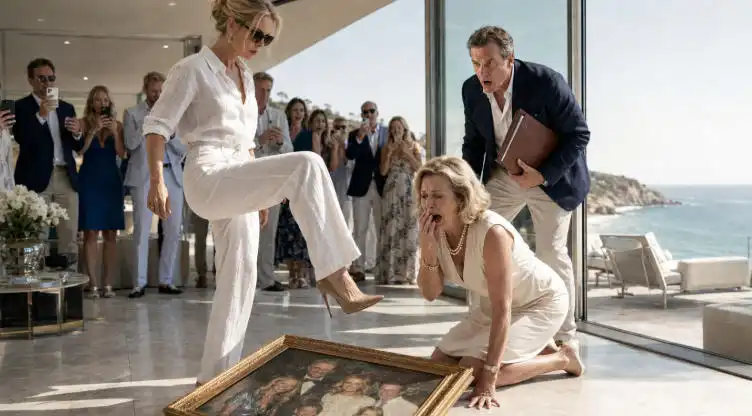
On the terrace floor, already placed beneath the open sky, was a framed painting wrapped in museum glass.
The Whitaker family masterpiece.
My mother saw it and staggered forward.
“You have it.”
“I own it.”
“No,” she whispered. “That belongs to our family.”
“It belonged to the lienholder,” I said. “Then it belonged to the court process. Then it belonged to me.”
Uncle Richard stepped closer.
“You cannot just take legacy.”
I looked at him.
“You forged legacy. I purchased collateral.”
My mother’s eyes filled with tears.
Not for me.
For the painting.
She knelt beside it like it was a body.
Her fingers hovered over the frame but did not touch the glass.
“You don’t understand what that means,” she said.
“I understand exactly what it means.”
She looked up.
“Please.”
That word landed strangely.
I had imagined it for years.
Please.
From her mouth.
To me.
I thought it would feel like thunder.
It felt like a door closing quietly.
“Please what?” I asked.
She lowered her head.
“We need help.”
“How much?”
Her face burned.
“A few hundred would get us through the week.”
Uncle Richard stared at the ground.
The man who once toasted to removing dead weight could not meet my eyes.
My mother clasped her hands.
“I will do anything.”
There it was.
The performance.
The public humility she hoped would purchase my guilt.
But I had learned from experts.
Never react to a performance.
Read the contract.
My lawyer, Helen Price, walked out onto the terrace holding a slim black folder.
Behind her stood a court-appointed restitution officer and two staff witnesses.
My mother froze.
“What is this?”
Helen opened the folder.
“A settlement option,” she said. “Voluntary. Reviewed by counsel. It allows partial reduction of civil penalties through documented restitution labor, public correction statements, and cooperation with ongoing asset recovery.”
Uncle Richard recoiled.
“Labor?”
Helen looked at him over her glasses.
“Beach cleanup and estate maintenance under a supervised vendor program. Paid at the legal rate, garnished toward the judgment. No one is forcing you. The alternative is continued collection.”
My mother’s mouth trembled.
“You want me to pick up trash?”
I looked toward the beach below my villa.
Plastic bottles glinted near the rocks after the morning tide.
“I want you to repay people you helped steal from.”
“I never stole from you.”
The old reflex came back into her voice.
Sharp.
Superior.
Mother again.
I stepped closer.
“No. You stole something worse.”
She stood.
“You always had this cruel streak.”
I smiled.
“There she is.”
Her face hardened.
“You think money makes you better?”
“No,” I said. “Documentation does.”
Helen handed her a page.
“Mrs. Whitaker, this includes your signed authenticity letters, your email approving the relabeling of Chloe’s studies, and your insurance statement regarding the burned canvases.”
My mother stared at the paper.
Her hand shook.
Uncle Richard whispered, “Caroline…”
She snapped, “Be quiet.”
I looked down at the masterpiece.
“Do you remember what you told me when I was thirteen?”
She said nothing.
“You said this painting was worth more than my future.”
Her eyes darted to my foot.
I lifted my heel above the frame.
She gasped.
“No.”
My staff went silent.
The ocean wind moved through the terrace curtains.
I could see every choice my mother had made reflected in the glass.
The Thanksgiving table.
The wine.
Brandon’s ashes.
Her finger pointing toward the door.
I brought my heel down.
The museum glass cracked.
My mother screamed.
Not loudly.
Worse.
A broken little sound.
I stepped again.
The frame split.
The canvas beneath did not tear the way she expected.
Because it was not the original.
It was a replica.
A court-approved display copy.
The actual painting was already secured in climate storage as evidence and collateral.
But my mother did not know that for three full seconds.
For three full seconds, she believed I had destroyed the god she loved more than her daughter.
Then I bent down and lifted the cracked replica.
On the back was a label.
Not a museum label.
A forensic one.
Helen read it aloud.
“Replica produced after the original was removed from the Whitaker Gallery storage room in 2017. Pigment analysis inconsistent with claimed date. Signature later added.”
My mother stared.
“No.”
“Yes,” I said.
Uncle Richard backed away.
“Caroline, what did you do?”
She turned on him.
“What did I do? You moved the invoices!”
“And Brandon painted over the base layer!”
My assistant’s phone was already recording.
So were the restitution officer’s notes.
So were the security cameras.
Public pressure is not always a crowd.
Sometimes it is three witnesses and the exact sentence someone should never say out loud.
Helen closed the folder.
“Thank you. That clarification will be useful.”
Uncle Richard’s face collapsed.
My mother realized what had happened.
She had not come to beg.
She had walked into a deposition with ocean views.
“You trapped us,” she whispered.
“No,” I said. “I opened the door.”
The final consequences were not dramatic in the way movies make them dramatic.
No one was dragged screaming from my terrace.
No lightning struck the house.
No one fainted into the pool.
But by sunset, my mother and uncle had signed the restitution agreement.
Not because I forced them.
Because the alternative was worse.
Their remaining civil exposure was brutal.
Their social circle was gone.
Their legal bills had eaten through what pride had not.
The agreement required cooperation, public correction letters to defrauded collectors, testimony about Brandon’s forgery process, and supervised work through a coastal cleanup contractor whose wages would be garnished toward restitution.
So yes.
The woman who once called me worthless spent mornings on the beach below my villa picking up plastic cups, cigarette filters, and broken glass.
Uncle Richard worked beside her in a sun hat too small for his head.
They were not slaves.
They were debtors finally doing work attached to the damage they caused.
Some days, I saw them from the terrace.
My mother never looked up.
But the staff said she looked at every newspaper left in the service area.
Especially the ones with my name in them.
Chloe Vale Breaks Record at London Auction.
Chloe Vale Retrospective Announced in Paris.
The Louvre Acquires Storm Table Series.
The first time my work entered the Louvre, I did not call her.
I went alone.
I stood in front of my painting while tourists moved around me.
The piece was called Thanksgiving Weather.
It did not show my family.
Not directly.
It showed a dinner table after everyone had left.
A red stain spreading across white cloth.
A barefoot woman visible only as a reflection in the dark window.
Outside, a storm moving away from the house.
An older woman beside me studied it for a long time.
Then she said softly, “It feels like surviving something.”
I said, “Yes.”
She asked, “Did you?”
I looked at the painting.
Then I thought of the girl in the driveway holding ashes.
The woman in the framing shop painting on scraps.
The daughter standing at the Malibu door while her mother finally learned the cost of cruelty.
“Yes,” I said. “I did.”
Brandon served time for fraud.
Not as much as some people wanted.
Enough to ruin the myth of him.
When he got out, he tried to sell a podcast about being “canceled by family betrayal.”
No one bought it.
Uncle Richard left California after completing his restitution work and moved into a small apartment near Phoenix.
He sent me one letter.
It began with excuses.
It ended with, “I should not have poured the wine.”
That was the closest thing to honesty he could afford.
I did not answer.
My mother lasted longer in Malibu than anyone expected.
For months, she arrived early for cleanup.
Pearls gone.
Hair pinned back.
Hands red from salt air and cheap gloves.
At first, I thought she was performing shame.
Then one morning, my groundskeeper told me she had been crying behind the equipment shed with a newspaper in her lap.
It was the article about the Louvre.
There was a photo of me standing beside my painting.
My mother had folded the page so only my face showed.
“She kept saying,” the groundskeeper told me, “‘That’s my daughter.’”
I asked, “Was she proud?”
He looked uncomfortable.
“No, ma’am. I think she was realizing it too late.”
That sentence stayed with me.
Too late.
A lot of people think revenge is about making someone suffer forever.
It is not.
Real revenge is when the lie finally stops working.
My mother’s lie was that I had no value.
The world corrected her.
The courts corrected her.
The collectors corrected her.
The beach work corrected her.
But most of all, my life corrected her.
I did not become powerful because they humiliated me.
I became powerful because I refused to let humiliation be the final version of me.
The last time I saw Caroline, she was sitting alone on the sand after a cleanup shift.
The sun was setting.
Her shoes were beside her.
She looked old.
Not evil.
Not grand.
Just old.
I walked down the stairs from the villa.
She stiffened when she saw me.
“I’m finished for the day,” she said quickly.
“I know.”
We stood there with the waves moving between us.
She looked up at the house.
“Do you hate me?”
I thought about lying.
Then I thought about telling the truth in the sharpest possible way.
Instead, I chose peace.
“I don’t carry you enough to hate you.”
Her eyes filled.
That hurt her more than anger would have.
She nodded.
“I saw the Louvre article.”
“I know.”
“You looked beautiful.”
I almost laughed.
All those years, and that was what she chose.
Not brave.
Not talented.
Not I’m sorry.
Beautiful.
Still, I could hear the effort.
So I accepted only what was useful.
“Thank you.”
She wiped her cheek.
“I was wrong.”
The waves dragged foam over the sand.
“Yes,” I said. “You were.”
“I should have protected you.”
“Yes.”
“I should have stopped Richard.”
“Yes.”
“I should have believed you.”
I looked at the water.
“No. You should have loved me before I had proof.”
She covered her mouth.
There was nothing left to say after that.
So I walked back up the stairs.
Not dramatically.
Not slowly.
I did not look back.
My house glowed above the cliff.
My paintings were being packed for Paris.
My name belonged to me.
And for the first time in my life, I understood that closure is not when the person who broke you finally cries.
Closure is when their tears no longer decide your worth.
That night, I opened my old sketchbook.
The one from Thanksgiving.
The pages still smelled faintly of smoke and wine.
On the last blank page, I drew a small girl standing barefoot in front of a locked door.
Then I drew the same girl years later, holding the key.
Not because someone gave it to her.
Because she built the house herself.
So pick a side and share it clearly:
Was Chloe cruel for making her mother face public consequences — or did that family finally get exactly what they earned?
Disclaimer: Mention of any brand or trademark is for identification only and does not imply partnership or endorsement
They Laughed While Security Beat the “Alley Thief”… Then One Video Made Everyone REGRET It
A Diner Owner Called Him a “VAMPIRE” and Kicked Him Into the Rain… Then KARMA Pulled Up in 18 Wheels
A Hollywood Producer Humiliated a Quiet Crew Worker on LIVE Video… Then KARMA Walked In Holding a Sealed Trust File