


Officer Davis did not move at first.
He just stared at the small red light on his bodycam.
Still recording.
Still saving every word.
Still holding Richard’s voice inside it like a loaded weapon.
Richard’s face went pale.
The guards who had their hands on me suddenly let go.
One of them looked at the other like he had just realized they were not security anymore.
They were witnesses.
And maybe suspects.
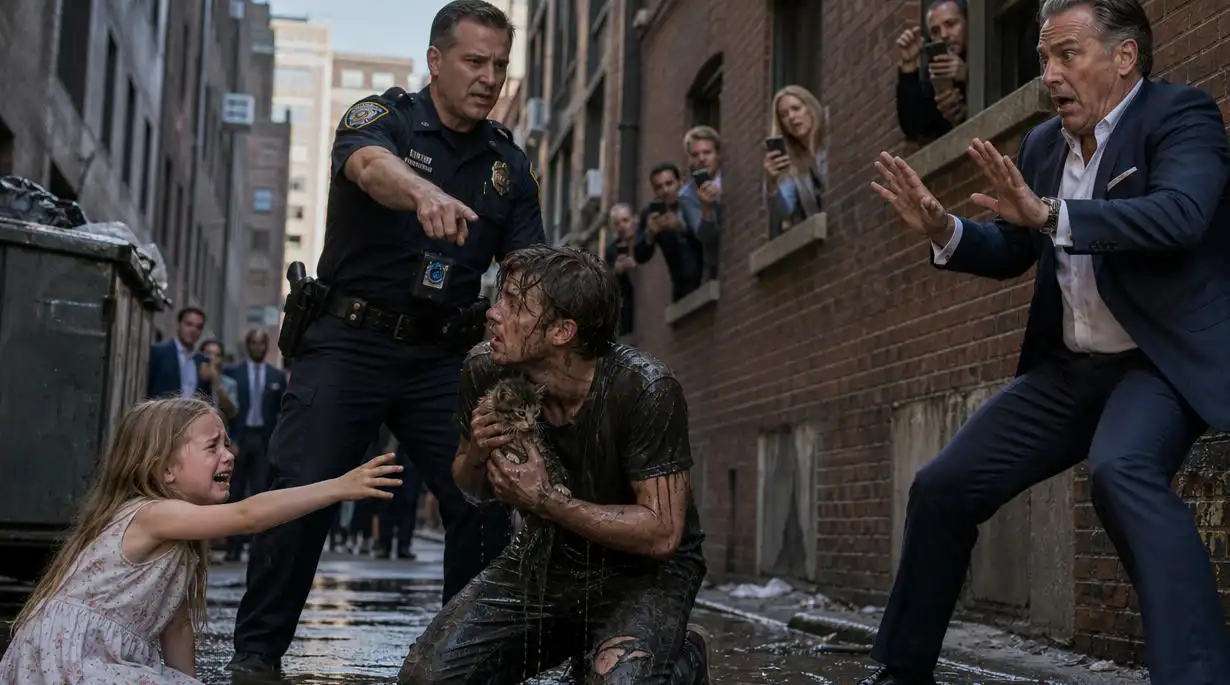
I was on the ground behind a luxury apartment building in Boston, soaked in sewer water, bleeding from my eyebrow, holding a half-dead kitten against my chest.
Richard stood above me in a wool coat that probably cost more than everything I owned.
He had just called me a thief.
He had just ordered men to take me down.
He had done it in front of a little girl, her mother, half a dozen tenants, two apartment buyers, and every phone pointed at us.
All because he didn’t want a homeless man ruining the image of his “premium residential experience.”
Officer Davis spoke quietly.
That made it worse.
“Mr. Richard Vale,” he said, “step away from him.”
Richard tried to laugh.
It came out wrong.
“Officer, don’t be ridiculous. This man trespassed on private property. My security team was assisting you.”
Davis looked at the guards.
“Were you assisting me?”
Neither of them answered.
Emma was still crying.
Her little pink coat was dirty from where she had knelt on the pavement. Her mother had one arm around her, but Emma kept reaching toward me.
“Mittens,” she sobbed. “Please, is she okay?”
I tried to lift the kitten higher.
“She’s breathing,” I said.
My voice sounded like gravel.
The cat was wrapped in my torn hoodie. Her fur was matted with mud and drain sludge. One eye was barely open. Her tiny body trembled so hard I could feel it against my ribs.
Emma’s mother covered her mouth.
“Oh my God,” she whispered. “He actually got her.”
A man in a navy suit had been recording from beside a black SUV. He turned his phone toward Richard.
“You told them to hit him after he came out with the cat.”
Richard snapped, “I told you to stop filming.”
The man did not lower his phone.
“No.”
That single word seemed to spread through the alley.
No.
No, the rich man did not get to decide what people saw.
No, the poor man did not have to disappear quietly.
No, the story was not going to be rewritten before the police report.
Richard looked around and realized the crowd had changed.
Five minutes earlier, people had been uncomfortable.
Silent.
Careful.
The kind of silence money buys.
Now they were angry.
A woman holding a grocery bag said, “I saw him crawl in there.”
Another man said, “That pipe is full of wastewater. He could’ve died.”
A young tenant whispered, “Richard said he was staging it.”
Davis knelt beside me.
“Tom, can you stand?”
“I don’t know.”
“Then don’t try.”
Richard stepped forward.
“Officer, this is getting out of hand. I’ll file the trespass complaint tomorrow. Right now I have private investors waiting upstairs.”
Davis stood.
His voice stayed calm.
“Your investors can wait.”
Richard’s mouth tightened.
“Do you know who I am?”
Davis looked at the kitten in my arms.
Then he looked back at Richard.
“I know what I just recorded.”
For the first time, Richard said nothing.
The first siren came from the main street.
Then another.
People turned toward the alley entrance as two patrol cars rolled up beside the brick wall.
The blue lights bounced across the wet pavement.
Across the drain cover.
Across Richard’s polished shoes.
Across my hands, which were shaking so badly I was afraid I might drop the cat.
Emma pulled free from her mother and ran to me.
Her mother tried to stop her, but Davis held up one hand.
“It’s okay.”
Emma dropped to her knees beside me.
She didn’t seem to care that I smelled terrible.
She didn’t seem to care that I was bleeding.
She only looked at the little bundle in my arms.
“Mittens,” she whispered.
The kitten made the smallest sound.
Emma broke.
She cried the way children cry when their whole world almost ends and then somehow comes back.
“Thank you,” she said to me. “Thank you, sir.”
Sir.
Nobody had called me that in a long time.
Most people called me buddy when they wanted me to move.
Man when they were annoyed.
You when they were afraid to touch my name.
Richard had called me trash.
But this little girl, with tears on her cheeks and mud on her knees, called me sir.
I looked away before anyone saw what that did to me.
One of the new officers took control of the guards.
Davis began asking questions.
Names.
Company.
Who employed them.
Who gave the order.
Richard kept trying to interrupt.
“This is a misunderstanding.”
“This is being blown out of proportion.”
“This man has been loitering here for weeks.”
“He created a safety issue.”
I finally looked up.
“You blocked the drain cover.”
Richard stared at me.
“What?”
“The maintenance panel,” I said. “It’s been loose for days. I told your building manager. Twice.”
Davis turned.
“You reported it?”
I nodded.
“First time, he told me to get lost. Second time, he said Mr. Vale didn’t want homeless people talking to residents.”
Emma’s mother looked at the open drain and went pale.
“My daughter could have fallen in.”
A tenant spoke from behind her.
“Any of us could have.”
Richard raised both hands.
“Now we’re taking safety advice from a man sleeping next to dumpsters?”
That was his mistake.
The alley went dead quiet.
Davis looked at him as if Richard had just dug his own grave and handed everyone shovels.
“Mr. Vale,” Davis said, “you need to stop talking.”
But Richard couldn’t.
Men like him never know when power has left the room.
He pointed at me.
“He is not a hero. He’s a liability. People like him reduce property value. My job is to protect this development.”
Emma’s mother stood slowly.
“Your job was to fix the drain.”
Richard turned on her.
“Ma’am, with respect, you should have been watching your child’s animal.”
The crowd reacted at once.
“What did he just say?”
“Are you serious?”
“She’s six!”
Emma clutched her mother’s coat.
Davis stepped between them.
“That’s enough.”
Richard’s phone began buzzing in his hand.
Then buzzing again.
Then again.
He looked down.
His expression shifted.
Not fear yet.
Confusion.
Then irritation.
Then something close to panic.
Because the man in the navy suit had already posted the video.
So had the tenant with the grocery bag.
So had a woman on the third-floor balcony.
Within ten minutes, the alley was on Facebook.
Not a clip.
Not a rumor.
A clear, ugly timeline.
A sick homeless man hearing a kitten crying in a sewer drain.
A developer mocking him.
A little girl begging.
A man crawling into filth while everyone else hesitated.
A kitten pulled out alive.
Then Richard ordering private guards to assault him anyway.
The caption on the first video was simple:
He saved a little girl’s cat. The developer had him beaten anyway.
By the time the ambulance arrived, the post had been shared thousands of times.
By the time animal control took Mittens to an emergency vet, the comment section was moving faster than anyone could read.
By the time I was lifted onto a stretcher, Richard had stopped talking to the crowd and started whispering into his phone.
“No, don’t respond yet,” he hissed. “Tell corporate legal this is misleading. Tell them he trespassed. Tell them we have a vagrancy issue.”
Davis heard every word.
So did the phones.
At the hospital, they cleaned the cut over my eye.
They checked my ribs.
They asked how long I had been coughing.
I told them a month.
That was not true.
It had been closer to a year.
The doctor frowned at my chart.
“Tom, you have old injuries that never healed right. You’ve been living outside?”
I looked at my hands.
“Mostly.”
“You need treatment. Real treatment.”
I almost laughed.
People said need like need could pay a bill.
Before I could answer, a nurse came in holding a phone.
“Is this you?”
The video was playing on her screen.
I saw myself crawling out of the drain.
I saw Emma screaming for her cat.
I saw Richard’s guard slam me into the wall.
I looked smaller than I remembered.
Weaker.
But not ashamed.
For once, the camera had not caught me stealing space.
It caught me saving something.
The nurse wiped her eyes.
“My dad shared it,” she said. “Half of Boston has seen it.”
I closed my eyes.
That scared me more than the guards.
I did not want to become some charity story people watched while eating dinner.
I did not want pity.
I wanted my body to stop hurting.
I wanted Emma’s cat to live.
I wanted one night where nobody told me to move.
Officer Davis came to the hospital around midnight.
He held his cap in both hands.
“Tom,” he said, “I need to tell you what’s happening.”
I braced myself.
Men with badges usually brought bad news to people like me.
Davis sat down.
“The guards gave statements.”
“And?”
“They both said Richard ordered them to remove you by force before I arrived fully into the alley. One admitted Richard told them to ‘make it look like trespassing.’”
My throat tightened.
Davis continued.
“My bodycam confirms you told everyone you heard an animal in the drain before you entered. Multiple witnesses confirm Emma identified the cat. The video shows you leaving the drain with the cat before force was used against you.”
I stared at the blanket.
“So I’m not being arrested?”
Davis looked almost offended.
“No, Tom. You’re not being arrested.”
I breathed for what felt like the first time all day.
Davis leaned forward.
“Richard may be.”
The room went quiet.
Davis spoke carefully, like every word had weight.
“Possible charges include assault by joint venture, solicitation, intimidation, false reporting, and depending on the district attorney’s review, reckless endangerment tied to the unsecured drain and the order given afterward.”
I swallowed.
“I don’t want trouble.”
Davis nodded.
“I know. But trouble found you.”
He reached into his folder and pulled out a printed form.
“There’s more. A civil rights attorney contacted the hospital. She says you don’t have to speak to anyone from Richard’s company. Not their lawyers. Not their PR team. Nobody.”
I almost laughed again.
“Why would they talk to me?”
Davis held up his phone.
The video had passed three million views.
Then five.
Then eight.
By dawn, it was over ten million.
The next morning, I woke up to sunlight through hospital blinds and a city that had apparently decided it knew my name.
News vans were outside the luxury apartment building.
A local reporter stood near the alley saying, “This is where witnesses say a homeless man risked his life to rescue a child’s missing cat before being assaulted by private security.”
The drain had yellow tape around it.
The building’s front doors had reporters on both sides.
Tenants walked out covering their faces.
One woman shouted, “Ask Richard why he ignored the maintenance complaints!”
That line became another clip.
By 9:30 a.m., the parent company’s stock opened lower.
By 10:00, it was plunging.
Not because Wall Street suddenly cared about me.
Because investors hate liability.
They hate video.
They hate executive arrogance recorded from twelve angles.
They hate a viral scandal that connects child safety, private security, false accusations, and a luxury brand built on trust.
Richard’s company released a statement at 10:14 a.m.
It said they were “reviewing the incident.”
Facebook ate it alive.
People posted screenshots under the statement.
Review this.
A photo of me holding Mittens.
Review this.
A clip of Richard saying, “People like him reduce property value.”
Review this.
A freeze-frame of the guard’s fist raised while Emma cried.
At 11:02 a.m., the board called an emergency meeting.
At 1:37 p.m., Richard Vale was terminated.
Not suspended.
Not placed on leave.
Terminated.
The company statement said his conduct was “inconsistent with our values.”
People in the comments said, “You mean inconsistent with being caught.”
By late afternoon, prosecutors confirmed they were reviewing criminal charges.
The two guards were arrested first.
Richard was questioned that evening.
A week later, he was charged in connection with ordering the assault and making false claims about a supposed break-in.
His lawyers tried to say he was protecting residents.
The bodycam made that impossible.
His own voice ruined him.
“You hear imaginary cats now?”
“Stop recording!”
“Take him down anyway.”
“People like him reduce property value.”
There was no PR firm in America that could turn those words into concern for public safety.
Then came the civil case.
The attorney Davis mentioned was named Karen Whitlock, though she was nothing like the screaming women people joke about online.
She was calm.
Sharp.
Terrifying in a courtroom.
She visited me in the hospital two days after the incident.
She brought coffee, a clean sweater, and a legal pad full of notes.
“Tom,” she said, “I’m not here to make you famous. I’m here to make sure they cannot buy your silence for the price of a motel room.”
I looked at her.
“I don’t know how lawsuits work.”
“That’s why they count on men like you giving up.”
“I don’t want to hurt anyone.”
She set down her pen.
“You didn’t. They hurt you.”
That sentence stayed with me.
For years, I had apologized for existing too close to other people’s comfort.
Sorry, I’ll move.
Sorry, I didn’t know this doorway was private.
Sorry, I was just getting cardboard.
Sorry, I smell like rain.
Sorry, I’m coughing.
Sorry, I’m still here.
Karen would not let me say sorry.
She built the case with Davis’s bodycam, witness statements, maintenance complaints, security contracts, the viral footage, the company’s own emails, and the emergency vet record for Mittens.
That last one mattered more than I expected.
Because it proved the cat had been trapped in the drain long enough to be in real danger.
It proved Emma wasn’t making it up.
It proved I did not crawl into that pipe for attention.
And the maintenance records proved something even worse.
The drain cover had been flagged three times.
Not once.
Three times.
A subcontractor had warned that the back alley drainage channel was unsafe and needed immediate repair.
Richard had delayed the fix because the alley renovation was not visible to buyers.
He wanted money spent on lobby lighting instead.
Lobby lighting.
A child’s pet nearly died.
A child could have fallen in.
I nearly drowned in sewage.
And he chose lobby lighting.
When that email came out, the board stopped pretending.
The settlement offer changed.
At first, they offered me enough for a few months indoors and medical bills.
Karen slid the paper back across the table.
“No.”
Their lawyer blinked.
“Ms. Whitlock, your client has limited earning history.”
Karen smiled without warmth.
“My client has ten million witnesses.”
The lawyer stopped blinking.
The final settlement was confidential in exact numbers.
But not in meaning.
It was enough to pay my medical treatment.
Enough to secure housing.
Enough to make sure I was never forced to sleep behind Richard’s building again.
Enough to start over.
When the agreement was signed, Karen handed me the pen.
“Take your time,” she said.
My hand shook.
Not because I was afraid.
Because for the first time in years, my signature mattered.
Richard tried one last time to save himself.
He posted a video apology.
He wore a plain gray sweater instead of his usual suits.
He sat in front of a bookshelf.
He said he had “allowed stress to affect his judgment.”
The comments did not forgive him.
One woman wrote, “Stress doesn’t make you order a beating.”
A veteran wrote, “A man’s character is what he does when nobody can help the weak. Yours was filmed.”
Emma’s mother posted one comment.
Just one.
My daughter still wakes up crying. Tom still saved her cat. That is the only apology I care about.
The apology video disappeared within hours.
Richard lost his job.
Then his board seat.
Then his partnership offers.
Developers stopped inviting him to private meetings because nobody wanted his name attached to a project.
The criminal case moved slowly, the way legal things do, but it moved.
The guards took plea deals.
Richard fought longer.
Men like him always think delay is power.
But delay does not erase video.
In the end, he stood in court while the prosecutor played the bodycam.
The judge watched Richard point at me.
Watched him lie.
Watched him order violence after I came out of the drain with a dying cat.
Richard’s face looked empty.
Not sorry.
Just exposed.
He was ordered to pay fines, complete probation conditions, and stay away from me, Emma’s family, and the apartment property. The civil settlement had already destroyed the polished life he used like armor.
His name, once printed on glossy brochures, became a warning in business articles.
A case study.
How not to manage a crisis.
How not to treat vulnerable people.
How one man’s cruelty can cost a company millions before lunch.
As for me, healing was not instant.
Stories online make it sound like money fixes everything by Friday.
It doesn’t.
My ribs hurt for weeks.
My lungs took months.
The doctor found an old untreated infection that had weakened me badly. There were appointments, scans, medication, physical therapy, and nights when I woke up in a clean bed convinced someone was about to tell me to leave.
But nobody did.
Karen helped me set up a trust.
Davis checked on me more than he had to.
Emma’s mother sent updates about Mittens.
The first photo showed the cat wrapped in a tiny blanket at the vet.
The second showed her eating.
The third showed Emma holding her on a sofa, both of them looking sleepy and safe.
On the back of the printed photo, Emma wrote in crooked letters:
Thank you, Mr. Tom. Mittens says thank you too.
I kept it on my kitchen counter.
My kitchen counter.
Those words still feel strange.
Six months after the alley, I bought a small brick rowhouse on a quiet street.
Not a mansion.
Not a luxury condo.
Just a narrow home with a blue door, old wood floors, a leaky faucet I fixed myself, and a patch of sunlight by the front window where a cat could sleep.
I did not buy it to show Richard I had won.
I bought it because every person deserves a door that locks from the inside.
The day I moved in, Davis came by carrying a toolbox.
Karen brought paperwork.
Emma and her mother brought cookies.
And Mittens came in a little carrier, wearing a ridiculous pink collar.
She stepped out, sniffed my floor, and immediately acted like she owned the place.
Emma giggled.
“She remembers you.”
I crouched down slowly.
Mittens walked toward me and pressed her head against my hand.
I had faced cameras, lawyers, doctors, and reporters without crying.
That cat broke me in three seconds.
Emma hugged me around the neck.
“You’re not in the alley anymore,” she whispered.
“No,” I said. “I’m not.”
Later, I used the rest of the settlement to create something I had been thinking about since the hospital.
The Mittens Fund.
Officially, it helps rescue injured and abandoned city animals.
Unofficially, it does something else too.
It pays homeless and low-income people small stipends to help monitor alley colonies, report unsafe drains, guide rescuers, and connect lost pets with shelters.
Because people like me notice things.
We know which cats sleep under which stairs.
We know which dogs were dumped behind which market.
We know which drains are broken, which fences are loose, which animals are crying where nobody else wants to walk.
For years, the city treated that knowledge like nothing.
Now it saves lives.
The first rescue we funded was a gray kitten trapped under a loading dock.
The volunteer who found him was a man named Luis who slept in his van.
When the shelter director thanked him, he lowered his head like he expected a catch.
I knew that look.
I told him, “You did good.”
He looked at me for a long moment.
Then he nodded.
Sometimes dignity returns quietly.
Not with applause.
Not with a viral video.
Just with one person saying your name like it belongs in the room.
A year after the incident, the alley behind Richard’s old building looked different.
The drain was repaired.
The bricks were pressure washed.
The dumpsters were moved.
There was a security camera over the service entrance and a small sign near the wall:
Report animal distress or unsafe conditions immediately.
No one put my name on it.
I didn’t want that.
But one afternoon, I walked past and saw a little girl showing her father the drain.
“That’s where Mittens was,” she said. “And that’s where Mr. Tom saved her.”
Her father looked down the alley.
“Sounds like Mr. Tom is a brave man.”
I kept walking.
But I smiled all the way home.
Richard once said people like me reduce property value.
He believed worth was measured by polished shoes, clean coats, private security, and how quickly you could make the uncomfortable disappear.
He was wrong.
Worth is what you do when someone small is crying and no one powerful wants to get dirty.
Worth is crawling into the dark because a child believes her cat is still alive.
Worth is telling the truth even when rich men tell you to shut up.
And sometimes, justice is not lightning.
Sometimes it is a bodycam.
A child’s voice.
A dozen phones.
A rescued kitten.
A lawyer who refuses the first offer.
A boardroom full of frightened executives watching their stock fall because the world finally saw what they protected.
Tom got a home.
Mittens got a second life.
Emma got her best friend back.
Richard got exactly what he tried to give me:
a public record he could never escape.
So choose a side.
Do you stand with the man who crawled into filth to save a little girl’s cat, or the developer who cared more about luxury image than a human life? Share this if you believe dignity should never depend on how much money someone has. 💙
Disclaimer: Mention of any brand or trademark is for identification only and does not imply partnership or endorsement
A Diner Owner Called Him a “VAMPIRE” and Kicked Him Into the Rain… Then KARMA Pulled Up in 18 Wheels
A Hollywood Producer Humiliated a Quiet Crew Worker on LIVE Video… Then KARMA Walked In Holding a Sealed Trust File
A Free Public Defender Was Shoved Into a Cake by an Ivy League Hedge Fund Prince… but They Had NO IDEA Who He Really Was 😳