

He announced his engagement in MY family’s Napa tasting room… then told security to drag me out because I looked “too dirty” to stand near his guests.
I was wearing work boots.
Dust on my jeans.
Grape stains on my hands.
To everyone else, I looked like a seasonal harvest worker.
That was the point.
Julian stood under the crystal lights with Amber hanging on his arm in a white designer dress, smiling like she had just won the lottery.
He lifted a glass of our darkest reserve red and told the crowd:
“Welcome to my winery.”
My stomach went cold.
Then Amber laughed and pointed at me.
“Is she staff? Why is she staring like that?”
Julian turned slowly, like he was embarrassed to even know me.
“Clara,” he said loud enough for every investor, critic, and guest to hear, “this is a private event. You’re not family. You’re not ownership. You’re just temporary labor.”
People turned.
Phones came up.
One woman whispered, “Oh my God…”
Then Julian snapped his fingers at two security guards.
“Get her out before she stains the floor.”
Amber smiled and added, “Or my dress.”
That was when I stopped feeling hurt.
And started counting witnesses.
Because Julian didn’t know one thing.
The land.
The deed.
The old cellar records.
The signature authority.
None of it belonged to him.
It never had.
I had spent the entire harvest season letting him believe I was powerless.
I let him insult me.
I let him flirt with Amber in front of staff.
I let him tell suppliers he was “modernizing the family legacy.”
I even let him schedule his engagement party in the tasting room my grandfather built with his own hands.
But I wasn’t alone that night.
At exactly 7:18 p.m., the family lawyer walked through the doors carrying a sealed envelope.
Behind him came Mr. Rossi, our 78-year-old head gardener, still holding pruning shears.
Julian’s smile disappeared.
Amber grabbed his sleeve.
And when Julian whispered, “Remove them,” Mr. Rossi stepped in front of his guards and said:
“Not one step closer.”
Then the lawyer raised the envelope and said my full legal name in front of the entire room.
That was the moment Julian realized the “temporary worker” had been setting the table all along. 🍷
Full Story is in the comments.
Be honest: if a man used your family name, your family land, and your family legacy to impress another woman… would you expose him publicly, or handle it quietly?
Score: 116/120
【C】— REELS + TEXT-TO-IMAGE PROMPTS
12S SORA2 VIDEO PROMPT:
Ultra-realistic American drama, cinematic handheld camera, Napa Valley luxury winery tasting room at sunset, wealthy guests in formal clothes watching. First 3 seconds: a smug white male winery manager in a tuxedo snaps his fingers and says, “Get the dirty harvest girl out,” as two guards step toward a dusty white woman in work boots holding grape-stained gloves. His glamorous blonde fiancée in a white designer dress laughs, “She’ll stain my dress.” The woman stays calm, eyes cold. A silver-haired lawyer enters holding a sealed envelope, followed by an elderly gardener blocking the guards. The manager’s smile collapses. The woman grabs a glass of dark red wine, splashes it across the fiancée’s white dress, knocks the manager’s wineglass from his hand, and shoves him backward into a huge winery pomace bin. Guests gasp, phones recording, no special effects, raw realistic acting, emotional dialogue, natural lighting, tense faces, 12 seconds.
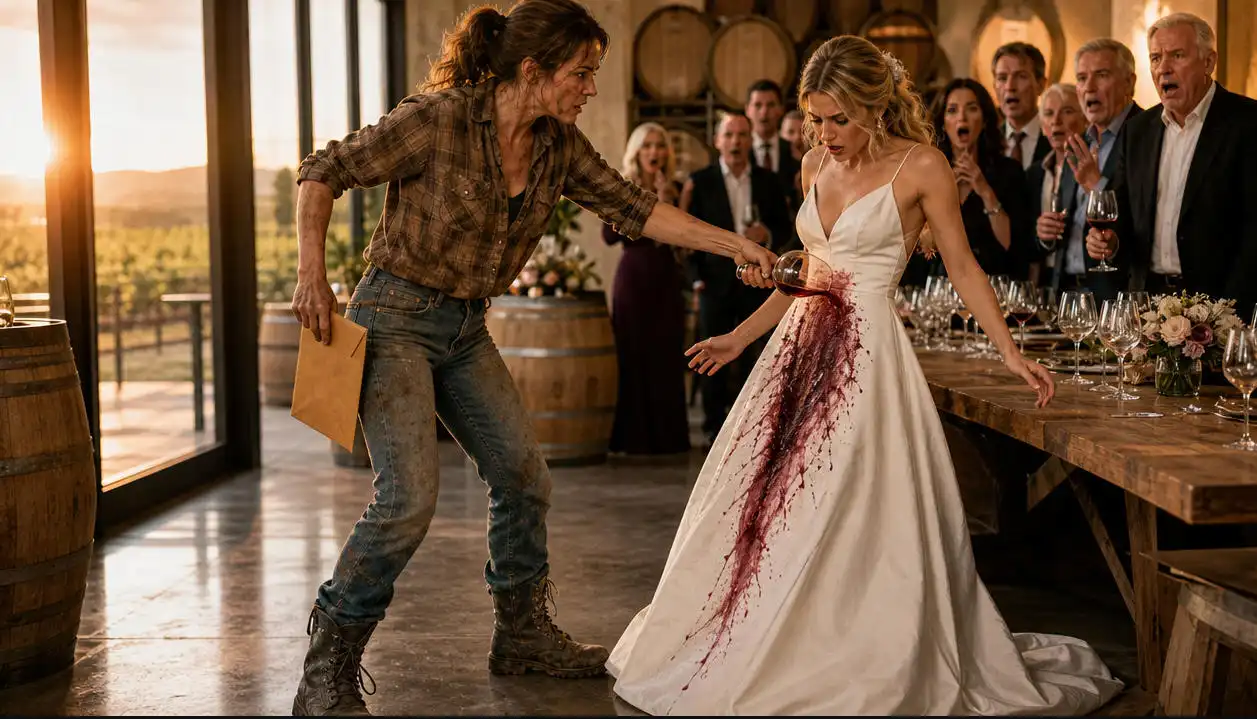
IMAGE PROMPT: Ultra-realistic cinematic Napa Valley winery tasting room, sunset through tall windows, a dusty white woman in work boots splashing dark red wine onto a shocked blonde woman’s expensive white engagement dress, smug male manager recoiling with a shattered wineglass falling from his hand, sealed legal envelope visible in the woman’s other hand, wealthy guests gasping in background, intense facial expressions, luxury wine barrels and crystal glasses, dramatic handheld documentary feel, no text, no watermark, 16:9.
【D】— FULL STORY
The lawyer raised the envelope and said my full legal name in front of the entire tasting room.
Not “Clara from harvest.”
Not “the girl in the boots.”
Not “temporary labor.”
He said, “Clara Whitmore, sole legal heir of Whitmore Ridge Estate and Winery.”
The room went silent so fast I could hear the ice settle in Amber’s glass.
Julian’s face changed first.
It wasn’t fear.
Not yet.
It was annoyance.
The kind of annoyance men get when reality interrupts a performance they paid a lot of money to stage.
“David,” he said to the lawyer, forcing a laugh, “this is not the time.”
David Whitaker had been my family’s attorney for nearly forty years. He had known my grandfather before I was born. He had drafted my father’s trust. He had sat with me in the hospital parking lot three nights after Dad died because I couldn’t make myself walk back into the house.
He did not laugh.
“This is exactly the time,” David said.
The guests shifted.
A few lowered their champagne flutes.
A few raised their phones higher.
Amber looked from Julian to me, then back to Julian.
“What is he talking about?” she whispered.
Julian ignored her.
He stepped down from the small platform near the fireplace, still holding himself like a king descending to discipline a servant.
“Clara,” he said through his teeth, “you’re embarrassing yourself.”
I looked down at my boots.
They were dusty from Block Seven, the old Cabernet vines my grandfather planted when he was twenty-six.
My jeans had a tear on the knee.
My hands were stained purple from helping the pickers that morning.
I knew what I looked like.
That was why the room believed him at first.
A woman in work boots is easy to dismiss.
A man in a tailored tuxedo with a microphone is easy to believe.
Julian had built his whole lie on that.
He turned back toward the crowd and spread his hands.
“Ladies and gentlemen, I apologize. This is a family matter involving a former employee who has had some difficulty accepting recent changes.”
Former employee.
I almost smiled.
Amber’s mother, seated near the front with pearls around her neck, leaned toward the woman next to her and whispered, “How sad.”
That whisper did more to steady me than anything else could have.
Sad.
That was what they thought I was.
A sad woman.
A bitter ex.
A jealous laborer.
A girl who showed up at her former boyfriend’s engagement party because she couldn’t let go.
Julian had counted on it.
He had counted on my silence.
For eight months, he had counted on it.
Eight months earlier, my father’s funeral had filled the little stone chapel above the vines. Men who had worked our land for thirty years stood in the rain with their hats in their hands. Women from town brought casseroles. The tasting room closed for three days.
Julian had stood beside me at the grave, holding my hand.
“I’ll take care of everything,” he said.
Back then, I believed him.
He was the general manager my father had hired five years earlier. Smart. Polished. Smooth with investors. Good with press. He knew how to say “legacy” in a room full of donors and make people feel like they were buying history, not wine.
He also knew how to wait.
After Dad died, I was drowning in paperwork, grief, and the kind of exhaustion that makes the simplest decision feel impossible.
Julian started small.
“You don’t need to come to the supplier meeting.”
“I’ll handle payroll.”
“Just sign here so I can talk to the distributors.”
“You should rest, Clara.”
Then he got bolder.
He changed passwords.
Moved invoices to a private account.
Told staff all major decisions had to go through him.
When I questioned him, he kissed my forehead and said, “You’re emotional. Let me protect you from business stress.”
Protect me.
That word still tasted like rust.
By spring, I started hearing rumors.
A barrel vendor called him “Mr. Whitmore.”
A reviewer congratulated him on “taking over the family estate.”
A guest asked me if Julian’s “late father-in-law” had left him the vineyard.
Then I saw Amber’s first post.
She stood on our south terrace at sunset, holding a glass of my grandfather’s reserve.
Caption: My future husband’s winery feels like heaven.
Future husband.
I stared at those words so long my phone went dark in my hand.
Julian had been sleeping beside me two nights before.
When I confronted him, he didn’t deny it.
He just sighed, like I was an inconvenience.
“Amber understands the kind of life this place deserves,” he said. “You never did.”
“The kind of life?” I asked.
“Events. Press. Investors. Luxury. You want dirt under your nails and old men telling stories about your grandfather.”
“My grandfather built this place.”
“And I can make it famous.”
That was the first time I saw him clearly.
Not as the man I loved.
Not as the man my father trusted.
As a tenant in someone else’s house, already measuring the drapes.
I wanted to scream.
I wanted to throw him out that day.
But David stopped me.
“Let him talk,” he said.
“David, he’s telling people he owns the winery.”
“Then we need him to tell the right people.”
I did not understand at first.
David did.
Julian had employment authority. He had management access. He had been granted limited signature power after Dad’s illness, but only for operations. Not ownership. Not transfers. Not loans. Not sale of land. Not brand licensing.
But paperwork is not the same as perception.
Julian understood perception.
So we decided to let him show us how far he would go.
I moved into the old cottage behind the barrel barn.
I put on work clothes.
I worked harvest.
I let staff think I was stepping back because I was grieving.
Only a few people knew the truth.
David.
Our accountant.
And Mr. Rossi.
Mr. Rossi had been at Whitmore Ridge longer than anyone alive except my father. His back was bent, his hands were knotted, and he could tell if a vine was thirsty by touching one leaf.
He called me “little miss” until I was thirty-four.
The day I told him what Julian was doing, he took off his hat and looked toward the main house.
“Your grandfather would come out of his grave and chase that boy to Sonoma,” he said.
I laughed for the first time in weeks.
Then he got serious.
“You want him stopped?”
“Yes.”
“Then don’t slap him too early.”
That became our rule.
Do not slap him too early.
So I waited.
I cleaned tasting glasses while Amber strutted through the room with influencers.
I carried crates while Julian told a distributor, “Once I formalize control, we’ll phase out the old staff.”
I stood ten feet away while he told a wedding planner, “Clara’s family was sentimental. I’m practical.”
I watched him rename my father’s private reserve selection for Amber.
Amber’s Blush.
A red blend.
Named after a woman who once asked if grapevines were trees.
Every insult went into a folder.
Every invoice.
Every false statement.
Every email where Julian implied he had ownership authority.
Every promotional mockup using the Whitmore family crest for his personal engagement event.
The final piece came when he sent invitations.
Cream cardstock.
Gold lettering.
Julian Vale and Amber Sinclair request the honor of your presence at their engagement celebration at Whitmore Ridge Estate, the private family winery of the groom.
The groom.
Not manager.
Not employee.
Groom.
I read the invitation twice.
Then I called David.
“He did it,” I said.
David was quiet for a moment.
Then he said, “Then we go public.”
Which brought us to that night.
The tasting room glowed like a magazine spread. Candles on every table. White roses in silver bowls. A string quartet near the old stone fireplace. Rows of our best bottles lined up like trophies behind Julian’s rented stage.
He had invited critics, investors, local society people, and half the Napa social circle Amber had spent years trying to impress.
He had also invited the press.
That was his mistake.
Men like Julian do not just want to steal.
They want applause while they do it.
I arrived through the service entrance with the harvest crew.
My hair was tied back.
My shirt was plain.
My hands were stained from the crush pad.
One young server looked embarrassed for me.
“Clara,” she whispered, “are you sure you want to be here?”
“I have never been more sure of anything.”
At 7:00, Julian took the microphone.
At 7:04, he thanked “my incredible team.”
At 7:07, he toasted “new beginnings.”
At 7:10, he kissed Amber in front of everyone.
At 7:12, he announced that after the wedding, he and Amber planned to “refresh the estate’s direction,” including “staff restructuring” and “legacy brand modernization.”
Mr. Rossi stood beside me near the back wall.
His jaw tightened.
“Legacy brand,” he muttered. “I planted the west hill before that boy’s mother bought her first crockpot.”
Then Amber saw me.
Of course she did.
People like Amber can spot someone they think is beneath them from across a room.
She whispered to Julian.
Julian looked over.
For half a second, his eyes widened.
Then he smiled.
Not kindly.
Victoriously.
He raised the microphone again.
“Well,” he said, “it seems we have an unexpected visitor.”
The room turned.
My chest tightened, but I did not move.
Julian walked toward me with theatrical patience.
“Clara,” he said, “this event is private.”
“I know.”
“You’re not on the list.”
“I know.”
Amber stepped beside him, holding her glass of red wine, her white dress fitted so tightly she looked afraid to breathe.
“Is this the ex?” she asked, loud enough for the front tables to hear.
A few people made uncomfortable sounds.
Julian put one hand up, pretending to be gracious.
“Let’s be compassionate. Clara has been struggling since her father passed.”
There it was.
The dead father card.
Used against me in my own house.
My fingers curled around the work gloves in my hand.
Amber tilted her head.
“Poor thing,” she said. “But grief isn’t an excuse to crash someone else’s celebration.”
Someone else’s.
I looked at the fireplace.
My grandfather had laid those stones.
I looked at the long oak bar.
My father had sanded it himself one summer because he said machine work had no soul.
I looked at the window where my mother used to sit before she died, watching the fog lift over the vines.
Someone else’s celebration.
Julian snapped his fingers.
Security moved.
“Escort her out,” he said. “Gently, if she behaves.”
The first guard reached for my arm.
Mr. Rossi stepped in front of him.
He was smaller than both guards.
Older than both guards.
But there are men who spend their lives lifting weights, and men who spend their lives wrestling stubborn earth.
Mr. Rossi was the second kind.
He held his pruning shears at his side, closed, not raised.
His voice was low.
“Do not touch the owner.”
People gasped.
Julian laughed sharply.
“The owner?”
At exactly that second, the double doors opened.
David walked in wearing his navy suit, carrying a leather folder and one sealed envelope.
Behind him came two men I recognized from the county recorder’s office and a uniformed Napa County sheriff’s deputy who had agreed to stand by because David had warned him there might be trouble removing trespassers.
Not arresting anyone.
Not yet.
Just standing there.
Publicly.
Calmly.
Legally.
Julian’s face went pale at the edges.
Amber whispered, “Julian?”
He did not answer.
David walked to the center of the room.
“Good evening,” he said. “My apologies for interrupting. My name is David Whitaker. I represent the Whitmore family estate.”
Julian snapped, “You are interrupting a private event.”
David looked at the crowd.
“That is one of several false statements made tonight.”
A murmur rolled through the room.
Julian stepped closer.
“Careful.”
David opened the folder.
“No, Mr. Vale. I would advise you to be careful.”
Then he read the first document.
The deed.
Recorded in Napa County.
The owner of Whitmore Ridge land, buildings, trademarks, and production assets was the Whitmore Family Trust.
The sole beneficiary after my father’s death was me.
Clara Evelyn Whitmore.
Not Julian Vale.
Not Amber Sinclair.
Not any company Julian had quietly registered three months earlier with a name close enough to confuse investors.
David lifted the sealed envelope.
“This is the final letter of intent signed by Edward Whitmore before his death. It confirms what the trust already states. Management authority granted to Mr. Vale was limited, revocable, and never included ownership rights.”
The deputy stood by the door.
The county men nodded.
The press recorded every word.
Amber backed away from Julian like his lie was contagious.
“You told me your name was on everything,” she hissed.
Julian’s mask cracked.
“Amber, don’t do this now.”
“Do what? Find out I got engaged to an employee?”
Someone in the crowd actually laughed.
Not loudly.
But enough.
Julian heard it.
And that was when the arrogance turned ugly.
He spun toward me.
“You think this makes you powerful?” he said. “You’re a vineyard girl who got lucky being born into land. I built this place into something people care about.”
I stepped forward.
“No. You built a costume.”
His jaw flexed.
“You have no idea what it takes to run this estate.”
“I know exactly what it takes,” I said. “It takes people like Mr. Rossi. Like Elena in the cellar. Like the pickers you called replaceable. Like my father, who trusted you when he was sick.”
His eyes flashed.
“You were too weak to lead.”
“No,” I said. “I was grieving. You confused that with weakness.”
The room went quiet again.
That sentence landed harder than I expected.
Maybe because half the people there were old enough to know grief does not make you stupid.
It makes predators impatient.
David handed me the folder.
I opened it and pulled out copies of the emails.
“On March 18, you told Porter & Lane Distributors you were the controlling owner.”
Julian’s mouth opened.
“On April 2, you instructed accounting to route a tasting event deposit into Vale Hospitality Consulting.”
The accountant near the back raised her hand slightly.
“I have the transfer record,” she said.
Amber stared at him.
“You used our engagement deposit?”
Julian’s voice sharpened.
“Be quiet.”
That was his second mistake.
The first was stealing.
The second was forgetting that women like Amber only enjoy cruelty when it points away from them.
She turned on him instantly.
“You told me Clara was a broke ex-girlfriend living off pity.”
I laughed once.
It escaped before I could stop it.
Amber snapped her gaze to me.
“And you!” she said. “You let me stand here like an idiot?”
“You dressed yourself,” I said.
A few guests gasped.
Mr. Rossi coughed into his fist, which was his version of laughing.
Amber’s face twisted.
“This dress cost more than your truck.”
“That may be true,” I said.
Then I picked up the nearest glass of our darkest reserve red from the tasting table.
Amber saw it and froze.
“Don’t you dare.”
For one heartbeat, the whole room held its breath.
I thought about every time she had posted pictures of my home and called it her future.
Every time she had smiled at staff like they were furniture.
Every time she had worn my family crest on an invitation she had no right to send.
I stepped close.
“This is the Whitmore Mourvèdre,” I said. “Very deep color. Terrible on white fabric.”
Then I threw it across the front of her dress.
The wine hit like spilled midnight.
Amber screamed.
The room erupted.
Phones flew higher.
Julian lunged for the glass in my hand, but I slapped his wrist hard enough that his own wineglass flew from his fingers and shattered against the floor.
“Do not touch me,” I said.
He stepped toward me again.
Mr. Rossi moved.
The deputy moved.
Julian stumbled backward, lost his footing near the service aisle, and crashed straight into the open pomace bin the cellar crew had rolled in earlier from the crush pad.
It was huge.
Purple.
Wet.
Full of skins, seeds, stems, and the sour-sweet leftovers of fermentation.
He landed in it with a sound I will never forget.
Not because it was loud.
Because it was perfect.
For a second, only his polished shoes stuck up over the rim.
Then he sat up, covered from tuxedo collar to cuff in crushed grape waste.
A woman near the fireplace whispered, “Oh my Lord.”
Then someone laughed.
Then someone else.
Then the whole room broke.
Julian Vale, the self-declared master of Whitmore Ridge, sat in a vat of leftovers.
Amber sobbed over her ruined dress.
The guests recorded.
The sheriff’s deputy tried very hard not to smile.
David, professional to the bone, simply said, “Mr. Vale, you are hereby terminated for cause.”
Julian wiped grape skins from his face.
“You can’t do this.”
“I can,” I said. “And I just did.”
The next hour was not as dramatic, but it mattered more.
David served Julian with formal termination paperwork.
The deputy informed him that several financial complaints had already been filed.
Our accountant handed over records of diverted deposits, unauthorized vendor contracts, and emails showing Julian had represented himself as owner to multiple third parties.
By midnight, Julian was gone from the estate.
Not walking proudly.
Not waving to guests.
He was escorted out in a borrowed jacket because his tuxedo smelled like fermented regret.
Amber left separately with her mother, crying into a napkin and yelling that she had been “misled.”
Maybe she had.
But she had also enjoyed every second of looking down on people she thought were beneath her.
The next morning, the story was everywhere.
Not the way Julian had planned.
The local wine blogs called it “The Pomace Party.”
One headline read:
Napa Manager Accused Of Fraud After Claiming Ownership Of Historic Family Winery
Another simply said:
White Dress, Red Wine, Big Lie.
Amber’s career as a wine reviewer collapsed almost overnight.
It turned out people in the wine industry forgive many things.
Bad taste.
Bad scores.
Bad manners.
But they do not forgive a critic who publicly attaches herself to a fraud and mocks vineyard workers in the room that feeds her reputation.
Her partnerships vanished.
Her column was paused.
Invitations dried up.
She posted one tearful apology video saying she had “trusted the wrong person.”
The comments were not kind.
Julian’s consequences took longer, but they were heavier.
The investigation uncovered more than we expected.
Diverted event revenue.
Misrepresented ownership to investors.
Unauthorized use of estate branding.
Attempts to set up a parallel hospitality company using relationships built through Whitmore Ridge.
The district attorney filed charges related to fraud and embezzlement.
His attorney tried to argue it was a business misunderstanding.
David gave them the emails.
The invoices.
The recordings.
The invitation.
The county records.
And, ironically, dozens of videos from Julian’s own engagement party where he stood under our lights and called my winery his.
He eventually accepted a plea deal that left him facing up to ten years depending on sentencing and restitution compliance.
When I heard that number, I did not cheer.
That surprised me.
For months, I had imagined revenge would feel like fire.
It felt more like setting down a heavy box.
I was relieved.
I was tired.
And I was finally free.
Two weeks after the party, I reopened the tasting room.
No crystal chandeliers.
No rented string quartet.
No white roses.
Just the old oak bar, clean glasses, local cheese, bread from the bakery in town, and the people who had kept the estate alive while Julian played king.
I stood in front of the staff and tried to make a speech.
I had written one.
It was folded in my pocket.
But when I saw Elena wiping her eyes near the barrel room, and Mr. Rossi standing with his old hat against his chest, I forgot every word.
So I told the truth.
“My father used to say a winery is not land. It’s not buildings. It’s not labels. It’s people who show up when the vines are ugly, not just when the glasses are full.”
Mr. Rossi looked down.
I kept going.
“I disappeared for a while. I let someone else speak too loudly in my family’s house. That will never happen again.”
The staff was quiet.
Then Elena said, “Good.”
Everyone laughed.
That was the first day Whitmore Ridge felt like home again.
A month later, we released the wine.
I had no intention of naming a bottle after Julian.
That would have given him too much honor.
But Elena suggested we reclaim the humiliation.
“Not his name,” she said. “His lesson.”
So we bottled a limited reserve red called The Pretender’s Pour.
The label was simple.
A dark red splash across cream paper.
Under it, in small letters:
Estate-owned. Truth-aged. Best served to people who mistake kindness for weakness.
It sold out in forty-eight hours.
Then we released a second batch.
That sold out in one day.
By the end of the quarter, Whitmore Ridge had the highest direct-to-consumer sales in its history.
Not because of scandal.
Because people understood the story.
A woman in work boots had been mocked in a room full of people.
A man in a tuxedo had tried to steal what a family spent a century building.
And the truth walked in with a sealed envelope.
The best part happened quietly.
One evening near harvest, Mr. Rossi found me by the old Cabernet vines.
The sky was orange.
The air smelled like dust and leaves.
He handed me a cluster of grapes and said, “Your grandfather would be proud.”
I swallowed hard.
“For the wine?”
“For waiting,” he said. “And for knowing when not to wait anymore.”
I looked across the valley.
For the first time since my father died, the vineyard did not feel like a burden.
It felt like an inheritance.
Not just of land.
Of backbone.
Julian thought dignity was something he could rent with a tuxedo and a microphone.
Amber thought class was something stitched into a white dress.
They were both wrong.
Dignity is how you stand when people laugh.
Class is how you treat the hands that harvest what you drink.
And ownership is not what you announce at a party.
It is what stands up in court, on paper, in history, and in the hearts of the people who built it.
So yes.
I ruined the dress.
I knocked the glass out of his hand.
And I let him fall into the waste he created.
Some people said I should have handled it quietly.
I disagree.
When someone steals your family name in public, lies in public, humiliates you in public, and uses your grief as a weapon in public…
The truth deserves a public entrance too. 🍷
Choose a side: Was Clara RIGHT to expose Julian and Amber in front of everyone, or should she have kept it private? Share this if you believe dignity should never be mistaken for weakness.
Disclaimer: Mention of any brand or trademark is for identification only and does not imply partnership or endorsement

They Laughed While Security Beat the “Alley Thief”… Then One Video Made Everyone REGRET It
A Diner Owner Called Him a “VAMPIRE” and Kicked Him Into the Rain… Then KARMA Pulled Up in 18 Wheels

A Hollywood Producer Humiliated a Quiet Crew Worker on LIVE Video… Then KARMA Walked In Holding a Sealed Trust File