


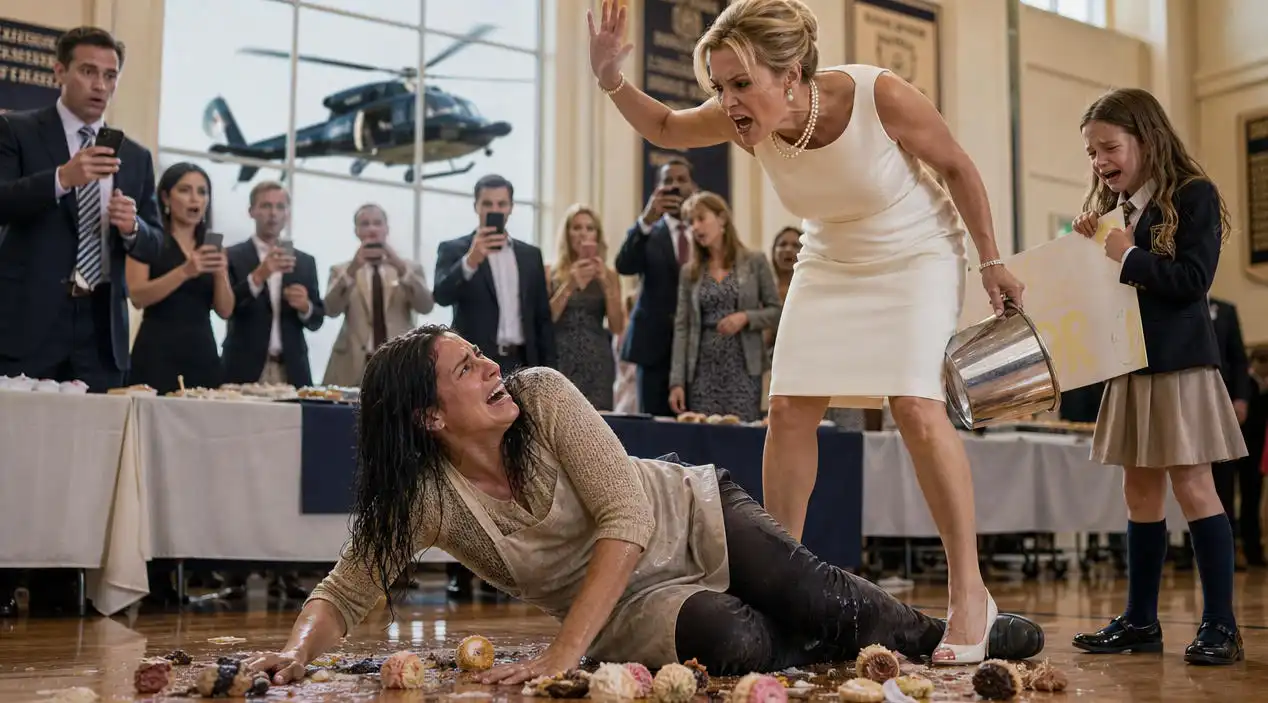
The helicopter blades made the gym windows tremble.
For the first time that morning, Penelope Whitaker stopped smiling.
The man walking across the football field did not look confused. He did not look lost. He looked like he already knew exactly where he was going.
And he was coming straight toward me.
I was still on the floor.
My apron was soaked.
My cheek was burning.
Pink icing was smeared across my sleeve, and the cupcakes my daughter and I had baked until midnight were crushed under the heel marks of parents who had stepped backward instead of helping.
Penelope glanced at the principal.
“Richard,” she whispered. “Why is Charles Whitmore here?”
The principal didn’t answer.
He couldn’t.
His mouth had gone dry.
Everyone in New England knew Charles Whitmore.
Hospitals had wings named after him.
Universities had scholarships named after him.
And Hawthorne Preparatory Academy had spent the last ten years bragging about the Whitmore Family Science Center, the Whitmore Athletic Complex, and the Whitmore Annual Fund.
He was the kind of man people stood straighter for.
The kind of man Penelope mentioned at dinner parties even though he had probably forgotten her name.
The gym doors opened.
Cold air rushed in.
Charles Whitmore stepped inside with two assistants behind him, both in dark coats, both holding leather folders.
No one spoke.
Penelope quickly adjusted her pearl necklace and forced a smile.
“Mr. Whitmore,” she said, stepping forward like she owned the place. “What a wonderful surprise. We weren’t expecting—”
He walked right past her.
Past the principal.
Past the PTA table with its printed donation cards.
Past the mothers who had been laughing at me seconds earlier.
He stopped in front of me.
Then he knelt down on the floor.
“Olivia,” he said, his voice breaking. “My God. What happened?”
The gym went still.
My daughter, Emma, clung to my arm.
“I’m okay,” I told him.
Charles looked at my wet hair.
At my red cheek.
At the cupcakes smashed under Penelope’s son’s shoe.
Then he looked at Emma.
Her face was streaked with tears.
That was the moment his expression changed.
Not loud.
Not dramatic.
Worse.
Controlled.
Dangerously controlled.
He stood up slowly.
“Who did this?”
Nobody answered.
Penelope swallowed.
“This is being blown out of proportion,” she said. “There was a small misunderstanding about bake sale standards.”
Charles turned toward her.
“A misunderstanding?”
Her son, Mason, still had frosting on his shoe. He was grinning until his mother pinched his sleeve.
Penelope laughed softly.
“You know how emotional some scholarship families can be.”
That word landed in the gym like a slap.
Scholarship.
The old-money mothers looked away.
The principal winced but said nothing.
I could feel Emma stiffen beside me.
We were not a scholarship family.
Not that it would have made any difference if we were.
But Penelope had built her entire little kingdom on one belief:
Money made you worth more.
She looked at my plain dress, my tired face, my homemade cupcakes, and the fact that I came to school events alone.
So she decided I was beneath her.
She had been doing it since September.
At drop-off, she would smile at other mothers and say, “Some of us had to work very hard to keep Hawthorne selective.”
At the winter concert, she moved my seat assignment from the third row to the back “by accident.”
At the parent luncheon, she told me, “The faculty appreciates enthusiasm, but this is not a hospital cafeteria.”
That one made me pause.
Because she knew I worked at a hospital.
She just didn’t know what I did there.
Most people at Hawthorne knew me as Emma’s mom.
A single mother.
Quiet.
Always arriving just before meetings started.
Always leaving early if my pager buzzed.
I never corrected anyone.
I had spent too many years fighting real battles in rooms full of children with no hair, brave smiles, and parents sleeping in chairs.
I did not have energy to impress women who judged the stitching on a handbag.
My name was Dr. Olivia Bennett.
I was a pediatric oncologist.
For the past fourteen years, I had treated children with the kinds of diagnoses that turned strong fathers silent and made mothers bargain with God in hospital chapels.
Charles Whitmore’s daughter, Lily, had been one of those children.
When Lily came to me, she was six.
Tiny wrists.
Big brown eyes.
A stuffed rabbit tucked under one arm.
Her family had been told to prepare for the worst.
I didn’t promise miracles.
Doctors don’t get to do that.
But I promised Charles and his wife that I would fight for their daughter as if she were my own.
And I did.
For eighteen months, my team and I fought.
Chemo.
Complications.
Fevers at 3 a.m.
Clinical trial paperwork thick enough to fill a drawer.
Nights when Lily was too weak to lift her head but still asked if Emma could send her another drawing.
Because Emma had drawn pictures for every child on my floor since she was old enough to hold crayons.
Lily survived.
Not because of money.
Not because of status.
Because medicine, timing, research, faith, stubbornness, and a whole team of exhausted people refused to quit.
Charles never forgot.
That morning, he had flown in because the hospital foundation and Hawthorne had been discussing a new pediatric wellness partnership.
I had not told anyone at the school.
I didn’t want a banner.
I didn’t want a speech.
I only agreed to attend the bake sale because Emma had begged me.
“Mom, you always help other kids,” she said the night before while stirring frosting. “Can we help my school too?”
So we baked.
Vanilla cupcakes with lemon buttercream.
Lily’s favorite.
Emma wrote little cards beside each tray:
“Made with love.”
Penelope saw them and laughed.
“Cute,” she said when we arrived. “But the donor table is for approved families.”
“I signed up,” I said.
She looked me up and down.
“Of course you did.”
Then Mason spit on the tray.
And Penelope turned cruelty into a performance.
Now Charles Whitmore was standing in the middle of Hawthorne’s gym, staring at her as if she had crawled out from under a rock.
“Mrs. Whitaker,” he said, “did your son spit on food at a school fundraiser?”
Penelope’s face tightened.
“He’s twelve.”
Charles looked at Mason.
“Twelve is old enough to know better.”
Mason’s grin disappeared.
Penelope lifted her chin.
“You do not speak to my child that way.”
Charles nodded once.
“You’re right. I’ll speak to the adults responsible.”
Then he turned to the principal.
“Dr. Harlan, did you witness this?”
The principal’s face flushed.
“I arrived after the, ah, water incident.”
I looked at him.
That was a lie.
He had been standing three feet away when Penelope picked up the bucket.
He had said, “Penelope, perhaps—”
Then he stopped.
Because stopping Penelope meant risking her family’s annual gala money.
Charles’s assistant opened one of the leather folders.
The principal’s eyes dropped to it.
His face changed.
Charles said, “Before I walked in here, my office received a message from Dr. Bennett.”
Penelope laughed.
“She called you?”
“No,” Charles said. “She pressed the emergency contact on a donor visit schedule my team sent her this morning.”
Penelope blinked.
Charles continued.
“That message included live audio from the gym.”
The room went cold.
A father near the coffee table lowered his phone.
Penelope whispered, “That’s illegal.”
I finally stood up.
My legs were shaking, but my voice was steady.
“This is a school fundraiser in a public event space,” I said. “Half the parents here were filming before I touched my phone.”
Charles’s assistant added, “And Hawthorne’s own event policy states that all public fundraising events may be photographed, recorded, and archived for promotional and security purposes.”
The principal looked like he might faint.
Because he knew the policy.
He had signed it.
Every parent had.
Penelope opened her mouth, but nothing came out.
Charles looked at the principal again.
“I also reviewed the partnership terms this morning. The Whitmore Foundation’s ten-million-dollar pledge is restricted funding. It requires the school to demonstrate compliance with its anti-bullying policy, parent conduct agreement, and donor ethics clause.”
Penelope’s eyes widened.
Ten million.
The number moved through the room like electricity.
A mother whispered, “Ten million dollars?”
Charles didn’t raise his voice.
That made it worse.
“I came here today to announce that pledge in honor of Dr. Olivia Bennett, the physician who saved my daughter’s life.”
A sound went through the gym.
Gasps.
Whispers.
One woman covered her mouth.
The principal gripped the edge of the table.
Penelope stared at me.
For the first time since I had met her, she looked unsure.
“You’re…” she started.
“A doctor,” I said. “Yes.”
Charles turned to the room.
“Not just a doctor. One of the finest pediatric oncologists in the world.”
The mothers who had mocked my cupcakes suddenly looked at the floor.
The fathers who had recorded my humiliation now held their phones like evidence.
Penelope’s cheeks went red.
“Well,” she said sharply, “that does not excuse her behavior.”
“My behavior?” I asked.
“You embarrassed the school,” she snapped.
That was Penelope’s gift.
She could set the fire, then blame you for the smoke.
My daughter stepped behind me.
I felt her little hand reach for mine.
That gave me the strength to keep going.
“No,” I said. “I showed up with cupcakes. You dumped water on me, slapped me, shoved me into a table, allowed your son to spit on food, and demanded my child be removed from school.”
The gym was silent.
Charles looked at the principal.
“Is that accurate?”
The principal’s jaw worked.
Penelope glared at him.
“Richard.”
He looked at her.
Then at Charles.
Then at the folders.
Then at the parents filming.
His loyalty shifted so fast it almost made me dizzy.
“Yes,” he said quietly. “That appears to be what happened.”
Penelope’s mouth dropped open.
“Excuse me?”
The principal straightened his tie.
“Mrs. Whitaker, your conduct today was unacceptable and inconsistent with Hawthorne values.”
A laugh escaped from somewhere in the crowd.
Penelope heard it.
Her face twisted.
“Hawthorne values?” she hissed. “I built this PTA. I raised more money than any woman in this room.”
Charles stepped closer.
“And you used that position to terrorize a child and her mother.”
Penelope pointed at me.
“She doesn’t fit here.”
Charles said, “Then perhaps the problem is what Hawthorne has become.”
His assistant handed the principal a document.
“Effective immediately,” Charles said, “the Whitmore Foundation is suspending all current and future sponsorship discussions with Hawthorne Preparatory Academy.”
The principal went pale.
“Mr. Whitmore—”
Charles held up one hand.
“Unless the board takes immediate corrective action.”
Penelope let out a bitter laugh.
“You can’t be serious. Over cupcakes?”
Charles’s voice turned hard.
“No. Over cruelty.”
He listed the conditions one by one.
A formal incident report.
An emergency board review.
A written apology to Emma.
Replacement of the ruined fundraiser inventory at Penelope’s expense.
Review of the principal’s failure to intervene.
And immediate removal of Penelope Whitaker as PTA president pending disciplinary action.
The room erupted.
Not loudly.
Worse.
Whispers.
Screens lighting up.
Parents texting.
The kind of social death that happens before anyone says it out loud.
Penelope spun toward the principal.
“You are not removing me.”
The principal swallowed.
“Penelope, given the circumstances—”
“I said no.”
Charles looked at him.
The principal stood taller.
“Mrs. Whitaker, you are relieved of your PTA duties effective immediately.”
That was when the gym broke.
Someone gasped.
Someone muttered, “Finally.”
One father near the raffle table said, “About time.”
Penelope heard that too.
Her eyes filled with rage.
“You people are cowards,” she shouted. “Every one of you smiled at my luncheons. You begged me for auction seats.”
Nobody defended her.
Not one person.
Mason tugged her sleeve.
“Mom, can we go?”
She slapped his hand away.
“Be quiet.”
That small gesture told everyone exactly what they needed to know.
The principal said, “Security will escort you to collect your belongings.”
“Security?” Penelope repeated, almost laughing. “For me?”
Charles said, “For Dr. Bennett and her daughter.”
Two campus security officers appeared near the door.
They didn’t touch Penelope.
They didn’t need to.
They simply stood there while she realized the room had turned against her.
All at once, the old hierarchy cracked.
The women who had once fought for a seat beside Penelope now stepped aside to avoid being near her.
The fathers who had laughed at her jokes now kept their eyes on their phones.
The principal, who had spent years bowing to her checkbook, suddenly looked deeply committed to “community standards.”
Penelope grabbed her designer coat from the PTA chair.
Her hands were shaking.
“You’ll regret this,” she said to me.
I looked at her.
For one second, I thought about all the things I could say.
I could tell her about Lily.
About the children who would never get to attend bake sales because their hospital rooms became their classrooms.
About parents who would sell everything they owned for one more normal morning with their child.
About how disgusting it was to measure human worth by a last name, a donation, or a cupcake tray.
But Emma was watching.
So I chose the words I wanted my daughter to remember.
“No,” I said softly. “I won’t.”
Penelope’s face hardened.
Then she turned and walked out.
Mason followed with his backpack half open, his sneakers squeaking across the polished floor.
No one clapped.
No one cheered.
But the silence was enough.
As soon as the doors closed, Emma buried her face in my waist.
“I’m sorry, Mommy,” she sobbed.
My heart cracked.
I knelt in front of her.
“You have nothing to be sorry for.”
“She ruined our cupcakes.”
I wiped her tears with my thumb.
“Sweetheart, cupcakes can be remade.”
She looked at the smashed tray.
“But everyone saw.”
“Yes,” I said. “They did.”
That was the part I wanted her to understand.
Shame only wins in darkness.
Penelope wanted us humiliated because she thought the crowd belonged to her.
But crowds change when truth walks in.
Charles crouched beside Emma.
“I heard you helped make these.”
Emma nodded.
“They were lemon.”
He smiled sadly.
“Lily’s favorite.”
Emma’s eyes widened.
“You know Lily?”
“She talks about your drawings all the time.”
That made Emma smile through her tears.
A small smile.
But real.
Charles stood and turned back to the crowd.
“I came here to make an announcement,” he said. “I still intend to make one.”
The principal looked stunned.
“You do?”
Charles nodded.
“The Whitmore Foundation will donate ten million dollars to Hawthorne Preparatory Academy.”
The room exhaled.
Then Charles added, “In Dr. Olivia Bennett’s name.”
My breath caught.
“Charles—”
He shook his head.
“Let me finish.”
He faced the parents.
“This gift will establish the Bennett Center for Childhood Courage and Community Service. Its purpose will be to fund pediatric health education, need-based student support, anti-bullying programs, and service partnerships with children’s hospitals across New England.”
The principal looked like he had been handed oxygen.
Then Charles said, “The funds will be released only after the board confirms new leadership standards, parent conduct enforcement, and a permanent community oversight seat.”
He turned to me.
“And I am asking Dr. Bennett to accept that honorary trustee seat.”
Every face turned toward me.
This time, it felt different.
Not like judgment.
Like recognition.
I looked at Emma.
She squeezed my hand.
“Say yes,” she whispered.
So I did.
“Yes,” I said.
The gym erupted then.
Not wild applause.
Warm applause.
The kind that starts from shame and turns into relief.
A few parents came up to apologize.
Some were sincere.
Some were afraid.
I could tell the difference.
One mother in a camel coat cried and admitted Penelope had bullied her for years.
Another father said Mason had tormented his son on the soccer team but no one wanted to cross Penelope.
A teacher quietly thanked me.
Then the cafeteria staff did something I will never forget.
They came out with clean trays.
Flour.
Sugar.
Bowls.
The head cook, Mrs. Alvarez, looked at Emma and said, “Honey, I think this school still needs cupcakes.”
So we baked again.
Right there in the school kitchen.
Teachers helped.
Parents helped.
Even the principal cracked eggs nervously like he was defusing a bomb.
Emma laughed for the first time all morning.
By noon, the table was full again.
Not perfect cupcakes.
Some leaned.
Some had too much frosting.
One tray had sprinkles that looked like they had survived a tornado.
But every single one sold.
Charles bought the first dozen.
“For Lily,” he said.
That afternoon, the board met.
By Monday morning, Penelope’s photo was removed from the PTA page.
By Wednesday, the school sent a formal letter to all families confirming her removal and announcing a conduct review.
By Friday, Mason was withdrawn from Hawthorne.
Not expelled publicly.
Not dragged through the mud.
Just gone.
Penelope tried to tell people she had “chosen a better academic environment.”
But too many phones had recorded the truth.
Her gala invitations slowed.
Her luncheon seats disappeared.
The women who used to orbit her found new tables.
That is how people like Penelope fall.
Not always with sirens.
Sometimes with silence.
Sometimes with doors that stop opening.
As for the principal, the board placed him under review. He kept his job, but not his power. A new parent ethics committee was created, and every public event had clear reporting rules after that.
And me?
I stayed.
Not because Hawthorne was perfect.
It wasn’t.
But because my daughter deserved to see that cruel people do not get to decide where good people belong.
A month later, Emma and I walked past the new construction sign near the science building.
It read:
The Bennett Center for Childhood Courage
Emma stared at it for a long time.
Then she slipped her hand into mine.
“Mom,” she said, “does this mean everyone knows who you are now?”
I laughed.
“I guess so.”
She thought about that.
Then she said, “Good. But I liked you before they knew.”
That was the only honor I needed.
The next bake sale looked different.
No velvet ropes around the donor table.
No approved-family nonsense.
No Penelope standing guard like a queen.
There were store-bought brownies, homemade pies, gluten-free cookies, lopsided cupcakes, and one little sign Emma made herself.
It said:
Kindness is the standard.
And this time, everyone understood it.
So yes, Penelope lost her title.
Her influence.
Her little throne.
But the school gained something better.
A reminder.
Money can build a gym.
Status can buy a table.
But character is what decides whether you deserve a seat.
🔥 Pick a side: Penelope got exactly what she deserved — or the school should have punished the principal just as hard. Share this with someone who believes respect matters more than money.
Disclaimer: Mention of any brand or trademark is for identification only and does not imply partnership or endorsement

They Laughed While Security Beat the “Alley Thief”… Then One Video Made Everyone REGRET It
A Diner Owner Called Him a “VAMPIRE” and Kicked Him Into the Rain… Then KARMA Pulled Up in 18 Wheels

A Hollywood Producer Humiliated a Quiet Crew Worker on LIVE Video… Then KARMA Walked In Holding a Sealed Trust File