

The room went dead before the man even finished his sentence.
He did not raise his voice.
He did not rush toward Tristan.
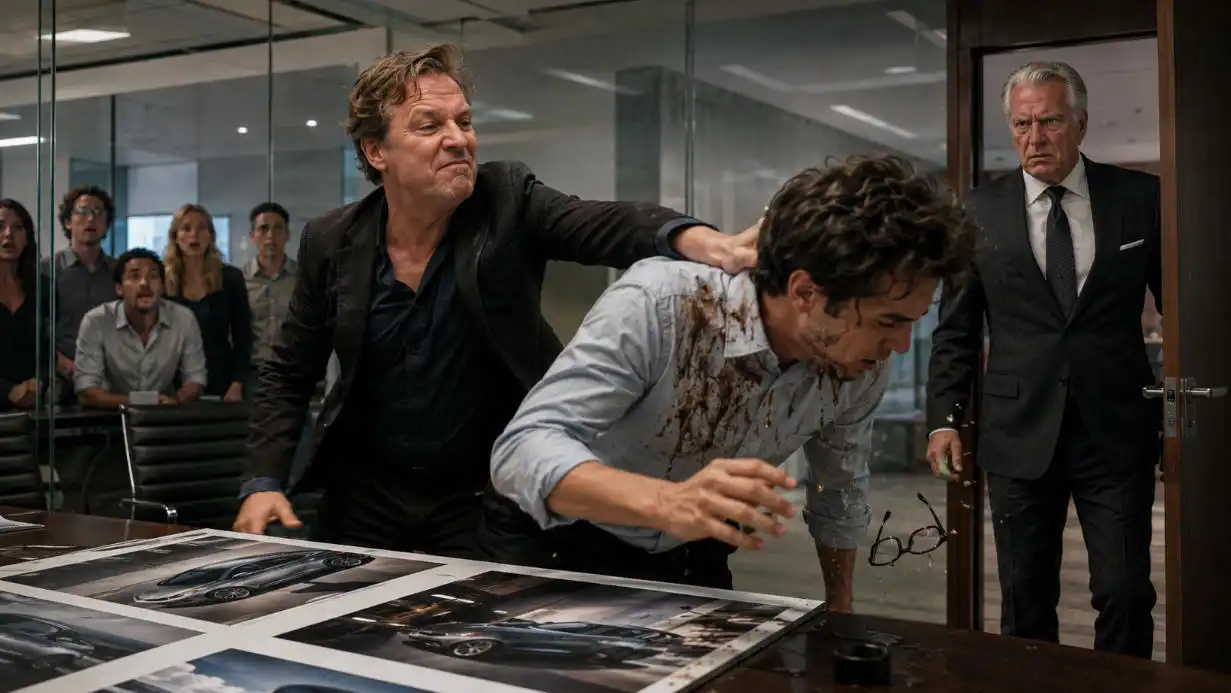
He simply stood inside the glass doorway, looking from Oliver’s soaked shirt to the broken glasses on the floor.
Then he looked at the campaign board with the luxury car logo.
Every executive in that brainstorm room suddenly seemed to remember how to sit up straight.
Ten minutes earlier, Oliver had been treated like furniture.
Not a person.
Furniture.
Something in the way.
Something quiet.
Something you could push aside when the louder people wanted the credit.
He was twenty-seven years old, a junior copywriter at Halden & Cross, one of those polished Madison Avenue agencies where the lobby smelled like expensive leather and the people spoke in phrases like “brand architecture” and “cultural ownership.”
Oliver’s desk was near the supply closet.
Tristan’s office had glass walls and a skyline view.
That told you everything.
Oliver was shy, careful, and soft-spoken. When he got nervous, certain sounds caught in his throat. He could write a line that made grown men tear up, but sometimes he needed three seconds to say his own name.
Tristan loved those three seconds.
He used them like a weapon.
“Come on, Ollie,” he’d say in meetings. “The client doesn’t have all day.”
Or, “Maybe send it in an email. Words seem to like you better on paper.”
People laughed because Tristan had power.
That was the first rule in the agency.
The person with power was funny.
Even when he was cruel.
Tristan had become creative director two years too early and fifteen years too arrogant. Everyone knew he had help getting there. His uncle had been college friends with the agency president, and somehow Tristan’s “vision” kept getting promoted after other people did the work.
He wore expensive sneakers to show he was relaxed.
He wore a watch that cost more than Oliver’s rent to show he wasn’t.
And he treated junior employees like disposable coffee cups.
Oliver had learned to survive by staying quiet.
He wrote.
He revised.
He smiled when people took credit for lines he made.
He went home with headaches.
But the luxury car campaign was different.
The client was massive.
A global brand.
The kind of account that paid for half the agency’s bonuses and almost all of Tristan’s ego.
For three weeks, Oliver had worked late on a concept called “Built For The Roads That Made Us.”
It wasn’t flashy.
It wasn’t loud.
It was about fathers teaching daughters to drive.
Immigrants buying their first family car.
Veterans driving home.
Small towns.
Long highways.
A car as a witness to American life.
Oliver had written the final line on a napkin during lunch:
“Some machines move you. The right one brings you home.”
He knew it was good.
Not because he was cocky.
Because the room went silent when he first read it to the junior team.
The intern, Mason, had even whispered, “That’s actually amazing.”
But Mason wanted Tristan’s approval more than he wanted a conscience.
So by the morning of the final internal presentation, Oliver’s lunch was gone.
He found the brown paper bag in the trash near the coffee machine, smashed under a leaking cup.
His name was still written on it.
Mason leaned against the counter and grinned.
“Sorry, man. Thought it was old.”
Oliver looked at the bag.
Then at Mason.
“It was in the fridge.”
Mason shrugged.
“Tristan said you don’t eat before big presentations anyway. Something about nerves.”
The art director, Vanessa, walked past with a tablet tucked under her arm.
Oliver tried to stop her.
“Vanessa, did you get the revised boards I sent last night?”
She didn’t slow down.
“I’m sure Tristan has what we need.”
That was the second rule in the agency.
If Tristan wanted your work, it became his work.
The brainstorm room was full by nine.
Glass walls.
Long white table.
Screens glowing.
Half the creative department standing along the sides with coffee cups and fake smiles.
The agency president, Martin Cross, sat at the far end pretending this was a normal meeting and not the account that kept him awake at night.
Tristan arrived eight minutes late.
Of course he did.
He came in laughing into his phone, then pointed at Oliver without saying hello.
“Let’s have our junior poet warm up the room.”
A few people chuckled.
Oliver connected his laptop with shaking hands.
His first slide appeared.
A rural two-lane road at sunset.
A father’s hand on a steering wheel.
A teenage daughter in the passenger seat.
Oliver took a breath.
“This campaign is about more than performance. It’s about memory. About the roads that—”
His throat caught.
Not for long.
Just one second.
But Tristan leaned back with a smile.
“There it is.”
Oliver swallowed.
“The roads that shape a family.”
He clicked to the next slide.
Then the next.
By the fourth slide, the room had changed.
Nobody was checking phones.
Nobody whispered.
Even Martin Cross leaned forward.
Oliver read the final line.
“Some machines move you. The right one brings you home.”
Silence.
Real silence.
The kind that means something landed.
Then Tristan clapped once.
Slow.
Mocking.
“Cute.”
Oliver looked over.
Tristan smiled with all his teeth.
“But let’s hear from the adults.”
He plugged in his own laptop.
Vanessa immediately lowered her eyes.
That was when Oliver knew.
The first slide appeared.
Same sunset road.
Different font.
Same emotional structure.
Same family angle.
Same ending.
Then Tristan clicked to the final slide.
“Some cars move you. Ours brings you home.”
Oliver felt the floor tilt.
He heard someone inhale sharply.
Mason stared at the table.
Vanessa’s jaw tightened, but she said nothing.
Oliver stood halfway.
“T-Tristan… that’s my concept.”
Tristan didn’t even blink.
“Your concept?”
“My line. My deck. I sent it to—”
“To the team,” Tristan cut in. “That’s how agencies work. Ideas get improved by people with actual client experience.”
Oliver’s voice shook.
“You changed three words.”
The room got colder.
Tristan stood.
“Careful.”
Oliver should have sat down.
That was what everyone expected.
The quiet guy should sit down.
The guy with the stutter should know his place.
But something in him had been bending for too long.
He picked up the printed deck from the table and opened to his timestamped notes.
“I have the drafts. The emails. The version history.”
A little murmur moved through the room.
Tristan’s face darkened.
“Oh, now you’re making accusations in front of leadership?”
“I’m asking you not to present my work as yours.”
That was the sentence that broke Tristan.
Not because it was rude.
Because it was true.
He grabbed the half-full Coke from beside Martin’s laptop.
Martin said, “Tristan—”
Too late.
The liquid hit Oliver across the face and collar.
Cold.
Sticky.
Humiliating.
Gasps rose from the table.
Oliver didn’t move.
The Coke dripped from his chin onto his shirt.
Tristan stepped closer.
“You want to play victim? Fine. Let’s make it believable.”
He slapped Oliver’s glasses off his face.
They skidded across the floor and cracked against the chrome leg of a chair.
Oliver bent down instinctively.
Tristan shoved him toward the door.
Not hard enough to send him to the ground.
Hard enough that everyone saw.
Hard enough that no one could pretend it was an accident.
“You can’t even get through one sentence,” Tristan said. “You think you’re saving a global account?”
A few people looked away.
That hurt more than the shove.
The looking away.
Oliver picked up his glasses with both hands.
One lens was cracked.
His face burned.
His shirt clung to him.
His hands shook so badly he almost dropped the frames.
Then he said, very quietly, “You really shouldn’t have done that.”
Tristan laughed.
“What are you gonna do? Write me a sad little email?”
Oliver wiped Coke from his cheek.
He didn’t yell.
He didn’t threaten.
He didn’t explain.
He reached into his pocket and checked his phone.
There was one unread text.
Dad: Downstairs. Security says I’m early. Which floor?
Oliver stared at it.
For one second, his thumb hovered.
Then he typed:
He slipped the phone back into his pocket.
Tristan was still talking.
That was Tristan’s mistake.
Men like him always think cruelty is a performance, and they always stay onstage too long.
“You see?” Tristan said to the room. “This is why juniors shouldn’t be emotionally attached to raw material. They confuse participation with ownership.”
Martin Cross cleared his throat.
“Let’s settle down.”
But Martin wasn’t angry at Tristan.
He was nervous about the room.
That was the third rule in the agency.
The scandal mattered only when someone important saw it.
And someone important was about to.
Oliver stood near the glass door, wet and silent.
Mason whispered to another intern, “Is he crying?”
Oliver heard him.
He did not turn around.
Vanessa finally said, “Tristan, maybe we should pause.”
Tristan pointed at her.
“No. We should not pause. We should stop babying people who are not built for pressure.”
Then the door opened.
A tall man in a charcoal suit stepped into the room.
Silver hair.
Calm face.
No entourage.
No announcement.
Just presence.
The kind of man who made powerful people suddenly aware of their posture.
Martin Cross shot out of his chair.
“Mr. Alden. We weren’t expecting you for another twenty minutes.”
The room shifted.
Everyone knew that name.
Charles Alden.
Global CEO of Alden Motors.
The client.
The budget.
The account.
The reason half the people in that room still had jobs.
Charles did not look at Martin.
He looked at Oliver’s shirt.
Then the broken glasses in his hand.
Then the Coke dripping onto the carpet.
Then he looked at Tristan.
“What happened to my son?”
Nobody breathed.
Not Mason.
Not Vanessa.
Not Martin.
Not Tristan.
Oliver closed his eyes.
There it was.
Not shouted.
Not dramatized.
Just the truth.
A simple sentence that cut through the entire room.
Tristan’s mouth opened.
Nothing came out.
For once, he was the one who couldn’t speak.
Charles stepped fully into the room.
“My son,” he repeated, “asked me not to interfere with his career. He wanted to earn his place without my name. I respected that.”
He looked at the campaign board.
“Now I’m wondering whether I respected the wrong thing.”
Martin’s face had gone gray.
“Charles, I assure you, this is not representative of—”
Charles raised one finger.
Martin stopped.
Charles turned to Oliver.
“Are you hurt?”
Oliver shook his head.
“I’m okay.”
“You are covered in soda.”
“I know.”
“Your glasses are broken.”
“I know.”
Charles’ jaw tightened.
“Who touched you?”
Oliver did not answer right away.
That was the thing about him.
Even then, he didn’t want revenge.
He wanted the truth handled correctly.
So he bent down, picked up his printed deck, and placed it on the table.
Then he opened his laptop.
“My drafts are timestamped,” he said. “The first version was created three weeks ago. I emailed the team. The campaign line was mine. The structure was mine. Tristan presented a modified copy.”
Tristan found his voice.
“That is wildly misleading.”
Charles looked at him.
Tristan swallowed.
“Creative departments collaborate. Junior staff often misunderstand how ideation ownership works.”
Oliver clicked open the folder.
Version history.
Emails.
Private notes.
Presentation exports.
Every file showed dates and times.
Then Oliver opened a shared workspace activity log.
The room saw Tristan’s login access Oliver’s deck at 11:42 p.m. the previous night.
Then Vanessa’s design export at 12:18 a.m.
Then Tristan’s final presentation file at 12:41 a.m.
Nobody needed a law degree.
The theft was sitting there in blue and gray.
Vanessa covered her mouth.
Mason looked sick.
Martin whispered, “Tristan…”
But Tristan wasn’t done.
People like him never stop at the first lie.
They build a second lie around it.
“I reviewed junior submissions,” Tristan said. “That’s standard. If Oliver has some emotional issue with hierarchy—”
Charles interrupted him.
“Did you pour a drink on him?”
Tristan blinked.
“That was an unfortunate moment.”
“Did you hit his glasses off his face?”
“It wasn’t a hit. I moved my hand and—”
“Did you shove him?”
The room was silent.
And then a small voice came from near the wall.
Mason.
“I recorded part of it.”
Everyone turned.
The intern’s face was pale now.
Not smug.
Not amused.
Afraid.
Tristan stared at him like he had been betrayed by a chair.
Mason held up his phone.
“I only recorded because I thought… I thought Tristan was being funny.”
Nobody laughed.
Charles extended his hand.
“Send it to Mr. Cross. Now.”
Mason looked at Martin.
Martin nodded fast.
The video played on the wall screen thirty seconds later.
There it was.
Coke in Oliver’s face.
The slap.
The shove.
The words.
“You can’t even get through one sentence.”
The room watched itself become evidence.
That was the legal hammer.
Not shouting.
Not revenge.
Evidence.
Timestamped files.
Witnesses.
Video.
Physical contact.
Workplace humiliation.
Client asset theft.
Charles turned to Martin.
“I want your general counsel on the phone.”
Martin nodded.
“Of course.”
“Now.”
Martin fumbled with his phone.
Charles continued, his voice still low.
“Until this is resolved, Alden Motors is suspending all active approvals with Halden & Cross.”
Martin looked like he had been punched.
“Charles, please. The annual budget—”
“Frozen.”
The word landed like a gavel.
Tristan whispered, “You can’t just—”
Charles looked at him.
“I can.”
He glanced at the campaign board.
“You built your entire quarter around our account. Our North American launch, our dealer network campaign, our heritage series, our electric line refresh. Every dollar is paused as of this moment.”
Martin gripped the back of his chair.
“Charles, there has to be a path forward.”
“There is.”
Every person in the room leaned toward that sentence.
Charles pointed at Tristan.
“He is finished in this industry by the end of the day, or Alden Motors removes every account from this agency by tomorrow morning.”
Tristan’s face drained.
“You’re threatening an entire company because your son got embarrassed?”
Charles took one step closer.
“No. I am responding to a director who stole work, assaulted an employee, mocked a speech difficulty, and did it all inside a room full of people too scared to stop him.”
That hit the room harder than the budget freeze.
Because it was not only about Tristan.
It was about all of them.
The ones who laughed.
The ones who looked away.
The ones who knew and stayed quiet.
Charles turned to Martin.
“And I want a written record. Termination for cause. Formal notice to the client board. Cooperation with any employment claim Oliver chooses to file. A corrected authorship record for the campaign materials. And a company-wide apology.”
Martin nodded too quickly.
“Yes. Absolutely.”
Tristan laughed once.
A broken sound.
“You can’t fire me like this. My contract—”
Martin finally looked at him the way weak leaders look at a problem once it threatens them personally.
“Your contract has a conduct clause.”
Tristan froze.
Martin’s voice got colder as his fear turned into self-preservation.
“And an intellectual property clause. And a client disparagement clause. And, apparently, we now have video evidence of physical misconduct.”
Tristan looked around for help.
Vanessa stared at the table.
Mason stared at his phone.
The account managers stared at the floor.
Nobody came.
That was the loneliest moment for a bully.
The first moment without an audience.
Martin walked around the table.
“Badge.”
Tristan blinked.
“What?”
“Your badge.”
“Martin, don’t be ridiculous.”
“Now.”
Tristan looked at Charles.
Then Oliver.
Then the glass walls.
Outside the room, employees had gathered.
They couldn’t hear everything, but they knew enough.
They saw Martin reach for Tristan’s lanyard.
They saw Tristan pull back.
They saw Martin take the badge anyway.
It snapped loose from the clip.
A small plastic rectangle.
But to Tristan, it was a crown being removed.
Security arrived three minutes later.
Not dramatic.
Not violent.
Just two men in dark suits standing by the door while Tristan packed nothing.
Because Martin would not let him go back to his office.
“We’ll ship your personal items,” Martin said.
Tristan’s face twisted.
“You people are making a mistake.”
Oliver finally spoke.
“No. You made it.”
Tristan stared at him.
For the first time, he saw Oliver clearly.
Not the stutter.
Not the junior title.
Not the quiet guy near the supply closet.
A person.
A person he had underestimated so badly it had cost him everything.
As security walked him through the open office, people turned.
Not cheering.
Not clapping.
Just watching.
The way they had watched Oliver get humiliated.
Only now the humiliation belonged to the right man.
Tristan stepped into the elevator without his badge, without his title, without the account he had bragged about for months.
By lunch, the agency’s internal statement went out.
By three, three senior executives from Alden Motors had joined a call with Halden & Cross legal.
By five, Tristan’s name was removed from the campaign ownership documents.
By the next morning, two trade reporters were asking why a high-profile creative director had “suddenly departed” during a global client visit.
Martin tried to keep the language clean.
Charles did not.
He did not post gossip.
He did not insult Tristan.
He simply issued a formal client statement:
Alden Motors would not partner with leadership teams that tolerated plagiarism, workplace humiliation, or abuse of junior employees.
No names.
No drama.
But everyone in the industry knew.
And in advertising, reputation is currency.
Tristan’s went bankrupt overnight.
His upcoming panel appearance disappeared from the event website.
A podcast canceled his interview.
Two recruiters stopped returning his calls.
By Friday, he was no longer “a visionary creative leader.”
He was a cautionary tale whispered over coffee.
But the most important part happened inside the agency.
Not online.
Not in the headlines.
In the same glass room.
Martin called the creative department together.
This time, Oliver sat at the table.
Not against the wall.
At the table.
Martin looked exhausted.
Smaller somehow.
“I owe Oliver an apology,” he said. “And I owe this department a better standard than fear.”
Nobody moved.
Martin turned to Oliver.
“Your campaign will go forward under your name. You will lead the creative development with Vanessa supporting design.”
Vanessa looked up quickly.
Oliver did too.
Martin continued.
“And effective immediately, Oliver Alden is interim creative lead on the Alden Motors account.”
Mason made a sound like he had swallowed wrong.
Oliver’s face warmed.
“I’m still a junior copywriter.”
Charles, standing quietly near the back, smiled for the first time.
“No,” Martin said. “You were classified as one.”
That sentence stayed with Oliver longer than he expected.
You were classified as one.
How many people are trapped under labels someone else gave them?
Too quiet.
Too old.
Too slow.
Too nervous.
Too poor.
Too young.
Too hard to understand.
Too easy to ignore.
Oliver looked around the room.
He saw fear.
Guilt.
Hope.
And for the first time, attention that did not feel like mockery.
He took a breath.
His throat tightened.
The old panic rose.
Every eye was on him.
But then Charles gave him the smallest nod.
Not a rescue.
Permission.
Oliver placed both hands on the table.
“I don’t want anyone punished for being scared yesterday,” he said.
Mason’s eyes dropped.
Oliver continued.
“But I do want one rule.”
Martin nodded.
“Name it.”
“If someone presents work, their name stays attached to it. Junior, senior, intern, whoever. No exceptions.”
Vanessa whispered, “Agreed.”
Oliver looked at her.
“And if someone is being humiliated, we don’t wait to see whether the person hurting them has more power.”
That one landed.
Hard.
Mason stood up.
His voice shook.
“I threw away your lunch.”
The room turned.
Mason looked like he wanted the floor to open.
“I did it because Tristan told me to. But I still did it. I’m sorry.”
Oliver studied him.
Part of him wanted to be angry.
Part of him was angry.
But another part saw a young man who had almost become Tristan by practicing on smaller cruelties.
So Oliver nodded once.
“Don’t apologize to power next time. Apologize to the person you hurt.”
Mason nodded, eyes red.
“I will.”
A week later, Oliver’s campaign was presented to the full Alden Motors board.
His voice caught twice.
Nobody laughed.
He paused.
Breathed.
Continued.
When the final line appeared on the screen, Charles looked down at his hands.
Not because he was the CEO.
Because he was a father.
Some machines move you. The right one brings you home.
The board approved the campaign unanimously.
The agency kept the account.
Barely.
Martin survived, but his control over the creative department did not. HR launched a full review. Anonymous reports surfaced about Tristan taking credit for work, screaming at assistants, killing careers with private threats, and rewarding people who helped him bully others.
Vanessa admitted she had redesigned Oliver’s deck after Tristan pressured her.
She kept her job but lost her leadership title for six months.
Mason was moved to another team and required to complete a formal ethics program.
Oliver asked that he not be fired.
Not because Mason deserved mercy automatically.
Because Oliver believed correction was more useful than destruction when someone still had shame left.
Tristan had no shame.
That was why he lost more.
Three months later, Oliver saw him once.
Across the street from a coffee shop near Bryant Park.
No entourage.
No expensive swagger.
Just a man in sunglasses looking at his phone, pretending not to notice people who once begged for his approval.
Oliver did not cross the street.
He did not need to.
Some victories are not speeches.
Some victories are peace.
The campaign launched that fall.
It became one of Alden Motors’ most emotional American ads in years.
Families wrote letters.
Dealers requested posters.
A veteran from Ohio sent a photo of his old car with a note that made Oliver cry at his desk.
And every printed credit, every internal case study, every award submission listed the same name:
Concept & Copy Lead: Oliver Alden
Not hidden.
Not borrowed.
Not stolen.
His.
On the night the campaign won its first industry award, Oliver stood backstage with his father.
Charles adjusted Oliver’s tie the way he had when Oliver was a boy.
“You know,” Charles said, “I wanted to storm in sooner.”
Oliver smiled.
“I know.”
“You asked me not to.”
“I wanted to earn it.”
Charles looked toward the stage.
“You did.”
Oliver swallowed.
His throat tightened again, but this time he did not hate it.
It was just part of him.
Not a weakness.
Not a punchline.
Just part of the way his words found their way out.
When his name was called, the room applauded.
Oliver walked onto the stage.
He saw Martin standing.
Vanessa clapping.
Mason near the back, clapping harder than anyone.
And for one strange second, Oliver thought about that cracked pair of glasses.
The Coke on his shirt.
The laughter.
The silence of people who should have helped.
Then he looked at the audience and began.
“I used to think having a quiet voice meant I needed louder people to speak for me.”
He paused.
The room waited.
Respectfully.
He smiled.
“I was wrong.”
The applause came before he finished.
Not because he was powerful now.
Because he had survived people who mistook kindness for weakness.
And because the truth, when handled with evidence and patience, can be louder than any bully in the room. ⚖️
So pick a side:
Team Oliver — expose the bully publicly when the abuse happened publicly.
Or
Team “Handle It Privately” — protect the company first.
Share this if you believe quiet people deserve respect before the world finds out who they are.
Disclaimer: Mention of any brand or trademark is for identification only and does not imply partnership or endorsement
They Laughed While Security Beat the “Alley Thief”… Then One Video Made Everyone REGRET It
A Diner Owner Called Him a “VAMPIRE” and Kicked Him Into the Rain… Then KARMA Pulled Up in 18 Wheels
A Hollywood Producer Humiliated a Quiet Crew Worker on LIVE Video… Then KARMA Walked In Holding a Sealed Trust File