

Those six words did not come loudly.
They did not need to.
The woman in the black judicial robe stood just inside the glass doors of Vale & Stratton’s lobby, framed by the Chicago skyline and a wall of stunned faces.
Federal agents filled the hallway behind her.
Marcus Vale’s hand was still extended toward me like I was a stray dog he had just paid to disappear.
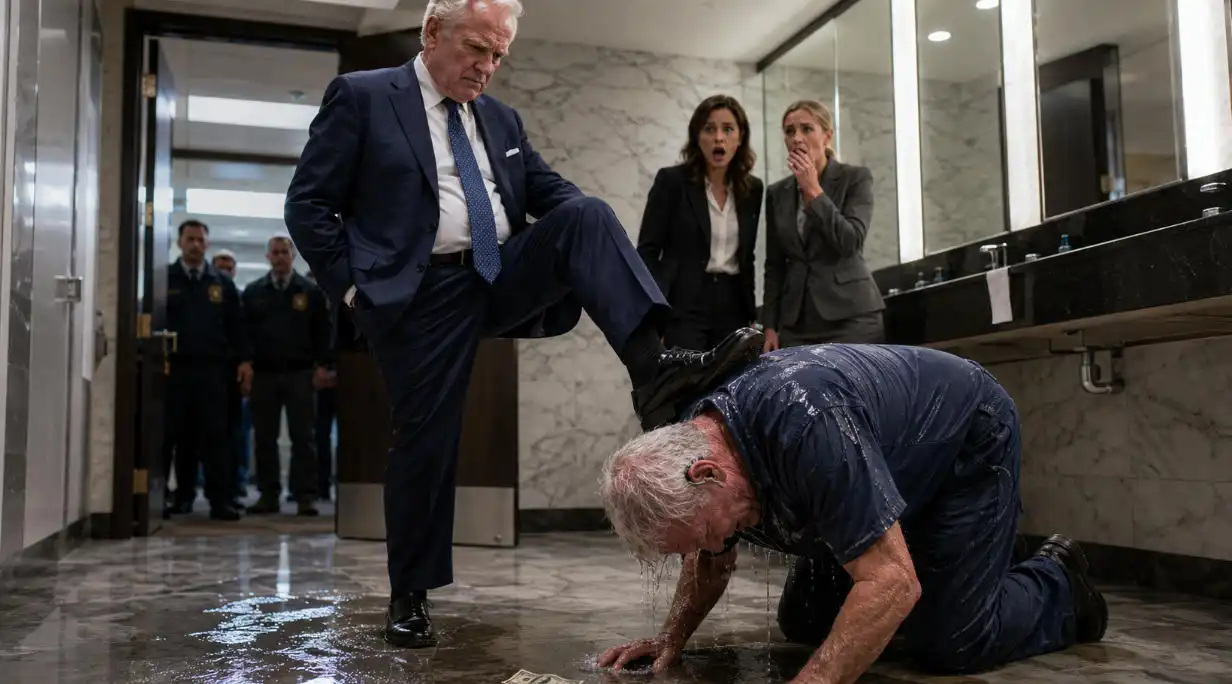
The five-dollar bill lay wet against the bathroom tile.
My cheek burned from where his shoe had pinned me down.
And for the first time in three years, Marcus looked at me like he finally understood one thing.
I had not come back to clean his floors.
I had come back to clean the rot out of his empire.
“Mr. Whitaker,” the Chief Justice said again, softer this time, “your case is reopened.”
Marcus swallowed.
Nobody moved.
Not the assistant holding an empty coffee cup.
Not the legal specialist who had mocked my hearing aid.
Not the junior associate standing in the hallway with her phone halfway raised, recording everything.
Only me.
I slowly pushed myself up from the floor.
My knees hurt.
My palms were wet.
My white hair dripped cold water onto the marble.
Marcus forced a laugh.
It came out thin.
“This is absurd,” he said. “Your Honor, I don’t know what you think this is, but this man is a former convict. He has no business in this building.”
The Chief Justice looked at him.
“Formerly convicted,” she said.
That one word cut the air.
Formerly.
Marcus heard it.
So did everyone else.
His face twitched.
Three years earlier, Marcus Vale had stood in a courtroom and watched me be sentenced to prison for crimes I did not commit.
Perjury.
Evidence tampering.
Witness intimidation.
A neat little package wrapped in lies.
The newspapers called me Samuel Whitaker, the fallen legend of American trial law.
A disgrace.
A monster.
A man who had spent forty years defending the rule of law only to die under the weight of his own corruption.
But I did not die.
Marcus only thought I did.
That had been his first mistake.
His second was believing a man could lose his voice and still not know how to listen.
I am deaf in one ear and hard of hearing in the other.
After prison, people shouted at me like volume could replace decency.
Marcus did worse.
He used my silence as proof I was weak.
When I first walked back into Vale & Stratton as a janitor, I wore gray coveralls, thick glasses, and the kind of posture rich men never notice unless they want to complain.
The firm’s restroom sat outside the private conference wing.
That meant every partner, assistant, client, and clerk passed through that hallway.
It was perfect.
People talk in hallways.
They confess in restrooms.
They brag when they believe the man beside the mop bucket is too old, too poor, too deaf, and too broken to matter.
For three months, I cleaned toilets under the name “Sam.”
Nobody asked for a last name.
Nobody cared.
The legal assistant who dumped coffee grounds on my wet floor was named Ashley.
She did it every Tuesday.
Not because she had to.
Because Marcus laughed the first time.
“Careful,” she would say, stepping over the mess. “Wouldn’t want the help getting bored.”
The legal specialist was Connor.
He made jokes about my hearing.
“Maybe he can’t hear dirt,” he said once.
People laughed because cruelty feels safer when it has an audience.
I never answered.
I never reacted.
I just looked down, cleaned the mess, and returned to the supply closet where a small encrypted recorder sat inside a box labeled “Urinal Cakes.”
That was where Marcus taught me everything I needed to know.
Not directly.
He was too careful for that.
But arrogant men confuse careful with untouchable.
He spoke around me.
Above me.
Through me.
He told junior lawyers which bank transfers needed “cleaner descriptions.”
He told assistants to delete calendar entries after meetings.
He told a private investigator not to worry because “dead men don’t appeal.”
That last sentence was recorded on a rainy Thursday at 7:18 p.m.
I played it back eleven times.
Not because I needed to hear it.
Because after three years in a prison cell, hearing Marcus say the quiet part out loud felt like watching the first crack appear in a concrete wall.
The day he humiliated me in the restroom, Vale & Stratton was hosting a celebration.
Marcus had just been named Senior Managing Partner.
There were photographers downstairs.
Champagne near the conference room.
A banner in the lobby that said:
Integrity. Legacy. Justice.
I almost smiled at that.
Almost.
I was mopping outside the men’s restroom when Ashley came around the corner with her paper coffee cup.
She saw the wet floor sign.
She saw me.
Then she tipped the cup over.
Dark coffee grounds splattered across the tile.
“Oh no,” she said, smiling. “Guess you missed a spot.”
Connor leaned against the wall.
“Maybe write it down for him,” he said. “He probably can’t hear shame.”
A few people laughed.
I bent down with a rag.
That was when Marcus stepped out of the private conference room.
His navy suit fit like it had never known rain.
His cufflinks were gold.
His shoes were so polished I could see the ceiling lights in them.
At first, he barely looked at me.
Then he froze.
Recognition moved across his face like a shadow.
He knew my eyes.
You can change a beard.
You can change a name.
You can let your hair go white and your shoulders bend.
But men who betray you remember your eyes.
Marcus stepped closer.
“Everyone out,” he said.
Nobody left.
They only backed up.
That is the thing about public cruelty.
People claim they do not want to watch.
But most of them make sure they can still see.
Marcus lowered his voice.
“I heard you died.”
I looked at him.
He smiled.
“Shame.”
Then he poured the ice water over my head.
The shock of it took my breath for half a second.
Cold ran down my neck and under my collar.
Ashley gasped, then covered it with a laugh.
Connor said, “Wow.”
Marcus leaned in.
“You should have stayed buried, Samuel.”
There it was.
My name.
The room shifted.
Ashley looked from him to me.
“Wait,” she said. “You know him?”
Marcus ignored her.
“He was once a big man,” he said, loud enough for everyone. “A courtroom celebrity. Thought he was untouchable.”
He tapped my chest with two fingers.
“Then he learned what happens when he crosses the wrong people.”
I said nothing.
Not because I had no words.
Because silence makes guilty men fill the space.
Marcus did exactly that.
“You came here for revenge?” he asked. “In a janitor’s uniform?”
He laughed.
“That is the saddest thing I’ve ever seen.”
Then he pointed at the floor.
“Clean it.”
I bent slowly.
Not because he won.
Because the recorder in my breast pocket had a clear line to his voice.
Marcus hated that I was calm.
He wanted begging.
He wanted fear.
He wanted the old Samuel Whitaker to break in front of young lawyers who had only heard my name as a warning.
So he made it worse.
“On your knees,” he said.
Ashley whispered, “Marcus…”
He turned on her.
“Did I ask you to speak?”
She went quiet.
That was Marcus.
He did not just want obedience from the weak.
He demanded silence from everyone around him.
I lowered one knee.
The hallway had gone still.
I saw phones.
I saw faces.
I saw a young paralegal crying and doing nothing.
Marcus stepped forward and pressed his shoe against my cheek, forcing my face toward the tile.
Not hard enough to break bone.
Hard enough to show ownership.
“You see this?” he said to the staff. “This is what happens when garbage forgets where it belongs.”
The words echoed.
I let them.
Then he dropped the five-dollar bill.
“Hush money,” he said.
And the elevator opened.
At first, people thought it was more guests for the celebration.
Then they saw the badges.
FBI.
Six agents entered first.
Then two more.
Then the Chief Justice of the United States walked in behind them.
Her name was Eleanor Reeves.
I had argued before her when she was still an appellate judge.
Back then, she had told a room full of law students, “Samuel Whitaker is dangerous to liars because he respects procedure more than applause.”
I never forgot that.
Marcus clearly had.
“Your Honor,” he said quickly, stepping away from me. “This is not what it looks like.”
The Chief Justice looked at the wet floor.
The coffee grounds.
The bill.
My soaked uniform.
Then at Marcus.
“It rarely is,” she said.
An FBI agent approached me.
“Mr. Whitaker, are you injured?”
I signed, “No.”
Then I spoke aloud, because Marcus needed to hear my voice.
“I have what you came for.”
Marcus’s eyes snapped to me.
“No,” he said.
Just that.
No.
It was the smallest word he had spoken all day.
And the most honest.
I reached into my coverall pocket and pulled out a sealed drive.
Then I reached into the lining of my mop bucket and removed a thick waterproof folder.
Inside was a signed affidavit from a dying accountant named Peter Hall.
A ledger of offshore transfers.
Internal emails.
Altered witness statements.
Copies of payments made to the false witness who helped send me to prison.
And, most important, the trust documents Marcus had spent years trying to bury.
The original ownership structure of Vale & Stratton.
Marcus had never owned the firm.
Neither had the partners who toasted him downstairs.
The controlling interest belonged to a private legal foundation created thirty years earlier by the firm’s true architect.
Me.
Samuel Whitaker.
After my conviction, Marcus moved to seize operating control.
He convinced the board that my shares were invalid because I had died in custody.
That lie worked because he had arranged for a false death notice to be filed through a corrupt prison contractor, then used the confusion to clean out accounts tied to whistleblower clients and foreign shell companies.
He did not just steal my name.
He used my disappearance to turn the firm into a washing machine for dirty money.
The Chief Justice opened the folder.
She did not look surprised.
That told Marcus everything.
He turned to the agents.
“You can’t search private firm records without a warrant.”
One agent held up a document.
“We have one.”
Marcus backed up.
“This is privileged material.”
Another agent said, “Not when the firm is used in furtherance of financial crimes.”
Legal words.
Clean words.
Beautiful words.
Crime-fraud exception.
Marcus knew them.
He had used them against others.
Now they were being used against him.
The first agents moved toward the records department.
Others entered the partner offices.
One took Marcus’s phone.
He jerked back.
“I am the managing partner of this firm.”
I wiped water from my face.
“No,” I said. “You were an employee with excellent stationery.”
The junior associate in the hallway made a sound that was almost a laugh.
Marcus heard it.
His face flushed dark red.
Then the Chief Justice turned to me.
“Mr. Whitaker, the emergency order vacating your conviction was signed this morning. The federal review panel found prosecutorial misconduct, fabricated testimony, and unlawful suppression of exculpatory evidence.”
Ashley put a hand over her mouth.
Connor looked at the floor.
Marcus said nothing.
So I did.
“Tell them the rest.”
The Chief Justice paused.
Then she faced the room.
“Samuel Whitaker was wrongfully convicted. The witness who testified against him has recanted under oath. Financial records now show that Mr. Vale and others benefited directly from Mr. Whitaker’s removal.”
There it was.
Not gossip.
Not rumor.
The law speaking in public.
Marcus tried one last time.
“You people are making a mistake,” he said. “Do you have any idea what this will do to the firm?”
I looked around the lobby.
At the marble.
The glass.
The banner promising justice.
Then I bent down and picked up the five-dollar bill.
The paper was damp.
Wrinkled.
Small.
Marcus watched me.
I stepped toward him.
The agents tensed, but I raised my empty hand.
I did not hit him.
I did not shove him.
I did not need to.
I removed my hearing aid slowly and placed it in my pocket.
The room went silent.
Then I folded the five-dollar bill once.
Twice.
And pressed it against Marcus’s mouth.
Not violently.
Not dramatically.
Just firmly enough that the whole lobby understood.
“You offered this to buy my silence,” I said. “Now keep it.”
His eyes widened.
No one laughed.
That made it better.
Because this was not comedy.
This was the bill coming due.
An agent stepped behind Marcus.
“Marcus Vale, you are under arrest for conspiracy, obstruction of justice, money laundering, witness tampering, and deprivation of rights under color of legal process.”
The handcuffs clicked.
That sound does not need music.
Marcus looked at the crowd as if expecting someone to save him.
No one moved.
Not Ashley.
Not Connor.
Not the partners who had clapped for him twenty minutes earlier.
The people who worship power are usually the first to step away when power changes hands.
As agents led him through the lobby, he passed beneath the banner.
Integrity.
Legacy.
Justice.
The photographers downstairs were still there.
So were the clients.
So were the interns.
Marcus Vale, the golden lawyer of Chicago, left his own celebration in handcuffs while an elderly janitor stood barefoot on a wet restroom floor behind him.
That image went everywhere.
But the public arrest was only the beginning.
Over the next eight months, federal prosecutors pulled apart Marcus’s empire thread by thread.
The accountant’s affidavit led to the offshore accounts.
The offshore accounts led to shell companies.
The shell companies led to judges’ clerks, private investigators, expert witnesses, and a former prosecutor who had helped bury evidence in my case.
Marcus had not acted alone.
He had built a circle of respectable criminals.
They wore tailored suits.
They donated to museums.
They sat on charity boards.
And they sold justice by the hour to whoever could afford the lie.
At trial, Marcus looked smaller.
Not physically.
Spiritually.
The shine was gone.
His hair had thinned.
His famous courtroom voice cracked twice during testimony.
He claimed he had been protecting the firm.
He claimed I had been unstable.
He claimed the documents were misunderstood.
Then prosecutors played the restroom recording.
His own voice filled the courtroom.
“You should have stayed buried, Samuel.”
The jury heard it.
The judge heard it.
I heard it too.
And this time, I was not behind the defense table in chains.
I was sitting in the front row.
Free.
Marcus stared straight ahead as the recording continued.
“Dead men don’t appeal.”
That was the moment his lawyer stopped taking notes.
The verdict took less than four hours.
Guilty.
Guilty.
Guilty.
Again and again.
Marcus Vale was stripped of every asset tied to the conspiracy.
His lakefront home.
His private accounts.
His firm shares.
His offshore trusts.
His art collection.
Even the scholarship fund he had used as a reputation shield was seized and rebuilt under court supervision for wrongfully convicted defendants.
The judge sentenced him to life in federal prison, citing the scale of the corruption, the destruction of lives, and the deliberate use of the justice system as a weapon.
When the sentence was read, Marcus finally turned around and looked at me.
For one second, I saw the restroom again.
The water.
The tile.
The shoe.
The five-dollar bill.
But I felt no rage.
That surprised me.
For three years in prison, I thought revenge would taste like fire.
It did not.
It tasted like clean air.
After the sentencing, I walked outside into the cold Chicago afternoon.
A reporter shouted, “Mr. Whitaker, what will you do now?”
I could have given a grand speech.
I could have cursed Marcus.
I could have talked about justice and legacy and the cost of betrayal.
Instead, I said the only thing that felt true.
“I’m going back to work.”
Two weeks later, the sign outside the building came down.
Vale & Stratton disappeared letter by letter.
In its place went a new name.
Whitaker House of Law.
Not Whitaker & Partners.
Not Whitaker Global.
Not some polished branding approved by consultants.
House of Law.
Because the law is not supposed to be a throne.
It is supposed to be shelter.
The first floor became a wrongful conviction clinic.
The private conference wing became hearing rooms for veterans, widows, whistleblowers, and families who had been ignored because they lacked money or influence.
The restroom where Marcus humiliated me was remodeled.
Not erased.
Remodeled.
I kept one tile.
The tile where my cheek had touched the floor.
People told me that was strange.
Maybe it was.
But I framed it and hung it in my office with a small plaque beneath it:
Never confuse silence with surrender.
Ashley resigned before the trial ended.
A month later, she wrote me a letter.
She admitted what she had done.
The coffee grounds.
The laughing.
The way she had joined cruelty because it felt safer than standing alone.
She did not ask for a job.
She asked if there was anything she could do to make it right.
I sent her to the clinic downstairs.
Not as a lawyer.
As a volunteer.
Her first assignment was cleaning intake files for exonerees who had nobody else.
Connor never apologized.
Some people learn from shame.
Some only resent being exposed.
That is not my burden.
The young paralegal who cried in the hallway became one of the best investigators our clinic ever hired.
Her name was Maya.
On her first day, she stood in my doorway and said, “I should have helped you sooner.”
I told her, “Then help the next person sooner.”
She did.
A year after Marcus was sentenced, I visited the prison where I had once lived as inmate 41792.
Not for him.
For a man named Luis who had written to our clinic from solitary confinement.
His file smelled like old paper and neglect.
The evidence was thin.
The trial transcript was worse.
His mother had sent handwritten letters for twelve years.
Nobody answered.
We answered.
As I left the prison that day, a guard recognized me.
Not from my conviction.
From the news.
He said, “Mr. Whitaker, after everything they did, how did you stay so calm?”
I looked at the steel doors.
I thought about the restroom.
Marcus’s shoe.
The laughter.
The five-dollar bill.
Then I said, “Because anger can open a door, but discipline walks you through it.”
That is what Marcus never understood.
He mistook cruelty for control.
He mistook my disability for ignorance.
He mistook my uniform for my worth.
And worst of all, he mistook the law for a weapon only rich men could hold.
He learned otherwise.
Not in an alley.
Not through revenge.
Not through rumor.
In court.
On paper.
Under oath.
In front of everyone.
That is the only ending that would have satisfied me.
The firm now has my name on the wall, but I still walk through the building before sunrise sometimes.
The cleaning crew knows me.
Not as a symbol.
Not as a legend.
As Samuel.
I know who has a sick child.
Who sends money to their mother.
Who takes the train at 5 a.m.
Who works two jobs and still says good morning.
When I see a partner step around a custodian without looking at them, I stop the partner and introduce them.
Every time.
Respect is not a department policy.
It is a habit.
And the day we stop practicing it, men like Marcus start growing again in the dark.
The five-dollar bill is still in evidence.
The government asked if I wanted it returned after the appeals ended.
I said yes.
When it came back, sealed in plastic, I did not put it in a drawer.
I hung it beside the framed tile.
People who visit my office always notice those two things first.
The tile.
The bill.
Then they look at the skyline and the law books and the name on the door.
And they understand.
A man can be shoved to the floor and still rise higher than the person standing over him.
A voice can be mocked and still become testimony.
A janitor’s uniform can hide the owner of the building.
And five dollars can become the most expensive mistake a corrupt man ever made.
So here is where I stand.
Marcus did not lose because I hated him.
He lost because he believed nobody beneath him was keeping receipts.
He lost because the people he mocked were listening.
He lost because the truth does not have to shout when the evidence is signed, sealed, copied, and waiting for the right courtroom.
⚖️ Choose a side:
Samuel was right to let the law destroy Marcus publicly.
Or Samuel should have shown mercy after Marcus was exposed.
Share this with someone who still believes character matters more than status.
Disclaimer: Mention of any brand or trademark is for identification only and does not imply partnership or endorsement
They Laughed While Security Beat the “Alley Thief”… Then One Video Made Everyone REGRET It
A Diner Owner Called Him a “VAMPIRE” and Kicked Him Into the Rain… Then KARMA Pulled Up in 18 Wheels

A Hollywood Producer Humiliated a Quiet Crew Worker on LIVE Video… Then KARMA Walked In Holding a Sealed Trust File