



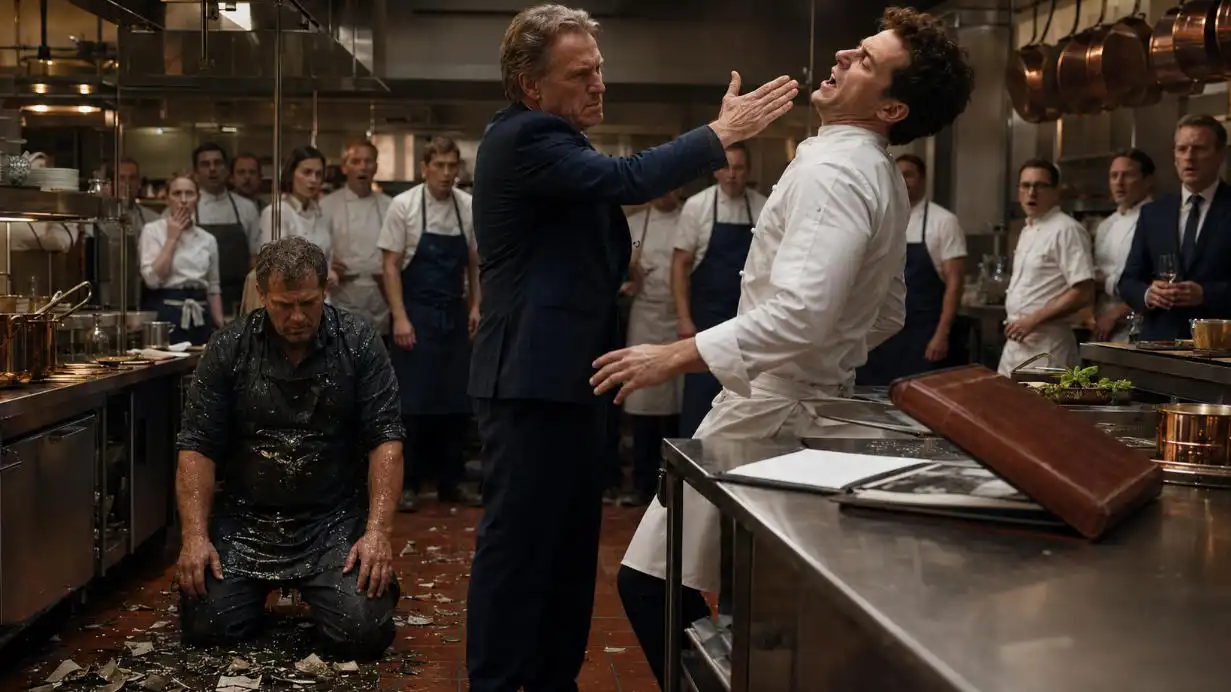
Chef Rex saw what was printed on the final acquisition page… and his face went white.
For the first time in twelve years, the man who built his career on stealing from me had nothing clever to say.
The kitchen was silent.
Not quiet.
Silent.
The kind of silence that makes a man hear his own breathing.
His sous-chef still had one shoe near the back of my neck.
The waiter who had poured spoiled leftovers down my shirt was frozen with the empty container in his hands.
And the most powerful food critic in America, Arthur Bellamy, stood beside me like he was waiting for an order.
Rex blinked at the folder.
Then at Arthur.
Then at me.
“No,” he whispered.
Arthur’s jaw tightened.
“Yes, Chef,” he said coldly. “The purchase is final.”
Then he turned toward me, lowered his head, and said the words Rex had never imagined hearing in his own kitchen.
“Boss, the acquisition of this restaurant was completed at 7:04 p.m.”
The room broke.
A server gasped.
A line cook dropped a spoon.
Someone near the dry storage door muttered, “Boss?”
Rex took one step back like the floor had moved under him.
I slowly pushed myself up from the tiles.
My palms were cut from the glass, but not badly.
My sleeve was soaked.
My arm throbbed where the sous-chef had burned me earlier with the edge of a hot pan.
But I stood.
And when I did, every person in that kitchen suddenly remembered I had a spine.
My name is Julian Cross.
For six months, everyone in that restaurant knew me as the man who washed grease traps, scrubbed stock pots, and cleaned out the garbage barrels behind the loading dock.
They called me “bucket boy.”
They called me “the ghost.”
Rex called me worse.
But before that?
Before the oil stains and the rotten scraps?
I was the legal heir to Crossland Fields, one of the largest private agricultural and food-supply empires in the Western Hemisphere.
Organic beef.
Heirloom vegetables.
Specialty grains.
Truffles.
Olive oil.
Wagyu programs.
Rare mushrooms.
Restaurant-only produce.
Emergency cold-chain distribution.
We didn’t just sell food.
We controlled the invisible heartbeat behind half the luxury restaurants in America.
Most diners never knew our name.
Most chefs did.
Rex definitely did.
Because he used to eat at my family table.
He used to call my father “sir.”
He used to tell my mother her lavender honey glaze was the best thing he had ever tasted.
He used to stand beside me in the test kitchen and say, “One day, Jules, we’re going to change food together.”
I believed him.
That was my first mistake.
Twelve years ago, when my father got sick, Rex started spending more time in our family kitchen.
He said he wanted to help preserve our recipes.
He said the world deserved to taste them.
He said he loved me like a brother.
Then my father died.
And Rex disappeared with three locked recipe books, two supplier formulas, and one encrypted drive containing proprietary fermentation processes my family had spent thirty years developing.
Six months later, he opened Maison Verre in Napa Valley.
Three years later, he had Michelin stars.
Seven years later, he was giving interviews about his “self-made genius.”
He told reporters inspiration came to him in dreams.
He told young chefs talent was about discipline.
He told the world he had invented flavors he had stolen from a dead man’s kitchen.
My lawyers told me to move carefully.
My mother told me not to let anger make me sloppy.
So I waited.
I built the company quietly.
I learned contracts.
I learned logistics.
I learned exactly how fragile a luxury restaurant becomes when its suppliers stop answering the phone.
Then, when Rex grew too famous to question, I came back.
Not in a suit.
Not with cameras.
Not with a lawsuit first.
I came in through the loading dock.
I applied under a shortened name.
Julian C.
Dish room.
Trash rotation.
Late nights.
No questions.
Rex recognized me on the second day.
I saw it in his eyes.
He walked into the scullery, stared at me, and smiled like God had sent him entertainment.
“Well, well,” he said. “The prince found a mop.”
I kept scrubbing.
He leaned closer.
“What happened, Julian? Family money dry up? Or did you finally realize bloodlines don’t make talent?”
I said, “I needed work.”
That was all.
From then on, he made sure I got the worst of everything.
If a sink backed up, I cleaned it.
If a freezer leaked, I mopped it.
If a barrel of spoiled stock split open, I carried it.
The staff learned fast.
If they wanted Rex to like them, they laughed at me.
If they wanted a promotion, they humiliated me.
The sous-chef, Marcus, was the worst.
He was forty-six, built like a butcher, with a shaved head and a temper that made younger cooks flinch.
He once pressed a hot pan against my forearm because I did not move fast enough.
“Kitchen accident,” he said.
Rex watched from across the pass.
He smiled.
The waiter, Dylan, liked public cruelty.
He was the one who poured leftover sauce into my shoes.
He was the one who said guests should see “what failure looks like.”
He was the one who took videos on his phone.
He thought he was making jokes.
He was making evidence.
Every insult.
Every shove.
Every stolen recipe reference.
Every time Rex bragged about “his” signature dishes.
Every supplier name he mentioned.
Every secret technique he should never have known.
It all went into a file.
The kitchen had cameras.
The loading dock had cameras.
The staff group chat had screenshots.
The wine office had recordings.
And every contract Maison Verre signed with premium suppliers had a clause Rex never bothered to read.
A morality clause.
A trade-secrets clause.
A source-integrity clause.
And a catastrophic damages clause tied to stolen proprietary culinary processes.
Rex thought fine dining was about ego.
My family knew fine dining was about leverage.
The night everything changed, Maison Verre was hosting a private tasting for Arthur Bellamy.
Arthur was not just a critic.
He was the critic.
One word from him could make a restaurant impossible to book.
One raised eyebrow could send investors running.
Rex had been chasing him for years.
So Rex prepared a twelve-course tasting menu.
Lavender-smoked duck.
Black garlic jus.
Corn silk cream.
Truffle ash butter.
Persimmon vinegar glaze.
My father’s food.
My mother’s food.
My childhood on a plate.
And Rex smiled through all of it like a thief wearing a crown.
I was in the back washing garbage buckets when Dylan came through the swinging door.
“Chef says you’re too visible,” he said.
“I’m in the dish pit.”
“Yeah. Still visible.”
He dumped a container of sour, spoiled vegetables down the front of my shirt.
The smell hit hard.
A few prep cooks laughed.
One looked away.
Dylan grinned.
“You finally smell like your future.”
I took a breath.
Said nothing.
Then Rex walked in.
He had Arthur Bellamy behind him.
That was when I knew Rex wasn’t just being cruel.
He was performing.
He wanted Arthur to see that he was untouchable.
That even his enemies ended up beneath him.
Rex pointed at me like I was an insect.
“Arthur, forgive the mess,” he said. “Every palace has a sewer.”
Arthur did not laugh.
Rex did not notice.
He picked up a metal basin full of dirty vegetable water and held it over my head.
“You remember dreams, Julian?” he said. “You had so many.”
Then he poured it over me.
Cold water ran down my face.
Carrot peels stuck to my shirt.
The kitchen watched.
The front-of-house staff watched through the door.
A few guests near the chef’s counter turned their heads.
Rex loved that.
He lived for witnesses.
“Look at him,” Rex said. “This is what happens when a man thinks birthright can replace talent.”
I wiped water from my eyes.
“Rex,” I said quietly, “stop.”
That made him laugh harder.
“Stop?” he said. “You don’t give orders here.”
Marcus stepped closer.
In his hand was a skillet fresh from the burner.
He pressed the hot rim near my sleeve, close enough to burn fabric and skin.
I flinched.
The smell of scorched cotton hit the air.
Rex tilted his head.
“Careful, Marcus. We don’t want to damage company property.”
The staff laughed again.
Arthur’s face darkened.
I saw his fingers curl.
But he waited.
Just like I had asked him to.
Because Arthur Bellamy was not there by accident.
Three months earlier, he had called me after receiving an anonymous sample of Rex’s new menu.
He said, “Julian, this tastes like your father.”
I said, “It is.”
There was a long silence.
Then Arthur said, “Tell me what you need.”
Arthur had eaten at my parents’ table twenty years before.
He had written the only review my father ever cared about.
He knew the lavender honey glaze.
He knew the black garlic ratio.
He knew the corn silk cream.
He knew the dishes were stolen.
But recognition was not enough.
We needed Rex to prove intent.
We needed him to say enough.
Do enough.
Serve enough.
Sign enough.
That night, he finally did.
Rex snapped his fingers.
Marcus kicked a small pile of broken glass from a shattered prep jar toward my knees.
“Kneel,” Rex said.
A young pastry cook whispered, “Chef, come on…”
Rex turned on her.
“You want his job?”
She went pale.
I lowered myself slowly.
Not because he owned me.
Because thirty feet away, in the wine alcove, two attorneys were watching a live camera feed.
Because every word was being captured.
Because the purchase agreement was already signed, escrowed, and waiting on final transfer confirmation.
Because Rex had scheduled this humiliation at the exact same time his investors were finalizing the sale of Maison Verre to an anonymous buyer.
He thought he was cashing out.
He had no idea he was selling to me.
Rex crouched in front of me and held out half a moldy baguette.
“Here,” he said. “A donation from the house.”
He dropped it on the floor.
“Eat.”
The kitchen went still.
Even Dylan stopped smiling.
Rex’s voice got softer.
Meaner.
“You were born next to greatness, Julian. That’s all. You never had it. You never earned it. Your father was brilliant. You were furniture.”
I looked up at him.
For a second, I almost broke.
Not from fear.
From the sound of my father’s name in his mouth.
Then Rex made his final mistake.
He leaned close enough that only the front row of staff could hear.
But the microphones caught it.
“You want to know the truth?” he whispered. “Your father should’ve given those books to me. I made them famous. I made them matter.”
Arthur Bellamy’s face changed.
That was the confession.
Not legal language.
Not a courtroom speech.
Just pure arrogance.
Rex turned toward Arthur, expecting admiration.
“Forgive the theater,” he said. “Old family drama.”
Arthur walked forward.
One step.
Two.
Rex smiled.
Then Arthur slapped him.
Not hard enough to injure him.
Hard enough to end the performance.
The sound cracked through the kitchen.
Rex touched his cheek, stunned.
“Arthur—”
“Don’t,” Arthur said.
Then Arthur placed the leather folder on the prep table.
The front page carried the Crossland Fields seal.
Beneath it:
Acquisition Confirmation: Maison Verre Holdings, LLC.
Effective immediately.
Controlling owner:
Julian Cross.
That was when Rex went white.
I stood up.
Marcus moved away from me so quickly he backed into a rack of sheet pans.
They crashed to the floor.
Nobody moved to help him.
Arthur looked at me.
“Boss,” he said, “the acquisition of this restaurant was completed at 7:04 p.m.”
I nodded.
“Thank you, Arthur.”
Rex’s mouth opened.
Closed.
Opened again.
“You?” he said.
I rolled down my burned sleeve.
“Yes.”
“No,” he said. “You’re washing trash cans.”
“I was observing operations.”
“You lied.”
I looked around the kitchen.
At the staff.
At the cameras.
At the glass.
At the spoiled food on my shirt.
“No, Rex,” I said. “I worked the job you gave me.”
His eyes darted to the attorneys stepping through the back hallway.
Then to the security team entering from the loading dock.
Then to the investors standing behind them, faces tight with panic.
One of them, a silver-haired man named Conrad Pike, spoke first.
“Chef Rex, what the hell is going on?”
Rex pointed at me.
“This is a trick.”
I laughed once.
Not loudly.
Just enough.
“You signed the sale documents this afternoon,” I said. “You represented that all intellectual property used by Maison Verre was original or legally licensed. You also certified there were no active trade-secret disputes.”
Rex swallowed.
I continued.
“You then served twelve dishes tonight containing protected Crossland family processes and proprietary supplier preparations. You described them on camera as your inventions.”
One attorney opened a tablet.
Another set a printed packet on the counter.
“And ten minutes ago,” I said, “you admitted you took my father’s recipe books.”
Rex shouted, “That’s not what I said!”
Arthur looked at him with disgust.
“It is exactly what you said.”
Dylan tried to slide his phone into his pocket.
Security stopped him.
“Leave it,” one guard said.
Dylan’s face collapsed.
Marcus raised both hands.
“I was just following Chef’s orders.”
I turned to him.
“You burned my arm.”
“It was an accident.”
“The camera disagrees.”
The pastry cook started crying quietly.
Not out of sadness for Rex.
Out of relief.
People like Rex make entire rooms afraid to breathe.
When they fall, the room exhales.
Rex tried to straighten his jacket.
Tried to become the famous chef again.
“You can’t run this restaurant without me,” he said.
“No,” I said. “I won’t run this restaurant with you.”
His face twisted.
“You need my name.”
“I own your name as a business asset for the next ninety days,” I said. “After that, it becomes a liability.”
Conrad Pike cursed under his breath.
Rex turned to him.
“Conrad, tell him.”
Conrad took a step back.
That broke Rex more than the slap.
Powerful men can survive enemies.
They cannot survive watching cowards abandon them.
I reached for the cigar case my head of security had brought in.
My father used to keep cigars for celebrations, though he rarely smoked them.
I did not light it.
I simply held it.
A symbol.
A pause.
A reminder that I did not need to rush.
Rex stared at it.
“You think this makes you a man?” he said.
“No,” I said. “Surviving you did.”
Then I gave the first order.
“Cut Maison Verre from all Crossland premium supply immediately.”
My logistics director, standing near the office door, nodded.
“Effective now.”
I looked at the kitchen.
“No Crossland beef. No heirloom produce. No black truffles. No reserve grains. No emergency distribution. No valley dairy. No heritage poultry.”
Rex shook his head.
“You can’t do that before service.”
“I just did.”
The executive sous-chef whispered, “We have twenty-six covers left.”
“Then serve what you can legally source,” I said.
Rex lunged toward the folder.
Security caught him by both arms.
He struggled.
His perfect white jacket wrinkled.
For the first time all night, he looked small.
I stepped closer.
“Second order. Rex is removed from the premises.”
“You can’t remove me from my kitchen!”
I looked him dead in the eyes.
“You sold it.”
The room felt that one.
Rex did too.
His knees bent slightly, like his body had finally understood what his pride could not.
Then my lead attorney spoke.
“Mr. Voss,” she said, using Rex’s legal surname, “you are being served notice of breach, fraud in representation, misappropriation of trade secrets, workplace abuse claims, and violation of source-integrity clauses. Estimated damages begin at one hundred million dollars.”
Rex’s face went slack.
“One hundred…”
“Million,” she said.
Dylan made a sound like he might be sick.
Marcus sat down on a crate.
The investors started whispering.
Arthur Bellamy looked around the room.
“I will also be publishing a statement,” he said. “Not a review. A correction.”
Rex snapped his head toward him.
“Arthur, don’t do this.”
Arthur’s voice turned ice cold.
“You used a dead man’s work, abused his son in public, and served stolen legacy as genius. I should have done it sooner.”
Rex started pleading then.
Not apologizing.
Pleading.
There is a difference.
“Julian,” he said, “come on. We were friends.”
“No,” I said. “I was your friend.”
His mouth trembled.
“I made one mistake.”
I looked at the scar forming on my arm.
“At least three hundred that I have documented.”
He lowered his voice.
“We can settle.”
“We will.”
“You’ll give me a chance?”
“The court will give you dates.”
That was when the staff understood.
This was not revenge in the alley.
This was not a punch.
This was not rage.
This was paperwork.
Contracts.
Cameras.
Clauses.
Ownership.
The kind of hammer men like Rex never see until it is already above them.
Security walked him toward the back.
As he passed the garbage station, he turned and spat, “You think people will love you for this? They’ll call you cruel.”
I stepped beside him.
Dylan’s moldy baguette still lay near the floor drain.
The same piece Rex had dropped in front of me.
I picked it up with tongs and tossed it into the waste bucket.
Then I looked at Rex.
“No,” I said. “They’ll call me late.”
He tried to pull away.
His shoe slipped on the wet floor.
He stumbled backward into the open garbage barrel Marcus had dragged out earlier.
Not headfirst.
Not dangerously.
Just enough that his spotless white jacket hit the rim, and old vegetable scraps smeared across the back.
The kitchen gasped.
Then nobody laughed.
That mattered.
I did not want laughter.
I wanted witnesses.
“Get him out,” I said.
Security escorted him through the loading dock.
Not the front entrance.
The same way I had entered for six months.
The door shut behind him.
And the kitchen breathed again.
I turned to the staff.
Some looked terrified.
Some ashamed.
Some relieved.
The pastry cook wiped her face.
I said, “Anyone who participated in abuse, theft, destruction of records, or harassment will be investigated. Anyone who was afraid and stayed silent will be heard. Anyone who wants to work in a kitchen built on respect can apply to stay.”
Nobody spoke.
Then the oldest prep cook, a man named Luis, took off his cap.
“I’m sorry,” he said.
His voice cracked.
“I should have said something.”
I nodded.
“You should have.”
He lowered his eyes.
“But you can start now.”
That night, we closed Maison Verre.
Not for one day.
For six months.
The headlines came fast.
At first, Rex tried to fight publicly.
He posted a statement claiming I was unstable.
Then the videos came out.
Not all of them.
Just enough.
The basin of water.
The moldy bread.
The confession.
Arthur’s statement.
The supplier documents.
The stolen recipe logs.
The public turned quickly.
Chefs who once praised Rex deleted old posts.
Investors sued him to recover losses.
His cookbook publisher paused distribution.
His television pilot vanished.
The Michelin attention he had worshipped became a microscope.
Within eight months, Rex lost his house in St. Helena.
Within a year, he filed for bankruptcy protection.
The one-hundred-million-dollar judgment was not fully collectible, of course.
Men like Rex hide money until lawyers teach them new definitions of pain.
But the judgment followed him.
So did the truth.
He tried consulting.
No serious restaurant hired him.
He tried private dinners.
Guests canceled when they learned the story.
The last time I saw him, it was not in court.
It was outside a grocery store in Sacramento.
He was thinner.
Unshaven.
Digging through a discarded produce crate behind a market.
For one second, our eyes met.
He looked away first.
I did not celebrate.
That surprised me.
For years, I had imagined that moment would feel like victory.
It did not.
It felt like a door closing.
The real victory came later.
When Maison Verre reopened under a new name.
Not mine.
My mother’s.
Evelyn House.
We kept three people from the old staff.
Luis became kitchen manager after completing leadership training.
The pastry cook, Amelia, became head of pastry.
Arthur came to opening night, but he did not review it.
He simply sat by the window and ate my mother’s corn silk cream with tears in his eyes.
My father’s recipes returned to the table with his name attached.
Every menu carried a note:
Legacy is not what you steal. Legacy is what you protect.
I built a worker protection program inside Crossland Fields after that.
Anonymous reporting.
Mandatory supplier ethics clauses.
Emergency legal aid for kitchen staff facing abuse.
Training for managers who thought fear was leadership.
Rex had taught me something useful after all.
A food empire is not powerful because it can ruin one chef.
It is powerful because it can make cruelty expensive.
Years later, people still ask whether I went too far.
They say, “He lost everything.”
No.
He lost what he stole.
He lost the stage he used to humiliate people.
He lost the lie that made him rich.
That is not cruelty.
That is accounting.
My mother once told me, “Julian, never become the kind of man who enjoys another person’s ruin.”
I try to live by that.
But she also said, “Never confuse mercy with handing a thief the keys twice.”
So I did not hand Rex the keys.
I took them back.
And every time a young dishwasher walks through one of my kitchens now, nobody calls him garbage.
Nobody calls her invisible.
Nobody touches them.
Nobody tells them scraps are their future.
Because sometimes the person covered in grease is not beneath you.
Sometimes he is the reason your kingdom has food at all. ⚖️
Share this if you believe dignity matters more than status.
Choose a side: Julian showed justice, or Julian went too far.
Disclaimer: Mention of any brand or trademark is for identification only and does not imply partnership or endorsement

They Laughed While Security Beat the “Alley Thief”… Then One Video Made Everyone REGRET It

A Diner Owner Called Him a “VAMPIRE” and Kicked Him Into the Rain… Then KARMA Pulled Up in 18 Wheels

A Hollywood Producer Humiliated a Quiet Crew Worker on LIVE Video… Then KARMA Walked In Holding a Sealed Trust File