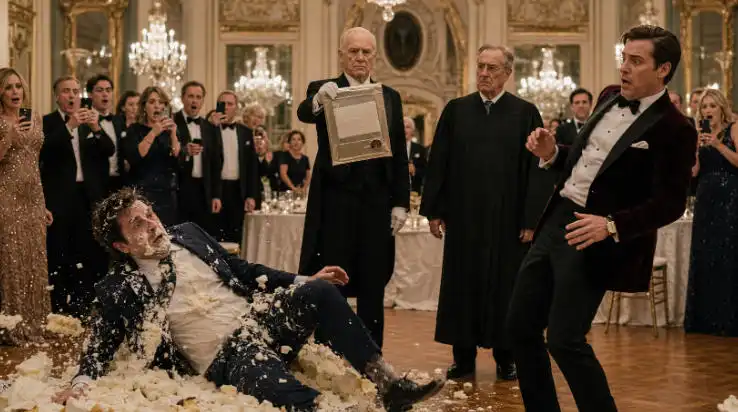



The ballroom went quiet before anyone knew why.
Not silent.
Just quiet enough for every fork to stop tapping crystal plates.
Harrison Vale stood beneath the chandeliers of The Plaza, wearing a tuxedo that cost more than most people’s rent, smiling like a man who had already won.
And the mayor had just said the one sentence Harrison had been waiting all year to hear.
“Ladies and gentlemen, please welcome the one woman who can decide whether Harrison Vale Capital lives or dies…”
Harrison’s smile widened.
His wife, Celeste, lifted her champagne glass.
Their son Bryce kept his phone up, still recording, because humiliation had become entertainment to that family long before that night.
And from the side of the ballroom, a woman stepped into the light.
At first, Harrison didn’t recognize her.
No one would have blamed him.
The woman walking toward the stage wore a deep midnight-blue gown, tailored so perfectly that the room seemed to shift around her.
Her silver hair was swept back in a polished twist.
Diamonds rested at her ears.
Not loud diamonds.
Old-money diamonds.
The kind that didn’t beg to be noticed.
The kind that assumed the room already knew.
She walked slowly.
Calmly.
As if every powerful person in that ballroom had been waiting for her permission to breathe.
Then Harrison saw her eyes.
And the blood drained from his face.
Those were the same eyes that had looked up at him from the marble floor of his penthouse only three hours earlier.
The same eyes he had stared into after dumping dirty vase water over her head.
The same eyes he had dismissed as belonging to a nobody.
The housekeeper.
Josephine.
Only she was not his housekeeper.
Not really.
The mayor smiled proudly and read from the card in his hand.
“Josephine Whitaker, Chairwoman of the Whitaker Global Relief Foundation.”
A murmur moved through the ballroom.
Harrison’s fingers tightened around the edge of the podium.
Celeste’s champagne glass lowered.
Bryce’s phone dipped.
Josephine reached the stage, shook the mayor’s hand, and turned toward the audience.
She didn’t look at Harrison immediately.
That was the first punishment.
She made him wait.
For a man like Harrison Vale, being ignored was worse than being insulted.
He had built his entire life on being seen.
Magazine covers.
Donor walls.
Panels.
Press releases.
Every smile measured.
Every handshake calculated.
Every act of kindness photographed from the correct angle.
And now Josephine Whitaker stood ten feet away from him, looking past him as if he were nothing more than a stain on the carpet.
The irony was almost too perfect.
Earlier that evening, Harrison had stood in his penthouse barking orders like a king.
His home sat at the top of a glass tower overlooking Central Park.
The apartment was beautiful in the way expensive things can be beautiful without being warm.
White marble floors.
Black steel staircase.
Floor-to-ceiling windows.
Modern art Harrison didn’t understand but loved explaining to guests.
A grand foyer with a long mirror that made everyone entering the apartment look smaller.
Josephine had arrived there three weeks earlier under the name “Josie Walker.”
A quiet domestic worker.
Recommended through a private staffing agency.
Older.
Polite.
Efficient.
Invisible.
Exactly the kind of person Harrison never bothered to question.
To him, staff members were furniture that breathed.
Useful until they weren’t.
Celeste treated them with the exhausted cruelty of someone who had never earned a thing but believed she deserved everything.
Bryce, sixteen and rich enough to be bored by decency, treated every adult with less money than his father like content.
He filmed doormen.
He mocked waiters.
He posted delivery drivers.
And Harrison laughed.
“Kid’s got an instinct for power,” he would say.
Josephine had heard it all.
She had cleaned around their dining table while Harrison talked about “public-private partnership money” like it was already in his account.
She had poured coffee while Celeste bragged that the gala would “wash away that ugly article about the layoffs.”
She had stood at the edge of the room while Harrison told his lawyers, “The foundation board wants a story. Give them children, hunger, veterans, whatever polls well.”
He said it while eating caviar from a mother-of-pearl spoon.
Josephine had said nothing.
She never interrupted.
She only watched.
And listened.
Because the Whitaker Global Relief Foundation did not give major commitments blindly.
Not anymore.
Not after three financial scandals in five years involving charming men with perfect smiles and empty souls.
Josephine had spent forty years learning one lesson:
A man’s speech tells you what he wants.
His treatment of powerless people tells you who he is.
So when Harrison Vale Capital applied for a massive philanthropic-backed liquidity partnership tied to city housing and community investment funds, Josephine did something her board hated.
She went in herself.
No press.
No announcement.
No limousine.
No entourage.
She accepted a temporary placement in the Vale penthouse under a legal alias arranged through the foundation’s compliance counsel.
It was unusual.
But it was not illegal.
Every staff contract in the Vale home included consent to security monitoring in common areas.
Every gala applicant signed a morality and conduct clause.
Every executive seeking funds certified that neither they nor their household leadership engaged in abuse, coercion, discrimination, fraud, or reputationally damaging conduct.
Harrison signed it himself.
He didn’t read it.
Men like Harrison rarely read anything that limited them.
By the afternoon of the gala, Josephine already knew enough to deny him.
The hidden debt.
The angry investors.
The quiet pressure campaign on city officials.
The layoffs disguised as “strategic restructuring.”
The staged charity visits.
But she had not expected the cufflinks.
That was the thing about cruel people.
They rarely destroy themselves over something large.
They do it over something small.
A missing piece of jewelry.
A cold dinner.
A parking spot.
A person who fails to look afraid quickly enough.
At 5:12 p.m., Harrison began shouting from the master bedroom.
“Celeste!”
His wife appeared at the top of the stairs in a silver gown.
“What now?”
“My cufflinks.”
“Which cufflinks?”
“The Dresden blue sapphires. The custom ones.”
Celeste sighed.
“You had Josie polish them.”
Harrison’s head turned.
Josephine stood beside the entry console, arranging fresh water glasses for the driver and security team waiting downstairs.
“I placed them on your dresser, sir,” she said.
He walked toward her.
Each step clicked against the marble.
“You placed them.”
“Yes, sir.”
“You touched them.”
“Yes, sir. You asked me to polish them.”
He gave a small laugh.
It was not a laugh with humor in it.
It was a laugh designed to make the other person feel poor.
“Do you know what those cost?”
Josephine looked at him evenly.
“No, sir.”
“Of course you don’t.”
Celeste drifted down the stairs behind him.
“She probably thought they were costume jewelry.”
Bryce appeared near the hallway, already smiling.
“Wait, is Dad going off?”
Harrison ignored his son.
His eyes stayed on Josephine.
“People like you are always close to things you can’t afford.”
That sentence made even one of the younger maids look down at the floor.
Josephine heard a footman inhale sharply.
The driver outside the private elevator shifted uncomfortably.
It was not exactly public.
Not yet.
But it was witnessed.
That mattered.
Josephine clasped her hands in front of her.
“I did not take your cufflinks.”
Harrison stepped closer.
“Then where are they?”
“I don’t know.”
Wrong answer.
Or maybe the right one.
Because Harrison wanted a target more than he wanted the truth.
He turned, grabbed the tall vase from the entry table, and held it in both hands.
White lilies sagged over the rim.
The water inside had turned cloudy.
Celeste raised one eyebrow.
“Harrison.”
For a second, Josephine thought Celeste might stop him.
Instead, his wife smiled.
“At least make her clean it up before we leave.”
Bryce laughed.
“Dad, wait. Let me record.”
He lifted his phone.
That should have been the moment Harrison remembered he was a man going to a charity gala to beg for money.
Instead, it became the moment he showed the whole truth of himself.
“You know what you are?” he said.
Josephine did not answer.
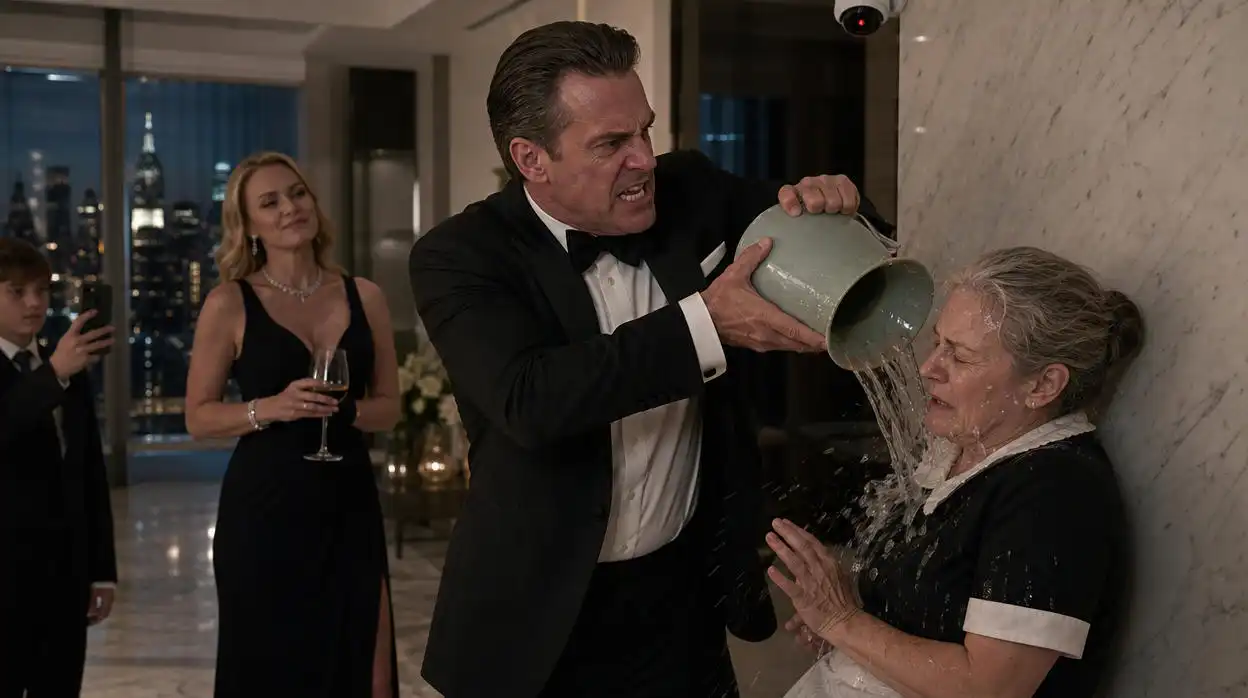
He tipped the vase.
Cold, dirty water poured over her hair, her face, her shoulders.
The lilies slapped against her chest and fell to the floor.
Bryce burst out laughing.
Celeste covered her mouth, but not out of horror.
Out of amusement.
“Worthless trash,” Harrison said. “That’s what you are. Worthless trash in a uniform.”
Josephine stood dripping in the foyer.
Brown water ran down her cheek.
Her black dress clung to her arms.
A piece of dead leaf stuck near her collar.
She did not wipe it away.
That seemed to anger him more.
He lifted his hand and slapped her.
The sound cracked through the foyer.
The younger maid gasped.
The driver looked toward the elevator doors.
Josephine staggered back and hit the wall hard enough to shake the framed photograph beside her.
Harrison pointed down.
“On your knees.”
Josephine’s voice was quiet.
“Sir?”
“My shoes.” He lifted one polished black shoe. “You got filth on them. Clean them.”
Bryce moved closer with his phone.
“Say sorry, Josie. Come on. This is perfect.”
Celeste picked up a glass of water from Josephine’s tray and handed it to Harrison.
“She missed the left shoe.”
Harrison smirked and took it.
He splashed the water onto the toe of his own shoe.
“Now she has work to do.”
The staff watched.
No one moved.
That is one of the ugliest truths about power.
It doesn’t only hurt the person on the floor.
It freezes everyone around them.
Josephine lowered herself to one knee.
Then the other.
The marble was cold beneath her.
Harrison leaned over her.
“Look at me when you clean.”
She looked up.
Not angry.
Not broken.
Just still.
And for one second, Harrison seemed unsettled.
Because there was no fear in her face.
Only memory.
Josephine glanced past him toward the hallway mirror.
Above it, tucked into the molding, the security camera blinked red.
It had audio.
It covered the foyer.
Harrison had installed it himself after accusing a previous valet of stealing a watch he later found in his golf bag.
The system stored footage in a private cloud.
But Josephine had already learned during her first week that the building’s security office also kept mirrored logs for insurance and incident review.
The Vale family had demanded it after a jewelry courier once claimed he was shoved by their former chef.
Josephine had read the household onboarding packet.
Harrison had not.
She wiped one shoe with the small towel from the tray.
Then the other.
She did it slowly.
Precisely.
Like a woman signing a document.
When Harrison finally stepped back, he adjusted his jacket.
“Fire her tomorrow.”
Celeste shrugged.
“Why wait?”
Harrison checked his watch.
“Because we’re late.”
Bryce lowered his phone and grinned.
“I’m posting that after the gala.”
Josephine stood.
Water dripped from her sleeve to the marble.
Harrison leaned close enough for only her to hear.
“People like you should be grateful when people like me let you stand indoors.”
Josephine looked at him.
Then she said the only sentence she had spoken in almost five minutes.
“I hope your evening gives you exactly what you deserve.”
Harrison laughed all the way into the elevator.
Twenty minutes later, Josephine was in the service bathroom downstairs with a towel around her shoulders.
The younger maid, Maria, cried while trying to help her dry off.
“I’m so sorry,” Maria whispered. “I should have done something.”
Josephine touched her hand.
“You were afraid.”
Maria nodded.
“That’s what men like him count on.”
Josephine looked at herself in the mirror.
Her cheek had reddened.
Her shoulder ached.
Her hair was ruined.
But her eyes were clear.
She took out her phone and made three calls.
The first was to her foundation’s general counsel.
“I need the applicant conduct file opened immediately.”
The second was to the building’s head of security.
“This is Josephine Whitaker. Preserve all foyer footage from 5:00 to 5:30 p.m. under legal hold.”
There was a long pause.
Then the man stammered, “Mrs. Whitaker? Of course.”
The third call was to her driver.
“Bring the blue gown. The Plaza entrance on 58th. Service side.”
By 7:40 p.m., Harrison stood at The Plaza beneath golden ceilings and crystal chandeliers, telling donors that compassion was “the highest form of capitalism.”
People applauded.
Of course they did.
A room full of powerful people will applaud almost anything if it comes with good wine and assigned seating.
Celeste stood beside him, radiant and empty.
Bryce posted a selfie with the caption:
“Gala life. Some people work. Some people lead.”
In a side room, Josephine changed.
A stylist from the foundation team pinned her hair.
A makeup artist softened the red mark on her cheek but did not erase it completely.
Josephine stopped her.
“Leave enough for people to see.”
The woman hesitated.
“Are you sure?”
“Yes.”
When the mayor introduced Harrison, the room treated him like a savior.
“Mr. Vale has presented an ambitious plan to stabilize community investment, expand affordable housing partnerships, and support family-based financial education across New York…”
Josephine listened from backstage.
The words sounded noble.
On paper, they almost were.
But Harrison’s company was not healthy.
He needed the foundation money not to help families.
He needed it to stop a run.
His investors had started pulling capital after a series of quiet losses.
A municipal partnership would signal trust.
The Whitaker Foundation’s support would bring banks back to the table.
Without it, Harrison Vale Capital would face redemptions he could not cover.
That was why he smiled so hard.
That was why his hand shook slightly when he reached for the microphone.
“Charity,” Harrison said, “is not about pity. It’s about dignity.”
Josephine almost laughed.
Dignity.
The word sat in his mouth like stolen jewelry.
He continued.
“My family has always believed every person deserves to be seen.”
At that, one of Josephine’s attorneys backstage looked at her.
She said nothing.
The mayor returned to the podium.
“And now, the final approval for tonight’s philanthropic partnership rests with a woman whose foundation has changed millions of lives across the world…”
That was when the ballroom quieted.
That was when Josephine stepped out.
And that was when Harrison understood that God, fate, karma, and contract law had all arrived wearing the same blue gown.
Josephine took the microphone.
The room applauded warmly.
She waited until the applause faded.
Then she looked directly at Harrison.
Not for long.
Just long enough.
His mouth opened.
No sound came out.
Celeste whispered, “Harrison?”
Bryce stared at the stage with the color gone from his face.
Josephine turned back to the room.
“Good evening.”
Her voice was steady.
“I came tonight prepared to speak about trust.”
She paused.
“Trust is the backbone of philanthropy. It is the quiet promise that money given in the name of human dignity will not be placed into the hands of people who secretly despise human beings.”
The room shifted.
Harrison forced a laugh.
It died alone.
Josephine continued.
“Before the Whitaker Foundation enters a major partnership, our board reviews financial risk, governance, legal exposure, and character.”
She let that word hang.
Character.
“Many applicants know how to perform generosity in public. Fewer know how to practice decency when they believe no one important is watching.”
Harrison leaned toward the mayor.
“Is this part of the program?”
The mayor did not answer.
He had just been handed a folder by Josephine’s counsel.
His face had changed.
Josephine pressed a small remote.
The ballroom screens behind her lit up.
Not with the foundation logo.
Not with charts.
Not with smiling children from Harrison’s proposal.
With a frozen image of Harrison’s penthouse foyer.
Harrison’s voice filled the ballroom.
“People like you are always close to things you can’t afford.”
Gasps.
A woman near the front covered her mouth.
A banker at table twelve slowly lowered his wineglass.
The video played.
Harrison towering over Josephine.
Celeste laughing.
Bryce lifting his phone.
The vase tipping.
The dirty water pouring over Josephine’s head.
Then the slap.
The sound echoed through The Plaza ballroom.
No one moved.
Not one person.
The video showed Josephine hitting the wall.
It showed Harrison forcing her to kneel.
It showed him lifting his shoe.
It showed Celeste handing him another glass of water.
It showed Bryce recording and laughing.
Then Harrison’s voice:
“People like you should be grateful when people like me let you stand indoors.”
The screen went black.
For three full seconds, nobody breathed.
Then the room exploded.
Not with shouting.
With whispers.
The kind of whispers that end careers faster than screams.
“That’s him?”
“Was that tonight?”
“His own staff?”
“Oh my God.”
“Is that his son?”
“Is Celeste laughing?”
Harrison stepped toward Josephine.
“This is edited.”
Josephine turned to him calmly.
“It is the complete timestamped security file from your own residence, preserved by your building’s third-party system under legal hold.”
His jaw tightened.
“You were trespassing.”
“No. I was lawfully employed under a temporary household services agreement that your office approved.”
Celeste found her voice.
“You lied about who you were.”
Josephine looked at her.
“I gave your family every opportunity to show who you were.”
That landed harder than any insult.
Bryce’s phone was still in his hand.
A man at the next table said, “Put it down, kid.”
Bryce did.
Josephine faced the audience again.
“The Whitaker Global Relief Foundation will not proceed with any partnership involving Harrison Vale Capital.”
Harrison whispered, “No.”
Josephine did not stop.
“Additionally, after reviewing the conduct clause signed by Mr. Vale, the foundation is withdrawing all pending commitments connected to his firm.”
A banker stood and stepped away from Harrison’s table.
Then another.
Then a city official.
Josephine continued.
“We have also notified the municipal oversight board that our foundation will recommend immediate suspension of all related city-backed charitable investment pathways pending review.”
The mayor’s face hardened.
He took the microphone.
“Based on what we have just seen, my office will request an emergency ethics and funding review effective immediately.”
Harrison lunged for the podium.
“Do you understand what you’re doing?”
Josephine looked at him as security moved closer.
“Yes.”
Her voice stayed soft.
“That is the difference between us.”
The ballroom erupted.
Not in applause at first.
In outrage.
People stood.
Phones came up.
Reporters who had been invited for society-page coverage suddenly found themselves holding the story of the year.
Celeste grabbed Harrison’s sleeve.
“Fix this.”
He turned on her.
“Me? You were laughing!”
“You poured the water!”
“Our son recorded it!”
Bryce shouted, “You told me to!”
The perfect family cracked in public.
That was the part no money could repair.
Because rich people can survive scandal when they remain united.
The Vales fell apart before dessert.
Security escorted Harrison from the stage.
As he passed Josephine, he whispered, “You planned this.”
Josephine looked at him.
“No. You did.”
By midnight, the video was everywhere.
Not because Josephine leaked it.
She didn’t need to.
There were three hundred people in that ballroom and half of them had phones.
The clip spread from private donor circles to financial media before breakfast.
By 8:00 a.m., investors began requesting withdrawals.
By 9:30 a.m., two banks froze pending credit discussions.
By 10:15 a.m., the city announced a formal review of all partnerships connected to Harrison Vale Capital.
By noon, three board members resigned.
By 2:00 p.m., Harrison was locked out of his own firm’s emergency meeting.
At 4:45 p.m., the board issued a statement.
Harrison Vale had been removed as CEO.
Effective immediately.
The statement used polite words.
“Conduct inconsistent with firm values.”
“Reputational risk.”
“Loss of stakeholder confidence.”
But everyone knew what it meant.
They had watched him pour dirty water on a woman he believed was powerless.
They had watched him slap her.
They had watched him force her to kneel.
And then they had watched that same woman stand under chandeliers and take away the only thing he truly worshipped.
His image.
The money followed.
It always does.
Without the foundation partnership, Harrison Vale Capital’s already-fragile position collapsed.
Redemption requests overwhelmed the firm.
Clients demanded answers.
Regulators asked questions.
Former employees came forward.
One assistant described being screamed at for using the “wrong pen.”
A receptionist said she had been fired after refusing to cover for Harrison’s affair with a consultant.
A junior analyst revealed that charitable donations were timed to distract from poor quarterly performance.
None of those stories would have mattered alone.
That is another ugly truth.
Powerful people are often forgiven one small cruelty at a time.
But Josephine’s video gave everyone a frame.
Suddenly, every whisper had a face.
Every rumor had a voice.
Every victim had proof that they had not imagined the pattern.
Within a week, Harrison’s name disappeared from the firm website.
Within two weeks, the firm entered restructuring.
Within a month, the penthouse was listed quietly through a private broker.
Celeste left for Palm Beach.
Bryce’s school asked him to complete the semester remotely after parents demanded action.
His TikTok account vanished.
For once, he learned what it felt like to be watched without control.
As for Harrison, the newspapers exaggerated some things.
He did not become a beggar overnight.
Men like Harrison do not fall from towers directly into gutters.
They fall through lawyers.
Through lawsuits.
Through frozen accounts.
Through friends who stop answering.
Through restaurants that suddenly have no tables.
Through charity boards that remove their plaques.
Through doormen who still open doors but no longer say “Good evening, Mr. Vale” with respect.
Six months later, Josephine saw him once.
Not in court.
Not at a gala.
Outside a coffee shop on Madison Avenue.
He wore an old coat and no tie.
His hair had gone dull.
He was arguing with someone on the phone about legal fees.
For one brief second, he looked up and saw her through the window.
Josephine was seated inside with Maria, the younger maid from the penthouse.
Maria was no longer working for the Vales.
Josephine had offered her a position through the foundation’s residential dignity initiative, a program supporting domestic workers who reported abuse and wage theft.
Maria was studying office administration at night.
She looked lighter now.
Like someone who had been allowed to put down a weight.
When Maria noticed Harrison outside, she froze.
Josephine placed a hand over hers.
“He can’t hurt you here.”
Maria swallowed.
“I still feel stupid for being scared.”
“Fear is not stupidity,” Josephine said. “Fear is information. Courage is what you do with it after.”
Harrison stared through the glass.
For a moment, Josephine thought he might come inside.
Maybe apologize.
Maybe rage.
Maybe beg.
But he did none of those things.
He lowered his eyes first.
Then he walked away.
That was the quietest victory.
Not the applause.
Not the headlines.
Not the board vote.
That moment.
A man who had once forced her to kneel could no longer meet her gaze.
Josephine never celebrated his suffering.
She had seen enough suffering in her life to know it is not a toy.
Her victory was not that Harrison lost everything.
Her victory was that the truth finally cost him something.
There is a difference.
The Whitaker Foundation redirected the withdrawn funds into worker protection programs, city shelters, food security grants, and legal support for domestic employees.
At the next annual gala, Josephine did not mention Harrison by name.
She didn’t have to.
She stood on the same stage at The Plaza and spoke to a room full of donors who now listened very carefully.
“Dignity,” she said, “is not how we treat people when cameras are pointed at us.”
She looked across the ballroom.
“It is how we treat people when we believe nobody powerful will ever know.”
Maria sat in the audience that night.
So did two former Vale employees.
So did the building security manager who preserved the footage.
And when Josephine finished, the applause was different.
Not polite.
Not rich.
Human.
Afterward, Maria hugged her near the side entrance.
“I keep thinking about that night,” Maria said. “You were on the floor, and I thought it was over.”
Josephine smiled gently.
“No.”
She looked back at the ballroom.
“That was the moment he stepped onto mine.”
Sometimes justice does not roar at first.
Sometimes it kneels.
Sometimes it stays quiet.
Sometimes it lets cruelty speak clearly enough that nobody can pretend they misunderstood.
And then, when the room is full, when the microphones are live, when the people who once laughed are suddenly watching their own faces on a screen…
Justice stands up.
So pick a side:
Would you have exposed Harrison publicly at the gala, or should Josephine have handled it quietly behind closed doors?
Share this with someone who believes character is proven by how you treat people who can’t do anything for you. ⚖️
Disclaimer: Mention of any brand or trademark is for identification only and does not imply partnership or endorsement

They Laughed While Security Beat the “Alley Thief”… Then One Video Made Everyone REGRET It
A Diner Owner Called Him a “VAMPIRE” and Kicked Him Into the Rain… Then KARMA Pulled Up in 18 Wheels

A Hollywood Producer Humiliated a Quiet Crew Worker on LIVE Video… Then KARMA Walked In Holding a Sealed Trust File