


For three seconds, the Harvard president didn’t say anything.
He only stared at me on the floor.
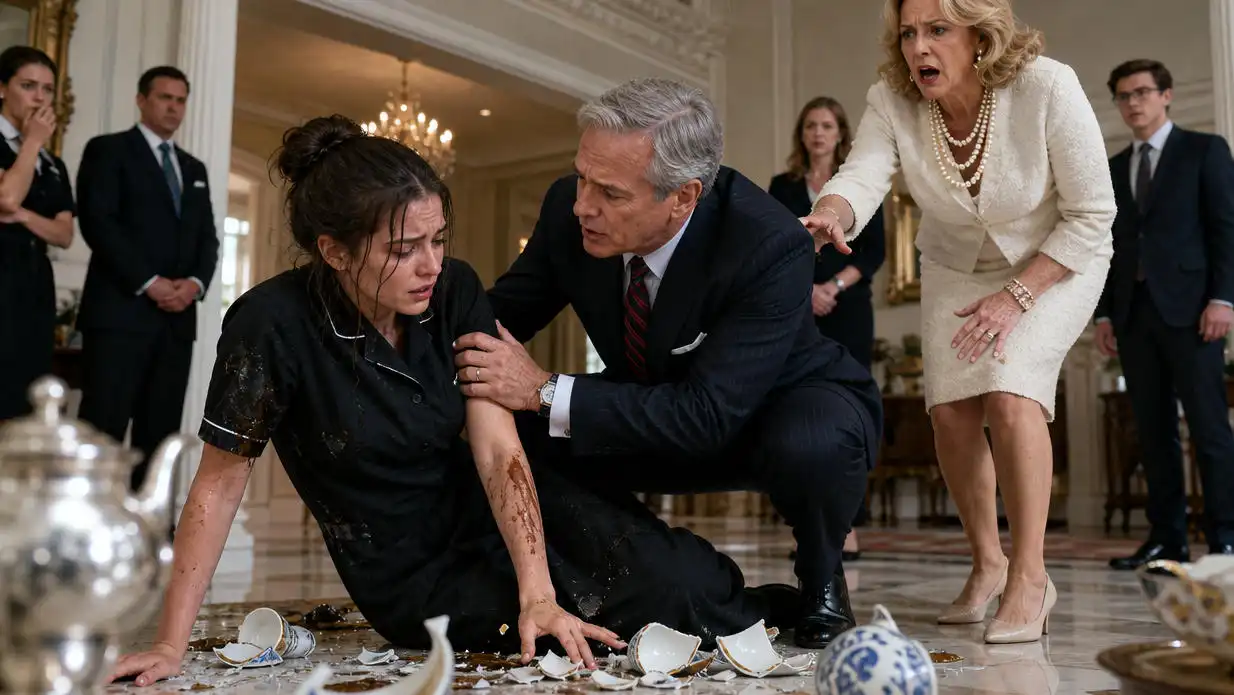
Coffee was cooling on my sleeve.
Tiny pieces of porcelain were pressed into my palm.
And Eleanor Whitmore, who had just called me a thief in her marble kitchen, stood behind him with her hand still hanging in the air.
She had expected a handshake.
She got silence.
The kind of silence that makes rich people nervous.
“Dr. Halpern?” Eleanor said, forcing a laugh. “I’m so sorry you had to see this little household issue.”
The president didn’t turn around.
He crouched beside me.
“Are you hurt?”
His voice was low.
Careful.
Not the voice people use with servants.
Not the voice Eleanor had used with me.
I kept my eyes down.
“Only my arm,” I said.
Eleanor stepped forward fast.
“She is being dramatic. She drank my daughter’s imported water, then caused a scene. We’re under enormous pressure today, as you can imagine.”
Behind her, Caroline Whitmore stood in a white blouse and navy skirt, the uniform of a girl who had been trained since birth to look innocent in expensive rooms.
Her private tutor, Mr. Langford, adjusted his glasses.
He had been paid $650 an hour to polish her essay, coach her interview, and apparently nod whenever cruelty needed a witness.
He cleared his throat.
“It was unfortunate,” he said. “But Mrs. Whitmore was simply defending boundaries.”
Boundaries.
That was what they called it.
Not humiliation.
Not assault.
Not forcing a woman twice Caroline’s age to kneel on shattered china.
Boundaries.
I had heard that word all morning.
Eleanor used it whenever she meant ownership.
“My kitchen.”
“My staff.”
“My daughter’s future.”
“My Harvard connection.”
That last one was why I was there.
Not because I needed nanny work.
Not because I had nowhere else to go.
I was there because for twelve years, families like the Whitmores had learned how to polish cruelty until it looked like leadership.
And Harvard had a problem.
Not a money problem.
Not a prestige problem.
A character problem.
Every spring, the university received applications wrapped in perfect paper.
Legacy names.
Private school recommendations.
Service trips photographed by professionals.
Essays about compassion written by children who had never cleaned up after themselves.
The admissions committee could measure grades.
We could verify scores.
We could read recommendations.
But we could not always see what happened when applicants believed no one important was watching.
So, quietly, unofficially, and only in the rarest cases, we watched.
That year, Caroline Whitmore’s file had become one of those cases.
Her numbers were flawless.
Her family history was impressive.
Her mother had donated to museums, chaired charity luncheons, and spoke publicly about “educating the next generation of ethical leaders.”
But three separate people had warned us.
A former housekeeper.
A dismissed driver.
A scholarship student from Caroline’s school.
None of them wanted revenge.
They only said the same thing:
“Please don’t let that girl become powerful without knowing who she really is.”
So I came to the Whitmore mansion as Margaret Bell.
A temporary nanny.
Plain shoes.
Gray hair pulled back.
No jewelry except a thin wedding band.
No one asked for my résumé.
Eleanor only asked whether I could “speak proper English,” lift laundry, and keep out of sight.
That told me almost everything.
The mansion sat on a quiet Boston street where even the trees looked inherited.
Inside, the floors gleamed.
Oil portraits watched from dark walls.
Silver-framed Harvard diplomas sat beside antique lamps.
Everything in that house whispered old money.
But the people inside shouted insecurity.
By 8:00 a.m., Eleanor had corrected the way I folded napkins three times.
“Harvard notices details,” she said.
By 8:30, Caroline had thrown a cashmere sweater at me because the “texture felt hostile.”
By 9:00, Mr. Langford was coaching Caroline near the breakfast room.
“If they ask about hardship,” he said, “mention the literacy center.”
Caroline rolled her eyes.
“I hated that place. The kids smelled like cafeteria food.”
Her mother snapped, “Caroline.”
Not because she was ashamed.
Because I was in the room.
Caroline glanced at me.
“What? She’s staff.”
I carried the tray without changing my face.
That was the first rule.
Do not react.
People show you more when they believe you cannot hurt them.
The second rule was simpler.
Remember everything.
At 10:12, Eleanor received a call from someone named Bixby.
I was wiping the marble island.
“Yes, the final team is coming here,” she said into the phone. “Of course they are. We don’t wait in lines like everyone else.”
A pause.
Then she laughed.
“No, Caroline doesn’t need to be perfect. She needs to look inevitable.”
I wrote that sentence down later.
At 10:40, Mr. Langford pulled a folder from his leather bag.
“Your personal statement has been adjusted,” he told Caroline. “The part about your bond with household employees is stronger now.”
Caroline groaned.
“Do I have to say ‘dignity of labor’ again? It sounds so fake.”
Eleanor said, “Then say it beautifully.”
They all laughed.
I was standing four feet away, holding a basket of linens.
That was the third rule.
When someone humiliates you in public, let them believe they are safe.
Because safe people are careless.
By noon, the house had become a stage.
Fresh flowers in the foyer.
Coffee in polished silver.
Imported mineral water arranged beside crystal glasses.
Eleanor inspected everything like a general before battle.
“Caroline,” she said, “remember: warmth, discipline, global awareness.”
Caroline nodded.
Then she looked at me.
“Can she not be visible when they arrive?”
Eleanor didn’t even blink.
“She won’t be.”
I almost smiled.
Because visibility was exactly why I had come.
Around 12:30, I felt dizzy.
I had been on my feet since dawn.
The kitchen was warm, and Eleanor had refused to let me eat until “after the important people leave.”
There were twenty-four glass bottles of Italian mineral water lined up on the counter.
I opened one.
One sip.
That was all.
Caroline saw me first.
“Mom.”
The way she said it was not alarm.
It was excitement.
Like she had found a stain to point at.
Eleanor turned.
Her eyes dropped to the bottle.
The whole room changed.
Mr. Langford stopped mid-sentence.
The cook looked away.
Two house staff members froze near the pantry.
Eleanor came toward me slowly.
“What,” she said, “do you think you are doing?”
I set the bottle down.
“I’m sorry, ma’am. I felt lightheaded.”
“That water is for Caroline.”
“I understand. I can replace it.”
“Replace it?”
She laughed once.
Sharp.
Cruel.
“You think this is about money?”
It was always about money with people who insisted it wasn’t.
She stepped closer.
“You people never understand placement. Some things are not for you.”
The cook whispered, “Mrs. Whitmore…”
Eleanor raised one hand.
“Do not defend her.”
Then she turned back to me.
“My daughter has the most important interview of her life in less than an hour, and this woman decided her thirst mattered.”
Caroline folded her arms.
“She probably wanted to touch something expensive.”
Mr. Langford gave a tiny smile.
It was quick.
But I saw it.
That smile cost him his career.
I said, “I apologize for taking the water.”
Eleanor’s face tightened.
“Not good enough.”
She reached for the silver coffee pot.
For one second, I thought she meant to refill a cup.
Then the hot coffee hit my sleeve.
Pain flashed up my arm.
I stepped back.
Gasps came from the pantry.
“Now,” Eleanor said, “maybe you’ll remember what belongs to whom.”
I looked at my arm.
Red skin.
Steam.
Coffee dripping onto the floor.
My hand trembled.
Not from fear.
From restraint.
Because I knew exactly what was about to happen.
And I knew exactly who was due at the door.
Eleanor mistook my silence for weakness.
She always had.
“On your knees,” she said.
I looked up.
“No.”
The word was quiet.
That made her angrier.
She slapped me across the face.
My head turned with the force of it.
The sound cracked through the kitchen.
Nobody moved.
That was the part I still remember most.
Not the pain.
The watching.
People always think cruelty requires monsters.
It doesn’t.
Sometimes it only requires a room full of people deciding their paycheck matters more than your dignity.
Eleanor grabbed my arm.
I pulled back.
Her fingers slipped.
She shoved.
My heel caught the edge of the service stairs.
I fell down two steps into the side passage.
The porcelain cup in my hand shattered under me.
A piece cut into my palm.
Caroline stepped down after me.
Not to help.
To look.
“You got blood on the runner,” she said.
Then she nudged my shoe with the tip of hers.
Not a hard kick.
Just enough to tell me what she thought I was.
Furniture.
Trash.
A problem to be moved.
Mr. Langford came to the doorway.
“Margaret,” he said, using the fake name Eleanor had given him. “This can still be handled gracefully.”
I laughed once.
That was the first sound I made that didn’t belong to the role.
His eyes narrowed.
Eleanor pointed at the broken pieces.
“Kneel. Apologize to my daughter. Tell her you are sorry for trying to make her day about you.”
The doorbell rang.
For half a second, everyone froze.
Then Eleanor transformed.
It was almost impressive.
Her face softened.
Her shoulders relaxed.
She became the woman from charity photographs.
“Oh!” she said brightly. “They’re here.”
She looked down at me.
“Stay there.”
Then she turned to Caroline.
“Smile.”
The front door opened.
Voices entered the foyer.
Dr. Samuel Halpern, president of Harvard University, stepped inside with three senior members of the final interview committee.
I had known Samuel for twenty-eight years.
He had chaired beside me.
Argued with me.
Lost votes to me.
Trusted me.
And now he was standing ten feet away while I sat on Eleanor Whitmore’s floor, coffee on my sleeve, blood in my palm, and red swelling across my cheek.
Eleanor swept forward.
“Dr. Halpern, welcome to our home. We are honored beyond—”
He walked past her.
Straight past.
No handshake.
No greeting.
No polite old-money theater.
His eyes were on me.
That was where the Facebook post ended.
Here is what happened next.
Dr. Halpern crouched beside me and said, very clearly, “Madam Chair, who did this to you?”
The room went dead.
Not quiet.
Dead.
Eleanor blinked.
Caroline’s mouth opened.
Mr. Langford’s glasses slid down his nose.
One of the committee members, Dean Alvarez, covered her mouth.
The cook whispered, “Oh my God.”
I stood slowly.
Dr. Halpern helped me.
I did not need help standing.
But I let him.
Because Eleanor needed to see it.
Respect.
Public.
Undeniable.
I looked at her.
“My name is Dr. Margaret Bellamy,” I said. “Chair of the Ivy League Admissions Ethics Review Committee.”
Eleanor stared at me like the English language had failed her.
“No,” she whispered.
I took the folded white apron from my waist and set it on the marble table.
“Yes.”
Caroline stepped backward.
“Mom?”
Eleanor’s face went pale, then red.
“This is absurd,” she snapped. “This is entrapment. This woman lied her way into my home.”
I said, “Your staff agency was informed that a temporary domestic worker would be observing household culture during the applicant review period.”
Eleanor looked toward the cook.
The cook looked down.
I continued.
“You signed the consent language in the supplemental household visit release.”
“I sign hundreds of things.”
“That has consequences.”
Dr. Halpern turned to Mr. Langford.
“And you are?”
Mr. Langford swallowed.
“Thomas Langford. Academic consultant.”
“Were you present when Mrs. Whitmore struck Dr. Bellamy?”
He hesitated.
Eleanor snapped, “Thomas.”
That one word told us everything.
Who paid him.
Who owned him.
Who he feared.
He said, “I… I saw a disagreement.”
Dean Alvarez stepped forward.
“A disagreement?”
Mr. Langford looked at my arm.
Then my cheek.
Then the broken porcelain.
His voice shrank.
“She slapped her.”
Eleanor gasped.
“Thomas!”
He kept going, because cowards often become honest only after the powerful change sides.
“She poured coffee on her sleeve. And she told her to kneel.”
Caroline cried, “You’re making it sound worse than it was!”
I turned to her.
“You kicked my shoe while I was on the floor.”
“It wasn’t a kick.”
“No,” I said. “It was a message.”
Her eyes filled with tears.
Not remorse.
Fear.
There is a difference.
Eleanor rushed toward me.
“Dr. Bellamy, please. You must understand. This was an emotional morning. Caroline has worked her entire life for this.”
I looked around the mansion.
The portraits.
The silver.
The staircase.
The staff pretending not to listen.
“Has she?”
Eleanor flinched.
I opened the leather folder Dean Alvarez handed me.
Inside was Caroline Whitmore’s application file.
Perfect paper.
Perfect scores.
Perfect lies.
I placed it on the table.
“Caroline wrote that her lifelong commitment to service came from the respect she learned watching her family treat working people with dignity.”
Nobody spoke.
I turned one page.
“She wrote that her mother taught her every person deserves to be seen.”
The cook started crying quietly.
I turned another page.
“She submitted a letter from Mr. Langford describing her as ‘unusually humble.’”
Mr. Langford closed his eyes.
Eleanor whispered, “Please don’t do this in front of her.”
That almost made me laugh.
She had no problem humiliating me in front of her daughter.
But accountability?
That required privacy.
“No,” I said. “You chose the audience.”
Then I rolled up my sleeve.
The burn had darkened.
Ugly red skin across my forearm.
A committee member took a photo for the record.
Eleanor recoiled as if the wound itself had accused her.
I opened the small stamp case Dean Alvarez carried.
Inside was the red stamp used only in confirmed ethics disqualification cases.
Not for bad essays.
Not for weak grades.
For fraud.
Misconduct.
Material character deception.
Permanent institutional rejection.
Eleanor shook her head.
“No. You can’t. She’s seventeen.”
“She is old enough to watch cruelty and enjoy it,” I said. “She is old enough to lie about compassion. She is old enough to benefit from forged virtue.”
Caroline sobbed.
“I didn’t forge anything!”
I looked at Mr. Langford.
He stared at the floor.
“Mr. Langford?”
His voice broke.
“I edited the essay heavily. Mrs. Whitmore directed the themes.”
Eleanor spun toward him.
“You parasite.”
He laughed bitterly.
“Now I’m a parasite?”
Dr. Halpern said, “Enough.”
His voice filled the room.
I placed Caroline’s file flat on the table.
Eleanor grabbed the edge.
“Margaret—Dr. Bellamy—please. We can resolve this. I know people on boards. I know donors. I know—”
“That is exactly the problem.”
I pressed the stamp into the red ink.
Caroline whispered, “Mom, stop her.”
Eleanor looked at the committee.
At the staff.
At the tutor.
At the president she had worshiped.
Nobody moved for her.
For the first time that day, Eleanor Whitmore understood what it felt like to be powerless in a room full of witnesses.
I stamped the file.
PERMANENTLY DENIED — ETHICS REVIEW
The sound was small.
The consequence was not.
Caroline screamed.
Eleanor reached for the file, but Dean Alvarez took it first.
“This decision will be transmitted through the consortium,” she said. “Harvard, peer institutions, and participating elite secondary review offices will receive the ethics notice.”
Eleanor stumbled backward.
“You’re blacklisting my daughter.”
“No,” I said. “We are recording what happened.”
“That’s the same thing!”
“No,” Dr. Halpern said. “It is not. One is punishment. The other is truth.”
That sentence broke her.
Not loudly at first.
She simply sank into one of her antique chairs.
The same chair she had earlier told me not to dust too hard because it was “older than your bloodline.”
Her pearls sat crooked at her throat.
Caroline cried into both hands.
Mr. Langford began apologizing to everyone in the room except me.
So I stopped him.
“Mr. Langford.”
He looked up.
“Your involvement will be referred to the academic consultant registry and every school that accepted your character certification.”
His face drained.
“I have a family.”
“So do the students you helped push aside.”
The cook let out a breath.
One of the younger housekeepers started filming with trembling hands.
Eleanor saw the phone.
“Stop recording!”
The girl didn’t.
That video never went public from me.
I did not need public revenge.
Rules were enough.
But in houses like that, truth travels faster than gossip because everyone has been waiting years to speak.
By sunset, three staff members had given statements.
By the next morning, Mr. Langford’s consulting firm removed his profile.
By the end of the week, Caroline’s private school opened a conduct review into her service records and recommendation materials.
By the end of the month, Harvard’s decision had become final.
Then Yale.
Princeton.
Columbia.
Brown.
Dartmouth.
Penn.
Cornell.
The elite schools did not reject Caroline because her mother was rude.
They rejected her because the application presented a false moral record, supported by adults who lied, while the applicant participated in conduct that directly contradicted her claims.
That distinction mattered.
It still does.
Eleanor tried everything.
Lawyers.
Donors.
Old classmates.
A retired judge.
A cousin who once sat on a museum board with someone’s husband.
Every door that had once opened before she reached it now stayed shut.
The same social circle that had praised her table settings and charity speeches stopped returning calls.
Not because they were morally brave.
Because scandal is contagious among people who worship reputation.
Invitations disappeared.
Lunches became “full.”
Committees found “new leadership.”
One Boston hostess reportedly said, “We simply can’t risk the optics.”
That was the world Eleanor had built.
Polite.
Merciless.
Perfectly willing to abandon anyone who became inconvenient.
Caroline was sent abroad for a semester, then quietly transferred to a smaller college far from the legacy path her mother had designed.
I heard later that she struggled.
Not academically.
Socially.
For the first time, her last name could not carry her across the room.
I do not celebrate a young woman’s pain.
But I do believe consequences are sometimes the first honest teacher a person ever gets.
As for Eleanor, she never apologized directly.
Not at first.
She sent a letter through counsel that used phrases like “regrettable misunderstanding” and “heightened emotional circumstances.”
I returned it unsigned.
Six months later, a second letter came.
Handwritten.
No lawyer.
No letterhead.
Just Eleanor.
It said:
“I have spent my life mistaking polish for character. I taught my daughter the same disease. I do not expect forgiveness. I only wanted you to know that when I saw your arm in that room, I finally saw myself.”
I read it twice.
Then I put it away.
Forgiveness is not a performance.
Neither is accountability.
People asked me afterward whether I felt sorry for Caroline.
My answer was complicated.
I felt sorry for the child she might have been before her mother taught her people came in ranks.
I felt sorry for the girl who believed admission to a university mattered more than the humanity of the woman bleeding at her feet.
But I did not feel sorry for the consequences.
Because every scholarship seat has a shadow.
When a cruel child buys the costume of compassion, someone genuinely compassionate is pushed out.
A first-generation student.
A teacher’s daughter.
A kid working nights.
A boy writing essays after taking care of his younger siblings.
Those students do not have marble foyers.
They do not have tutors writing humility into their applications.
They only have the truth.
And the truth should still matter.
The burn on my arm faded.
The scar on my palm remained.
It is small.
A thin white line under my thumb.
Sometimes, when I sign denial letters in ethics cases, I see it.
And I remember Eleanor Whitmore’s kitchen.
I remember the silver coffee pot.
I remember the sound of the stamp.
But mostly, I remember the young housekeeper who kept recording after Eleanor screamed at her to stop.
A week after the incident, she sent me a note.
It said:
“I thought nobody important would ever believe people like us. Thank you for making them look.”
That note mattered more to me than Eleanor’s downfall.
Because justice is not only about punishing the cruel.
It is about reminding the quiet witnesses that they are not invisible.
So yes, Eleanor lost her social throne.
Caroline lost the Harvard future her family thought money had already purchased.
Mr. Langford lost the career he built selling fake virtue to desperate parents.
And I went back to my office, where applications continued to arrive in neat stacks.
But one thing changed.
That year, during final review, I read a file from a public-school girl in Ohio.
Her grades were excellent.
Her essay was simple.
No polish.
No dramatic rescue mission.
She wrote about working weekends at a nursing home and learning that dignity means doing hard things when no one praises you.
Her recommendation came from a supervisor who said she stayed late every Friday to wash residents’ hair because “people feel more human when someone takes time with them.”
I voted yes.
So did the committee.
She got the seat.
Not because Eleanor’s daughter lost it.
Because she had earned it.
And when I saw her walk across Harvard Yard that fall with her mother crying beside her, I felt the kind of peace revenge alone never gives.
The kind that says:
A door did not just close.
The right one opened.
So choose a side.
Was I too harsh for stamping Caroline’s file permanently denied after what happened — or did Eleanor and Caroline finally meet the rules they thought only applied to everyone else?
Share this if you believe character still matters when nobody “important” is watching. ⚖️
Disclaimer: Mention of any brand or trademark is for identification only and does not imply partnership or endorsement

They Laughed While Security Beat the “Alley Thief”… Then One Video Made Everyone REGRET It

A Diner Owner Called Him a “VAMPIRE” and Kicked Him Into the Rain… Then KARMA Pulled Up in 18 Wheels

A Hollywood Producer Humiliated a Quiet Crew Worker on LIVE Video… Then KARMA Walked In Holding a Sealed Trust File