


The governor’s hand stayed out in front of me.
My sleeve was dripping dirty water onto the polished kitchen floor.
Chad’s slap still burned across my cheek.
And for the first time all night, the loudest man in the room had nothing to say.
“Marcus,” the governor said again, quieter this time. “Boss… what happened here?”
I looked at his hand.
Then I looked at Chad.
He was still standing there in his spotless chef coat, one palm half-raised, like his body hadn’t caught up with the fact that his world had just cracked open.
Behind him, the sous-chefs stopped laughing.
The servers stopped moving.
Even the dinner crowd, the kind of crowd that paid $180 for a steak and pretended not to notice the people carrying their plates, had gone completely silent.
My name is Marcus Whitmore.
For one week, everyone at Whitmore Prime Chicago knew me as “Mike,” the new dishwasher.
Slow hands.
Old back.
Cheap shoes.
The invisible man in the apron.
Chad Beaumont, the executive chef, knew me as something even lower.
He called me “dish trash.”
He called me “the retirement case.”
He told the line cooks I smelled like bus stations.
He told the servers not to make eye contact with me because “charity hires start expecting respect.”
The funny thing was, Chad didn’t own that kitchen.
He didn’t own the knives, the copper pans, the imported salt, the dry-aged beef, the wine cellar, or the polished sign out front.
I did.
I owned Whitmore Hospitality Group.
Twenty-seven restaurants across eight states.
Three fine dining brands.
Two hotel partnerships.
One culinary training foundation.
And, because I was a fool who believed résumés more than people, I had signed Chad Beaumont to run the Chicago flagship six months earlier.
He looked perfect on paper.
James Beard semifinalist.
French training.
A face made for magazine covers.
He knew how to speak to investors.
He knew how to charm donors.
He knew how to stand beside me at ribbon cuttings and say, “We treat every employee like family.”
But numbers tell one story.
People tell the truth.
In the first three months, Chicago’s turnover rate doubled.
Dishwashers quit after two shifts.
Servers transferred out.
Prep cooks stopped applying.
Two hostess complaints disappeared from the system.
One busser left a voicemail crying so hard I could barely understand her.
Then came the anonymous letter.
It was written on receipt paper and mailed to our corporate office in Dallas.
No return address.
Just six sentences.
“Mr. Whitmore, you don’t know what is happening in your Chicago kitchen. Chef Chad abuses anyone he thinks is beneath him. Managers are scared of him because he brings in big customers. He pushed a prep cook last month. He steals tips from banquet staff. Please send someone who looks poor, or you will never see the truth.”
At the bottom, in shaky handwriting, it said:
“Don’t tell them you’re coming.”
So I didn’t.
I shaved my beard shorter.
Bought secondhand work pants.
Put on an old pair of nonslip shoes.
My operations director created a temporary file under the name Mike Rawlins.
No one in Chicago had ever met me in person except the general manager, who was conveniently on medical leave after what HR had called “stress complications.”
That alone told me enough.
On Monday morning, I walked through the service entrance of my own restaurant carrying a lunch bag with a turkey sandwich and a small digital recorder clipped inside the seam of my apron.
By Friday night, Chad had given me everything.
Not rumors.
Not feelings.
Evidence.
He underpaid a prep cook for “ruining his sauce.”
He ordered servers to pool private event tips, then redirected part of that pool into a “chef’s discretionary fund.”
He mocked a line cook’s accent.
He threatened to fire a single mother for asking to leave early for her child’s fever.
He screamed at a busboy until the kid’s hands shook so badly he dropped a stack of plates.
And every time he did it, he looked around first.
That was the part I understood.
Chad was not out of control.
He was controlled.
He knew when investors were in the room.
He knew when food critics were present.
He knew when customers might record him.
He saved his cruelty for dish pits, walk-ins, storage halls, and the narrow places where working people learn to swallow dignity because rent is due.
Then Sarah showed up.
She was twenty-nine, maybe thirty.
A new waitress from Milwaukee.
Polite.
Careful.
The kind of person who apologized when someone else bumped into her.
On her first night, Chad snapped his fingers at her from across the expo line.
“Blonde one,” he said. “Table twelve needs water.”
“My name is Sarah,” she answered, still smiling.
Chad didn’t even look at her.
“Names are earned here.”
I saw her face change.
Not much.
Just enough.
The little drop in the eyes when a person realizes the room will not protect them.
Later that night, she found me in the dish area stacking plates.
“You okay, Mike?” she asked.
I almost laughed.
Nobody had asked me that all week.
“I’ve had worse,” I said.
She handed me a clean towel.
“You shouldn’t have to.”
That was Sarah.
Not loud.
Not dramatic.
Just decent in a building where decency had been treated like weakness.
By Friday, the restaurant was hosting a private pre-gala dinner.
The governor was coming in with donors and civic leaders after a downtown event.
Chad had been unbearable since breakfast.
He checked his reflection in the oven doors.
He screamed about parsley.
He threw away twenty-two perfectly good steaks because “the marbling looked middle-class.”
He told everyone the governor’s visit could make him “national.”
“My name is going to be attached to this room,” he told the sous-chefs. “So keep the help invisible.”
Then he looked at me.
“Especially you.”
I kept washing.
I had already sent the first file to legal.
The second file had gone to HR.
The third had gone to our outside counsel.
By four o’clock, our corporate labor attorney had confirmed what I already knew.
Chad’s contract had a morality clause.
A workplace violence clause.
A wage integrity clause.
A clawback clause for misconduct tied to compensation.
And a termination-for-cause provision that required no severance if documented abuse was verified by witness, recording, or security footage.
Chad had signed every page.
Initialed every clause.
Smiled for the camera afterward.
At 7:40 p.m., the kitchen was overloaded.
Servers were rushing.
The line was shouting.
The dish pit was stacked high because Chad had pulled two dishwashers to polish copper pans for show.
Then he blamed me for being behind.
“Look at this,” he announced, loud enough for the servers and two nearby tables to hear. “This is what happens when corporate sends me a fossil with a sponge.”
A sous-chef laughed.
Another one said, “Careful, Chef. He might break a hip.”
I kept my hands in the sink.
Chad stepped closer.
“You deaf?”
“No, Chef.”
“Then answer like a man.”
“I’m moving as fast as one person can move.”
That was all I said.
Calm.
Plain.
True.
Chad hated it.
Cruel people do not just want obedience.
They want fear.
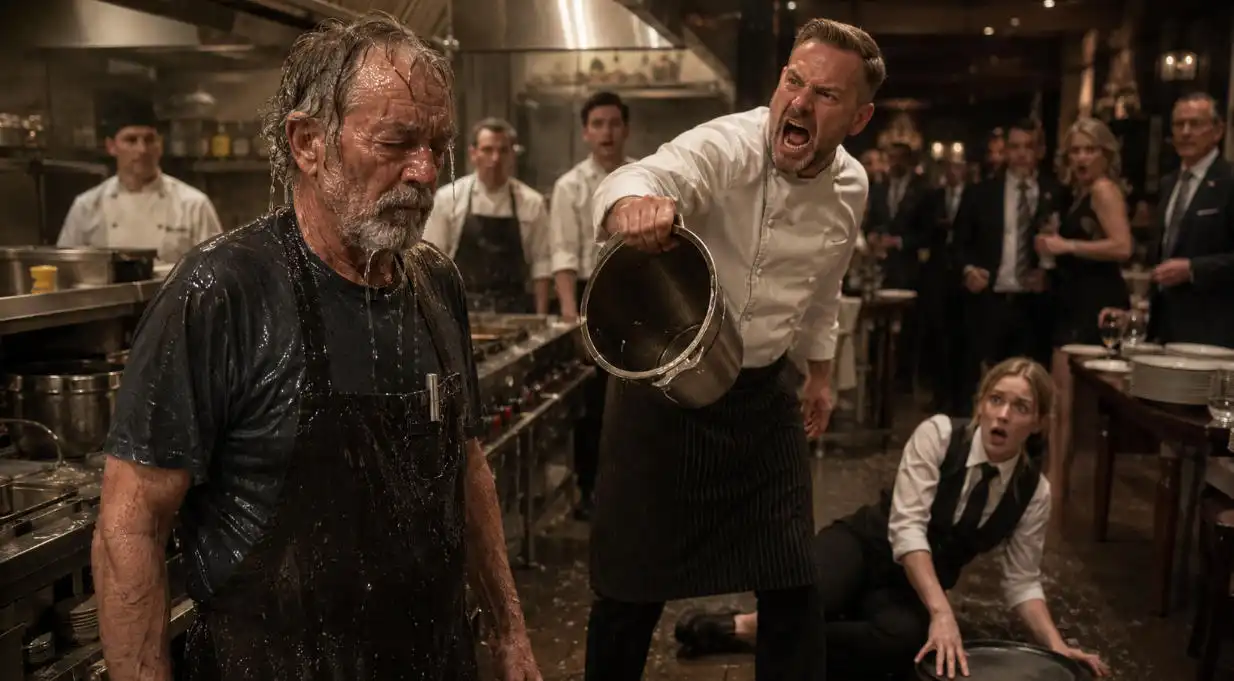
He grabbed the gray bucket under the rinse station.
It was full of greasy water, food scraps, and the brown foam that collects when a kitchen is too busy to breathe.
Sarah saw him lift it.
“Chef, don’t,” she said.
That made him smile.
He turned so everyone could see.
Then he dumped the entire bucket over my head.
Cold, filthy water ran down my face.
A piece of lettuce stuck to my shoulder.
Somebody gasped.
Somebody else laughed because nervous people sometimes laugh when they should be ashamed.
Chad leaned in.
“Now you look qualified.”
Sarah rushed forward with a towel.
“Stop it! That’s enough.”
Chad blocked her.
“You touch him, you clock out.”
“He’s a person,” she said.
That sentence should not have sounded brave.
But in that kitchen, it did.
Chad shoved past her with his shoulder.
Sarah slipped on the wet tile and fell against the prep station.
Her elbow hit steel.
The tray in her hands crashed to the floor.
That was the moment I stopped being undercover in my heart.
Until then, I had been gathering evidence.
After that, I was holding back anger.
I stepped toward her.
Chad slapped me.
Open hand.
Hard enough to turn my face.
In front of my staff.
In front of my guests.
In front of the governor entering the dining room.
“Know your place,” he said.
The words hung there.
Then the hostess whispered, “Governor Reed is here.”
Chad spun around.
His face changed instantly.
The bully disappeared.
The performer arrived.
He wiped his hands on a towel and moved toward the dining room with a smile so fake it could have been printed.
“Governor Reed,” he called warmly. “Welcome to Whitmore Prime. We are honored—”
But the governor was not looking at him.
He was looking at me.
Governor Reed and I had worked together for four years through my foundation, which funded culinary scholarships for veterans and single parents.
He had shaken my hand at three charity events.
He had eaten dinner at my home.
He knew exactly who I was.
He walked past Chad.
Past the maître d’.
Past the donors.
Straight into the kitchen.
The security detail followed.
The VIP guests followed.
Half the dining room stood up to see.
And there I was.
The owner of the company.
Soaked in dishwater.
A red mark on my cheek.
Standing beside a waitress on the floor.
“Marcus… boss… what happened here?”
I took his hand.
The flash from someone’s phone lit the room.
Then another.
Then another.
Chad whispered, “Boss?”
It came out like a prayer.
I turned to Sarah first.
“Are you hurt?”
She was trying to stand while pretending she wasn’t embarrassed.
“My elbow,” she said. “I’m okay.”
“No,” I said. “You don’t have to say that here.”
That broke something in her face.
Not weakness.
Relief.
I looked at the nearest server.
“Please get Sarah a chair and ice. Then call the non-emergency police line and request a report for workplace assault.”
Chad stepped forward.
“Mr. Whitmore, I can explain.”
I held up one hand.
“You’ve explained all week.”
His mouth opened.
Closed.
Opened again.
“I didn’t know it was you.”
The whole kitchen heard it.
That was the confession inside the apology.
Not “I’m sorry I hurt someone.”
Not “I was wrong.”
Just:
“I didn’t know it was you.”
I nodded slowly.
“That’s exactly the problem.”
Governor Reed looked at Chad with the kind of disgust polite men usually hide.
Chad tried to recover.
“This was a stress incident. A high-performance kitchen gets intense. We joke hard. Mike—Mr. Whitmore—was struggling. I was motivating staff.”
Sarah stood up, holding her elbow.
“You pushed me.”
Chad snapped, “Stay out of this.”
He caught himself too late.
In front of the governor.
In front of guests.
In front of cameras.
In front of every employee he had trained to be afraid.
I reached into my wet apron and pulled out the recorder.
Then I placed it on the stainless-steel counter.
Chad stared at it.
His skin went gray.
“This,” I said, “has five days of your leadership style.”
I pointed to the ceiling.
“Our cameras have the rest.”
Then I looked at my regional HR director, who had been seated in the dining room as one of the “VIP guests.”
She stood up from table six and walked into the kitchen with a folder.
Chad looked like the floor had moved under him.
“You were part of this?” he asked her.
She didn’t answer him.
She handed me the folder.
Inside were printed witness summaries, payroll discrepancies, screenshots from the tip system, and copies of Chad’s signed contract clauses.
I opened to the final page.
“Chad Beaumont,” I said, “your employment is terminated for cause, effective immediately.”
He laughed once.
A sharp, ugly sound.
“You can’t do that in front of my staff.”
“My staff,” I corrected.
That one landed.
His jaw tightened.
“You’ll hear from my attorney.”
“I hope so,” I said. “Because ours has already preserved the security footage, payroll records, tip pool records, and audio. You signed a wage integrity clause, a conduct clause, and a clawback clause tied to your executive bonus.”
I turned the folder so he could see his own initials.
“Your final bonus is frozen pending review. Any verified unpaid wages or misdirected gratuities will be reimbursed to employees before you see another dollar.”
The room stayed silent.
Not because people were bored.
Because people were watching a king discover the crown was rented.
Chad looked around for allies.
The sous-chef who laughed at me suddenly found the floor fascinating.
The other one stepped back.
The maître d’ folded his arms.
Servers stared at Chad with years of swallowed words in their eyes.
Then Sarah spoke.
Quietly.
“He made Jessie cry in the walk-in.”
A busboy near the wall looked up.
“He took our banquet tips last month.”
A prep cook said, “He told me if I reported my hours, he’d make sure no kitchen in Chicago hired me.”
That opened the door.
One by one, the room started talking.
Not shouting.
Not dramatic.
Just truth.
The kind of truth that had been waiting for one safe minute.
Chad turned red.
“You’re all replaceable,” he barked.
The governor’s chief of staff raised an eyebrow.
I almost thanked Chad for making the next part easy.
I handed the folder to my attorney, who had also been seated in the dining room.
“Begin the internal restitution process tonight,” I said. “Every employee who lost wages, tips, or shifts because of documented retaliation gets reviewed. No one who speaks will be punished.”
Then I turned to Chad.
“Your building access is revoked. Your company email is locked. Your name is removed from tonight’s menu before dessert. You will leave through the front door.”
He blinked.
“The front?”
“Yes,” I said. “You humiliated people in public. You can exit with the same audience.”
His face twisted.
For a second, I thought he might swing again.
Then two security officers stepped forward.
Chad pulled off his apron and threw it on the floor.
“This restaurant is nothing without me.”
Nobody moved to pick it up.
Not one person.
He walked out through the dining room while customers watched.
Phones followed him.
Whispers followed him.
The same room he had wanted to impress became the room that saw him clearly.
At the door, he turned back and pointed at me.
“You’ll regret this.”
I shook my head.
“No, Chad. I regret hiring you.”
That was the last thing I said to him that night.
Then I walked back into the kitchen, still dripping, still cold, still smelling like old dishwater.
I looked at my staff.
Some were crying.
Some were angry.
Some looked like they didn’t know what to do with a boss who had finally shown up.
“I owe all of you an apology,” I said.
No one expected that.
Maybe they expected a speech about excellence.
Or resilience.
Or family.
Corporate people love using “family” after letting a stranger hurt you.
I didn’t.
“I built a company big enough to hide bad men,” I said. “That is on me. I trusted numbers and reputation before I trusted turnover, silence, and fear. That changes tonight.”
Sarah sat with ice on her elbow.
Her eyes were wet, but her chin was up.
I turned to her.
“You defended a man you thought had no power.”
She looked embarrassed.
“I just thought someone should.”
“That,” I said, “is management.”
The next morning, Whitmore Prime Chicago closed for forty-eight hours.
Not for “renovations.”
Not for a vague social media statement.
We posted the truth:
Leadership misconduct had been discovered.
Affected employees would be paid.
An outside workplace review had begun.
The executive chef had been terminated for cause.
No employee would lose income during the closure.
Chad’s lawyer sent a letter by noon.
Ours sent back the footage.
The letter stopped.
Within a week, our review found enough to make my stomach turn.
Three banquet teams had been shorted.
Two employees had been pushed out after complaining.
One prep cook had been denied overtime through schedule manipulation.
Chad had also pressured vendors for personal favors in exchange for menu placement.
Nothing glamorous.
Nothing cinematic.
Just ugly, ordinary greed wearing a white coat.
We paid back every verified dollar with interest.
We covered Sarah’s medical visit and paid her additional compensation for the injury and emotional distress caused in our workplace.
The sous-chefs who laughed were suspended, then retrained or released based on what they had done beyond that night.
The HR manager who buried complaints resigned before the investigation finished.
The general manager on medical leave sent me one email.
“I tried to tell corporate. Chad made me look unstable.”
She came back three months later as regional director of employee experience.
And Sarah?
Sarah did not become general manager the next morning.
That would have made a good fairy tale and a terrible business decision.
Instead, I asked her if she wanted leadership training.
She said, “I don’t know anything about managing a restaurant.”
I said, “Good. Then we can teach you without unteaching cruelty.”
She spent six months learning scheduling, labor law basics, vendor relations, conflict reporting, guest recovery, and financial controls.
She made mistakes.
She asked questions.
She treated dishwashers like human beings.
That alone put her ahead of half the executives I’d met.
Eight months after the night Chad dumped that bucket on me, Sarah became general manager of Whitmore Prime Chicago.
At her promotion dinner, she invited the dish team to sit at the center table.
Not near the kitchen.
Not by the swinging door.
Center table.
She raised a glass and said, “No restaurant is fine dining if the people in the back are treated like garbage.”
Nobody clapped politely.
They stood.
There are moments when applause sounds like approval.
That night, it sounded like repair.
As for Chad, he did what men like him do when consequences arrive.
He blamed everyone.
He blamed “cancel culture.”
He blamed jealous staff.
He blamed me for entrapment.
He blamed Sarah for “overreacting.”
But no serious restaurant would touch him after the documented footage and contract findings became known through proper legal channels.
Not gossip.
Not revenge.
Records.
Facts.
His celebrity friends stopped returning calls.
The food magazine postponed his feature, then killed it.
A hotel group withdrew an offer.
The culinary board removed him from a mentorship program after reviewing the complaint file.
Sixteen months later, I saw him again.
It was behind a discount grocery store on the west side, near a row of restaurants where delivery trucks unloaded before dawn.
I was there visiting a community kitchen we funded.
Chad was by the dumpsters.
Thinner.
Unshaven.
Digging through black trash bags for discarded produce.
For one second, the old anger came back.
The slap.
Sarah on the floor.
The bucket.
The laughter.
Then he looked up and recognized me.
His face filled with something I had never seen on him before.
Shame.
Not humility.
Not yet.
Just shame.
“Marcus,” he said.
I didn’t answer right away.
He glanced at my coat, my car, the building behind me.
“You got what you wanted.”
“No,” I said. “I wanted you to treat people decently before any of this happened.”
He looked away.
I could have crushed him with words.
A younger version of me might have.
Instead, I handed him the card for a workforce re-entry program our foundation supported.
Not a chef job.
Not a shortcut back to power.
A program.
Counseling.
Basic work placement.
Anger management referral.
A path that started at the bottom, where he had once believed people were worthless.
He stared at the card.
“You serious?”
“Sarah is the reason I’m giving you that,” I said. “She told me people should have a way back if they’re willing to become different.”
His eyes flickered.
“She said that?”
“Yes.”
He swallowed hard.
For once, he had no performance ready.
I left him there with the card in his hand.
I don’t know if he used it.
That part is his story, not mine.
But I know what happened to Sarah.
I know what happened to the busboy who got his tips back.
I know what happened to the prep cook who stopped flinching when a chef walked behind him.
I know what happened to the dish pit.
We put a sign above it, small enough that guests would never notice, big enough that staff would.
It said:
“Every plate starts here.”
A restaurant can survive a bad review.
It can survive a broken oven.
It can survive a slow Friday.
But it should never survive by breaking the people nobody sees.
Chad thought power meant deciding who mattered.
He was wrong.
Power is what you do when nobody in the room can help you.
That night, Sarah had almost no power.
She still stood up.
Chad had plenty of power.
He used it to hurt someone he thought was beneath him.
So yes, I fired him in public.
Yes, I made him walk out through the room he wanted to rule.
Yes, I used every legal clause he signed and every camera he forgot about.
And no, I do not regret it.
Not for one second.
Because the real lesson was never that the dishwasher was secretly the owner.
The real lesson was this:
The dishwasher should not have needed to be the owner to deserve respect.
Share this if you believe people show their real character by how they treat someone who can’t do anything for them. And pick a side: was Marcus too harsh — or did Chad get exactly what he earned?
Disclaimer: Mention of any brand or trademark is for identification only and does not imply partnership or endorsement

They Laughed While Security Beat the “Alley Thief”… Then One Video Made Everyone REGRET It
A Diner Owner Called Him a “VAMPIRE” and Kicked Him Into the Rain… Then KARMA Pulled Up in 18 Wheels

A Hollywood Producer Humiliated a Quiet Crew Worker on LIVE Video… Then KARMA Walked In Holding a Sealed Trust File