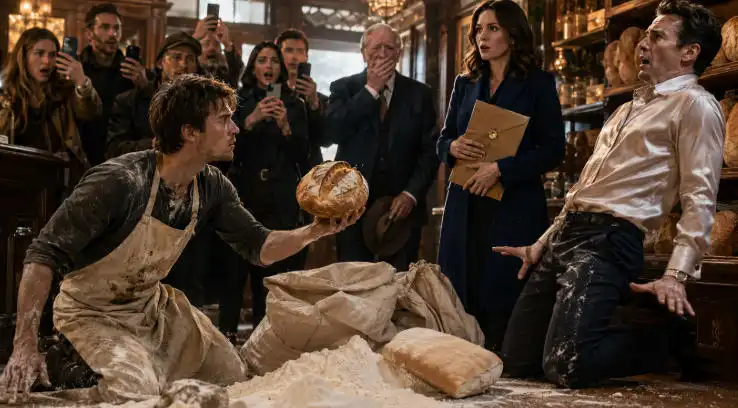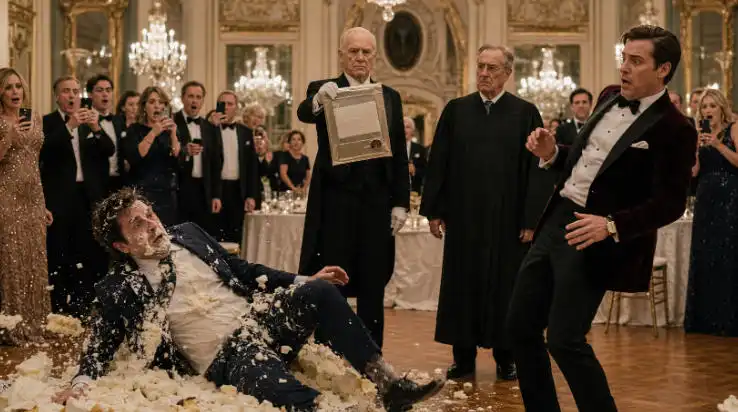



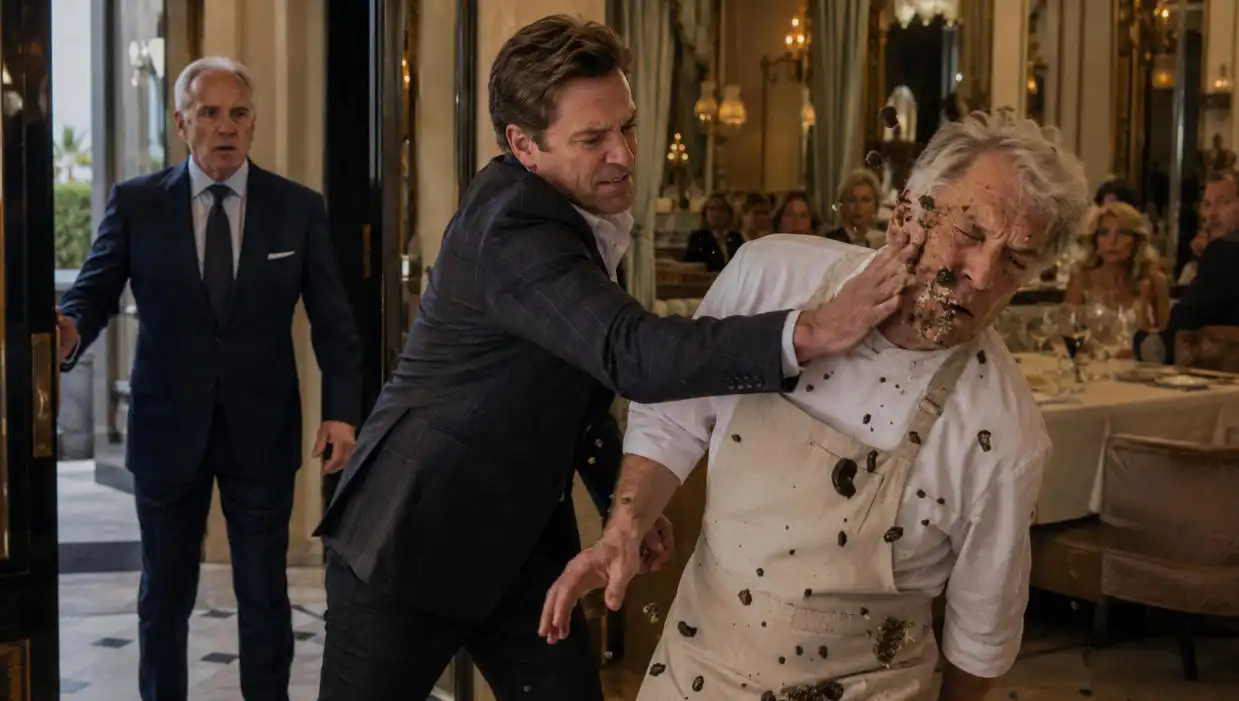
The chairman pointed at the truffle on the floor.
For one frozen second, nobody breathed.
Not the rich customers.
Not the waiters.
Not Brad, who still had one hand lifted like he was ready to shove me again.
The silver-haired man in the navy suit stared at that ruined black truffle as if Brad had dropped a priceless painting into a gutter.
Then he looked up at me.
“Master,” he said again, his voice shaking. “Please… tell me this is not what it looks like.”
I didn’t answer right away.
Because twenty years in kitchens had taught me something most loud men never learn:
The loudest person in the room is usually the weakest one.
And Brad had been loud all night.
He was thirty-two, polished, handsome in the way expensive clothes can fool people from across a room. His hair was slicked back. His watch was too shiny. His smile was too sharp.
He had been manager of Maison Bellecour for exactly eleven days.
A French restaurant in Beverly Hills.
White tablecloths.
Gold-trimmed plates.
A wine list longer than some novels.
And a kitchen full of exhausted people who were already afraid of him.
I had come in that afternoon as a “temporary prep cook.”
That was what the schedule said.
Oliver Stone.
Two-day trial.
Prep station.
No special notes.
That was the way I wanted it.
No announcement.
No chef coat with my name embroidered on it.
No old magazine covers.
No photos from Paris.
No whispering.
Just a white apron, a dull badge, and a crate of winter black truffles sitting on crushed ice.
I wanted to see the restaurant as it really was.
Not how people behaved when they knew the owner was watching.
Not how they smiled when a famous chef walked through the dining room.
The truth always comes out when people think the person in front of them has no power.
Brad showed me the truth before dinner service even started.
“You,” he said, snapping his fingers at me.
I looked up from the cutting board.
“My name is Oliver.”
“I didn’t ask.”
The young line cook beside me lowered his eyes.
Brad pointed at the truffles.
“These are for Table 12. Billionaire’s son. His friends. They spend more on champagne than you make in a month, so don’t embarrass us.”
I nodded.
“Understood.”
He leaned closer.
“And don’t talk to guests. Don’t do that humble old-man routine. People come here for elegance, not a retirement-home kitchen tour.”
A few cooks heard it.
Nobody laughed.
Nobody defended me either.
Fear has a sound.
It sounds like knives hitting cutting boards a little too fast.
I kept slicing.
Thin.
Even.
Perfect.
A good truffle does not need drama.
It needs respect.
At 7:40 p.m., the four young customers at Table 12 started getting loud.
They were all dressed like money had raised them but manners had not.
One of them waved at the dining room captain.
“Where’s the truffle guy?” he shouted. “We paid for the show.”
The floor captain, Mara, glanced toward Brad.
Mara had worked there for nine years. She knew better. I saw it in her face.
She knew those customers were trouble.
She also knew Brad enjoyed trouble when it came from rich people.
Brad marched into the kitchen with a grin.
“Old man,” he said. “Take the tray out.”
“That’s not how this course is served,” I said calmly.
His grin vanished.
“What did you say?”
“The truffle is finished in the kitchen. The aroma opens over the warm pasta. If I shave it table-side now, it becomes theater, not food.”
Brad stared at me as if a broom had spoken.
“You’re temporary.”
“Yes.”
“So be temporary quietly.”
I looked at the tray.
Then at him.
“If the guests want more truffle, charge for it. If they want a circus, hire one.”
The sous-chef coughed into his fist.
Brad’s face turned red.
But he didn’t fire me then.
He wanted an audience.
Men like Brad do not simply want power.
They want witnesses.
So he picked up the tray and walked into the dining room.
“Ladies and gentlemen,” he said loudly, “I apologize. Our prep cook is struggling with the concept of luxury.”
The rich table turned toward me.
So did half the restaurant.
A woman near the window lifted her phone.
One of the young men at Table 12 laughed.
“Is he the chef?”
Brad chuckled.
“No. He cuts vegetables.”
The table laughed harder.
I followed him because the tray was in his hand and the truffle was my responsibility.
That was my mistake.
Or maybe it was the bait Brad needed.
He held the tray toward me.
“Show them, Oliver. Be useful.”
I said nothing.
I reached for the truffle slicer.
The customer in the white jacket leaned back and smirked.
“Does he speak English?”
Brad answered before I could.
“Enough to follow orders.”
That was when I heard the first gasp from the staff.
Not because of the insult.
Because everyone in that restaurant knew I was being set up.
Brad lifted a handful of shaved truffle from the tray.
The scent hit the air immediately.
Earthy.
Deep.
Expensive.
He smiled at Table 12.
“Presentation matters.”
Then he smashed the truffle into my face.
Not tossed.
Not dropped.
Smashed.
The slices stuck to my cheek, my eyebrow, my mouth.
A few fell onto my apron.
Most landed on the marble floor.
The dining room went silent for half a heartbeat.
Then Table 12 exploded with laughter.
“Now that’s customer service,” one of them said.
The woman with the phone kept recording.
Mara, the floor captain, looked down at her reservation tablet.
The hostess turned away.
The sous-chef stood frozen at the kitchen door.
Brad leaned close enough for me to smell his cologne.
“Clean yourself up,” he whispered. “And remember who signs your hours.”
I wiped my cheek with a napkin.
Slowly.
“That was a very expensive mistake,” I said.
Brad laughed.
He thought I meant the truffle.
He pushed me hard.
My hip struck the prep table behind the service station.
Pain flashed down my leg.
A silver spoon clattered to the floor.
“Get him out of my kitchen,” Brad shouted. “He’s embarrassing the restaurant.”
That was when the front door opened.
And Charles Whitmore walked in.
The chairman of the American Association of Food Critics.
The man whose review could turn a restaurant into a destination overnight.
The man who had once called my bouillabaisse “the closest thing to memory a soup can become.”
The man I had not seen in eight years.
He walked past the hostess.
Past the tables.
Past Brad’s fake smile.
Then he saw me.
His face changed.
“Oliver?”
Brad blinked.
“You know our prep cook?”
Charles didn’t answer him.
He came straight to me, lowered himself to one knee in the middle of that polished Beverly Hills dining room, and took my hand like a priest greeting a saint.
“Master,” he said, voice trembling, “please take me as your student.”
A fork dropped somewhere behind him.
The rich customers stopped laughing.
Brad’s mouth opened.
No sound came out.
Charles stood slowly.
Then he pointed at the truffle on the floor.
“What happened here?”
Brad recovered just enough to lie.
“That employee was being disruptive,” he said quickly. “We had a small issue with hygiene and guest service.”
I looked at him.
He looked away.
Mara swallowed.
The woman with the phone lowered it.
Charles turned to me.
“Oliver. Did he do this?”
I could have ended Brad right there.
One sentence.
Yes.
He humiliated me.
He assaulted me.
He wasted premium truffle to impress children with credit cards.
But truth delivered too early can become argument.
Truth delivered with evidence becomes a hammer.
So I said only:
“Before I answer, Charles, may I ask why you came tonight?”
He smiled sadly.
“I came because you asked me to.”
Brad’s head snapped toward me.
I reached into my apron pocket and pulled out a folded document.
Brad actually laughed.
“What is that supposed to be?”
“A purchase agreement,” I said.
His laugh died.
Three weeks earlier, Maison Bellecour’s owner had called me in private.
The restaurant was beautiful.
The brand was famous.
But the soul was gone.
The old chef had quit.
The food had become decoration.
The staff was scared.
The numbers were bleeding.
The owner wanted to sell quietly before the name collapsed.
I had made one condition.
I would not buy a restaurant I had not seen from the bottom.
So I came in as a prep cook.
No one was told except the owner and my attorney.
The sale was scheduled to close that night at 8:15 p.m.
Charles Whitmore was not only the chairman of the critics’ association.
He was my witness.
Because twenty-two years earlier, when he was a desperate culinary student in Chicago, I had let him sleep in the dry storage room for two weeks after he lost his apartment.
I taught him stocks.
Sauces.
Discipline.
Respect.
He became a critic.
I kept cooking.
He called me “Master” because in our world, the title is not about ego.
It is about debt.
Brad stared at the paper.
“That’s fake.”
Charles took it from my hand, read the top line, and turned pale with anger.
“It is not fake.”
Brad looked toward Mara.
“Mara, tell him.”
Mara’s lips parted.
For the first time all night, she did not look away.
“I saw him do it,” she said quietly.
Brad’s eyes widened.
Mara took a breath.
Then stronger:
“He smashed the truffle into Oliver’s face. Then he pushed him.”
The dining room moved like a wave.
People turned.
Phones came back up.
One of the rich customers muttered, “Dude, this is bad.”
Brad snapped at him.
“Shut up.”
That was another mistake.
Rich people forgive cruelty when it entertains them.
They do not forgive being embarrassed publicly.
The young man in the white jacket stood.
“Don’t talk to me like that.”
Brad’s control was slipping.
So he reached for the only weapon weak managers know.
“Security,” he barked. “Remove the prep cook.”
Nobody moved.
Because by then my attorney had entered through the side door.
A calm woman named Denise Parker.
Gray suit.
Leather folder.
Eyes like a locked door.
She walked to the host stand and placed her folder on it.
“Mr. Oliver Stone is no longer a temporary employee,” she said. “As of 8:15 p.m., he is the controlling owner of Maison Bellecour.”
Brad turned white.
Denise continued.
“The prior owner signed final transfer documents twelve minutes ago. Mr. Stone requested that all management conduct during his evaluation period be documented.”
Brad whispered, “Documented?”
Charles looked at the ceiling.
I looked at the cameras.
Brad followed my eyes.
That restaurant had sixteen security cameras.
Two in the dining room.
One by the service station.
One aimed directly at the prep counter.
Brad had spent eleven days bullying people under perfect lighting.
Denise opened her folder.
“Mr. Brad Callahan, your employment is terminated effective immediately for workplace misconduct, destruction of inventory, physical aggression, and conduct damaging to the business.”
Brad grabbed the back of a chair.
“You can’t do that.”
I finally stepped forward.
“My restaurant,” I said. “My decision.”
The room went still again.
Not because I shouted.
Because I didn’t.
Brad looked smaller with every second.
His blazer seemed less expensive.
His watch seemed fake.
His smile was gone.
“You set me up,” he said.
“No,” I said. “I gave you a job title and a room full of people. You chose what to do with both.”
The rich customers stared at the floor.
Mara wiped her eyes.
The sous-chef stood in the kitchen doorway, breathing like someone had finally opened a window.
Brad pointed at me.
“You think they’ll respect you because of some old reputation?”
Charles stepped between us.
“Old reputation?” he said. “This man trained half the chefs you pretend to understand.”
Brad swallowed.
Charles raised his voice.
“Oliver Stone turned down three Michelin stars in Paris because he refused to let investors replace his dishwashers with underpaid contractors. He fed firefighters during the Bel Air fires out of his own kitchen. He closed his last restaurant because his wife was dying and he chose her over fame.”
Nobody moved.
I looked down.
I had not expected him to say that part.
My wife, Elena, had loved restaurants.
Not the glamorous part.
The morning part.
The smell of bread.
The first onions in butter.
The quiet dignity of people feeding strangers.
When she got sick, I walked away from everything.
Reviews.
Awards.
Television.
Investors called it foolish.
Elena called it freedom.
After she passed, I thought I was done.
Then the owner of Maison Bellecour called.
And I wondered whether one more kitchen could be saved.
Not for fame.
For the people inside it.
Brad’s voice cracked.
“I didn’t know.”
I looked at him.
“That is the point.”
He glanced around the dining room, searching for sympathy.
He found none.
The woman who had recorded the whole thing said, “You knew he was human.”
That landed harder than anything I could have said.
Denise handed Brad a paper.
“Leave the premises.”
Brad did not take it.
Instead, he looked at the truffle scattered across the floor.
Then he looked at me.
For one terrible second, I thought he might apologize.
A real apology can change a room.
But Brad was not ready for truth.
He was only ready for fear.
“You’re making a mistake,” he said. “My uncle knows the owner.”
I nodded.
“Your uncle knew the former owner.”
A ripple of laughter moved through the staff.
Small.
Shaky.
But real.
Brad turned toward the exit.
Then I stopped him.
“Brad.”
He froze.
I pointed at the floor.
“Pick it up.”
He stared at me.
“What?”
“The truffle. Pick it up.”
His face twisted.
“You want me to clean?”
“I want you to understand waste.”
He looked around.
Every phone was on him now.
Every customer.
Every server.
Every cook.
All watching the man who had treated work like shame discover that shame was never in the work.
It was in the cruelty.
Brad bent down.
His hands trembled as he gathered the ruined truffle from the floor.
Black slices stuck to his fingers.
His jaw clenched.
One of the rich customers whispered, “That’s disgusting.”
I turned to him.
“No. What was disgusting was laughing while a man was humiliated.”
The customer sat down.
Brad held the truffle in his palm.
“Now what?” he hissed.
I looked at the plate beside the service station.
“Put it there.”
He did.
I did not make him eat it.
Not really.
There are lines a decent man does not cross, even when he has the power to cross them.
But I did say this:
“You wanted to feed the room humiliation. Tonight, you can taste the cost.”
Brad stared at the plate.
His lips pressed together.
Then he picked up one tiny ruined shaving and put it in his mouth.
The dining room did not cheer.
That would have made us like him.
Instead, there was silence.
Heavy.
Public.
Permanent.
He swallowed.
And walked out.
The next morning, I held a staff meeting.
No cameras.
No guests.
No speeches.
Just the people who had kept that place alive while men like Brad took credit for their labor.
Mara stood near the back, arms crossed.
The sous-chef, Daniel, looked like he had not slept.
The dishwashers came in still wearing their waterproof aprons.
The hostess stood by the door, crying quietly.
I placed Brad’s old nameplate on the table.
Then I dropped it into the trash.
“This restaurant will never again be run by fear,” I said.
Nobody spoke.
So I continued.
“Every employee will be interviewed privately. Every wage will be reviewed. Every schedule will be rebuilt. Anyone who used power to hurt people will leave. Anyone who stayed silent because they were scared will be given one chance to speak.”
Mara raised her hand.
“I should have stopped him.”
“Yes,” I said.
Her face crumpled.
“But you were afraid,” I added. “Fear is not innocence. But it is not the same as cruelty.”
She nodded through tears.
“I’ll earn it back.”
“You will.”
Then I turned to Daniel.
“You’re acting executive chef for thirty days.”
His eyes widened.
“Me?”
“You corrected three sauces last night without being asked. You protected the pastry station during chaos. And when Brad pushed me, you took one step forward before fear stopped you.”
He looked ashamed.
I shook my head.
“One step is where courage begins.”
Within a week, Maison Bellecour changed.
Not the paint.
Not the chandeliers.
The soul.
The dishwashers got proper breaks.
The prep cooks got new knives.
The servers were allowed to refuse abusive guests.
The kitchen schedule was posted two weeks in advance, like adults deserved.
The menu shrank.
The flavors grew.
No smoke.
No gold leaf.
No nonsense.
Just food that respected the hands that made it.
Charles returned one month later.
Not as chairman.
As a diner.
He sat alone at Table 12.
The same table.
I sent him a bowl of onion soup with a lid of blistered Gruyère and a small black truffle shaving on top.
He laughed when he saw it.
Then he cried when he tasted it.
His review came out on a Sunday morning.
The headline was simple:
“Maison Bellecour Has Remembered What Restaurants Are For.”
By noon, the phone lines were full.
By three, every table was booked for six weeks.
By evening, three former employees who had quit under Brad asked if they could come back.
I said yes to two.
No to one.
Mercy is not the same as forgetting patterns.
As for Brad, his uncle did call.
He threatened lawyers.
Then Denise sent him the camera footage.
The call ended quickly.
Brad’s next job was not in management.
A commercial cleaning company hired him for night maintenance.
Months later, I saw him once.
Not in the dining room.
Not in a suit.
He was outside a restaurant two blocks away, unloading cleaning supplies from a van.
For a second, our eyes met.
He looked down first.
I did not smile.
I did not gloat.
I just nodded.
Because honest work is not punishment.
But for a man who built his pride on humiliating workers, becoming one was the only lesson strong enough to reach him.
That night, after service, Mara brought me a small plate.
One perfect shaving of black truffle over buttered pasta.
“Staff meal,” she said.
I looked at her.
She smiled.
“No cameras this time.”
We ate standing near the prep counter.
Daniel argued with the pastry chef about salt.
The dishwashers laughed in Spanish near the sink.
The hostess taught a new server how to fold napkins without panic.
For the first time in years, the kitchen sounded alive.
Not quiet from fear.
Loud from trust.
I thought of Elena then.
I thought of how she used to say a restaurant is not a room where rich people buy dinner.
It is a promise.
That someone’s labor will be honored.
That hunger will be met with care.
That dignity will never depend on a job title.
Brad thought my apron made me small.
He never understood.
An apron is not a symbol of weakness.
It is proof that someone is willing to serve.
And service, done with dignity, is stronger than power performed with cruelty.
So choose a side and share this:
Team Oliver — silence, evidence, and justice.
Or
Team Brad — power, arrogance, and public humiliation.
There is no middle ground when everyone saw what happened.
Disclaimer: Mention of any brand or trademark is for identification only and does not imply partnership or endorsement

They Laughed While Security Beat the “Alley Thief”… Then One Video Made Everyone REGRET It
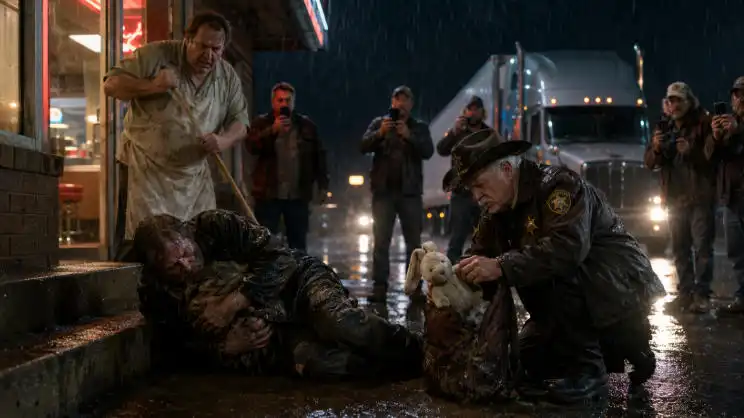
A Diner Owner Called Him a “VAMPIRE” and Kicked Him Into the Rain… Then KARMA Pulled Up in 18 Wheels

A Hollywood Producer Humiliated a Quiet Crew Worker on LIVE Video… Then KARMA Walked In Holding a Sealed Trust File