

The page Maggie opened was yellowed at the edges, soft from years of coffee steam and thumbprints.
Ethan stared at his own name written in blue ink across the top, but he could not make himself read the line beneath it yet.
Outside the café window, Richard Caldwell’s red sports car sat rumbling smoothly, alive again because of the man Ethan had just denied.
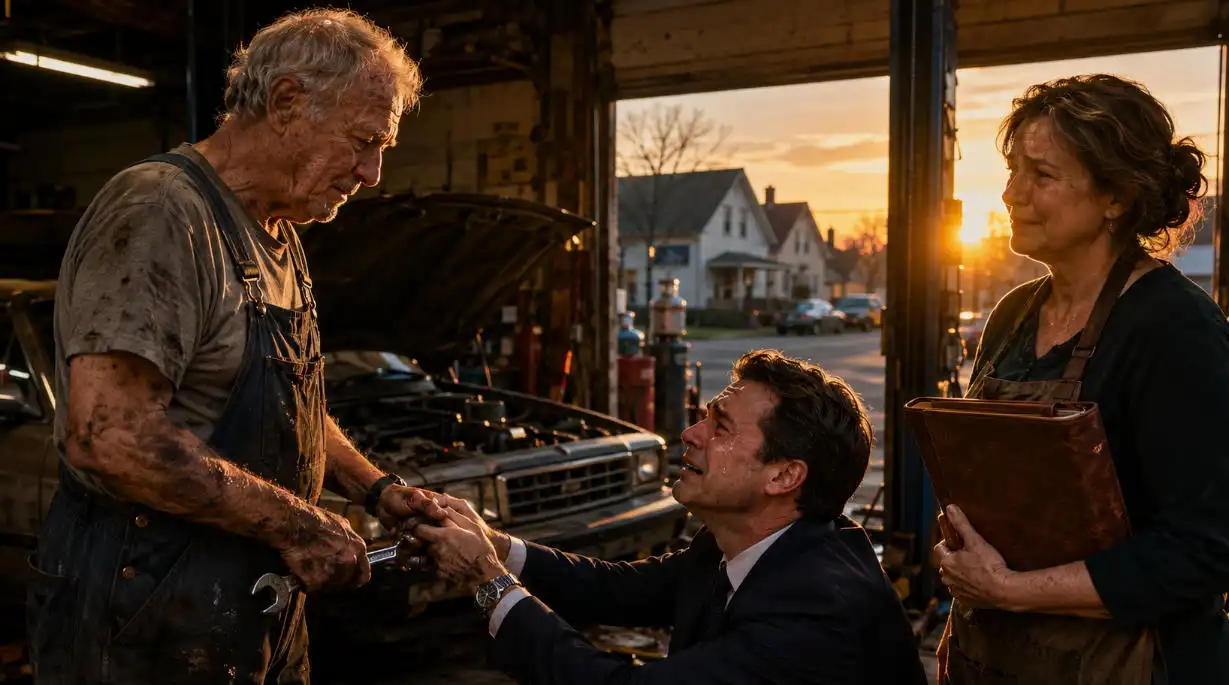
Arthur Miller stood beside it with one wrench in his hand.
And for the first time that afternoon, nobody in that little Ohio parking lot was laughing.
“Read it,” Maggie said quietly.
Ethan swallowed.
He had come to Maggie’s Café in Millfield, Ohio, wearing a pressed navy suit and a borrowed watch, hoping to land a partnership with Richard Caldwell, the son of a local real estate king.
Arthur had come in wearing a gray work shirt with Miller’s Garage stitched above the pocket.
One man looked like success.
The other looked like sacrifice.
And Ethan had chosen the wrong one in front of everyone.
“Before I read anything,” Richard said, forcing a laugh, “can we please not turn a business lunch into a funeral?”
No one laughed.
That was the strange thing about public shame.
At first, it feels loud.
Then, when the truth walks in, it gets very quiet.
Arthur wiped his wrench with a rag and took one step away from Richard’s car.
“Car’s running,” he said. “You can go now.”
Richard’s jaw tightened.
“I’m not going anywhere until I know what this old lady is trying to pull.”
Maggie turned her gray eyes on him.
“Old lady?”
Richard smirked.
“You heard me.”
Ethan looked up from the ledger. “Richard, stop.”
It was the first honest word he had said all afternoon.
Richard’s face twisted.
“Oh, now you found your voice?”
Arthur still said nothing.
That was what made it worse.
He had not yelled when Ethan called him a grease monkey.
He had not begged to be recognized.
He had not even looked angry.
He had simply looked tired.
A tiredness so deep it made Ethan remember being six years old, waking up to the sound of his father’s truck leaving before sunrise.
Back then, he thought dads were made of steel.
Now he saw the rust.
Maggie pushed the ledger closer.
“Ethan, your father told me never to show you this.”
“Then why are you showing me now?” Ethan asked.
“Because a man can survive being poor,” Maggie said. “He can survive being tired. He can even survive being forgotten. But no decent father should have to stand in public and hear his own child pretend he never existed.”
The words hit harder than Richard’s laugh had.
Ethan looked down.
The first entry was dated twelve years earlier.
Ethan Miller — tuition deposit — paid cash by Arthur Miller.
His throat tightened.
He turned the page.
Ethan Miller — dorm fee — paid by Arthur.
Another page.
Ethan Miller — laptop replacement after accident — Arthur paid, refused receipt.
Another.
Ethan Miller — emergency loan for business license — Arthur paid anonymously.
Ethan gripped the counter.
“No,” he whispered.
Maggie’s voice softened.
“Yes.”
Richard snorted.
“Oh, come on. A few bills? That’s what dads do. Can we get back to the actual meeting?”
An old man at the corner booth stood up.
His name was Walter Briggs, a retired steelworker who had eaten breakfast at Maggie’s every morning for thirty years.
He leaned on his cane and pointed it toward Richard.
“You sit down when decent people are talking.”
Richard blinked, stunned.
Walter turned to Ethan.
“Your daddy fixed my truck for free when my wife had cancer. Wouldn’t take a dime. Said I needed gas money for the hospital.”
Another man stood.
“Fixed my furnace fan motor in January,” he said. “Wasn’t even a car. My kids were sleeping in coats. Arthur stayed till midnight.”
A woman near the pie case wiped her eyes.
“When my husband died, Arthur kept my delivery van running for two years. Told me to pay when I could. I never could.”
Arthur shifted uncomfortably.
“Maggie,” he said, low. “That’s enough.”
“No,” Maggie said. “It is not.”
Ethan turned slowly toward his father.
“Dad… why?”
Arthur looked at the floor.
The whole café waited.
Richard’s luxury car idled outside like an insult that had been turned into evidence.
Arthur cleared his throat.
“You had places to go,” he said.
That was it.
Five words.
No speech.
No blame.
No dramatic confession.
Just a father giving the only explanation he thought mattered.
Ethan shook his head.
“I thought the scholarship covered college.”
“It covered some.”
“I thought the bank believed in my startup.”
Arthur gave a faint, sad smile.
“Banks believe in collateral.”
Ethan’s mouth went dry.
He remembered the call from a lender eight years earlier.
Congratulations, Mr. Miller.
Your small business application has been approved.
He had gone out with friends that night and bragged that the world had finally recognized his talent.
He never asked what had been put up behind the scenes.
“What collateral?” Ethan asked.
Arthur’s hand tightened around the rag.
Maggie answered for him.
“The garage.”
Ethan felt the room tilt.
Miller’s Garage.
The broken sign.
The leaking roof.
The place Ethan had spent his teenage years trying to escape.
The place he had mocked to Richard before lunch.
The place his father had risked so Ethan could rent an office with glass doors and call himself a founder.
Richard laughed under his breath.
“Wait. This is the big secret? He mortgaged a dump?”
Arthur turned then.
Not fast.
Not dramatically.
Just enough to let Richard see his face.
And something in that face made even Richard pause.
Arthur said, “That dump fed my family.”
Richard lifted his hands.
“Relax. I’m just saying, let’s not pretend this is some empire.”
Ethan’s ears burned.
Hours earlier, Richard had promised to introduce him to investors, but only if Ethan “cleaned up the family image.”
That was the deal.
An impossible, ugly little promise dressed as opportunity.
Richard had smiled over coffee and said, “If we work together, I need you to leave that dirty garage story behind. People invest in winners, not rust.”
And Ethan, desperate to look like a winner, had nodded.
Then Arthur walked in to buy a black coffee.
And Ethan failed the oldest test in the world.
“Dad,” Ethan said, his voice breaking, “the money for my first payroll…”
Arthur looked away.
Ethan knew.
“Dad.”
Arthur rubbed his forehead with the back of his wrist, leaving a faint streak of grease near his temple.
“Your employees had families,” he said.
A sound came out of Ethan that was almost a laugh and almost a sob.
He had blamed his father for never showing up to his launch party.
He had told people Arthur “didn’t understand ambition.”
But that same night, Arthur had been under a semi truck in the freezing rain, earning the money that kept Ethan’s company from missing payroll.
How do you apologize for being proud of a dream you did not know someone else was bleeding to hold up?
Richard checked his phone.
“This is touching, really. But Ethan, we have investors waiting. Are we doing business or not?”
Ethan looked at him.
For the first time all day, he really looked.
Richard’s hair was perfect.
His shoes cost more than Arthur’s monthly mortgage payment.
His smile had never carried a single ounce of shame because shame was something his family paid other people to feel.
“You knew,” Ethan said.
Richard frowned.
“Knew what?”
“You knew he was my father.”
The café held its breath.
Richard shrugged.
“I suspected. Small town.”
“You asked me in front of everyone anyway.”
“I gave you a chance to separate yourself from a bad look.”
Arthur’s eyes moved to Ethan.
Not pleading.
Not accusing.
Just waiting to see what kind of man his son would be now that the truth had nowhere left to hide.
Ethan stepped away from the counter.
Maggie whispered, “Ethan…”
Richard rolled his eyes.
“Oh, don’t get dramatic.”
Ethan walked outside into the parking lot.
The afternoon sun threw long shadows across the cracked concrete of Miller’s Garage across the street.
The old building leaned like it was tired of surviving.
Richard followed him, still holding his phone.
“Listen,” Richard said, lowering his voice. “I was hard on you, but that’s business. You want real money? You cut emotional anchors. That includes him.”
Ethan stopped.
Arthur stood several feet behind them.
Half the café had followed to the doorway.
The public pressure returned, but this time it did not crush Ethan.
It clarified him.
Richard pointed toward Arthur.
“He is exactly why people like us have to leave towns like this behind.”
Ethan asked, “People like us?”
Richard smiled.
“Yes.”
That was Richard’s mistake.
Because Ethan finally understood there was no “us.”
There was a man who inherited money.
And there was a man who inherited a sacrifice he had not been worthy of.
Richard leaned closer and said, just loud enough for Arthur to hear, “Your father is a dirty old wrench monkey. Useful, maybe. But not someone you bring into the room.”
Ethan hit him.
One punch.
Not heroic.
Not pretty.
Not something Arthur would have taught him to do.
But it came from a son whose shame had finally turned into rage.
Richard stumbled back against his own sports car, hand to his mouth, eyes wide.
The café erupted.
“Ethan!” Arthur barked.
Ethan stood breathing hard.
Richard spat, “You’re dead. Do you understand me? My family owns half this town.”
Arthur walked forward.
He didn’t look proud of the punch.
He looked disappointed by the need for it.
Then he reached into Richard’s open car window, turned off the engine, and removed the key.
Richard stared.
“What are you doing?”
Arthur tossed the wrench down at Richard’s feet.
The metal clanged against the concrete.
“Your car is legally on my property line,” Arthur said. “You authorized emergency repair in front of witnesses. You refused payment before I started running diagnostics. So here’s the deal.”
Richard’s face reddened.
Arthur pointed toward the garage.
“You pay the repair bill, the towing hold, and the storage fee. Then you take your mouth and your daddy’s money somewhere else.”
Richard laughed, but it shook.
“You can’t hold my car.”
Walter Briggs called from the café door, “Mechanic’s lien is real, son.”
Maggie lifted her phone.
“And I recorded your authorization when you shouted for somebody to fix it.”
Richard looked around.
For the first time in his life, the room — the street, the town, the witnesses — did not belong to him.
It belonged to truth.
Ethan turned to Arthur.
“Dad, I’m sorry.”
Arthur’s face tightened.
Those words were too small.
Both men knew it.
Ethan stepped closer.
“No. I don’t mean today only. I mean all of it. Every time I acted like this place embarrassed me. Every time I let people think I built myself alone. Every time I took your silence as nothing.”
Arthur’s jaw worked.
“I didn’t give so you’d owe me.”
“I know,” Ethan said. “That makes it worse.”
Maggie came outside with the ledger still in her arms.
“There’s more,” she said.
Arthur closed his eyes.
“Maggie.”
“He needs to know.”
“No,” Arthur said.
But Maggie was not asking anymore.
She opened to the back of the ledger.
“These aren’t payments to Ethan.”
Ethan looked.
The names were different.
Dozens of them.
Families.
Widows.
Veterans.
Single mothers.
Small businesses.
Beside each name was a repair Arthur had done for free or at cost.
Some had notes.
Paid with apple pie.
Paid with prayer.
Paid after harvest.
Never paid — do not ask again.
Ethan covered his mouth.
Maggie’s voice trembled.
“Your father kept half this town moving.”
Walter nodded.
“When the plant shut down, Arthur fixed cars so men could still get to interviews.”
The woman by the pie case added, “He kept my van running so I could deliver bread after my husband died.”
Another man said, “He refused money from my son after the accident.”
Ethan looked at Arthur as if seeing a stranger.
Not the kind you deny.
The kind you spend the rest of your life trying to deserve.
Richard backed toward his car.
“You people are insane.”
Then two black SUVs pulled into the lot.
The doors opened.
A pair of men in jackets stepped out, followed by a woman holding a folder.
Richard’s expression changed instantly.
“Mr. Caldwell?” the woman asked.
Richard swallowed.
“Yes?”
“I’m Agent Morales with the Ohio Department of Taxation. We have questions regarding Caldwell Development’s vehicle write-offs and vendor payment records.”
The café went dead silent again.
Maggie whispered, “Lord have mercy.”
Richard looked at Ethan.
“You did this?”
Ethan shook his head.
Arthur said nothing.
But the woman with the folder glanced toward the red sports car.
“This vehicle appears on three separate corporate expense filings under three different business categories.”
Richard’s mouth opened, then closed.
Arthur reached into his shirt pocket and pulled out a folded invoice.
“Then you’ll want the correct repair record,” he said. “For today.”
Agent Morales took it.
Richard’s face drained.
The same car he used to humiliate a poor mechanic had become one more piece of paper in a much bigger problem. 😱
Karma rarely arrives with thunder.
Sometimes it arrives with a clipboard.
Richard tried to argue.
He threatened attorneys.
He mentioned his father.
He said the word “misunderstanding” six times in two minutes.
But the agents did not blink.
His car stayed where it was.
His keys stayed with Arthur.
And the man who thought he owned the town had to call for a ride from the sidewalk while the people he mocked watched in silence.
Ethan wanted to feel satisfied.
A part of him did.
But another part was still standing in front of his father, holding years of regret with nowhere to put it.
Arthur turned toward the garage.
“Come on,” he said.
Ethan followed.
Inside Miller’s Garage, the air smelled like oil, old rubber, coffee, and winter.
Sunlight slipped through gaps in the metal siding.
The workbench was scarred.
The calendar on the wall was three months behind.
A photograph hung near the parts cabinet.
Ethan as a boy, sitting on Arthur’s shoulders, holding a toy wrench.
Ethan stared at it.
“I forgot that picture.”
“I didn’t,” Arthur said.
There was no accusation in it.
That made it hurt more.
Ethan walked to the old office.
The desk was piled with invoices, parts catalogs, and a cracked mug that said WORLD’S OKAYEST MECHANIC.
On the wall behind it was a framed business license.
Miller’s Garage.
Arthur J. Miller.
Established 1984.
Ethan touched the frame.
“I spent my whole life trying not to end up here.”
Arthur leaned against the doorway.
“I know.”
“Did that hurt you?”
Arthur was quiet long enough for Ethan to regret asking.
Then he said, “Every day.”
Ethan shut his eyes.
There are sentences that do not shout.
They just split a person open.
“I thought you were ashamed of me,” Ethan said.
Arthur looked startled.
“Ashamed?”
“You never came to the award dinners. The investor nights. The office opening.”
Arthur looked at his hands.
“I had work.”
“I know that now.”
“No,” Arthur said. “You don’t.”
He walked to a metal cabinet and opened the bottom drawer.
Inside was a stack of envelopes bound with a rubber band.
He handed them to Ethan.
Each envelope had Ethan’s name on it.
None had been sent.
Ethan opened the first.
It was a card from his college graduation.
Son, I sat in the back because I came straight from a brake job and didn’t want to embarrass you. I am proud of you beyond words. — Dad
Ethan’s hands shook.
He opened another.
Saw the newspaper piece about your company. You looked like your mother when you smiled. She would have cried. I did. — Dad
Another.
I wanted to come tonight, but the Henderson girl’s car broke down on her way to nursing school. I thought you’d understand one day. I hope you do. — Dad
Ethan pressed the letters to his chest.
His mother had died when he was twelve.
That was the first wound.
The one both men had walked around for years.
After her funeral, Arthur stopped talking much.
Ethan thought silence meant distance.
Arthur thought working meant love.
And between those two misunderstandings, a son grew embarrassed and a father grew invisible. 💔
“I thought you didn’t care,” Ethan whispered.
Arthur’s eyes shone.
“I cared so much I didn’t know how to say it without falling apart.”
Ethan broke then.
Not politely.
Not in a way that looked good on camera.
He sobbed in the office of the garage he had mocked, holding letters from the father he had denied.
Arthur stood still for one second.
Then he stepped forward and wrapped his arms around his son.
The hug was awkward at first.
Too many years stood between them.
But grief knows the way home.
Ethan buried his face in Arthur’s shoulder.
“I’m sorry, Dad.”
Arthur’s hand moved slowly to the back of his son’s head.
“I know.”
“No, I need to make it right.”
Arthur exhaled.
“You can’t undo it.”
“I know.”
“But you can stop doing it.”
That was the mercy.
Not pretending the wound never happened.
Not making forgiveness cheap.
Just opening one door and asking the son to walk through it differently.
By evening, the video from the café had spread through Millfield.
By morning, it had crossed county lines.
People saw Richard laughing.
They saw Ethan deny his father.
They saw Arthur fix the car.
They saw Maggie’s ledger.
But what people did not see was Ethan sitting at his kitchen table at 2:13 a.m., staring at his resignation email.
He had spent years chasing a high-paying job title that made him feel clean.
Director of Growth.
Strategic Partner.
Founder.
Consultant.
Words that looked good on LinkedIn.
Words that could not hold a candle to Dad.
At 2:27 a.m., Ethan sent the email.
By 8:00 a.m., he was standing in the doorway of Miller’s Garage wearing jeans, boots, and a plain gray work shirt.
Arthur looked up from under the hood of a pickup.
“What are you doing?”
Ethan held up a second shirt.
It had a patch on it.
Miller.
No first name.
Just Miller.
“I quit.”
Arthur slid out from under the truck.
“You what?”
“I quit the job. I pulled out of Richard’s investor deal. I called the bank. I’m restructuring the garage debt under my name.”
Arthur’s face hardened.
“No.”
“Dad—”
“No. I didn’t work this place forty years so you could chain yourself to my mistakes.”
Ethan stepped closer.
“This place wasn’t your mistake.”
Arthur looked away.
Ethan said, “It was your love. I was the mistake when I called it shame.”
Arthur’s eyes filled.
Ethan held out the shirt.
“I don’t know everything. I’ll mess up. I’ll probably strip bolts and order the wrong parts and make you regret teaching me.”
A faint smile touched Arthur’s mouth.
“Probably.”
“But I’m staying.”
Arthur looked at the shirt.
Then at his son.
“You sure?”
Ethan glanced around the garage.
At the cracked concrete.
At the unpaid kindness still living in old invoices.
At the photograph of a boy on his father’s shoulders.
“At last,” Ethan said, “I’m sure.”
Arthur took the shirt and pressed it against Ethan’s chest.
“Then first lesson,” he said.
Ethan wiped his eyes.
“What?”
Arthur pointed under the pickup.
“Never trust a man who says, ‘It only makes that noise sometimes.’”
Ethan laughed.
Arthur laughed too.
It was small.
Rusty.
A sound that had not been used enough.
But it was real.
Three weeks later, Caldwell Development was under formal investigation for tax fraud and false write-offs.
Richard’s red sports car remained legally held until the repair bill, storage fees, and lien paperwork were settled.
His family’s name still carried power, but now it carried questions too.
And Millfield, Ohio, had a long memory.
Maggie framed a copy of the paid invoice and hung it behind the café counter.
Walter told the story every morning with more dramatic pauses than necessary.
And Miller’s Garage got something it had not had in years.
A fresh coat of paint.
The sign still looked old.
Arthur insisted on keeping the original wood.
But underneath Miller’s Garage, Ethan added three words in clean white letters:
Honest Work. Quiet Love.
On the first Saturday after the new sign went up, a line of cars stretched down the block.
Some needed repairs.
Some did not.
A widow brought muffins.
A veteran brought a flag.
A young mother brought her son and asked if Arthur might show him how to change a tire someday.
Arthur said, “Bring him Saturday.”
Ethan watched his father become visible.
Not famous.
Not rich.
Visible.
That was better.
Near closing time, Ethan found Arthur sitting outside on an overturned bucket, looking at the sunset over the rusted rooftops.
Ethan sat beside him.
For a while, neither spoke.
Then Ethan said, “Do you forgive me?”
Arthur kept his eyes on the sky.
“I forgave you before you asked.”
Ethan’s breath caught.
“But,” Arthur added, “I was still hurt.”
Ethan nodded.
“I know.”
Arthur looked at him then.
“Don’t waste the forgiveness by pretending the hurt didn’t happen.”
Ethan’s eyes filled again, but this time he did not look away.
“I won’t.”
Arthur reached over and squeezed his shoulder.
Across the street, Maggie flipped the café sign to CLOSED.
Walter raised his cane from the window like a salute.
And for the first time in years, Ethan did not see a dying garage in a forgotten Ohio town.
He saw a legacy.
He saw a father.
He saw the cost of every door that had opened for him.
And he finally chose the one he should have walked through all along.
Some people inherit money and call it success.
Some inherit sacrifice and spend years too blind to honor it.
Ethan Miller almost lost the only man who had been quietly saving him his entire life.
But on that cracked concrete floor, under an old sign and beside a father with oil-stained hands, he began paying back the only debt that mattered.
Not with money.
With presence.
With humility.
With work.
And every morning after that, when Arthur unlocked the garage, Ethan was already there.
Wearing the shirt.
Holding the wrench.
Learning how to fix what was broken.
👇 Share this for every parent who loved in silence — and for every grown child who still has time to come home.
Disclaimer: Mention of any brand or trademark is for identification only and does not imply partnership or endorsement
They Laughed While Security Beat the “Alley Thief”… Then One Video Made Everyone REGRET It
A Diner Owner Called Him a “VAMPIRE” and Kicked Him Into the Rain… Then KARMA Pulled Up in 18 Wheels

A Hollywood Producer Humiliated a Quiet Crew Worker on LIVE Video… Then KARMA Walked In Holding a Sealed Trust File