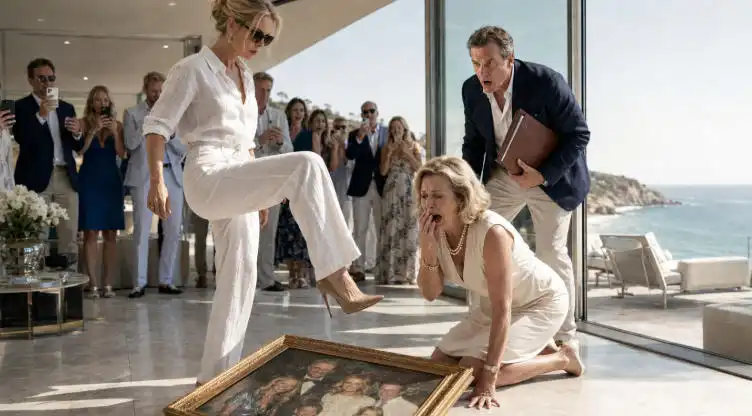
The envelope in my hand felt heavier than the stone table beneath it.
Brad stared at it like it was a loaded gun.
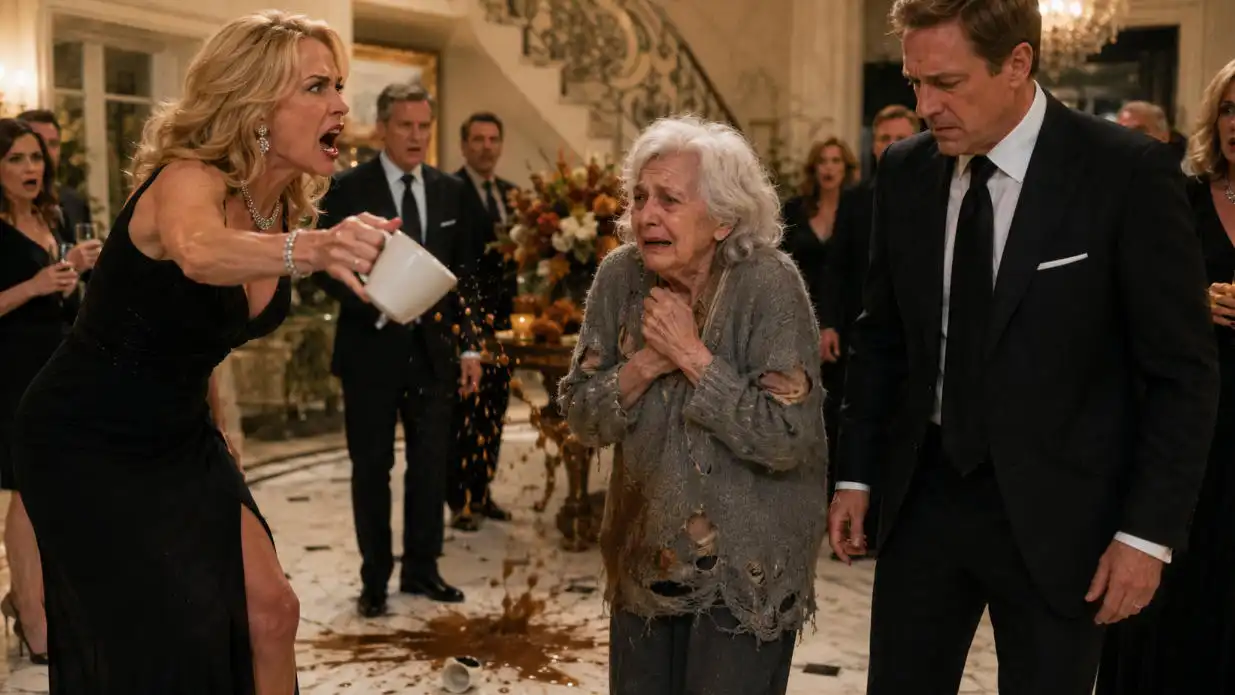
Madison stopped smiling for the first time since I had walked into her Beverly Hills mansion wearing that torn gray sweater.
And behind them, through the tall glass doors of my Napa Valley tasting hall, twelve private helicopters sat on the lawn like silent witnesses.
Nobody moved.
Not Brad.
Not Madison.
Not my lawyers.
Not even the security team standing by the carved oak doors.
I looked at my son and said, “Before I open this, Brad, I want you to remember something.”
He swallowed.
“You had a choice yesterday.”
He gave a nervous laugh.
“Mom, this is ridiculous. You scared us. We thought you were having some kind of breakdown.”
Madison reached for his arm.
“Brad, don’t engage with this. She’s clearly unstable.”
One of my attorneys, Mr. Collins, gently cleared his throat.
Madison turned toward him.
“And who are you supposed to be?”
He didn’t blink.
“Estate counsel for Helen Whitmore, majority owner of Whitmore Ridge Vineyards, Whitmore Heritage Holdings, and the Bradshaw-Whitmore Family Trust.”
Madison’s face changed.
Just a little.
Enough.
Brad’s jaw tightened. “Mom, why is he saying majority owner like that?”
“Because it is accurate,” I said.
He looked around the room.
The tasting hall was the same one where he had celebrated his twenty-first birthday.
The same hall where his father’s portrait hung over the fireplace.
The same hall where Brad used to run between barrels as a boy while I chased him, laughing, my hands stained purple from harvest.
Now he stood there with a woman who had called me a crazy old beggar.
And he looked more offended by my survival than my suffering.
“Mom,” Brad said, lowering his voice, “can we discuss this privately?”
I smiled.
“No.”
The word hit the room cleanly.
“No, Brad. Yesterday you made my humiliation public. Today, the truth will be public too.”
Madison scoffed.
“Oh, please. She’s being dramatic.”
Susan’s hand tightened on the back of my chair.
My niece Susan had not slept much the night before.
Neither had I.
After she drove me from Beverly Hills to the trailer park, she made me sit at her tiny kitchen table while her son microwaved gravy in a chipped bowl.
The trailer smelled like laundry soap, pumpkin pie spice, and hard years.
Susan kept apologizing because the heater rattled.
She apologized because the couch had a spring poking out.
She apologized because the turkey was almost gone.
And when she placed half of the final slice on my plate, I nearly cried.
“Aunt Helen,” she said, “don’t look at it like charity. You fed half this valley when Uncle Robert died. Let us feed you once.”
Her little boy, Caleb, brought me his blanket.
It had cartoon dinosaurs on it.
“I’m not cold,” I told him.
He shrugged. “Grandmas get cold anyway.”
That broke something open in me.
Not weakness.
Clarity.
For months, my advisors had warned me.
Brad’s spending had gotten reckless.
There were loans secured against cars he didn’t fully own.
Private club tabs.
Failed investments.
A silent partnership in a nightclub that was losing money faster than a cracked barrel loses wine.
And then came Madison.
Madison loved being near old money.
But she hated old people.
Especially old women who controlled it.
At first, she called me “adorable.”
Then “traditional.”
Then “difficult.”
Then she stopped pretending when she thought Brad had me cornered.
My accountants discovered emails.
Not enough for a criminal case by themselves.
Enough to raise my blood pressure.
Enough to show that Brad and Madison had been discussing “accelerating inheritance access.”
Madison had written one message that I would never forget:
“Your mother is sentimental. Use that. If she thinks she lost everything, she’ll sign anything just to feel safe.”
That was when my lawyers proposed a controlled test.
Not a trap in the illegal sense.
No false documents.
No forged signatures.
No threats.
Just a family truth audit.
I would tell Brad that I had been deceived by an online romance investment scam.
A pig-butchering scheme.
I would say I had lost liquidity.
I would say the winery was at risk.
I would come to him without staff, without a driver, without pearls, without the armor of wealth.
And I would ask for shelter.
One night.
One couch.
One act of decency.
The torn sweater was real.
It belonged to me.
I had worn it the winter after my husband Robert died, when I still walked the vineyard alone at sunrise because the silence inside the house was too loud.
The microphone sewn into the hem was legal.
California consent rules are strict, but Brad’s entryway had visible security recording notices because he insisted on them for his mansion.
His own system captured the audio and video.
His own posted policy made it usable.
That was the legal hammer he never saw coming.
Brad tried to straighten his jacket.
“This is insane. You staged your own poverty to embarrass me?”
“No,” I said. “I revealed your character.”
A few people shifted near the back of the tasting hall.
They were not guests.
They were board members.
Senior vineyard managers.
My finance director.
The head of the family foundation.
The woman who had overseen harvest logistics for twenty-eight years.
People Brad had ignored for most of his adult life.
People Susan greeted by name.
Madison looked at them, then at me.
“You brought an audience?”
I looked her directly in the eye.
“You created one yesterday.”
Her mouth opened.
Nothing came out.
Mr. Collins slid a tablet across the table.
The screen showed Brad’s mansion entrance.
Me standing in the torn sweater.
Brad in his tailored shirt.
Madison lifting the coffee cup.
Her voice filled the hall.
“Why is this crazy old woman on your marble floor?”
Several people inhaled sharply.
Madison’s face went white.
The video continued.
“She said she lost the winery to some online scammer, right? Honestly, Brad, this is what happens when old people get lonely and stupid.”
Brad looked away.
But the video was not done.
My own voice played next.
“Brad, I have nowhere else to go tonight.”
Then Brad’s voice.
“Mom, you should’ve been more careful with the family assets.”
The silence after that was colder than any winter morning in Napa.
Susan blinked hard.
Not because she was surprised.
Because hearing it again hurt.
Madison snapped, “That was private.”
“No,” Mr. Collins said. “It occurred in an entryway under active video surveillance with posted notice, in the presence of staff and guests.”
Brad pointed at him.
“You don’t get to talk to her like that.”
I almost laughed.
Yesterday he had let Madison call me stupid.
Today he defended me from a lawyer explaining facts.
That was Brad.
Always brave when money was watching.
I opened the first envelope.
“Brad, this is the termination notice for your advisory role at Whitmore Heritage Holdings.”
His face went blank.
“My what?”
“You never attended meetings. You never read reports. You used the title on club forms and loan applications. That ends today.”
He stepped forward.
“Mom, you can’t just do that.”
“I can. The board confirmed it this morning.”
Mr. Collins placed a copy of the vote on the table.
Brad looked at the papers but did not touch them.
The second envelope waited beneath my hand.
“This,” I said, “is notice that the family company will no longer guarantee any personal debts connected to you.”
Brad’s face flushed.
“You’re cutting off my credit?”
“No. I am cutting off your access to my name.”
Madison whispered, “Brad?”
He ignored her.
“Mom, you’re overreacting because of one bad night.”
“One bad night?” Susan said.
Her voice shook.
“That woman poured hot coffee at her feet.”
Madison snapped, “It didn’t touch her.”
Susan stepped around my chair.
“No. You aimed close enough to scare an old woman, then smiled because you thought nobody important cared.”
Madison turned red.
“Oh, spare me the trailer park morality speech.”
The room shifted.
That one sentence did more damage than any document I held.
Because every person in that hall knew who kept vineyards alive.
Harvest workers.
Drivers.
Cellar hands.
Pruners.
People who bent their backs before sunrise so people like Madison could swirl wine at charity dinners and pretend elegance came from glassware.
I looked at Madison.
“You will not insult my niece in my house.”
Brad said, “Madison, stop.”
But it was too late.
She had shown herself again.
The second legal hammer fell before lunch.
My finance director stood and explained that three of Brad’s sports cars were not personal property.
Not really.
They were titled through a family leasing entity, approved years ago when Brad claimed he needed them for “brand representation.”
He had missed every required usage report.
He had violated the company policy by pledging one as collateral in a private loan.
And because the lender had already filed demand, the cars would be removed and liquidated to offset exposure.
Brad’s voice cracked.
“You’re taking my cars?”
“No,” I said. “The company is recovering its assets.”
At that exact moment, through the tall windows, one of the security men near the driveway lifted a radio to his mouth.
Outside, tow trucks rolled into view.
Three of them.
The red Ferrari.
The black Bentley.
The silver McLaren.
Brad spun toward the glass.
“No. No, no, no. Mom, stop them.”
I watched his face as the first tow hook went under the Ferrari.
It was not pleasure I felt.
That surprised me.
I thought revenge would taste sweet.
It didn’t.
It tasted like grief finally getting a receipt.
Madison backed away from Brad.
“Those aren’t yours?”
Brad turned on her.
“They are mine.”
Mr. Collins corrected him quietly.
“They are not.”
Madison looked him up and down like she was seeing him without the lighting.
Without the mansion.
Without the borrowed glow of my last name.
“Brad,” she said slowly, “what exactly do you still own?”
He stared at her.
“Are you serious?”
She took another step back.
“I asked you a question.”
That was when I saw the whole thing collapse.
Not loudly.
Not dramatically.
Just one greedy person realizing another greedy person had no more use.
Brad’s phone started buzzing.
Then buzzing again.
Then again.
His lender.
His club manager.
Someone from the private aviation account.
The world he thought was his had received the morning memos.
Madison grabbed her purse.
“Unbelievable.”
Brad barked, “Where are you going?”
She didn’t even look ashamed.
“Away from whatever this is.”
“You said we were a team.”
She laughed once.
A small, cruel sound.
“No, Brad. I said you had potential.”
Then she walked out past the board members, past the security team, past Susan in her work boots, and past me without meeting my eyes.
Outside, she got into a rideshare before the Ferrari even left the property.
Nobody chased her.
Brad watched through the window until the car disappeared down the vineyard road.
For a moment, he looked like a little boy again.
Lost.
But lost is not the same as innocent.
I opened the third envelope.
This was the one that made him turn back.
“The family name license agreement is revoked.”
He frowned.
“What does that mean?”
“It means you may no longer use Whitmore Ridge, Whitmore Heritage, or the Bradshaw-Whitmore name in any business materials, fundraising documents, investment pitches, club applications, social promotions, or personal financial statements.”
His lips parted.
“You can’t take my name.”
“I’m not taking your legal surname. I am taking the family brand you have been renting without honor.”
Mr. Collins added, “Any violation triggers immediate civil action.”
Brad looked at the portrait over the fireplace.
His father’s portrait.
Robert would have hated this day.
But he would have understood it.
When Robert was alive, he used to say, “A family name is not a costume. It is a debt you pay forward.”
Brad had worn it like a tuxedo.
Susan had carried it like a lunch pail.
I motioned for Susan to come closer.
She did, reluctant as always to stand in the center of anything.
Her hands were rough from harvest work.
Her nails were short.
There was a small scar near her thumb from a pruning knife accident years ago.
She looked nothing like the glossy charity photos Madison used to post from my events.
But Susan knew which rows struggled after frost.
She knew which foreman had a sick wife.
She knew which migrant family needed help with school supplies before anyone asked.
She knew that the oldest vines on the west slope produced less fruit but more soul.
I picked up the final folder.
“Susan,” I said, “last night you gave me your last slice of turkey.”
She shook her head quickly.
“Aunt Helen, please don’t make that sound bigger than it was.”
“It was exactly as big as it was.”
Her eyes filled.
I continued.
“For years, I told myself blood would teach Brad what privilege could not. I was wrong. Love without accountability becomes permission.”
Brad whispered, “Mom…”
I held up my hand.
“No. Let me finish.”
The hall stayed silent.
“Effective today, Susan Miller will become managing owner-designate of Whitmore Ridge Vineyards, pending the formal transfer schedule already prepared by counsel. She will begin with a controlling operational stake, a board seat, and full executive training. The rest transfers in stages, tied to stewardship, worker protections, and preservation of the land.”
Susan stepped back like the floor moved.
“No. Aunt Helen, I can’t.”
“Yes,” I said. “You can.”
“I live in a trailer.”
“So did half the families who built this valley before anyone called it luxury.”
A few people in the back nodded.
Susan covered her mouth.
Brad exploded.
“You’re giving my inheritance to a picker?”
The room went dead.
That word hung there.
Picker.
Not cousin.
Not mother.
Not woman.
Not worker.
Just a small word full of contempt.
Susan flinched.
I stood.
Slowly.
The security team shifted, but I raised one hand.
I did not need protection from my son’s words.
I needed him to hear mine.
“Every bottle you bragged about was touched by a picker,” I said. “Every acre you borrowed against was tended by people you never bothered to learn from. Every dollar you spent came from hands you looked down on.”
Brad’s face twisted.
“I’m your son.”
“Yes,” I said. “And that is why you are getting a chance instead of a lawsuit.”
He froze.
That got his attention.
Mr. Collins handed him another document.
Brad scanned the first page.
His anger drained.
The emails.
The loan misrepresentations.
The brand misuse.
The attempt to pressure me into emergency asset transfers.
The statements Madison had made about exploiting my loneliness.
The attached video from Beverly Hills.
Everything neat.
Everything dated.
Everything admissible enough to ruin him if I chose to press it.
His hands trembled.
“What do you want?”
There it was.
Not “I’m sorry.”
Not “Are you hurt?”
Not “How do I make this right?”
Just negotiation.
I took a breath.
“You will enter the debt restructuring program Mr. Collins has prepared. You will surrender all company-linked property. You will repay what you can through wages, not withdrawals.”
Brad stared at me.
“Wages?”
“Yes.”
I looked out over the vineyard, where the winter rows stretched toward the hills.
“You will work.”
He laughed in disbelief.
“Doing what?”
The vineyard manager, Luis, stepped forward.
“We start winter weed control Monday at six.”
Brad looked at Luis like he had spoken another language.
“You want me to pull weeds?”
Luis said, “No. We expect you to learn why weeds matter.”
A small sound moved through the room.
Not laughter.
Justice has a different sound.
It is quieter.
Brad turned back to me.
“You can’t humiliate me like this.”
I said, “You humiliated yourself. I am giving you the only honest road left.”
He looked at Susan.
She wiped her eyes but held her ground.
For a second, I thought he might apologize.
A real one.
A human one.
Instead he said, “She’ll ruin it.”
Susan’s face hardened.
“No,” she said. “I’ll protect it.”
And I believed her.
The first month was ugly.
Brad arrived late on the first Monday in spotless boots that cost more than most workers’ weekly pay.
By noon, they were ruined.
By Wednesday, his hands blistered.
By Friday, Luis sent him home because he would not stop complaining.
But the wage deductions continued.
The debt plan continued.
The club memberships vanished.
The cars were sold.
The Beverly Hills house, which Brad had never truly owned free and clear, went into a negotiated sale after the guarantees disappeared.
Madison posted a photo from Miami with another man two weeks later.
Brad saw it during lunch break behind the equipment shed.
No one mocked him.
That was the first mercy the vineyard gave him.
Work does not care who left you.
It only asks whether you show up tomorrow.
Susan moved slowly into her new role.
Not like someone grabbing a crown.
Like someone carrying a sleeping child.
She spent her first week meeting with every department.
She asked the cellar team what equipment was overdue for replacement.
She asked payroll why seasonal workers were waiting too long for certain reimbursements.
She asked marketing to stop using worker images without names or permission.
She asked me why the foundation gala budget was larger than the emergency hardship fund.
I laughed when she asked that.
Then I cried.
Because Robert would have loved her question.
Within six months, Whitmore Ridge changed.
Not flashily.
Honestly.
A child-care stipend appeared for harvest families.
The oldest trailer park road was repaired through a community grant Susan personally fought for.
The Thanksgiving charity dinner was moved from the grand ballroom to the packing house, where everyone could come in jeans.
And on the first bottle released under Susan’s leadership, she refused to put her own face on the campaign.
Instead, she chose a photograph of hands.
Old hands.
Young hands.
Brown hands.
White hands.
Hands holding grapes beneath morning light.
The label read:
Stewardship Reserve.
I kept one bottle on my kitchen counter.
Not because it was the most expensive wine we ever made.
Because it was the first one that tasted like the truth.
As for Brad, the story did not end with him suddenly becoming a saint.
Real life is rarely that generous.
He quit twice.
Came back twice.
Got written up once for speaking disrespectfully to a crew supervisor.
Apologized badly.
Then better.
Then, one rainy morning, he arrived early and helped cover young vines before frost.
No camera.
No audience.
Luis told me later.
I did not praise Brad publicly.
He had lived too long on applause.
But I left a thermos of coffee near the shed the next morning.
He knew it was from me.
He said nothing.
He kept working.
A year after the helicopters landed at Susan’s trailer park, we held Thanksgiving at the vineyard.
Not the mansion.
Not the tasting hall.
Outside, under long strings of warm lights, between the sleeping vines.
Susan’s son Caleb sat beside me, taller now, still sweet.
He asked if helicopters were coming again.
I told him no.
“Good,” he said. “They were loud.”
Susan laughed so hard she nearly spilled her cider.
Brad stood at the edge of the gathering in plain work clothes, holding a plate.
He looked thinner.
Older.
Less polished.
Maybe more real.
He approached me after dinner.
For once, he did not look around to see who was watching.
“Mom,” he said.
I waited.
He swallowed.
“I’m sorry I left you outside.”
My chest tightened.
He continued.
“I’m sorry I cared more about how you looked in front of my guests than whether you were safe.”
That was closer.
Much closer.
I nodded.
“I hear you.”
He looked toward Susan, who was helping Caleb serve pie.
“She deserved it more than I did.”
I said, “She didn’t get it because she deserved your portion. She got it because she honored what you abandoned.”
He closed his eyes.
That one landed.
Then he said, very quietly, “Do I still have a place here?”
I looked at the vineyard.
At the workers laughing.
At Susan carrying pie.
At the land Robert and I had loved through drought, fire, frost, debt, harvest, grief, and grace.
“You have a place,” I said. “But not a throne.”
He nodded.
For the first time, that seemed enough.
Later that night, Susan found me near Robert’s portrait.
“You okay?” she asked.
“I think so.”
She stood beside me.
“I never wanted to take anything from Brad.”
“I know.”
“I only wanted you safe.”
I reached for her hand.
“That is why I trusted you with everything.”
Her tears came then.
Quietly.
Mine too.
Some people think inheritance is about blood.
It is not.
Inheritance is about what survives you.
A house can be sold.
A car can be towed.
A name can be misused until a lawyer takes it away.
But dignity?
Dignity is either protected or spent.
Brad spent his trying to impress people who left when the money did.
Susan protected hers in a trailer park kitchen with the last slice of turkey on a chipped plate.
That is why she owns Whitmore Ridge now.
That is why Brad reports to the vineyard before sunrise.
That is why Madison is just a footnote in a story she thought she could control.
And that is why I do not regret the torn sweater.
Not for one second. 🍷
Pick a side and say it plainly: Team Helen Was Right, or Team A Mother Should Never Cut Off Her Son.
Share this if you believe character matters more than blood.
Disclaimer: Mention of any brand or trademark is for identification only and does not imply partnership or endorsement
They Laughed While Security Beat the “Alley Thief”… Then One Video Made Everyone REGRET It
A Diner Owner Called Him a “VAMPIRE” and Kicked Him Into the Rain… Then KARMA Pulled Up in 18 Wheels
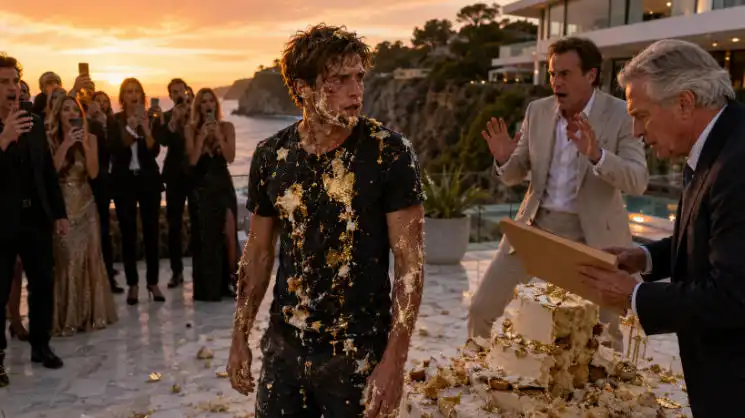
A Hollywood Producer Humiliated a Quiet Crew Worker on LIVE Video… Then KARMA Walked In Holding a Sealed Trust File